mariuscomper.uk RO
1903 facsimile with an interlaced headpiece, a red heading and Church Slavonic lettering. 1903 facsimile

Wallachia · 1508

Two coloursunder the press

In Macarie’s Liturgy Book, red ink marks headings and some of the initials. Separate the two colours on a page, then try to bring them into line on one sheet.

Look at the two inks

The book in Church Slavonic

Red ink marks a beginning

Macarie’s Liturgy Book, completed in 1508, is the earliest known book printed in Wallachia. Its text is in Church Slavonic.

On the page setting out the order of the service, the heading and the large initial are red. The interlaced headpiece and lines of text are dark. Choose which marks to see.

Printing in two passes

The sheet goes under the press again

In some copies, red and black sit slightly out of line. The historian P. P. Panaitescu inferred that the page went through the press for black ink first, then through again for red.

In the model, the lever turns the screw and the platen presses the sheet against the assembled type.

Aligning the colours

A few millimetres make a difference

Move the red passages in relation to the black. If the paper shifts between the two passes, an initial can touch the text that should start beside it.

Bring the red back into line and look again at the space between the initial and the first lines of text.

From sheet to book

Fold a sheet into four leaves

Two folds give a sheet four leaves with two sides each, in the format called quarto. The numbers show the order the pages must follow after folding.

The book has 17 gatherings. The first and last have four leaves each. The 15 in between have eight each.

What does the first page say?

The Liturgy Book opens with Basil the Great’s instructions to priests about the service and Communion. The catalogue identifies the opening leaf of the Academy Library copy.

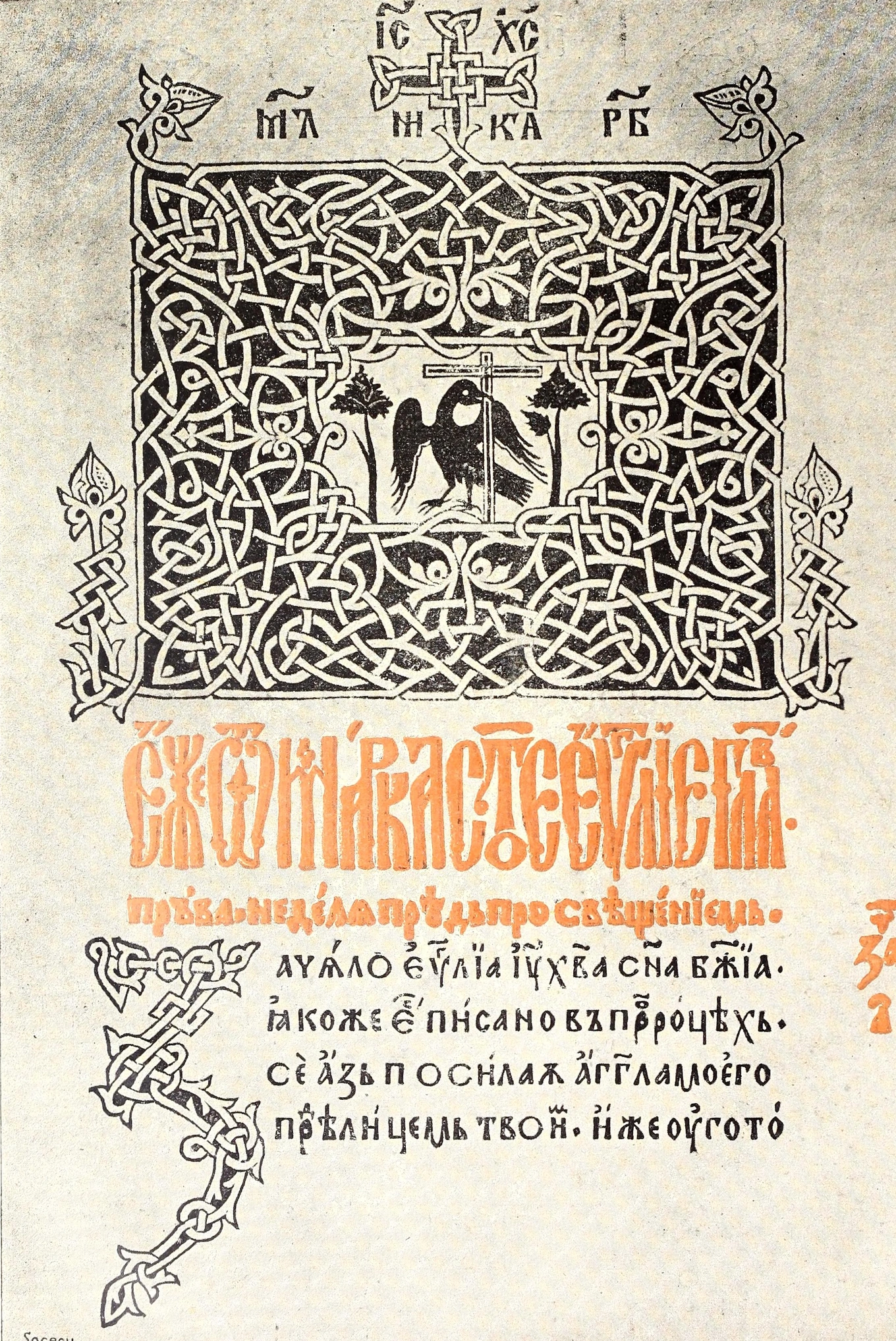
The Wikimedia photograph titled “Macarie1508” shows a page from Macarie’s Slavonic Gospel Book, printed in 1512. The Gospel of Mark begins below the red heading.

The same page appears under the 1512 Gospel Book in Bianu and Hodoș’s 1903 bibliography. Look for the bird in the headpiece, the large initial and the matching line endings. The Wikimedia record names the National Library in Sofia and gives no shelfmark for the copy.

Beneath the interlaced headpiece and red heading, the dark print starts with the opening words of the Gospel of Mark.

The photograph labelled “Macarie1508”

Wikimedia Commons · PDM 1.0

Open the image record ↗
The same page from the Gospel of Mark. The bird in the headpiece, initial and line breaks match.

The 1512 Gospel Book, 1903 facsimile

Bianu and Hodoș · p. 12

Open the 1903 facsimile ↗
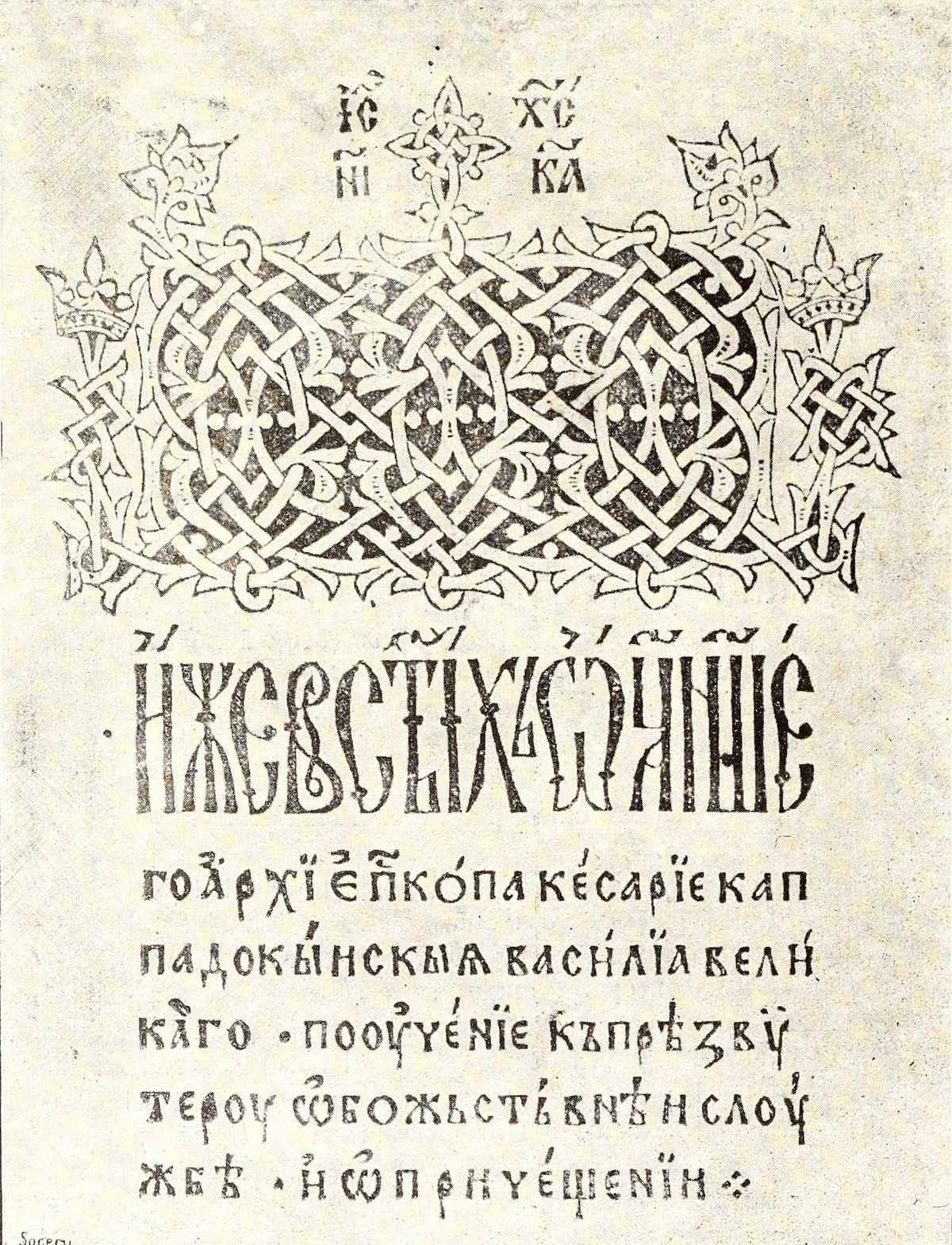
The page with Basil the Great’s instructions, reproduced in 1903 with its lettering and headpiece in black.

The opening of the 1508 Liturgy Book

The 1903 bibliography reproduces Basil the Great’s instructions on page 2. The National Heritage Institute catalogue records the same opening.

Open the 1903 facsimile ↗

The final passage gives the day as 10 November and the year as 7016. Bibliographies give the date as 10 November 1508. The book gives no place of printing. Dealu Monastery, near Târgovişte, is one proposed location.

How the illustrated page was made

The ink layers come from Bianu and Hodoș’s 1903 facsimile of the order of service on page 3. The model’s paper, colours and shift between impressions are illustrative.

The handpress shows a mechanism plausible for the period. The fold shows one illustrative arrangement of pages on a quarto sheet. Its numbers give the reading order.

  1. Octavian-Adrian Negoiță. Macarie’s Slavonic Liturgy Book
  2. National Heritage Institute. Early books catalogue
  3. Bianu and Hodoș, Old Romanian Bibliography, 1903
  4. Agnes Erich. Printing the Liturgy Book
  5. National Library of Romania. Revista BNR, 2008
  6. University of Chicago Library. History of the handpress