MC / locuri vii
RO

Corbi, Argeșrock-cut churchan open chronology

Two altars
in one
nave

At Corbii de Piatră, one nave contains two altar spaces cut into the rock. The first written record appears in 1512. The church may be older, but its beginning has no certain date.

Enter the cut in the rock.

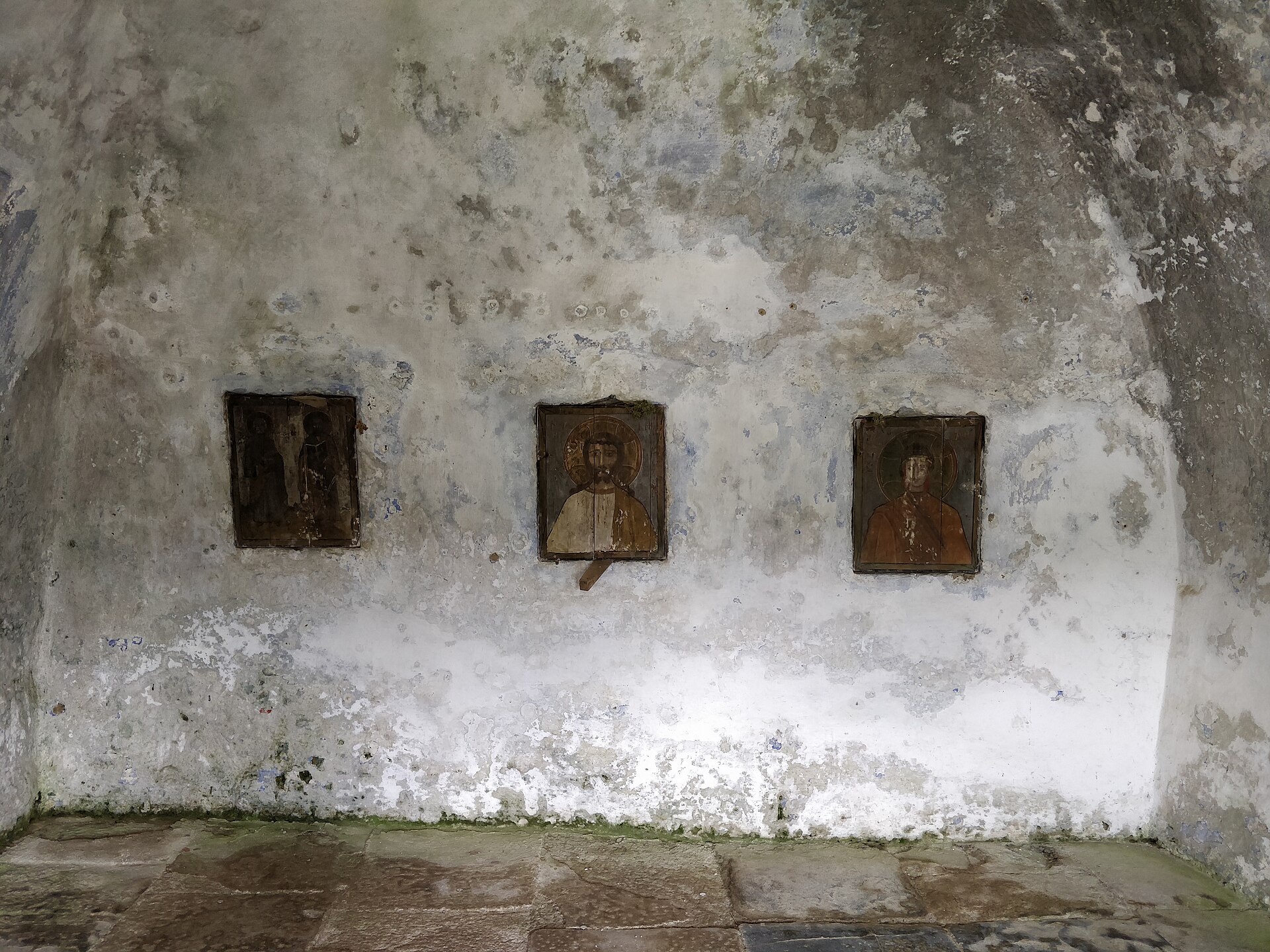
The rock-cut church interior at Corbii de Piatră, with old painting surviving on the stone walls
Interior photographed in 2018. Strainu, Wikimedia Commons, CC BY-SA 4.0.

23 June 1512first written record

A document tells us when it reopened, not when it was cut

On 23 June 1512, a document mentions Mușa, also known as Magdalena, in connection with the monastery’s reopening. This is the earliest known documentary attestation of the community. It gives the written history a firm point; it does not establish the year the church was cut into the rock.

The construction date remains disputed. The painting and form of the church have been associated with the thirteenth and fourteenth centuries, but stylistic evidence does not fix a precise year.

1512: the first known record, not the construction date.
One navetwo altar spaces

Two apses occupy the far end of the room

The church’s own description gives it one nave ending in two altars. Instead of one central apse, the rock forms two adjacent recesses. The plan is unusual, but it cannot by itself tell us who built the church or in which century.

The monastery’s account places both altars within the Byzantine Orthodox tradition. Their arrangement is not evidence that two denominations worshipped here. The section through the rock lets you follow the shape; it does not fill in details the sources leave unknown.

The carved outline and proportions are schematic, not measured.

Early nineteenth centurya new room

A new cut changed the route towards the altar

In the early nineteenth century, rock in front of the nave was cut away to enlarge the church. The new narthex measured about 5.5 × 4.5 m. The wall between the two altars was removed as part of the same intervention.

In the first view, the stone wall separates the two spaces. After the enlargement, the route runs through the narthex to the open altar area. Switch between the two stages to see the changes in section.

Compare the interior

Two apses, separated by an interior wall.

Painted evidencethirteenth–fourteenth centuries?

The painting gives a range, not a year

In a 1975 study, art historian Carmen Laura Dumitrescu dated the painting to the late thirteenth or early fourteenth century. It is a judgement about style and technique, not an inscription that records when the walls were painted.

In 1658, Paul of Aleppo described old paintings at Corbi. His account shows the paintings were already there by then, without settling their date. In the photograph, worn surfaces and surviving fragments are documentary evidence, not decoration for a reconstruction.

Worn fragments of Byzantine painting survive on the church’s stone walls
The same interior photograph, presented here as a record of surviving traces. Photo: Strainu, CC BY-SA 4.0.

6 June 1819the iconostasis

A painter dates one phase, not the church’s beginning

After the wall between the altars was opened, the iconostasis was painted by Ștefan Zugravul on 6 June 1819. His name and its date give us a firm point for one part of the interior. They document this later intervention, not the construction of the rock-cut church.

At Corbii de Piatră, the most accurate chronology has different levels: the first known record, a stylistic range for the painting and a precise date for the iconostasis. Each answers a different question.

Find it

The monastery is in Corbi village, Argeș County. See the monastery’s website for its historical account and visitor information.

Visit the monastery website

Sources and photograph

What can be dated, and what remains open

The three-dimensional section is an editorial diagram based on descriptions and photographs. It is not a scan of the rock, a survey or a measured plan.

Text and model: Marius Comper. mariuscomper.uk