Energy · Romania, 2019–2026
Electricity is no longer cheap at night: Romania’s power price, hour by hour, 2019–2026
The old advice says run the washing machine at night, when power is cheaper. On OPCOM, Romania’s power exchange, where suppliers buy the next day’s electricity, that was true until a few years ago. In 2019 the cheapest hour of the day was 4 a.m. In 2026 it is 2 p.m. If you pay the same price per kWh at every hour, your bill does not change; it matters for contracts with cheap hours and for hourly prices.
The picture below shows the price of every hour of 2,856 days, from 1 January 2019 to 26 October 2026. The cheaper an hour was than its day’s average, the brighter it is. Pick the hour you usually use power.
Pick the hour you usually run the washing machine, the oven or the car charger. Tap the picture for a single day.
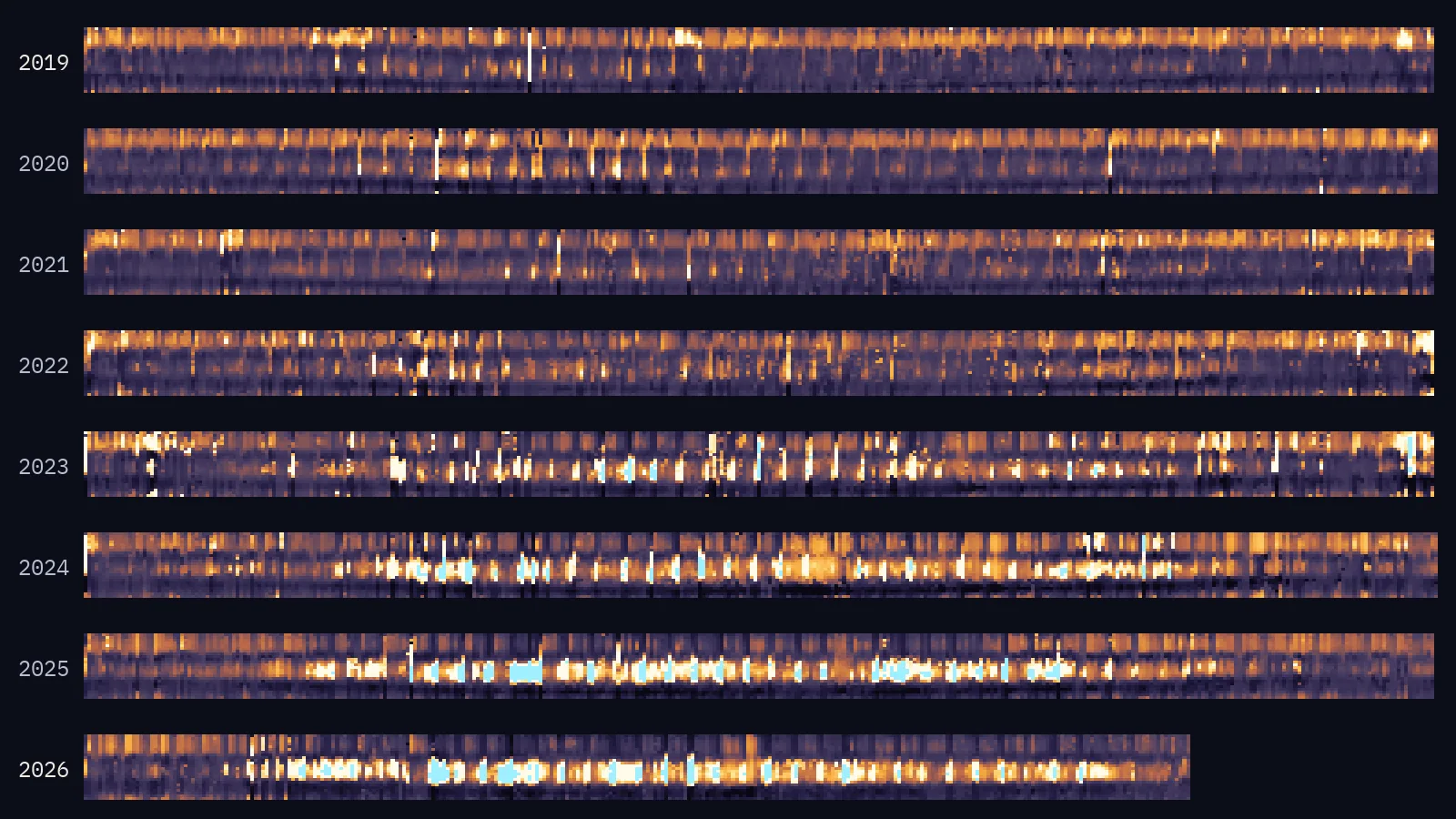
Every day from 1 January 2019 to 26 October 2026 (one thin column each) and each of its hours (top to bottom, midnight to 23:00). The glow shows how cheap the hour was against its own day’s average.
#4 a.m. and 2 p.m. have swapped places
Line up the 24 hours of each day from cheapest (1st) to dearest (24th). In 2019 the median place of 4 a.m. was 2nd and of 2 p.m. 11th: on half of all days, 4 a.m. was one of the two cheapest hours. In 2026 it is the other way round: 2 p.m. has the median place 2nd, 4 a.m. 11th.
In money the gap is large. In 2019 a kWh bought on the exchange for 4 a.m. cost 0.15 lei on average, and one for 2 p.m. 0.25 lei. In 2026, 4 a.m. cost 0.69 lei and 2 p.m. 0.33 lei: lunchtime was about 51% cheaper than 4 a.m.
In both 2019 and 2026 the dearest hour was most often 21:00, in the evening, when people are home and the sun has set.
#The months when daytime was cheaper than night
Classic two-rate contracts, such as Electrica’s 2021 offer, split the day in two: 7:00–22:00 is “day”, 22:00–7:00 is “night”. On the exchange, the day hours averaged less than the night hours on 7% of days in 2019, 31% in 2023, 54% in 2025 and 74% in 2026 (to 26 October, against the same period in earlier years).
It is not a weekend effect. Counting Monday to Friday only, the share rises from 1% in 2019 to 69% in 2026.
The first month in which daytime won on more than half the days was June 2023. In winter the night is still cheaper: in December and January the sun is weak and the days are short.
The exchange’s own figures show it too. In its 2025 report OPCOM gave the average for “peak hours” (on the exchange, 9:00–21:00 Romanian time) below the average for “off-peak hours”: 513 against 577 lei per MWh. The hours called “peak” had become cheaper than the rest.
#What this means for your bill
It depends on the contract. If you pay a fixed price per kWh, the same at any hour, the hour you run the washing machine changes nothing on the bill. The supplier’s cost changes: the power it buys on the exchange is dear at night and cheap at lunchtime.
| Contract | When it is cheap | On the exchange, 2026: the cheap hours against the rest |
|---|---|---|
| Fixed price | the same at every hour | — |
| Two rates, day/night (classic model) | Mon–Fri 22:00–7:00, all weekend | 9% cheaper (in 2019: 33%) |
| PPC Ore Smart+ | Mon–Fri 0:00–6:00, all weekend, 11:00–15:00 from March to October | 32% cheaper |
| Dynamic price (E.ON and Hidroelectrica offers since 2023) | follows the exchange hour by hour | cheapest hour: usually 14:00 |
Old two-rate contracts give the low price at night, Monday to Friday from 22:00 to 7:00, and all weekend. On the exchange those hours were 33% cheaper than the rest in 2019. In 2026 they were only 9% cheaper: the weekend and the 22:00 hour still keep them ahead. A Romanian consumer guide published in April 2026 described 22:00–7:00 for classic day/night contracts and noted that the benefit depends on the contract.
In March 2026 PPC Energie launched an offer called Ore Smart+, with a lower price at night from 0:00 to 6:00, all weekend and, from March to October, at lunchtime from 11:00 to 15:00. On the exchange those hours were 32% cheaper than the rest in 2026. It needs a smart meter and is not open to prosumers.
Anyone on a dynamic contract (the supplier bills the exchange price for each hour, plus a margin) feels the picture above directly. As an illustration, at 2026’s average exchange prices one kWh (about one wash cycle) costs 1.11 lei at 21:00 and 0.33 lei at 14:00, before network charges, taxes and VAT. Priced at the average for 4:00, 40 kWh for an electric car would cost about 14 lei more than at the average for 14:00. These contracts also need a smart meter.
#The hours when power cost less than nothing
On days with plenty of sun and low demand, the exchange price falls to zero or below. At a negative price, the seller pays to have the power taken. Between 2019 and 2022 it never happened in Romania. In 2023 there were 56 hours at zero or below, in 2024 115, in 2025 265, and in 2026, to 26 October, 256.
Of the 692 hours, 676 fell between 8 a.m. and 7 p.m., most of them between 11:00 and 17:00. 83% were at weekends, and 63% in April, May and June, when the sun is strong and demand is usually lower than in winter and summer.
#Why the cheap hour moved
Prices alone do not prove the cause, but the timing matches the sun: rooftop panels and solar farms produce most at midday. On 31 August 2026 ANRE, the energy regulator, counted 385,791 prosumers (homes and firms that make their own power and feed the surplus into the grid) with 4,282 megawatts installed. 151,040 of them also had batteries.
Romania’s exchange is coupled to the rest of Europe’s, so the price here also depends on the sun in Hungary, Germany or Italy. Romania’s cheapest hour, 14:00–15:00, is 13:00–14:00 in Central Europe, a window that in summer contains solar noon in Germany and Hungary. Other things matter too: demand, gas prices, water in the reservoirs, outages and how much power can cross borders.
At night there is no sun, and demand is covered by hydro dams, the nuclear plant, gas, coal and imports. In the evening, when everyone cooks and switches the lights on, the price jumps highest. In summer 2026 the Danube drought shut unit 1 of the Cernavodă nuclear plant, and in the evenings Romania imported up to 2,200 MW from its neighbours (Puterea.ro, 5 August 2026). The cheap hour had started moving in 2023, though: between 1 January and 26 October 2025, daytime was already cheaper on 54% of days.
#One day in 2019 and one in 2026
On 13 March 2019, 4 a.m. cost 31 lei per MWh on the exchange and 2 p.m. 200 lei. That was an ordinary day then: cheap night, dear day.
On 27 May 2026, 4 a.m. cost 657 lei per MWh. At 12:00, 19 lei. In the evening, at 21:00, 1,199 lei.
#How it was calculated
The data are OPCOM’s daily reports for Romania’s day-ahead market: the market clearing price for Romania in every interval from 1 January 2019 to 26 October 2026, 2,856 days. Until September 2025 the price was set per hour, then per quarter-hour; quarters were averaged into hours.
Hours are Romanian time. OPCOM numbers each day’s intervals from midnight Central European time, so the first interval starts at 1 a.m. in Romania. The clock was checked on days in 2019, 2020, 2021, 2023, 2024 and 2026 against the Energy-Charts series.
For each day, the average of 7:00–22:00 was compared with the average of 22:00–7:00. To keep years comparable, each year counts 1 January to 26 October. An hour’s place in its day is its order from cheapest (1) to dearest (24); a year shows the median place (at equal prices the earlier hour goes first).
OPCOM’s site shows the hourly prices day by day. Prices are exchange prices in lei per MWh (a MWh is 1,000 kWh; 1 euro is about 5 lei). Bills add network charges, taxes, the supplier’s margin and VAT. The day-ahead exchange is not the only market: suppliers also buy much of their power on long-term contracts. The picture shows where cheap power falls on each day.
In the picture, each hour is coloured by the ratio of its price to the day’s average. On the day the clocks go forward there is no 3 a.m.; on the day they go back, the two 3 a.m. hours are averaged.
#Sources
- OPCOM, Romanian day-ahead market (PZU): clearing price for every interval, daily reports 1 January 2019 – 26 October 2026
- OPCOM, 2025 annual report, p. 7: average base, peak and off-peak prices (Romanian)
- Energy-Charts (Fraunhofer ISE), Romanian day-ahead price, used only to check the clock
- ANRE (Romania’s energy regulator), prosumers at 31 August 2026 (Romanian)
- PPC Energie, PPC Ore Smart+ offer page, read on 26 October 2026 (Romanian)
- Profit.ro, 7 January 2021: the first market offers with separate day and night prices (Romanian)
- Playtech, 7 April 2026: what time to run the washing machine (Romanian)
- Economica.net, 17 October 2023: the first hourly-price offer for households, from E.ON (Romanian)
- Economica.net, 9 November 2023: Hidroelectrica’s dynamic-price offer (Romanian)
- Puterea.ro, 5 August 2026: why dynamic prices have not reached households (Romanian)