The Danube Delta, spring
The great pelican city
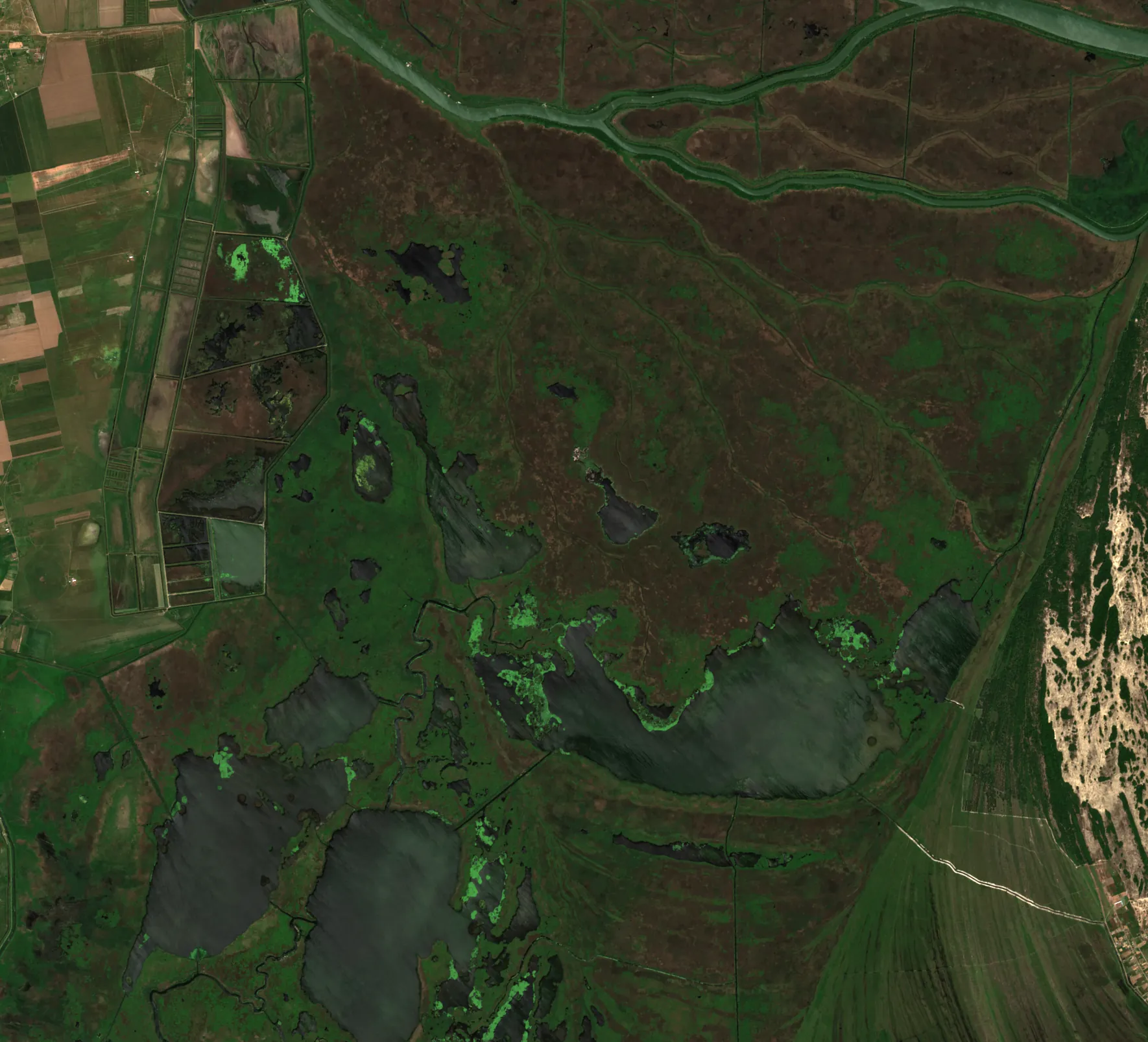
In 2016 a drone counted 17,000 pairs of great white pelicans nesting in the Danube Delta, about four times what every count for twenty years had found. Nobody has published a pair count since. The map is the real delta from orbit; the birds are drawn, one for every 100 pairs.
Scroll
One bird drawn = 100 nesting pairs (17,000 pairs, drone count, May 2016). Drawn size and flight are not to scale. Map: Sentinel-2.
A city on reed
For decades great white pelicans nested on plaur, the floating reed beds of the delta. Storms, ice, waves and the birds themselves tear the beds apart, so the colony moves: in the 40 years before 2016 it shifted between two lakes, Hrecișca and Buhaiova, five times. Since 2014 most nests are inside a compact reed bed at the north-west of Hrecișca.
In 2016 the colony was moving from Buhaiova to Hrecișca: 17,076 birds on nests at the north-west of Hrecișca, 1,568 on its other shores, 621 on Buhaiova (one point counted per nesting pair).
How many?
Since 1950, published estimates of nesting pairs exist for 30 years, made on the ground, from planes and once from a drone. Most years have none. Solid dots I checked in the original paper, number and year (6 years); hollow ones come from a 2019 compilation (24 years).
Marinov et al. put the estimates of the previous 20 years at 3,000–4,500 pairs. The table has lower ones too (1,800 in 1996, 460 nests counted in 1999, 1,900 in 2010) and one higher (4,600 in 2013). Then, in 2016, a drone photomosaic counted 17,000 pairs (15,000–19,000), about four times that band and 3.1 times the largest earlier estimate (5,400, in 1961). The authors note that fish-stock assessments showed no large increase, and that autumn counts in Israel and Bulgaria had long been far above what breeding counts from the delta and the rest of the Black Sea region could explain. They see new nesting space at work (compact reed colonised from 2014) and allow that earlier aerial counts missed birds.
Did the pelicans multiply, or did we finally count them? The data cannot say how much of the jump is method, and no pair count has been published since. SOR reports single-day counts of individuals (grey box on the chart). Individuals cannot be turned into pairs.
Same place, April and June
Drag the handle. Both halves show the same stretch of delta in 2020: April on the left, June on the right. At the edge of the western lake's reed, a pale patch appears.
At 10 m per pixel a pelican cannot be seen; a colony might show as a texture. My test could not settle it: 6 years have clear pictures of both seasons, and the bar was 8. A pale patch is not a headcount. How the test went
The city is open from April to September
GBIF holds 6,161 records of the species in Romania. 1,759 were made in May, 59 in March, 14 in December.
Most are people with cameras, not a census: they show when the birds are here and where observers go, not how many there are.
How far for breakfast?
Nobody has tracked a nesting delta pelican to its fishing grounds. Field observers estimate it flies up to 50–60 km each way (Platteeuw et al. 2004). One tagged delta pelican that was not nesting went beyond 100 km. In Greece, nesting pelicans were seen fishing 182.5 km from their colony.
Where is your town on this map? The solid ring is the 60 km estimate, the dashed one is the Greek 182.5 km.
Your year
Pick a year. The birds on the map are redrawn for the nearest published estimate, one bird per 100 nesting pairs. Start at 2016 and then try 2009 or 1999.
What this page could not do
The tests were written down before any number was computed. What was registered:
- Series: pass if 10 or more distinct years carry a published estimate of nesting pairs, each traced to a named source. Expected to fail: a consistent-method annual census, and 2016 marked as a change of method.
- Foraging: pass only with a published GPS or satellite study of breeding birds. Expected to fail.
- Satellite: count pale pixels in one fixed window at the north-west edge of Hrecișca, a nesting-season scene against a scene from before arrival in the same year, clear scenes only. Pass if at least 8 years go up. If fewer than 8 years have both scenes, the bar cannot be met and the page says so. Changed afterwards and disclosed: the date windows were widened after I saw which years had clear scenes, and the window was drawn after I had looked at three of the pictures.
The satellite test, in full
Drag the handle. Both halves show the same 3 km of delta in 2020: in the 2 April picture the reed at the north-west edge of Hrecișca is bare; in the 6 June picture a pale patch sits there.
At 10 m per pixel a pelican cannot be seen; a colony of thousands might show up as a texture. I wrote a test down before computing any pixel count: pale pixels in a fixed window, a nesting-season scene against a scene from before the birds arrive, same year. Afterwards, seeing which years had clear scenes, I widened the date windows to 15 March–25 April and 5 May–20 June (with the first windows only 4 years had both) and replaced the pale-pixel rule. The window itself was drawn after I had looked at the 2019, 2020 and 2025 pictures, two of the five years that went up. The bar was at least 8 years going up.
Result: only 6 years have clear pictures of both seasons, fewer than the 8 the test needed. The count rose in 5 of them (in 2019 by 2 pixels). The registered bar was not met, so I do not claim the colony is measured from orbit. A looser count, chosen after seeing the data, rose in 5 of 6: a hint, not a result. A pale patch is not a headcount either way.
How it was made
Sentinel-2 L2A true colour (Copernicus), up to two scenes per year (one before the birds arrive, one during nesting) from the Earth Search archive, cropped to about 17 km. GBIF record counts by month. Published nesting-pair estimates entered by hand, see the table. Birds are drawn, not photographed. Distances are measured to a point on a 0.1° grid near the delta's northern lobe, not to the colony.
The colony lies in a strictly protected zone of the Danube Delta Biosphere Reserve. This page shows lakes at map scale and prints no coordinates, landing places or routes. Please watch pelicans from the boats and sites of licensed local operators, never near the colony.
Sources
- Marinov, Kiss, Alexe et al., Monitoring the Great White Pelican breeding population using drones in 2016, Scientific Annals of the Danube Delta Institute 22:41–52 (opened, full text)
- Schogolev, Rudenko & Crivelli, Status of pelicans and cormorants on the northern Black Sea, Bird Conservation International 15 (2005), doi:10.1017/S0959270905000055 (opened, full text)
- Platteeuw, Beekman, Kiss et al., Colonial waterbirds and their habitat in the Danube delta, RIZA report 2004.002 (opened, full text)
- Kiss & Nichersu, Satellite telemetry of birds route for automatic data logging of pelicans deal behavior, Scientific Annals of the Danube Delta Institute (2002/2003), cited by Marinov et al. 2016 (not opened by me; two adults tagged in 2002, one failed, the other was not nesting)
- Kiss, Doroșencu, Alexe & Marinov, Data regarding fluctuations in the Great White Pelican population in the Danube Delta between 1950–2016, Oltenia 35(2), 2019, Table 1 (table read by a second model from indexed text; the PDF host blocked me)
- Hatzilacou, Feeding ecology of the Great White Pelican nesting at Lake Mikri Prespa, Colonial Waterbirds 19 (1996), 190–206 (abstract only)
- SOR, Delta Dunării rămâne Paradisul Pelicanilor (2018) (opened by a second model; the 2016/2017 figures come from search-index text of sor.ro (page returned 403))
- GBIF.org, Pelecanus onocrotalus occurrences in Romania, taxonKey 2480350 (API, 14 Nov 2026)
- Copernicus Sentinel-2 L2A, scenes listed below, via Element 84 Earth Search (10 m true colour)
| Year | Pairs | Checked (✓ number and year; n number only) | Published values |
|---|---|---|---|
| 1950 | 300 | — | |
| 1955 | 600–650 | — | |
| 1956 | 2,000 | — | |
| 1957 | 1,500 | — | |
| 1961 | 4,000–5,400 | — | 4,000; 4,800-5,400 |
| 1965 | 2,000–2,500 | — | |
| 1969 | 1,700 | — | |
| 1971 | 1,200 | — | |
| 1972 | 2,000 | — | |
| 1989 | 2,500 | — | |
| 1991 | 2,620–3,500 | — | 2,620; 3,000-3,500 |
| 1992 | 2,000–3,500 | — | 2,000-2,500; 2,500-3,000; 3,000-3,500 |
| 1994 | 3,000–3,500 | — | |
| 1996 | 1,800 | ✓ | 1,800 pairs (Schogolev et al. 2005); the compilation also lists 1,100 |
| 1997 | 1,700–2,300 | ✓ | 2,000 +/- 300 nests (Schogolev et al. 2005); the compilation also lists 3,500 |
| 1998 | 3,000 | — | |
| 1999 | 460 | ✓ | 460 +/- 30 active nests (Schogolev et al. 2005), counted nest by nest; 4,500 +/- 500 adults present |
| 2000 | 3,000–3,500 | — | |
| 2001 | 1,700–3,500 | ✓ | 1,700 +/- 150 nests (Schogolev et al. 2005); an alternative estimate of 3,500 is cited there |
| 2002 | 4,150 | ✓ | 4,150 pairs (Platteeuw et al. 2004, the most completely covered year); the compilation also lists 2,900-3,000 and 3,590-4,160 |
| 2004 | 3,500 | — | |
| 2005 | 3,000–3,900 | — | |
| 2008 | 3,500–4,160 | n | 3,560-4,160 (Munteanu 2009; Papp & Fantana 2008, cited in Marinov et al. 2016: publication years, not count years); the compilation also lists 3,500 |
| 2009 | 3,595–4,480 | — | |
| 2010 | 1,900 | — | |
| 2012 | 3,000–4,480 | — | |
| 2013 | 4,600 | — | |
| 2014 | 3,600–4,500 | — | |
| 2015 | 4,100–4,500 | n | 4,100-4,500 (aerial evaluation by SOR, cited in Marinov et al. 2016 by publication year) |
| 2016 | 15,000–19,000 | ✓ | 17,000 (15,000-19,000) pairs; 17,076 birds on nests at the NW of Lake Hrecisca; 19,155 on nests in total; 20,500 great white pelicans on the mosaic (Marinov et al. 2016) |
| Image | Date | Scene |
|---|---|---|
| 2017 before | 2017-04-03 | S2A_35TPL_20170403_0_L2A |
| 2018 nesting season | 2018-05-23 | S2B_35TPL_20180523_0_L2A |
| 2018 before | 2018-04-13 | S2B_35TPL_20180413_0_L2A |
| 2019 nesting season | 2019-05-28 | S2B_35TPL_20190528_1_L2A |
| 2019 before | 2019-03-19 | S2B_35TPL_20190319_0_L2A |
| 2020 nesting season | 2020-06-06 | S2A_35TPL_20200606_0_L2A |
| 2020 before | 2020-04-02 | S2B_35TPL_20200402_0_L2A |
| 2021 nesting season | 2021-05-22 | S2A_35TPL_20210522_0_L2A |
| 2021 before | 2021-04-22 | S2A_35TPL_20210422_0_L2A |
| 2022 nesting season | 2022-05-12 | S2B_35TPL_20220512_0_L2A |
| 2022 before | 2022-03-28 | S2A_35TPL_20220328_0_L2A |
| 2023 nesting season | 2023-06-01 | S2A_35TPL_20230601_0_L2A |
| 2024 nesting season | 2024-05-26 | S2A_35TPL_20240526_0_L2A |
| 2024 before | 2024-04-11 | S2B_35TPL_20240411_0_L2A |
| 2025 nesting season | 2025-06-05 | S2B_35TPL_20250605_0_L2A |
| 2025 before | 2025-04-23 | S2A_35TPL_20250423_0_L2A |
| 2026 nesting season | 2026-05-26 | S2C_35TPL_20260526_1_L2A |
| 2026 before | 2026-04-16 | S2C_35TPL_20260416_0_L2A |