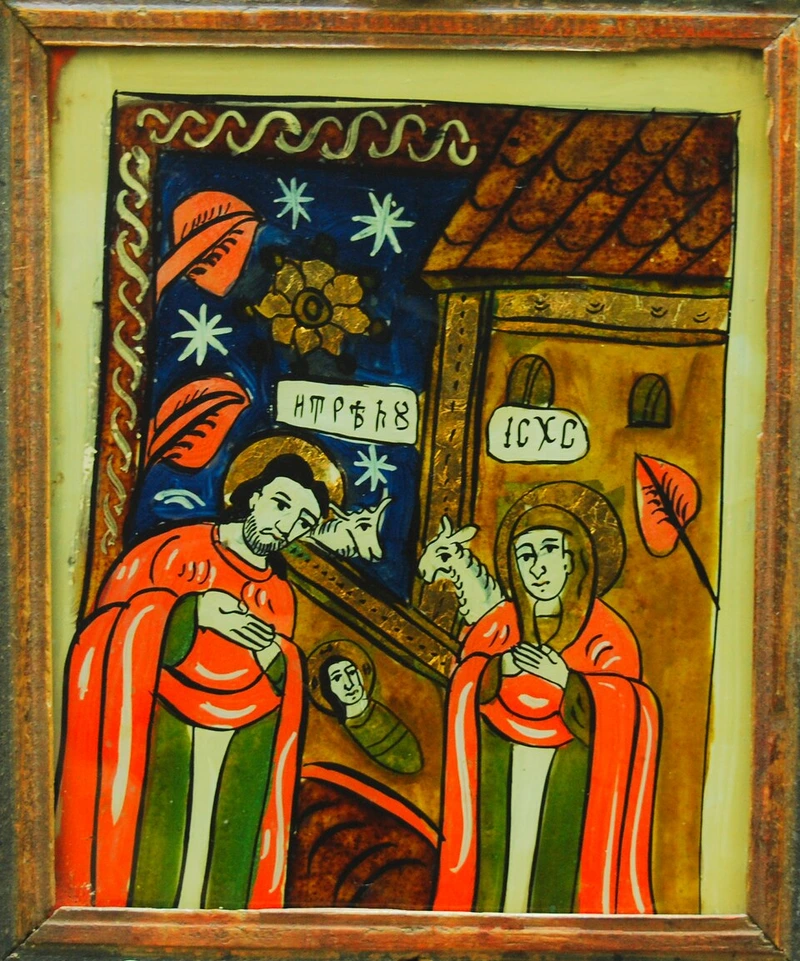
Transylvania
On the backof the glass
Icon painters applied colour to the back of the glass. Turn the pane and see why the fine lines go down first, followed by larger areas of colour.
Turn the glassThe pane
Hand-drawn glass holds its own ripples
Hand-drawn glass, known as glajă, can contain ripples and tiny bubbles. In some icons from the Făgăraș area, the glass measures between 0.5 and 1.5 millimetres thick.
Tilt the pane and follow the shifting strip of light. You look at an icon through the glass, from the side facing away from the paint.
In the workshop
The outline is closest to your eye
The painter put a paper pattern under the glass and traced its lines. In Șcheii Brașovului, painters called this “making the warp”. They wrote inscriptions in reverse so you could read them after turning the glass.
Areas of colour went down after the outlines and details. The background filled the spaces around them. Choose a stage, then turn the pane.
Try the order
Which colour stays visible?
Apply two overlapping colours. Seen from the front, the first colour is next to the glass and covers part of the paint that went down after it.
Choose the first colour.
Turn the pane to look from the painted side. The second colour is now closer to your eye.
Up close
Glass, paint and the wooden backing
Through the glass, you see the lines and details first, with colour around them. Where paint has lifted away, the glass may remain intact and reveal whatever sits behind the gap.
Separate the layers to see their order. The distances in the drawing are enlarged. Painters held the pane in a wooden frame and protected the back with paper or a thin board.