From North America, via the Banat
Ragweed: how it went from 1907 to all 42 counties
In 1907, at Băile Herculane spa in Banat, someone pressed the first Romanian specimen. Today, 9,940 GBIF records span all 42 counties — from the Banat roads to the edge of Iași. The map, year by year, from real data.
or tap the map above
Ragweed in
The entry
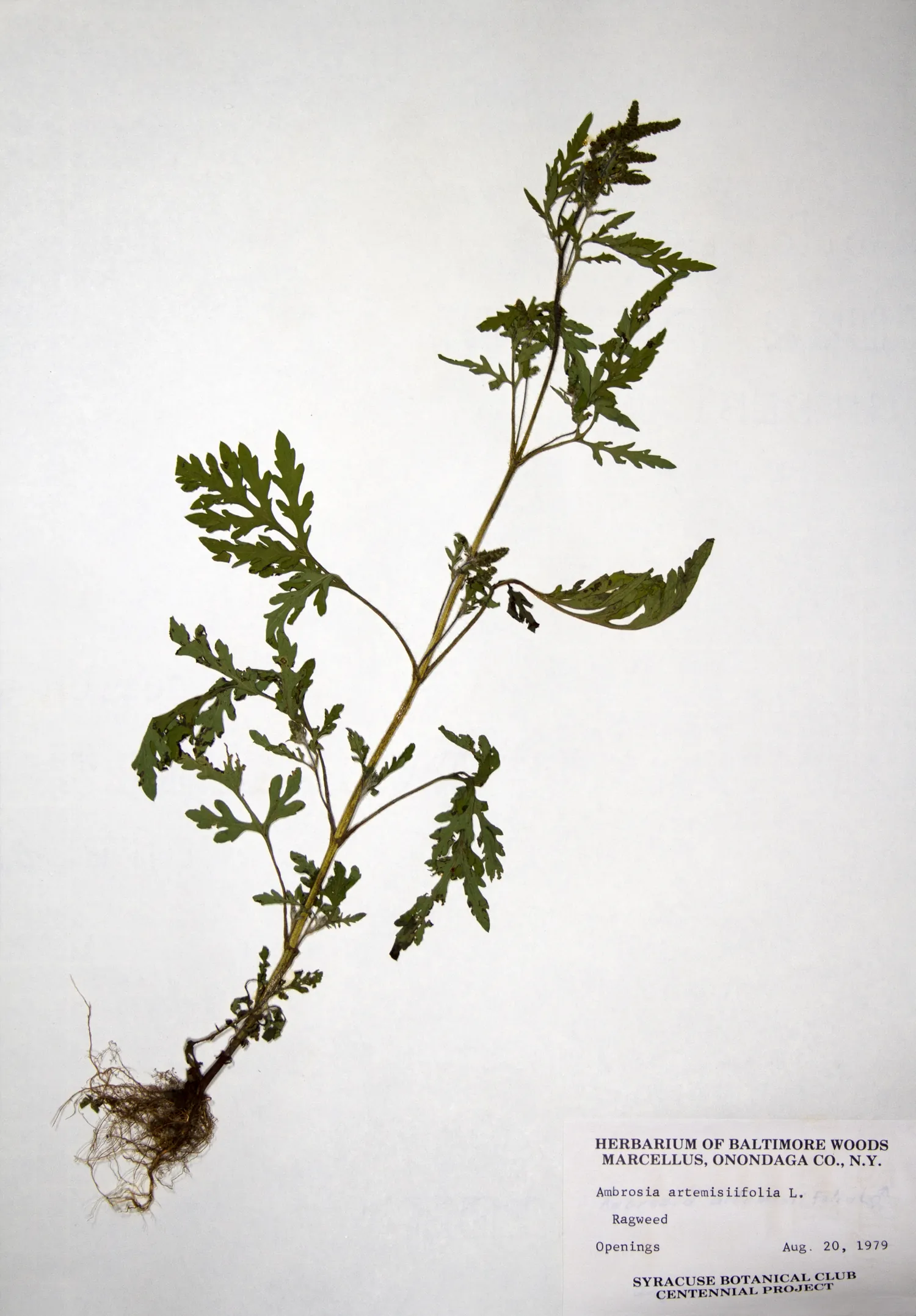
01The first Romanian record is a herbarium sheet from Băile Herculane, 1907
The oldest geolocated record in today's GBIF data is a pressed specimen from 1907, at Băile Herculane, Caraș-Severin county — at 44.88° N, 22.41° E. Another 1907 specimen without coordinates comes from the same zone. In 1910, three records appear at Orșova, across the Danube, in Mehedinți county. The next recorded appearances follow the same Pannonian corridor: 1946 Hunedoara; 1947 Cluj; 1957 Timiș; 1965 Maramureș; 1973 Arad.
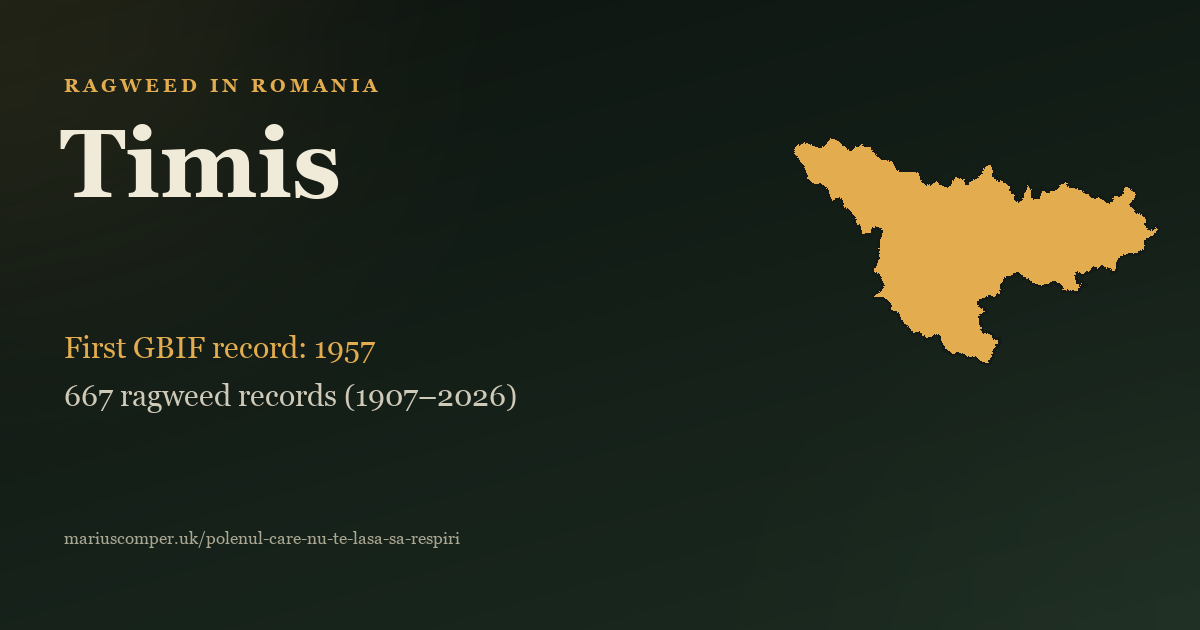
Ragweed crossed the Atlantic from North America probably inside agricultural and seed-contaminated cargo. On continental Europe it settled first in the Pannonian basin, from Szeged and Békéscsaba to Romania's border — exactly where today's map is densest: Arad 775; Caraș-Severin 747; Timiș 667; Bihor 506. From there it spread along the two corridors that act as a weed's motorway: roads and railways.
Road shoulders and railway embankments are, literally, the dispersal corridors: seeds ride the tyres and the wheels of trains, and take root in the neglected margins.
The pace
02Slow for half a century, then it took off
The cumulative count of GBIF records grows almost vertically after 1980. Two things are true at the same time: ragweed spread genuinely and massively — and eyes learned to see it. The Romanian academic inventories (2019–2022, published 2024) and the Pl@ntNet and iNaturalist apps produced over 71% of all records in 2020–2026 alone (7,100 of 9,940).
GBIF records of Ambrosia artemisiifolia in Romania, cumulative by year (geolocated records with a year only: 9,925 of 9,940). Source: GBIF, 11 November 2026.
The map does not prove ragweed appeared everywhere in the same years. It proves that inventories and apps have found it in all 42 counties — and the gap between west (records from 1907–1980) and east (records mostly after 2000) matches the known corridor of entry from the Pannonian plain towards the east and south-east — the same direction noted by the national alien-flora inventories (alien_plant_species_ro).
August
03Why August and September choke you
Of the 759 GBIF records with a completed month, 56.8% fall in August and September — 33.2% in August and 23.6% in September, versus 23.1% in July and just 6.1% in October. This is not a calendar coincidence: that is when the plant releases pollen.
What this means for you: a single ragweed plant can release up to a billion pollen grains per year (some estimates go to 3 billion), each 10–25 μm across — small enough to reach deep into the airways and eyes, light enough to travel tens of kilometres on the wind. Ragweed is the strongest source of seasonal allergy in Europe and the dominant problem in the Pannonian basin, which borders Romania.
In western Romania — Timiș, Arad, Caraș-Severin and Bihor — sensitisation rates belong to the Pannonian reservoir, and these are exactly the counties densest with ragweed in today's data.
The 759 records with a completed month, by month. 56.8% fall in August–September. Source: GBIF, 11 November 2026.
The law
04Law 62/2018: what you're owed, whose job it is, and what happens to those who refuse
Romania has, since 2018, a dedicated ragweed law — Law no. 62/2018 on the control of ragweed, published in the Official Gazette no. 227/2018. It says three clear things:
What you actually do, in three steps
- Ragweed on public land or by the road? A written report to the town hall (legal basis: Law 62/2018 and Government Ordinance 27/2002). Include the location — an address, or clear landmarks.
- Your neighbour ignores it? Notify them in writing; if they don't react, the report goes to the town hall, which issues a warning through the prefect's commission. For large infestations, a copy can also go to the public-health directorate.
- Ragweed on your own land? Mow or pull it before 30 June. If it has flowered already, don't mow it in full bloom and mask up — the sudden pollen release is exactly what you want to avoid.
Identify it
05Spot it in a second, deal with it at home
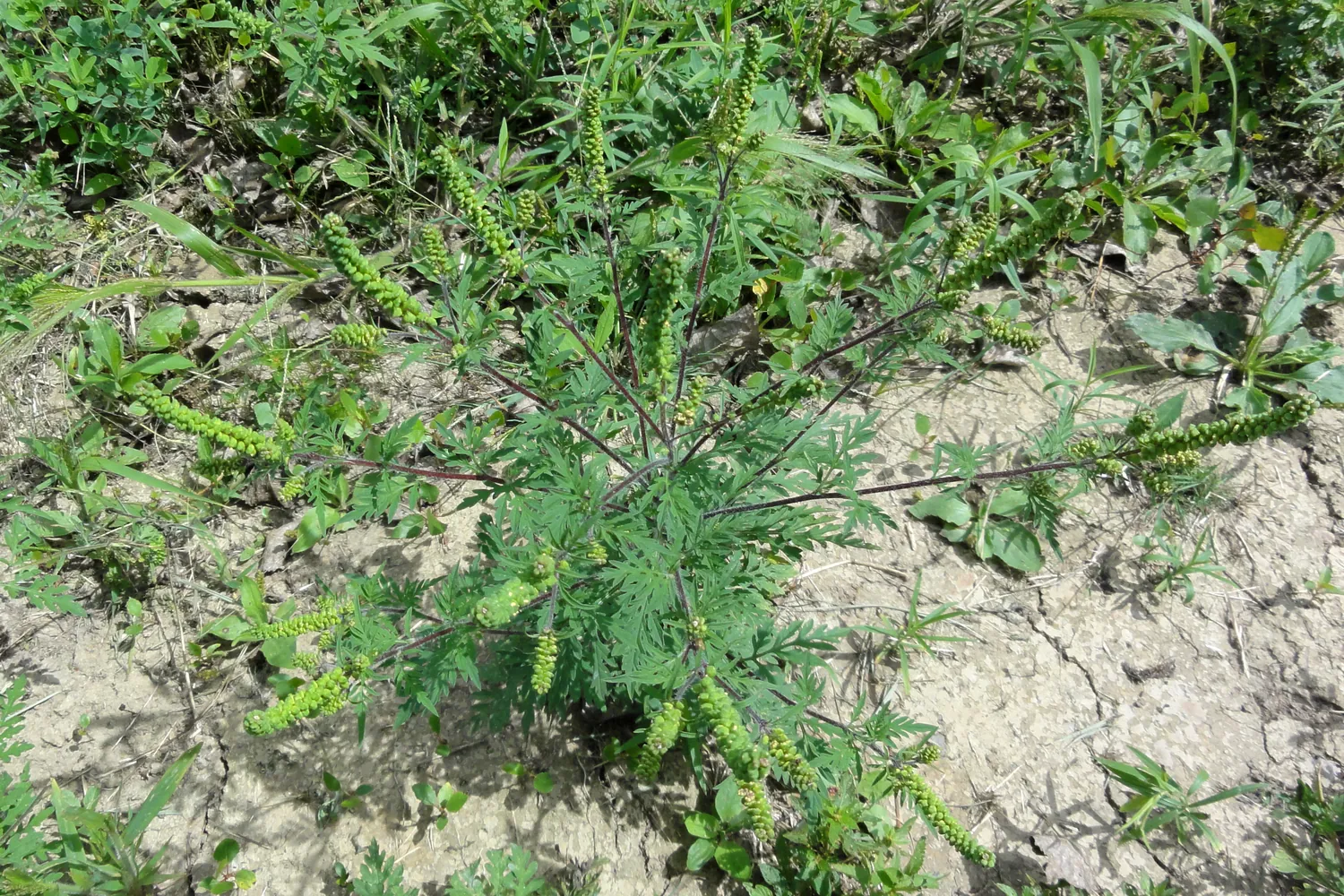
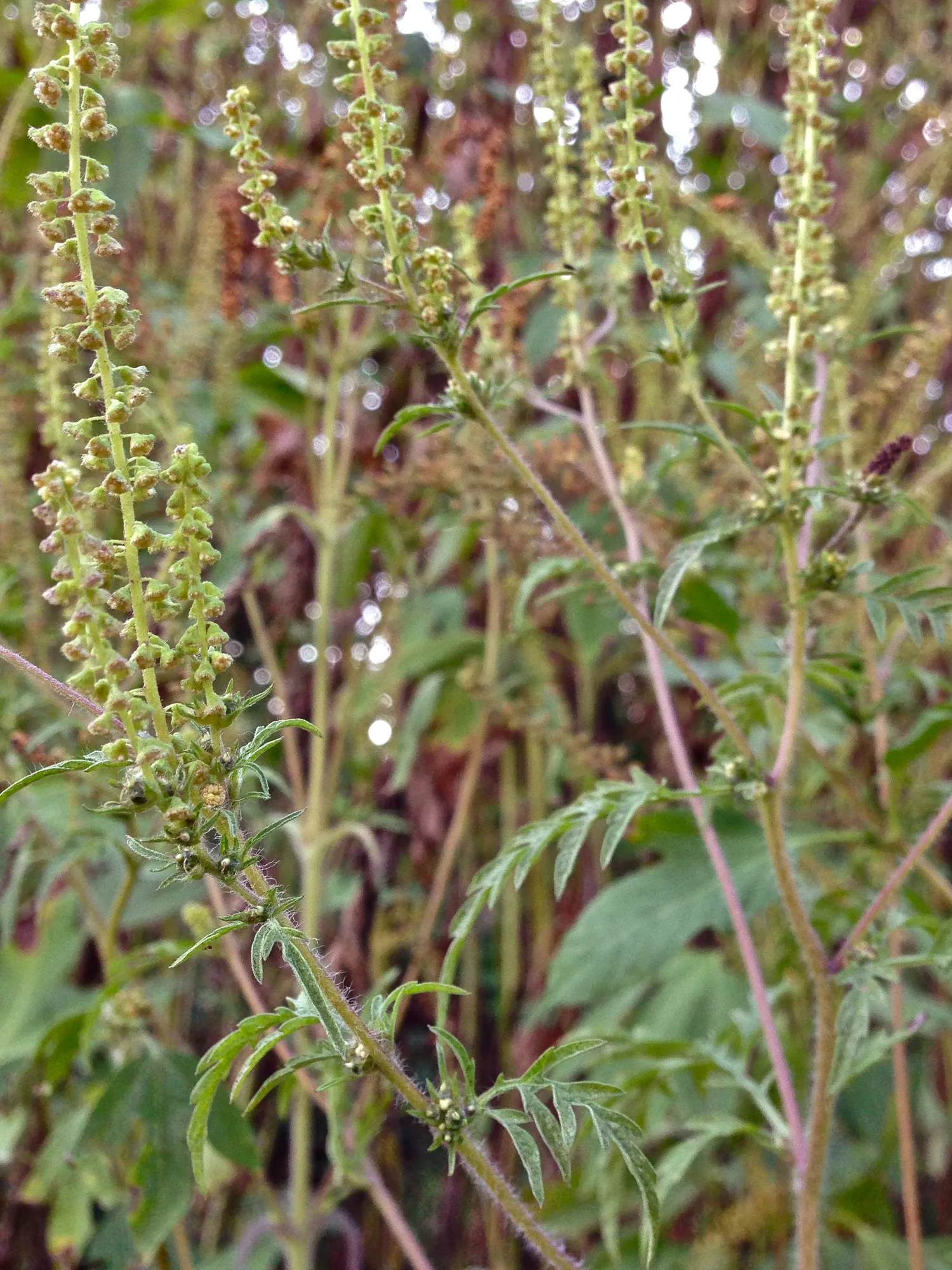
Ragweed (Ambrosia artemisiifolia) is an annual 0.3–2 m tall, with a hairy stem, very finely divided (twice-pinnate) light-green leaves and a faintly bitter smell when crushed. The flowers — thin greenish-yellow spikelets — appear from July to October at the top of the stem.
- Leaves are very finely divided, like a dill frond that grew too large; stem slightly hairy, dark green with a violet trace at the base.
- The male flowers are slender greenish-yellow spikelets at the top of the plant; the female ones are tiny, solitary, at the base of the spikes.
- It grows mostly on road and railway shoulders, abandoned land and fallow fields — exactly where the map has its densest points.
If you sneeze from July to October
Nasal congestion, sneezing fits, itchy eyes and a runny nose, always in the same period — talk to your GP or an allergist. Sensitisation is confirmed simply (prick test or specific IgE antibodies to ragweed). Specific immunotherapy (desensitisation) is the only treatment that stops the mechanism, and it starts in winter or spring, not in full season.
Method and sources
06What the map tells you — and what it doesn't
What it tells you: where ragweed was first recorded and how much of it each county has seen; the west–east direction of spread; how its points relate to primary roads and railways; the critical months of the allergy.
What it doesn't tell you: this is a map of presence, not prevalence. How many hectares each county holds, GBIF does not know. The huge 2020–2026 counts partly reflect reporting effort — the academic inventories and the apps — not only the plant's biology. Two inventories may partly overlap, so 9,940 is an upper bound. Two records carry no year, and two could not be assigned to a county. Every number on this page is computed exclusively from the GBIF files of 11 November 2026; county assignment was done by coordinates, against the geoBoundaries ROU ADM1 polygons (World Bank / ANCPI-derived, CC BY 4.0; simplified).
Sources
- GBIF.org — occurrence search download, Ambrosia artemisiifolia, country=RO, accessed 11 November 2026: api.gbif.org/v1/occurrence/search. 9,940 records; 9,925 with coordinates.
- Miu I V (2024). alien_plant_ro. Biodiversity Data Journal. Dataset doi:10.15468/zk9adu (CC BY 4.0) — 2019–2022 field inventories, 98,323 records of 396 alien plant species in Romania.
- Miu I V (2022). alien_plant_species_ro, version 1.1. NeoBiota. Dataset doi:10.15468/gg846v (CC0) — literature review 1778–2018, 42,776 records of 102 species.
- GBIF — iNaturalist Research-grade Observations (inaturalist.org, CC BY-NC 4.0) and Pl@ntNet automatically identified occurrences (plantnet.org, CC BY 4.0).
- OpenStreetMap contributors — Geofabrik extract “romania-2026-10-30” (ODbL), used for the distance test against roads and railways (~35,000 primary-road segments; 19,626 motorway/expressway segments; 24,146 rail segments; ~2,500 sampled points vs 400 random points).
- geoBoundaries ROU ADM0/ADM1, World Bank / ANCPI-derived, CC BY 4.0; simplified for display.
- Law no. 62/2018 on the control of ragweed, Official Gazette no. 227, 14 March 2018 — the legislative portal (published form).
- Schaffner U et al. (2020). Biological weed control to relieve millions from Ambrosia allergies in Europe. Nature Communications 11:1745. doi:10.1038/s41467-020-15586-1.
- Lake IR et al. (2017). Climate Change and Future Pollen Allergy in Europe. Environ Health Perspect 125(3):385–391. doi:10.1289/EHP173.
- Photos: “Ambrosia artemisiifolia — Common Ragweed”, Fritzflohrreynolds, CC BY-SA 3.0; “Ambrosia artemisiifolia BW-1979-0820-9891” (herbarium), R. A. Nonenmacher, CC BY-SA 4.0; “Ambrosia artemisiifolia 03341”, R. A. Nonenmacher, CC BY-SA 4.0 — all from Wikimedia Commons.
- See also on this site: karate-zeon (emergency derogations for pesticides in Romania) and codurile-de-pe-fructe (what the PLU sticker means).