The Riemann hypothesis · 21 November 2026
Every zero on one line
On 20 November the mathematician Levent Alpöge posted what he believes is a proof, found working with Claude, of the most famous unsolved problem in mathematics. So far it consists of a four-page note and code that a computer can check. On 21 November the Lean and Mathlib communities, who maintain the software that checks it, certified that the code is a correct proof of the Riemann hypothesis. A proof written for human readers has not yet been published. Here is what it claims, why mathematicians care, and what would change if it holds.
For 167 years mathematicians have tried to prove a rule about prime numbers. On 20 November 2026 the mathematician Levent Alpöge said he believed he had done it, working with the AI Claude. Computers have checked his proof. The Lean and Mathlib communities, who look after the checking software, say it correctly proves the Riemann hypothesis. Mathematicians are still working through it. This page shows what the rule is, and what changes if he is right.
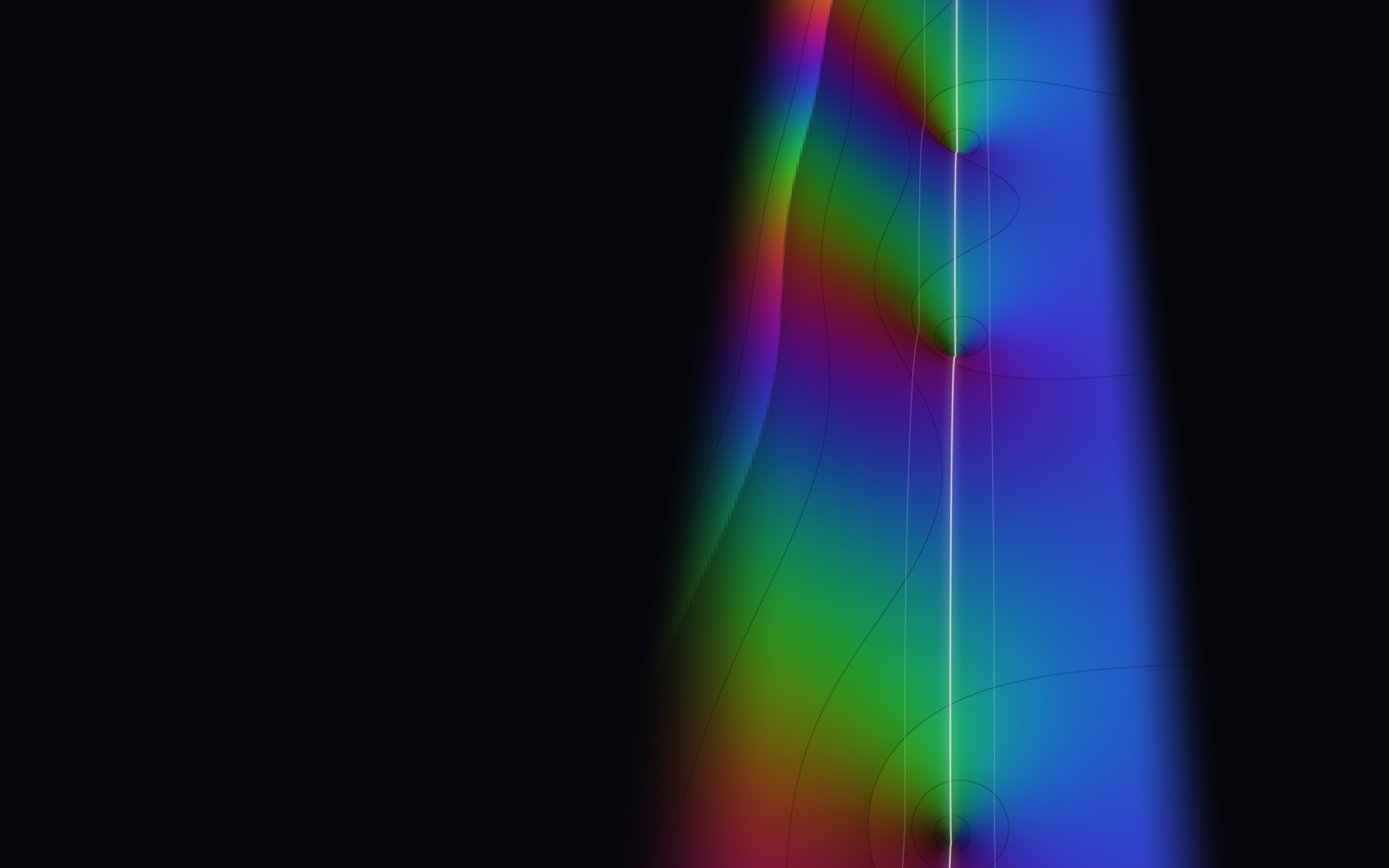
The terrain behind this text is real: the function at the heart of the problem, computed in your browser. Every dark well in it lies on the same straight line.
1 The primes, and a curve that almost fits
A prime is a whole number above 1 that only 1 and itself divide: 2, 3, 5, 7, 11, 13… Count them as you go and you get a staircase. Up to 100 it climbs 25 steps, at irregular moments. Primes crowd together, like 41 and 43, then nothing comes between 89 and 97.
A prime is a whole number above 1 that only 1 and itself divide evenly: 2, 3, 5, 7, 11… Each time you meet one, the line on the right climbs a step. They turn up at odd, unpredictable moments.
No simple rule predicts the next step. But in 1792 or 1793, aged about 15, Carl Friedrich Gauss noticed that primes thin out at a steady rate: near a number x, about one number in every ln x is prime (ln is the natural logarithm). Add up those odds and you get a smooth curve, the logarithmic integral, drawn here in gold.
You can find the next prime by testing numbers in order, but no simple rule says where it will turn up. Carl Friedrich Gauss, aged about 15, noticed that primes get rarer at a steady pace. That gave him a smooth gold curve that guesses how many there are.
From far away the fit is uncanny. Up to a million there are 78,498 primes; the curve predicts 78,628. The staircase and the curve become hard to tell apart.
From far away the guess is excellent. Up to a million there are 78,498 primes. The curve says 78,628.
Magnify the difference, though, and it wanders. The Riemann hypothesis is, at bottom, a claim about how far it can wander: never much further than about the square root of x. The white line is the real gap, primes counted to ten million. The shaded band is the limit the hypothesis would guarantee for every x from 2,657 on: a square root, times a logarithm. The primes stay inside. Nobody has proved that they always will.
Up close, the real count wobbles around the guess. The Riemann hypothesis says the wobble stays small: from 2,657 on, always inside the coloured band. Across the range shown, it does. The new proof claims it always will.
2 The landscape where the primes are written
In 1859 Bernhard Riemann found where the wandering comes from. He took a sum Leonhard Euler had tied to the primes, ζ(s) = 1 + 1/2s + 1/3s + …, and let s be a complex number: a point on a plane instead of a point on a line. The sum itself only works when the real part of s is above 1, but Riemann showed how to extend the function across the whole plane. That extension is the landscape. Here, height is its size and colour is its direction, like a compass needle at every point.
In 1859 Bernhard Riemann found a hidden map behind the primes. It is the coloured landscape you see: a function called zeta, spread over a flat plane.
Where ζ falls to zero the ground drops into a well, and every colour meets in a pinwheel. Riemann showed that these zeros hold everything about the primes: know where every well is and you can rebuild the prime staircase exactly. (The bright peak at the edge is the one point where ζ shoots to infinity.)
In some places the landscape dips down to zero, like a hole in the ground. These holes are called zeros. Riemann gave a formula that uses where the zeros are to count the primes exactly.
Seen from above, the strange thing jumps out. Every well in the central band lies on one vertical line, where the real part of s is exactly ½. (A few dull “trivial” zeros, at −2, −4, −6…, sit off to the left.) Riemann guessed, almost in passing, that all of them do, and set the question aside after what he called “fleeting vain attempts” to prove it. That guess is the Riemann hypothesis.
Look from above and something striking appears: the holes in the middle strip sit on one straight line. Riemann guessed that every zero in that strip does. That guess is the Riemann hypothesis.
Computers have since checked the first 12.4 trillion of these zeros (David Platt and Tim Trudgian, 2021): all on the line. But there are infinitely many, and one well off the line would sink the hypothesis. David Hilbert put it on his list of great problems in 1900; the Clay Mathematics Institute has offered $1m for a proof since 2000.
Computers have checked more than 12 trillion holes. All are on the line. But there are infinitely many, so checking can never finish. A single zero off the line would sink the hypothesis; only a proof can confirm it. There is a $1m prize for settling it.
3 Rebuilding the primes, one zero at a time
Riemann’s discovery can be watched. The pale staircase is a version of the prime count that climbs at every prime and every power of a prime (4, 8, 9, 16…). Its steps have different heights, which makes it easier to handle. The gold line is the first guess: a straight diagonal.
Now the clever part. The pale staircase climbs at every prime, and at powers of primes such as 4, 8 and 9. The gold line starts as a plain straight guess.
Each zero adds a wave to the guess. The higher up the line the zero sits, the faster its wave wiggles. Here is the first zero alone, at height 14.13.
Each hole on the line adds one wave to the gold line. Here is the first.
With ten zeros, corners start to appear at 2, 3, 4, 5, 7, 8, 9…
With ten waves, the gold line starts to bend into steps.
With a thousand, the waves cancel almost everywhere except at primes and their powers, where they pile up into steps. Drag the slider or press play. Turn on the sound to hear each zero as a note, pitched by its height: the primes are, in a real sense, the chord these notes make.
With a thousand waves, the gold line traces the staircase closely. Press play, and turn on the sound: each hole plays a note.
4 What if one zero strayed?
How big each wave grows depends on how far right its zero sits. On the line, at ½, a wave grows like √x, the square root. A zero further right would send out a wave that grows faster, like x0.7 or x0.9, and in time it would outgrow the waves from all the zeros on the line.
What if one hole sat off the line? Holes come in mirror pairs, so one of the two would sit to the right, and its wave would in time outgrow the waves of all the holes on the line.
Move the highlighted zero sideways. Zeros come in mirror pairs, so its twin moves too. The outer curve shows the growth such a zero would bring: the primes would keep straying from the smooth curve by amounts of roughly that size. The dots are the real primes, counted to ten million: the largest stray so far.
Try it: drag the red hole to the right. The red area shows how large the primes’ wandering could then grow. Each white dot is the largest wander actually measured so far. They stay small.
So the hypothesis is a promise of discipline: the primes keep as close to the smooth curve as anything this irregular possibly could, everywhere, forever. A great many theorems in number theory begin “assume the Riemann hypothesis”, because so much rests on that square-root control.
So the hypothesis says that however far you count, the number of primes stays close to Gauss’s guess. A great many other results depend on that.
5 The generalized version
Every prime above 5 ends in 1, 3, 7 or 9. Are the four endings shared fairly? Up to ten million each holds within 0.02 percentage points of a quarter. Yet the race is not random: the combined count of primes ending in 3 or 7 has been ahead of the combined count ending in 1 or 9 at almost every point, a quirk known as Chebyshev’s bias.
Primes above 5 end in 1, 3, 7 or 9. Up to ten million, each ending has almost exactly a quarter. Oddly, endings 3 and 7 together stay slightly ahead of 1 and 9 together almost all the way.
Each way of sorting the primes like this has a landscape of its own, built from what are called Dirichlet L-functions. This one sorts primes by the remainder left after dividing by 4. The Generalized Riemann hypothesis says that the wells in the central band of every such landscape sit on the same line, at ½. That is what Alpöge says he has proved. His note adds that the method should, “with more time”, reach the wider Extended hypothesis as well.
Sorting primes by their remainders gives landscapes like this one. The “generalized” hypothesis says that in every one, the holes in the middle strip sit on the same line. That is what Alpöge says he has proved.
6 A small world where it was already true
There is one setting where a Riemann hypothesis has been proved: arithmetic that wraps around, like a clock. Take the curve y2 = x3 + x + 1 and keep only whole-number points, with every number replaced by its remainder after dividing by a prime, here 97. The points scatter like stars.
There is a smaller world, clock arithmetic, where numbers wrap around like the hours on a clock. These dots are the points of one curve in that world.
Count them for each prime p and you get roughly p + 1, never off by more than 2√p: a square root again. Helmut Hasse proved this in the 1930s and André Weil extended it to all such curves in the 1940s. Each dot is a prime from 5 to 5,000 (except 31, where this curve breaks down); none leaves the band.
Count the points for each prime, and the difference from the expected number always stays inside the band. Helmut Hasse proved this in the 1930s: the same kind of rule, in the small world.
In 1969 Sergei Stepanov found an elementary proof of bounds like these. It rests on building a polynomial that vanishes many times over at each point, a property called multiplicity. Alpöge writes that his argument descends from Stepanov’s, but multiplicity is hard to find among whole numbers: it would mean something like “differentiating whole numbers”. His way round was a chain of objects called theta lifts, each imitating multiplicity. The detail he credits to Claude is the chain’s length: about √X lifts for a sum over primes and prime powers up to X.
The new proof borrows an idea from that small world. Claude suggested one key detail: how long a certain chain of steps should be.
7 A proof the machines checked first
Alpöge’s four-page note lists the main steps with dates, from 6 October to its last line: “11/16/26: GRH.” Late on Sunday 15 November he messaged Dario Amodei, Anthropic’s chief executive, to ask how he might announce it. Near the finish, he writes, Claude “far outpaced me”.
The mathematician’s note lists 20 steps, from 6 October to 16 November, when the last one reads “GRH”. Near the end, he writes, Claude “far outpaced” him.
There is no paper yet, only the note and the code. The argument is written in Lean, a language in which a computer checks every logical step, and released as one archive in 14 parts holding 175,187 files: about 17 million lines of code. Alpöge says a written-out version ran past 250,000 pages, and he chose not to post such an “unreadable” document. Printed on ordinary paper, 250,000 sheets would stand about 25 metres tall.
There is no normal paper yet. The proof is written in Lean, a language that computers check line by line. Alpöge says a full write-up ran past 250,000 pages: printed one page per sheet, a stack about 25 metres high.
Where the checking stands, 21 November 2026
- Does Lean accept every step? Yes. All 175,187 files compile, Lean’s core checker has replayed every one, and several independently written checkers accepted the result too. Two of them come with a formal proof that they cannot accept a false proof, a guard against any hidden flaw in Lean itself.
- Does it lean on anything extra? No. The headline theorems use only Lean’s three standard axioms.
- Does it prove the right statement? Yes. Two independent tools confirm that the theorem proved is exactly the Riemann hypothesis as already stated in Mathlib, Lean’s shared library of mathematics. On that basis the Lean and Mathlib communities certified both the statement and the proof. That certification covers the Riemann hypothesis. Separately, Sutherland’s comparison with the con-leche checker confirms that the proof also establishes GRH for Dirichlet L-functions; at 12:55 UTC his end-to-end run with Lean’s own comparison tool was still going.
- Does anyone understand it? Not yet in full. Terence Tao, pointing readers to the Lean community’s forum, wrote: “I imagine the digestion process will take some time.”
From the joint statement of the Lean and Mathlib communities, endorsed by the Lean FRO and the Mathlib Initiative, 21 November, and Andrew Sutherland’s verification report (MIT), updated 12:55 UTC, 21 November.
Independent programs have accepted every step of the code. Two separate tools confirm that it proves exactly the Riemann hypothesis, and the Lean and Mathlib communities have declared the proof correct. Mathematicians are still working through the argument.
Brian Conrey, a leading specialist on the hypothesis, called it “a monumental moment in human history”. Nestor Guillen of New York University said the AI worked “more like a tool”. Alpöge says he has not yet mastered all the mathematics involved and expects the argument to be greatly simplified. He addresses the timing too, a day after Anthropic’s stock-market debut, and calls the cynical reading false. The same day Ravi Vakil of Stanford posted a separate 940-page draft proof by Alessandro Maria Masullo, written without AI. Within hours Vakil reported that readers had found problems, and within a day independent reviews had published explicit counterexamples to steps it relies on: at the prime 2, for instance, a limit in the proof is zero where the theorem it is meant to prove gives log 2 (Eric Naslund’s review). Its chapter 13, which should deduce GRH, does not yet state its main theorem. Brian Conrad, who had been advising Masullo, told Scientific American: “It’s undergoing major revision.” As posted, the draft does not prove the hypothesis. Clay considers a solution only once it has appeared in an eligible publication, two years have passed and mathematicians generally accept it.
One leading expert called it “a monumental moment in human history”. The same day, a separate 940-page draft proof, written without AI, was posted. Within hours readers reported problems in it, and the mathematician who advised its author says it is “undergoing major revision”. The $1m prize is considered only after a proof is published, two years pass and mathematicians broadly accept it.
8 If it holds
For more than a century mathematicians have written “assuming the Riemann hypothesis” in front of results they believed but could not finish. If the proof stands, the ones that need only the version Alpöge claims become plain theorems overnight. Not all of them do.
If the proof is right, here is what changes, and what doesn’t.
If the proof holds
- Many results that begin “if the Riemann hypothesis is true” become facts.
- From 2,657 on, there is a proven ceiling on how far the prime count can stray from Gauss’s curve.
- Gary Miller’s fast test for primes is guaranteed to be right when it runs all its checks.
Still waiting
- Some results need a broader version of the hypothesis than the one Alpöge says he has proved.
Unchanged
- Encryption: the proof gives no known shortcut for breaking apart the large numbers that RSA encryption relies on.
Become theorems
- A sharp, permanent limit on the prime count
- For every x from 2,657 up, the number of primes up to x lies within √x·ln x/8π of Gauss’s curve (Lowell Schoenfeld, 1976).
- Every fair share of primes stays fair
- Primes already share out equally, in the long run, among the endings or remainders that can hold them. GRH limits how far any share can drift from fair: about √x times a logarithm, tiny next to the totals. The race from chapter 5 can lean, but only that far.
- The first prime in a sequence comes early
- In any sequence a, a+m, a+2m… where a and m share no factor, a prime turns up before (m log m)2 (Youness Lamzouri, Xiannan Li and Kannan Soundararajan, 2015, assuming GRH).
- A fast primality test becomes a proved one
- If an odd number passes Gary Miller’s 1976 checks for every base up to 2(ln n)2, it is certainly prime (Eric Bach, 1990). In practice little changes: computers already use quick random tests, and a slower proven method has existed since 2002.
Still waiting
- Artin’s conjecture on primitive roots
- That the powers of 2, for example, run through every non-zero remainder for infinitely many primes, and for a predictable share of them. Christopher Hooley’s 1967 proof of that share needs the hypothesis for wider families of landscapes: the Extended version Alpöge expects to reach but has not claimed. Unreviewed preprints this autumn claim the “infinitely many” part by other means.
- Results about number systems
- Peter Weinberger’s 1973 theorem on which number systems allow a kind of long division assumes a wider hypothesis too; some cases have since been proved separately.
Unchanged
- Your bank, and internet encryption
- The hypothesis is about how primes are spread, not how to take large numbers apart. A proof gives no known way to factor the numbers that RSA encryption relies on.
- Results already proved another way
- Hardy and Littlewood showed in 1923 that GRH makes every large enough odd number a sum of three primes; Ivan Vinogradov removed the need for GRH in 1937, and Harald Helfgott covered every odd number above 5 in 2013. So-called Siegel zeros, hypothetical wells near the edge that haunted a century of work, would be ruled out by GRH; a preprint posted this October excludes them directly, and mathematicians are still digesting it.
The largest change may be in how mathematics is done. The most famous problem in the subject now has a proof that machines verified before people had finished understanding it, found by a mathematician working with an AI that, by his account, outran him at the end. The understanding, the simplification and the paper that people can read are still to come.
Sources and method
- Levent Alpöge, note of 20 November 2026, alpo.ge/remark.pdf (claim, timeline, Stepanov lineage, √X chain of theta lifts, 250,000+ pages, Lean archive in 14 parts). Andrew Sutherland, verification report, updated 12:55 UTC, 21 November 2026 (compilation, kernels, axioms, statement comparison, scope of GRH). Lean and Mathlib communities, “Lean verification of the Riemann Hypothesis”, 21 November 2026 (certification, 17 million lines, verified checkers).
- AFP via Phys.org, 20 November 2026 (Conrey, Guillen, timing, Clay rules). TechCrunch, 20 November 2026 (Masullo). Ravi Vakil, post and update of 20 November 2026. Scientific American, “Dueling claims of Riemann hypothesis proofs emerge” (Conrad). Eric Naslund, review of Masullo’s manuscript (the prime-2 counterexample, pp. 495–496); Shaoqi Song, audit and revision; Ryan McCorvie, Lean formalization project (unfinished final chapter). Scientific American, updated story (Sutherland’s independent compilation and axiom check, Buzzard on the pending checks).
- Terence Tao, blog post of 20 November 2026.
- B. Riemann, “Ueber die Anzahl der Primzahlen unter einer gegebenen Grösse”, 1859 (“fleeting vain attempts” is a published English rendering; Clay’s translation has “fleeting futile attempts”). D. Platt and T. Trudgian, “The Riemann hypothesis is true up to 3·1012”, Bull. LMS 2021. L. Schoenfeld, Math. Comp. 1976. E. Bach, Math. Comp. 1990. C. Hooley, J. reine angew. Math. 1967. S. A. Stepanov, 1969. H. Helfgott, 2013. Y. Lamzouri, X. Li, K. Soundararajan, Math. Comp. 2015. T. Tao, post on Siegel zeros, 19 October 2026. Overview of conditional results: Wikipedia, Generalized Riemann hypothesis.
- Everything drawn is computed, not illustrated. The landscapes evaluate ζ(s) and the mod-4 L-function in double precision in your browser (Borwein’s accelerated alternating series, with the functional equation left of ½). The thousand zeros were computed with mpmath; the first is 14.134725…, the thousandth 1419.422480…. Primes up to ten million are sieved in your browser; point counts on the curve are exact.
Published 21 November 2026; updated the same afternoon with the Lean and Mathlib communities’ certification. The status of the proof is changing quickly; this page reflects what had been reported by then.