Every script on Earth
The letter A was once an ox’s head
Unicode 18.0, the standard computers use to display text, covers 175 scripts, and others are still waiting to get in. People invented writing from scratch at least three times, probably four. Yet most alphabets in use today descend from a single script, attested from about 3,800 years ago.
The A you are reading has had roughly this shape for about 2,600 years. The Romans took it from the Etruscans, who took it from the Greeks, who called it alpha.
The Greeks borrowed it around 800 BC from the Phoenicians, traders on the coast of today’s Lebanon. They called the sign ʾālep, ‘ox’, and used it for a consonant: the catch in the throat at the start of the word. Greek had no such sound, so it used the sign for the vowel a.
Turn ʾālep on its side and it has horns. The model scholars propose is the Egyptian hieroglyph of an ox head.
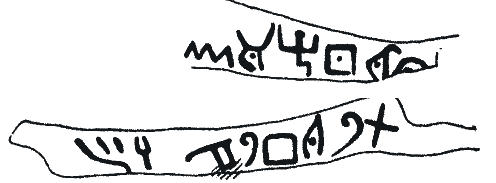
In between lies the step that fonts leave out: the earliest alphabetic inscriptions, from Egypt and Sinai early in the second millennium BC. Below is one of them, on a statuette found near the turquoise mines of Serabit el-Khadim. The script is not yet in Unicode, so its signs appear on the page hand-drawn, in a thin line.
1 · Four places
Writing was invented more than once
Writing did not spread from a single place. It arose independently in Mesopotamia, China and Mesoamerica; Egypt may be a fourth case.
Uruk, Mesopotamia, c. 3300 BC
The first tablets are accounts: barley, sheep, beer, rations for workers. Some signs were drawn into the clay, others impressed. Later, a cut reed left wedge-shaped marks, hence the name: cuneiform. The signs of these first tablets entered Unicode only in 2026 and still have no free font.
Abydos, Egypt, c. 3250 BC
Small bone and ivory labels from a royal tomb already carry signs that stand for sounds. Hieroglyphs would stay in use for more than three thousand years.
Whether the Egyptians invented writing on their own or had heard of Sumerian writing is still debated. Their signs and rules are different.
Anyang, China, c. 1250 BC
At the Shang court, inscriptions on cattle shoulder blades and turtle shells recorded the questions put to divination and sometimes the outcome. Today’s Chinese characters descend directly from those signs. The screen shows the modern forms; on the bones they looked different.
Oaxaca and the Maya region, from c. 600 BC
The oldest Zapotec texts date from around 600 BC, and Maya writing appears a few centuries later. The Cascajal block from Veracruz has been dated to around 900 BC, but its date and the reading of its signs remain disputed. The fourth invention has no place in Unicode yet, so its line shows a photograph instead: Maya glyphs from the Dresden Codex, 11th–12th century (plate from Sylvanus Morley, 1915, public domain).
2 · One birth
The alphabet was invented essentially once
Early in the second millennium BC, people who spoke a Semitic language took a few Egyptian signs and used them differently: each picture stood only for the first sound of the word in their own language. The script wrote only consonants, but with about two dozen signs anything could be written.
The word for ‘house’ was bayt. The picture of a house came to stand for the sound b: bēt, beta, B.
The word for ‘water’ was maym. The wavy sign came to stand for m: mēm, mu, M.
The word for ‘eye’ was ʿayn, which began with a throat sound Greek did not have. The Greeks kept the picture and used it for the vowel o.
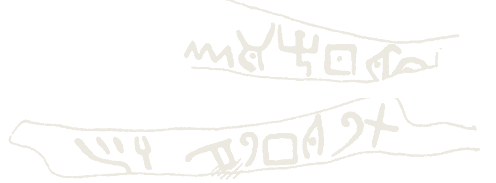
The Egyptian models are scholars’ proposals for a handful of letters. The core idea, a picture for its first sound, is widely accepted. The early-alphabet signs, drawn in a thin line, are copied from the Wadi el-Hol inscription in Egypt (drawings by INFIYNJTE, CC BY-SA 4.0).
3 · Where ʾālep went
One sign, dozens of scripts
Each script appears at the approximate date of its emergence or earliest evidence, with its first letter or the sign that stands in for it. Red: the road to the letter A. Blue: the Aramaic branch. Green: the Indian branch.
The Phoenicians spread the alphabet to ports around the Mediterranean. The Greeks added vowels. Aramaic, the chancery language of Near Eastern empires, carried it east.
The Etruscan alphabet adapted Greek letters and became the basis of the Latin one. Later, Gothic and Coptic also grew from Greek, which also took a few signs from Egyptian Demotic. From Aramaic came square Hebrew, Syriac and Nabataean, the parent of Arabic.
Towards India, Brahmi appears in the inscriptions of the emperor Ashoka. Many scholars see an Aramaic or Semitic model; others think it was created locally. Dotted lines mark links of this kind.
Missionaries, merchants and chanceries carried the signs further: Glagolitic and then Cyrillic for the Slavic languages, Tibetan from a North Indian model, Arabic with Islam. ʾĀlep is now alef, alif, alpha and az.
Traditional Mongolian script runs from top to bottom, with letters taken from the Uyghurs, who had them from the Sogdians, who had them from the Arameans. The same sign now stands upright.
On the Greek and Semitic branches the sign shown really descends from ʾālep. On the Indian branch it is the letter for a or the vowel carrier; its link to ʾālep is uncertain.
4 · Six ways to write
What a sign stands for
Every script does the same job: it ties signs to language. What differs is what one sign stands for.
In Chinese, a character usually stands for a syllable and often a meaning; many words take two characters or more. In a syllabary, like Cherokee, nearly every sign stands for a syllable.
Arabic and Hebrew use some letters to show vowels too, but usually leave out the marks for short vowels. In Devanagari and its relatives a consonant letter normally has a default vowel, a; marks attached to it change or cancel it.
The Greek alphabet gave vowels letters of their own. Hangeul, the Korean script, goes further: five basic consonant letters are modelled on the speech organs that make them, and letters stack into syllable blocks.
5 · Scripts with an author
Some scripts have a year and a name
Most scripts changed slowly, over centuries. A few were created by one person or a small group, sometimes within a few years.
1443
In 1443 King Sejong devised a script of 28 letters for Korean, officially published in 1446, so that people without schooling could read. The elite went on writing in Chinese characters for centuries.
1821
Sequoyah could not read in any language. He saw that people could send messages in writing and spent years on a syllabary for Cherokee, finished in 1821. Within a few years thousands of Cherokee had learned to read. Some signs look like Latin letters but carry other values: ᏣᎳᎩ looks like ‘GWY’ and reads tsa-la-gi.
1833–1959
In Liberia, Momolu Duwalu Bukele and others created the Vai syllabary around 1833. In Canada the missionary James Evans printed a hymnbook in Cree syllabics in 1841, made with Cree speakers; Cree tradition credits its own elders. Solomana Kanté presented the N’Ko alphabet in 1949, and Shong Lue Yang, a farmer who could not read, the Pahawh Hmong script in 1959.
1989
Around 1989–1990 the brothers Ibrahima and Abdoulaye Barry, then 14 and 10, began creating an alphabet for the Fula language in Guinea. Adlam is now in Unicode and can be typed on phones that support it.
6 · What cannot be read
Some scripts stay silent
Deciphering the signs and understanding the language are two different things. Sometimes both are missing.
Linear B, from Crete and mainland Greece, was deciphered in 1952 by Michael Ventris: it was Greek. The older Linear A uses many of the same signs, but the language behind them remains unknown.
The Meroitic signs, from Sudan, were deciphered in 1911 by Francis Llewellyn Griffith, but the language is only partly understood. The Indus Valley signs and the rongorongo tablets of Easter Island are not in Unicode and have not been deciphered; the line shows photographs of the objects: a unicorn seal (Metropolitan Museum of Art, CC0) and the Aruku Kurenga tablet (Trocadéro Museum photograph, Wikimedia Commons, CC BY-SA 3.0, cropped, greyscale).
For the Indus signs it is not even known whether they record a language. In 2022 François Desset and colleagues published a proposed decipherment of Linear Elamite; it remains disputed.
7 · At home
The letters English lost
Old English used Latin letters plus a few of its own: þ (thorn) and ð (eth) for th, ƿ (wynn) for w, and æ (ash) for a vowel like the one in ‘cat’. Its form of g later gave Middle English ȝ (yogh), for sounds now spelled gh or y.
By the end of the Middle Ages most had gone. In late manuscripts thorn could look like y, and printers sometimes used y for it, which is why the ‘ye’ in ‘ye olde’ was read ‘the’. Romanian made a bigger change: it was written in Cyrillic until Latin letters were officially adopted in 1860–62.
8 · All of them
All 175 scripts in Unicode 18.0
Each sign below is the first letter or usual sign of a script, sized by how many people read the languages written in it. Unicode sorts scripts into three groups by how safely they can be used in web addresses and file names. Excluded ones, mostly historic, are outlined. Tap any of them.
- 28recommended: the scripts of major languages
- 35limited use, by smaller living communities
- 111excluded: mostly historic, plus some new or little-used ones
- 6added since 2024, still without a free font; shown by their code
In red: 129 of the 175 scripts descend from the early alphabet (37 certainly, 92 in the majority view, mostly the Indian family). They cover about 77% of estimated readers. The rest are separate inventions: Chinese and its offshoots, cuneiform, hieroglyphs, scripts created from scratch.
No script matches that search.
Estimated readership by script
The estimate adds up, country by country, the literate speakers of each language, using Unicode CLDR 49 data. A person can count towards more than one script. Japanese contributes to both the Han and the kana totals.
9 · Your letter
Where every letter comes from
Pick a letter, your initial for example, to see its earlier forms and related letters in other alphabets.
What remains
An ox’s head is the proposed model for the sign that became Greek alpha and Latin A. On the way the sign turned over, grew round and stood upright, and its sound changed several times. For some branches of the tree the relationship between the letters remains uncertain. The idea stayed the same: one small sign for one sound.
The list is not closed. Unicode has added 14 scripts since 2024 alone. Some have been dead for thousands of years; others were created in recent decades and are in use today.
Sources and method
- Unicode Consortium, Unicode 18.0, Scripts.txt: the list of 175 scripts and the number of characters in each.
- Unicode CLDR 49: scriptMetadata (sample sign, place of origin, classification under UAX #31) and supplementalData (population, languages and literacy by country). Of the 175 scripts, CLDR 49 lists 28 as recommended for identifiers, 35 as limited use and 111 as excluded; Braille falls outside these groups.
- The Noto fonts (Google, SIL OFL 1.1), shaped with HarfBuzz. Free fonts for new scripts without a released Noto font: Kanchenjunga and Kedebideri (SIL, OFL), LXGW Seal (OFL), Alari Xuwasun Jurchen (OFL), plus Noto Sans Gurung Khema and Noto Serif Ol Onal (OFL, released on GitHub). For 6 scripts no verified free font exists yet, so they appear by their ISO code.
- Peter T. Daniels and William Bright (eds), The World’s Writing Systems, Oxford University Press, 1996.
- Stephen D. Houston (ed.), The First Writing: Script Invention as History and Process, Cambridge University Press, 2004.
- Orly Goldwasser, ‘How the Alphabet Was Born from Hieroglyphs’, Biblical Archaeology Review 36:2, 2010.
- Richard Salomon, Indian Epigraphy, Oxford University Press, 1998 (origin of Brahmi).
- Sam van Schaik, ‘A New Look at the Tibetan Invention of Writing’, 2011.
- The branch classification (‘descendants of the ox’) is the page’s own, following Daniels and Bright and the chapters of the Unicode Standard; the Indian family is marked ‘likely’, following Salomon.
- Images: Sinai 345, drawing by Alan H. Gardiner (1916, public domain); the Wadi el-Hol signs, drawings by INFIYNJTE (Wikimedia Commons, CC BY-SA 4.0, converted to outlines); the Dresden Codex, plate from Sylvanus Morley, An Introduction to the Study of the Maya Hieroglyphs (1915, public domain); Indus Valley seal, Metropolitan Museum of Art (CC0); the rongorongo tablet Aruku Kurenga, Trocadéro Museum photograph (Wikimedia Commons, CC BY-SA 3.0, cropped, greyscale). All cropped and resized.
- Rilly and de Voogt, The Meroitic Language and Writing System, Cambridge University Press, 2012.
- François Desset et al., ‘The Decipherment of Linear Elamite Writing’, Zeitschrift für Assyriologie 112, 2022.