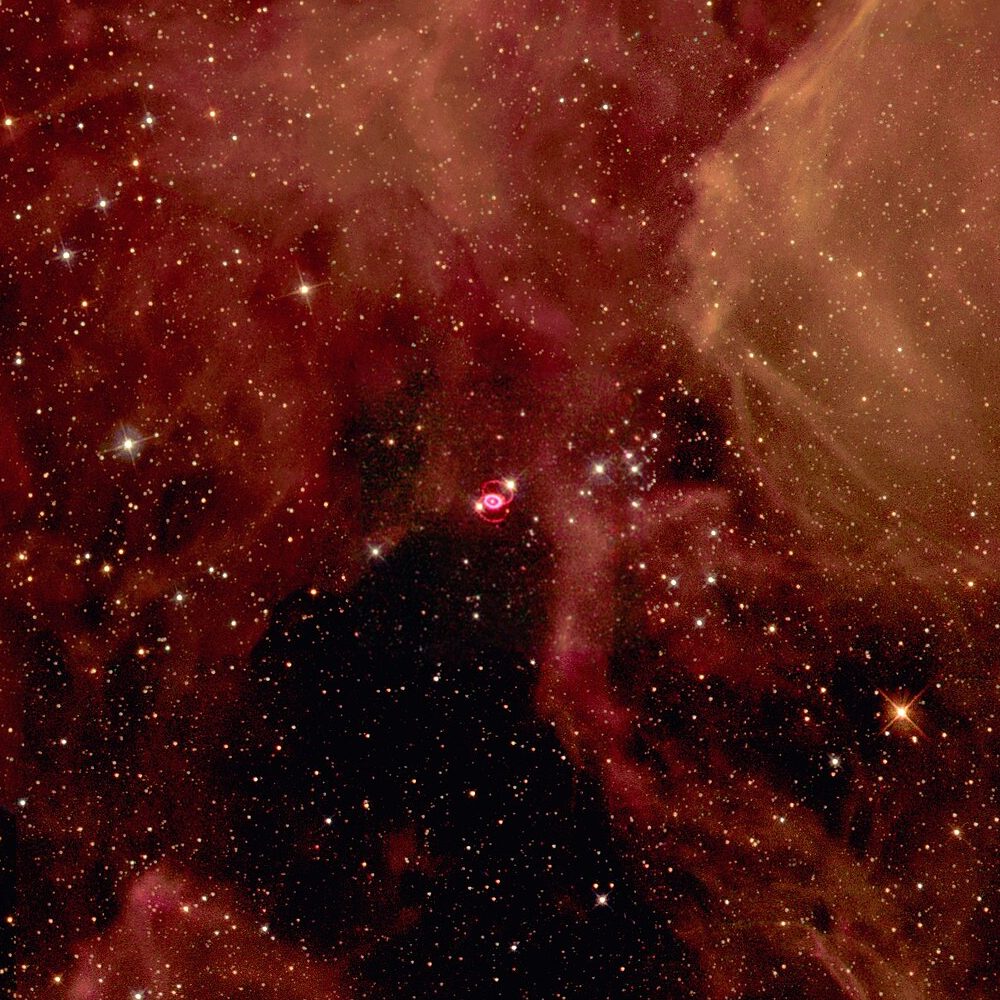
Supernova 1987A
Twenty-four neutrinos
On 23 February 1987, a few minutes after 07:35 in the morning (GMT), three detectors in Japan, the United States and Russia recorded a burst of neutrinos. It lasted 13 seconds. About three hours later, the light of a star that had exploded in a neighbouring galaxy reached the Earth.
The star
The star was called Sanduleak −69° 202, a blue supergiant in the Large Magellanic Cloud, a small galaxy that orbits our own. At birth it had about 20 times the mass of the Sun.
A star that heavy burns through its fuel in stages, each faster than the last. In a computer model of a slightly lighter star, 15 times the mass of the Sun, burning hydrogen takes 11 million years. Silicon, the last fuel, lasts 18 days.
How long each fuel lasts in a model star of 15 solar masses (logarithmic scale)
The collapse
Silicon burns into iron, and iron cannot be burned for energy. When the iron core grows too heavy to hold itself up, it collapses in a fraction of a second into a ball of neutrons about the size of a city.
Almost all the energy of that collapse, about 3 × 1046 joules on the usual estimate, leaves as neutrinos: around 1058 of them. Neutrinos barely interact with anything, so they fly straight out through the rest of the star. The light is trapped behind for hours, until the shock wave breaks through the surface.
160,000 years
The Large Magellanic Cloud is about 161,700 light-years away, by the most precise measurement (2019). Neutrinos travel at almost the speed of light. They crossed the space between the galaxies for about 160,000 years.
By the time they reached the Earth they had spread over a sphere so large that about 30 billion passed through every square centimetre of every person on Earth that day, if the usual estimate of 1058 is right. Almost all of them went straight through the planet as well.
Thirteen seconds
Three detectors happened to be running: Kamiokande-II, a tank of 3,000 tonnes of water in a zinc mine in Japan; IMB, 8,000 tonnes of water in a salt mine under Lake Erie; and Baksan, a scintillator under a mountain in the Caucasus. Each dot below is one recorded event, placed in time as the detector recorded it, sized by its energy.
Press play. The replay runs at real speed.
The three clocks were not equally good. IMB's was right to 50 thousandths of a second; Kamiokande-II's only to about a minute, and Baksan's had jumped 54 seconds between checks. So each detector's clock starts here at its own first event. Their absolute times, 07:35:35, 07:35:41 and 07:36:12 UT, cannot show who saw the burst first. One Kamiokande-II event (6.3 MeV, drawn faint) is often counted as background, which is why the total is given as 24 or 25.
Every event as a table
| Detector | Seconds after its first event | Energy (MeV) |
|---|---|---|
| Kamiokande-II | 0.000 | 20.0 |
| Kamiokande-II | 0.107 | 13.5 |
| Kamiokande-II | 0.303 | 7.5 |
| Kamiokande-II | 0.324 | 9.2 |
| Kamiokande-II | 0.507 | 12.8 |
| Kamiokande-II * | 0.686 | 6.3 |
| Kamiokande-II | 1.541 | 35.4 |
| Kamiokande-II | 1.728 | 21.0 |
| Kamiokande-II | 1.915 | 19.8 |
| Kamiokande-II | 9.219 | 8.6 |
| Kamiokande-II | 10.433 | 13.0 |
| Kamiokande-II | 12.439 | 8.9 |
| IMB | 0.000 | 38.0 |
| IMB | 0.412 | 37.0 |
| IMB | 0.650 | 28.0 |
| IMB | 1.141 | 39.0 |
| IMB | 1.562 | 36.0 |
| IMB | 2.684 | 36.0 |
| IMB | 5.010 | 19.0 |
| IMB | 5.582 | 22.0 |
| Baksan | 0.000 | 12.0 |
| Baksan | 0.435 | 18.0 |
| Baksan | 1.710 | 23.3 |
| Baksan | 7.687 | 17.0 |
| Baksan | 9.099 | 20.1 |
Three hours later
- 07:35 UTThe neutrinos arrive. Nobody knows: the detectors' records are searched only after news of the supernova spreads.
- about 09:30 UTIn New Zealand, the amateur astronomer Albert Jones looks at that part of the sky and sees nothing unusual.
- 10:39 UTRobert McNaught's photographic plates in Australia show the star already brightening, though they are not examined until after the discovery.
- 24 FebruaryIan Shelton notices the new star on a plate at Las Campanas in Chile; Óscar Duhalde had seen it by eye there the same night. It is the brightest supernova seen from Earth since 1604.
Also recorded: five events at the Mont Blanc detector 4.7 hours earlier. They have no match in the other detectors and most physicists do not count them as part of the burst.
What is left
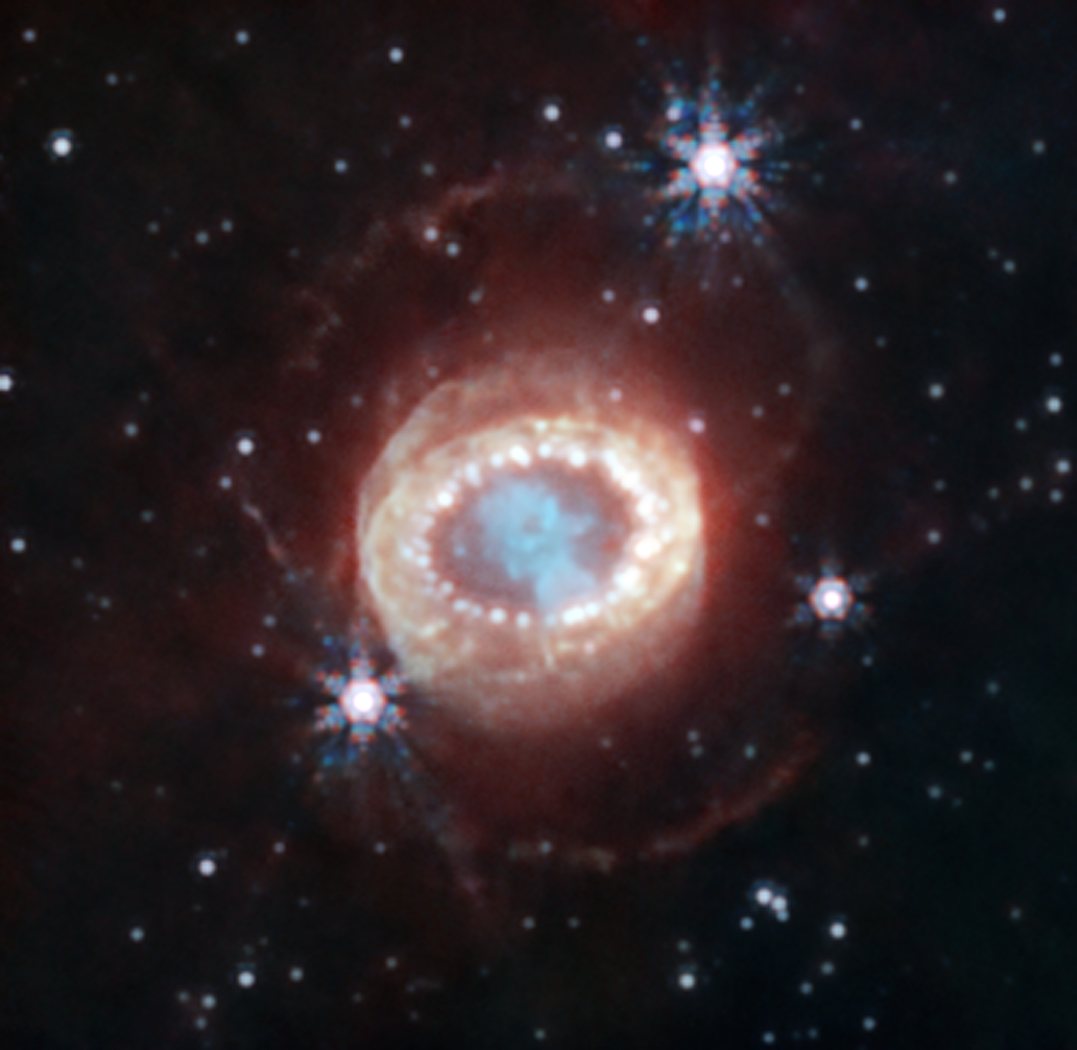
The James Webb Space Telescope photographed the remains in 2023: the ring is gas the star shed thousands of years before it died, lit up when the blast hit it. At the centre, in 2024, astronomers reported light that points to a neutron star left by the collapse, though the star itself has not been seen.
Sources
Every event on this page is from these. The positions of the dots inside each detector are illustrative: the detectors recorded where each event was, but the replay draws them at random places.
- D. F. G. Fiorillo et al., Supernova simulations confront SN 1987A neutrinos, Physical Review D 108, 083040 (2023), tables II–IV: every event's time and energy, the first-event clock times and their uncertainties; McNaught's plates at 10:39 UT.
- K. Hirata et al. (Kamiokande-II), Observation of a neutrino burst from the supernova SN1987A, Physical Review Letters 58, 1490 (1987): 12 events; about 1058 neutrinos and 3 × 1046 joules expected.
- R. M. Bionta et al. (IMB), Observation of a neutrino burst in coincidence with supernova 1987A, Physical Review Letters 58, 1494 (1987).
- G. Raffelt, review of the SN 1987A neutrino signal: the five Mont Blanc events 4.7 hours earlier had no counterpart in the other detectors.
- O. R. Pols, Stellar structure and evolution, table 12.1, after S. E. Woosley, A. Heger and T. A. Weaver, Reviews of Modern Physics 74, 1015 (2002): burning stages of a 15-solar-mass model.
- ESO conference proceedings, SN 1987A and other supernovae: Sanduleak −69° 202, a blue supergiant of 20 ± 4 solar masses at birth.
- G. Pietrzyński et al., A distance to the Large Magellanic Cloud that is precise to one per cent, Nature 567, 200 (2019): 49.59 kpc (about 161,700 light-years). N. Panagia: 51.4 kpc from the geometry of the ring around the supernova.
- University of Oregon, SN 1987A timeline: Albert Jones looked at the region around 09:30 UT on 23 February and saw nothing unusual.
- C. Fransson et al., Emission lines due to ionizing radiation from a compact object in the remnant of Supernova 1987A, Science 383, 898 (2024).
- Images: SN 1987A in the Large Magellanic Cloud, Hubble Heritage Team (AURA/STScI/NASA/ESA), public domain. Supernova 1987A, James Webb Space Telescope NIRCam, NASA, ESA, CSA, M. Matsuura, R. Arendt, C. Fransson, J. Larsson; processing A. Pagan (STScI), public domain.