La Craiu, Fânațele Clujului · Cluj‑Napoca, Romania
One square metre
On 14 July 2009, botanists laid a square on a hay meadow above Cluj-Napoca and wrote down every plant species growing in it. This is what they found, drawn plant by plant.
Scroll to zoom in from the hills to the plot.
La Craiu, Fânațele Clujului · Cluj‑Napoca, Romania
The meadow in your month
Pick a month. Plants likely to be in flower come into colour and the others fade. The flowering months are a rough guide from where and when people recorded each plant, not a measurement from this plot.
Find it in 30 seconds
A plant name and its picture appear. Click or tap that plant in the meadow. How many can you find in 30 seconds?
Who holds the records
This chart is the table from a 2012 paper that collected the highest plant counts ever found at each size of area. In that table, every record up to 49 m² comes from a temperate grassland, and rain forest takes over from 100 m².
So the picture is more complicated than a single record. In 2012, Transylvania held the records at 0.1 m² and at 10 m². Since then, a Swiss collection of plots sampled between 1884 and 1931 has shown 47 species on 0.09 m², and a team working in the same Transylvanian grassland complex reported 115 species on 10 m² in 2021, on ground that had become a sheep pasture. This square metre, with 79, is not a record: the highest count we found for 1 m² is Argentina's 89.
What is measured, and what is drawn
Everything about which plants grew here comes from one table in a published paper. Everything about how they look is a picture.
Measured by the botanists
- The 79 vascular plants that grew in this square metre, and the 43, 17, 6 and 2 that grew in the smaller squares nested in one corner. The counts match the paper exactly. Three mosses also grew in the square; they are counted by the paper but not drawn here.
- The smallest of those squares in which each plant was found, and the cover of each species in the surrounding 10 m² (from 0.3 % to 15 %).
- The place (46.840° N, 23.656° E, 549 m), the date (14 July 2009), and the grassland type: the plant community Festuco sulcatae-Brachypodietum pinnati, a long-mown meadow.
Drawn, not measured
- Where each plant stands. The paper gives no positions inside the square. The positions follow one rule: a plant is never drawn inside a smaller square in which its species was not found.
- How many plants of each species are drawn: from 1 to 14, in proportion to its cover class in the 10 m². This is a picture of the ratio, not a count of stems.
- Plant heights: typical heights from German Wikipedia for 47 species; for the other 32 a default of 40 cm (herbs) or 60 cm (grasses and sedges). They are drawn at 36 % of that height so that a square metre fits on a screen.
- The month of flowering. The botanists visited once. Each flowering window is taken from the months in which people recorded the species in Romania and nearby countries (GBIF, herbarium sheets and observations), keeping the months with at least 40 % of the peak month's records. It is a rough guide, not tested against a flora.
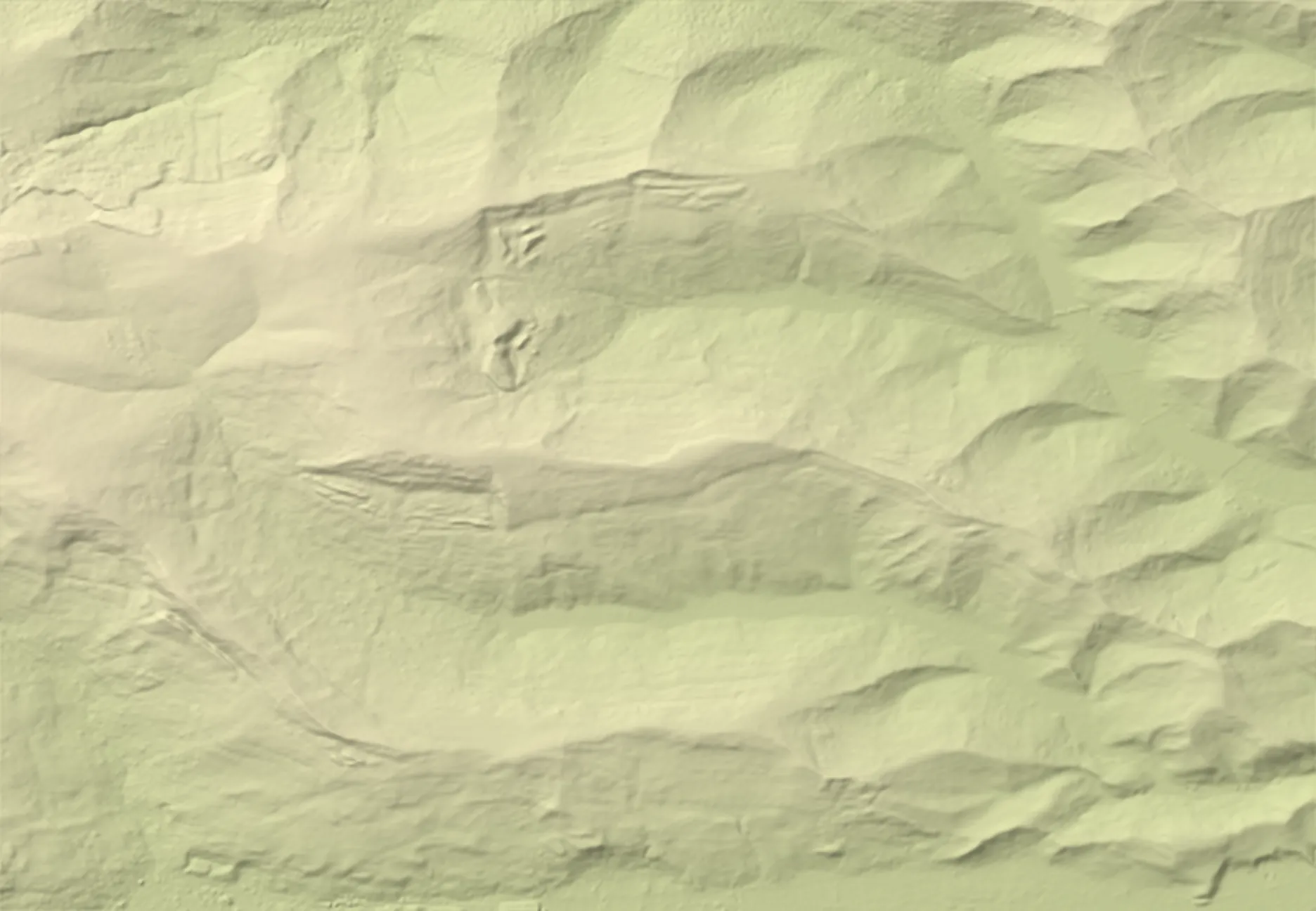
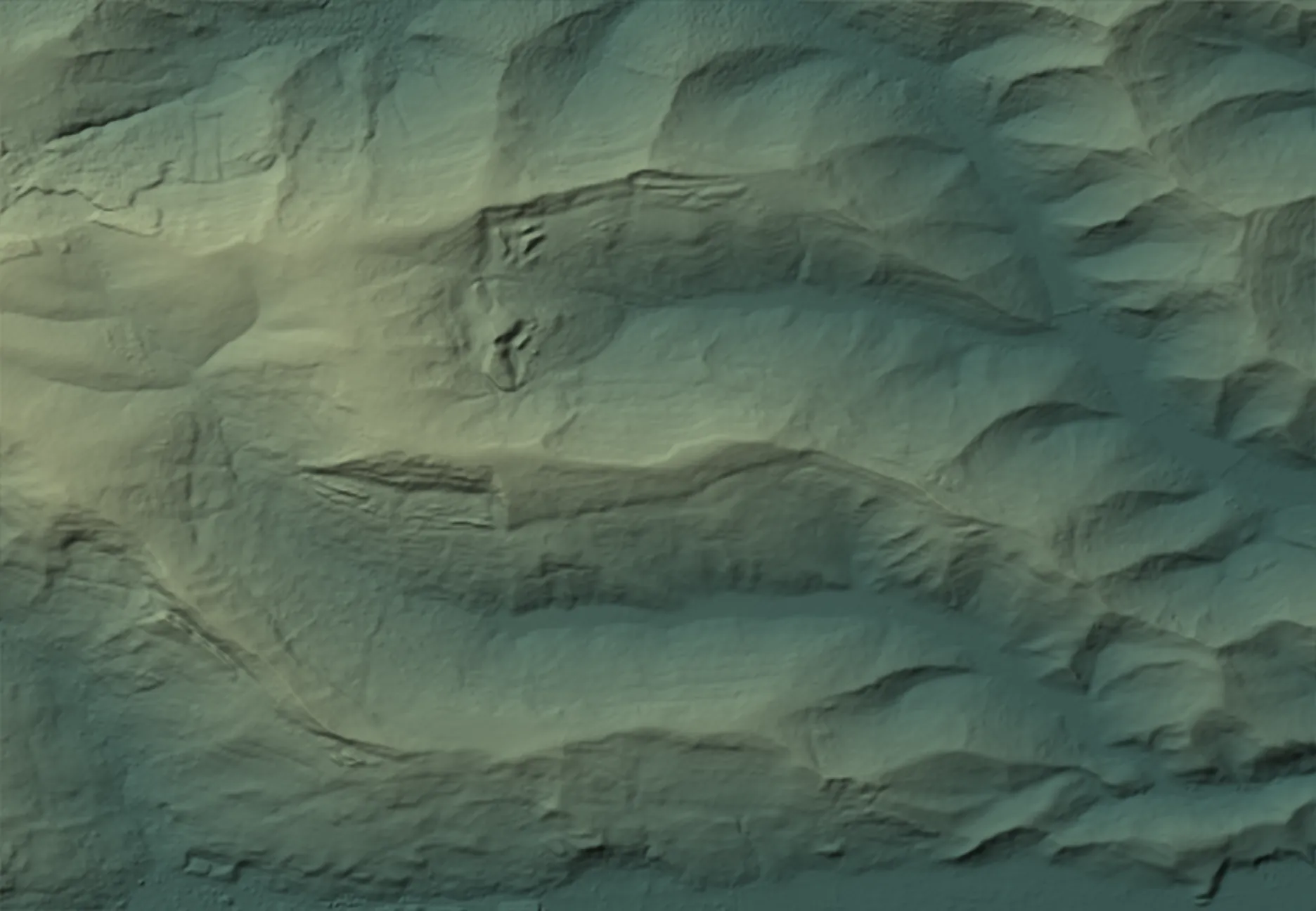
- The plants. 39 of the 79 species are cut from open-licence botanical plates: 7 from Lindman's Bilder ur Nordens Flora, 14 from Thomé's Flora von Deutschland, Österreich und der Schweiz (1885), 11 from Sturm's Deutschlands Flora in Abbildungen, 7 from other historical floras. They show the same species, not these individuals. 40 species had no open plate we could use; they are drawn as grey pencil sketches and marked so. The grass, sky and hills are decoration; the hills are a shaded relief from the Copernicus 30 m terrain model.
The test we wrote down first
Before building anything, we wrote down what had to be true: the record counts had to be found in the papers, and the species list of one plot had to reproduce the published counts. Both held: the list gives 43 species at 0.1 m² and 79 at 1 m², exactly as published.
At 10 m² our reading of the table gives 99, and the paper says 98. The table has taxa recorded only to genus or with a doubt, and the paper's rules for joining them are not spelled out. The page uses the paper's published count of 98 species, although our reading gives 99. We also wrote that the plot would show one square metre where a record is held, and it does not: the 1 m² record belongs to Argentina.
The flowering months were checked in part. We planned to compare them with published floras; German Wikipedia gave a readable flowering window for 53 of the 79 species. For 43 of those 53 (81 %) the record-based window overlaps it and has its centre within a month, which meets the 70 % we set beforehand. The other 26 species could not be checked, so the months stay a rough guide.
We also aimed for an open plate for at least 60 of the 79 species. We reached 39: some species have no usable open plate, and some plates could not be cut out cleanly, so they are drawn as sketches instead. The target was missed.
The 79 plants
Every vascular plant found in the square metre. Smallest square: the smallest nested square in which the species was found. Cover: its cover class in the surrounding 10 m².
| Plant | Smallest square | Cover | Flowering |
|---|
Sources
- Dengler, J. and coauthors (2012): Diversity of dry grasslands in Transylvania (Romania). Tuexenia 32: 319–359. Table 8: nested-plot series RO01 and RO02; plot header table. Plot RO01 NW, 14 July 2009.
- Wilson, J. B., Peet, R. K., Dengler, J. and Pärtel, M. (2012): Plant species richness: the world records. Journal of Vegetation Science 23: 796–802. Table 1.
- Roleček, J. and coauthors (2021): New world record of plant species richness in 10 m² plots. Tuexenia 41: 459–466 (115 and 110 species).
- Riedel, L. and coauthors (2023): The Historic Square Foot Dataset. Journal of Vegetation Science (doi 10.1111/jvs.13208): 47 species on 0.09 m².
- Terrain: Copernicus DEM GLO-30 (ESA, 2021), shaded for this page. Flowering months: GBIF.org occurrence counts for Romania, Hungary, Bulgaria, Serbia, Slovakia, Ukraine, Moldova, Austria, Czechia and Croatia, retrieved 14 November 2026.
- Plant names and Romanian common names: see the list below. Plates: licences and authors in the table of plates.
Plates and licences
Each plate is public domain or openly licensed on Wikimedia Commons; the cut-out is ours.
| Species | File | Author | Licence |
|---|---|---|---|
| Adonis vernalis | Illustration Adonis vernalis0 clean.jpg | User:Kilom691 | Public domain |
| Anthoxanthum odoratum | Illustration Anthoxanthum odoratum clean.jpg | Illustration_Anthoxanthum_odoratum0.jpg: Prof. Dr. Otto Wilhelm Thomé derivative work: Aroche (talk) | Public domain |
| Briza media | Illustration Briza media0 clean.png | unknown | Public domain |
| Campanula persicifolia | 561 Campanula persicifolia.jpg | Carl Axel Magnus Lindman | Public domain |
| Carlina vulgaris | 5 Carlina vulgaris.jpg | Carl Axel Magnus Lindman | Public domain |
| Caucalis platycarpos | Illustration Caucalis platycarpos cleaned more.jpg | unknown | Public domain |
| Cerinthe minor | Cerinthe minor Sturm11 cleaned.jpg | File:Cerinthe minor Sturm11.jpg: Johann Georg Sturm (Painter: Jacob Sturm) derivative work: Kenraiz | Public domain |
| Clematis recta | Clematis recta Sturm40 cleaned.jpg | File:Clematis recta Sturm40.jpg: Johann Georg Sturm (Painter: Jacob Sturm) derivative work: Kenraiz | Public domain |
| Convolvulus arvensis | 104 Convolvulus arvensis.jpg | Carl Axel Magnus Lindman | Public domain |
| Coronilla varia | Coronilla varia — Flora Batava — Volume v2.jpg | Jan Kops | Public domain |
| Dactylis glomerata subsp. glomerata | Illustration Dactylis glomerata0 clean.jpg | Prof. Dr. Otto Wilhelm Thomé | Public domain |
| Festuca pratensis | 442 Festuca pratensis.jpg | Carl Axel Magnus Lindman | Public domain |
| Filipendula vulgaris | Filipendula vulgaris Sturm134.jpg | Johann Georg Sturm (Painter: Jacob Sturm) | Public domain |
| Hieracium praealtum subsp. bauhinii | Hieracium praealtum Sturm59.jpg | Johann Georg Sturm (Painter: Jacob Sturm) | Public domain |
| Knautia arvensis | Illustration Knautia arvensis0 cleaned no-description.jpg | Otto Wilhelm Thomé | Public domain |
| Lepidium campestre | Lepidium campestre — Flora Batava — Volume v9.jpg | Jan Kops | Public domain |
| Leucanthemum vulgare | Leucanthemum vulgare Sturm13050.jpg | Johann Georg Sturm (Painter: Jacob Sturm) | Public domain |
| Lotus corniculatus | Illustration Lotus corniculatus0.jpg | unknown | Public domain |
| Onobrychis viciifolia | Illustration Onobrychis viciifolia0.jpg | unknown | Public domain |
| Picris hieracioides | Illustration Picris hieracioides0.jpg | unknown | Public domain |
| Plantago lanceolata | Plantago lanceolata (Curtis et al. 1777, Flora Londinensis v2, plate 10, BHL-127331) clean, no-description.jpg | Curtis, William; Darton, William; Edwards, Sydenham; Kilburn, William; Sansom, Francis; Sowerby, James; White, Benjamin; | Public domain |
| Primula veris | Illustration Primula veris0 clean.jpg | Prof. Dr. Otto Wilhelm Thomé | Public domain |
| Ranunculus polyanthemos agg. | Ranunculus polyanthemos Sturm05049.jpg | Johann Georg Sturm (Painter: Jacob Sturm) | Public domain |
| Rhinanthus cf. angustifolius | Illustration Rhinanthus serotinus0.jpg | Otto Wilhelm Thomé | Public domain |
| Rumex acetosa subsp. acetosa | Rumex acetosa (Billeder af nordens flora 1917ff., v2 359, BHL-39907) clean, no-description.jpg | Mentz, August; Ostenfeld, Carl Hansen; | Public domain |
| Salvia pratensis agg. | Illustration Salvia pratensis0.jpg | unknown | Public domain |
| Serratula tinctoria | 9 Serratula tinctoria.jpg | Carl Axel Magnus Lindman | Public domain |
| Seseli annuum subsp. annuum | Seseli annuum Sturm17.jpg | Johann Georg Sturm (Painter: Jacob Sturm) | Public domain |
| Stachys recta | Stachys recta Sturm48.jpg | Johann Georg Sturm (Painter: Jacob Sturm) | Public domain |
| Taraxacum sp. | Illustration Taraxacum officinale0.jpg | unknown | Public domain |
| Teucrium chamaedrys | Teucrium chamaedrys — Flora Batava — Volume v18.jpg | Jan Kops | Public domain |
| Thalictrum aquilegiifolium | Thalictrum aquilegifolium Sturm63.jpg | Johann Georg Sturm (Painter: Jacob Sturm) | Public domain |
| Trifolium montanum | Trifolium montanum - Deutschlands Flora in Abbildungen nach der natur - vol. 4 t. 38.jpg | Jacob Sturm | Public domain |
| Trifolium repens | Illustration Trifolium repens0.jpg | unknown | Public domain |
| Valeriana officinalis | 60 Valeriana officinalis.jpg | Carl Axel Magnus Lindman | Public domain |
| Veronica austriaca subsp. teucrium | Veronica teucrium — Flora Batava — Volume v6.jpg | Jan Kops | Public domain |
| Veronica prostrata subsp. prostrata | Veronica prostrata Sturm41.jpg | Johann Georg Sturm (Painter: Jacob Sturm) | Public domain |
| Viola cf. collina | Viola collina Sturm55.jpg | Johann Georg Sturm (Painter: Jacob Sturm) | Public domain |
| Viola hirta | 225 Viola hirta.jpg | Carl Axel Magnus Lindman | Public domain |


