Paris
gadjo, gadji
n., argot
a guy; a girl
[Romani gadžo, a man who is not Roma]
Le Robert
Paris · Bucharest · Newcastle
In Paris it means a girl, in Bucharest a girlfriend, in Newcastle a bloke. In Romani it meant someone who is not Roma. The word was welcomed. The people who brought it were not.
1 · One word
Romani has a word for everyone who is not Roma: gadžo for a man, gadži for a woman. By the early 20th century it was in the slang of the people it described.
In Bucharest, gagică is the ordinary word for a girlfriend, and gagiu for a boyfriend or a bloke. In French argot, gadjo just means a guy. On Tyneside and in Scotland, gadgie is a man. Each place took the Roma’s word for outsiders and used it for itself.
Paris
gadjo, gadji
n., argot
a guy; a girl
[Romani gadžo, a man who is not Roma]
Le Robert
Bucharest
gagiu, gagică
n., slang
a bloke; a girlfriend
[Romani gaği, a woman who is not Roma]
DEX; in the press by 1905
Newcastle
gadgie
n., dialect
a man
[Romani gadžo, a man who is not Roma]
Green’s Dictionary of Slang; in print by 1937
It is not alone. Below are words from Paris, London, Bucharest and Newcastle, each traced back along the road it took. Most came from Romani and Arabic, carried by slavery, empire, colonial war and migration. Most of the words are now ordinary slang. The people who brought them were enslaved in Wallachia, ordered out of Tudor England by law and given a dictionary label in Paris.
2 · Listen
In Maghrebi Arabic, wāš means “what?”. In French it is hardly ever a question.
A Paris teenager says wesh to say hello, to challenge someone, or as a tag at the end of a sentence; a 2024 study of the word finds all three and only rarely the old question. Le Petit Robert added it in its 2009 edition and dates its first use to 1983, in Algeria. Below are the three uses, with the recording of the word on its own.
People in France talk of a “banlieue accent”, often called Arab. When the linguist Zsuzsanna Fagyal measured it in 2005, a boy born in former Yugoslavia, with no Arabic at all, used the same tune as his friends. Her conclusion: being a Beur (French-born, of North African parents) “matters far less than being an integral part of the French working class in contact with immigrant languages”.
3 · Three lines
Three lines written for this page, of the kind you hear on a bus in Paris, London or Bucharest. Each underlined word opens its dictionary entry and draws its road.
3 · Three lines
Three lines written for this page, of the kind you hear on a bus in Paris, London or Bucharest. Each underlined word opens its dictionary entry and draws its road.
Paris RER D, Châtelet to Saint-Denis
, t’as vu le ? Il m’a mon tel, . Je le … nan, j’ai pas le .
Yo, did you see that guy? He nicked my phone, I swear. I’ll batter him… nah, can’t be bothered.
London Bus 38, Hackney to Victoria
, ’s been waiting time. My says the bouncer called us , .
What’s up, I’ve been waiting ages. My mate says the bouncer called us chavs, I swear.
Bucharest Metro M2, Piața Unirii to Berceni
Bă, ai văzut-o pe lui? E rău. Da’ el e : mi-a și n-am de .
Did you see his girlfriend? Seriously nice. But he’s awful: he nicked my cash and I’m in no mood for a scene.
Colours show which road a word came by. Dates mark records named in the text.
4 · The roads
Some of these words came down from the powerful: from an empire, from an army. Those words are now ordinary speech. Others came up from the enslaved and from migrants. Those words got in too, but the people who brought them were labelled.
4 · The roads
Some of these words came down from the powerful: from an empire, from an army. Those words are now ordinary speech. Others came up from the enslaved and from migrants. Those words got in too, but the people who brought them were labelled.
The long road from India
Roma are first named in Wallachia in a charter of 3 October 1385. Prince Dan I confirms to the monastery of Tismana the gifts his uncle Vladislav I had made to Vodița: land, mills, villages “and Gypsies, 40 households”. They are listed among the monastery’s property. For almost five centuries Roma in Wallachia and Moldavia could be owned, sold and given away by the state, monasteries and boyars.
Romanian took mișto, nasol, gagică, a ciordi and lovele from the language of people who had been enslaved; Graur found them in Bucharest newspapers from the 1890s on. In 1934 he wrote that no one should expect Romanian to have borrowed many Romani words, “because the Gypsies have always been despised”. In the same study he found that the argot of Bucharest’s thieves, street sellers and even schoolboys was made “to a very large extent” of Romani words.
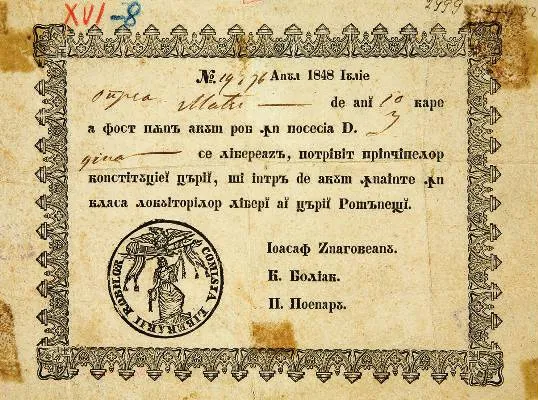
The story people tellThe most shared image of Romanian slavery is a Bucharest poster of 1852 offering 18 men, 10 boys, seven women and three girls for sale. Its central figure reuses an illustration attributed to Théodore Valerio and published in Adriano Colocci’s Gli Zingari in 1889, and the historians Elena Marushiakova and Vesselin Popov call it a counterfeit. The sales themselves are well documented, in charters, deeds and freedom tickets like the one shown here.
The colonial road
France invaded Algeria in 1830. Soldiers brought home the words they had picked up there: the Trésor de la langue française, the main historical dictionary of French, ties toubib, barda and chouïa to soldiers who had served in Africa, and bled to army slang. Smala, the camp of the Algerian resistance leader Abd el-Kader, entered French in a newspaper report of 1843 announcing that it had been taken and its treasure looted. By 1861 smala meant “a big family”.
The newer words come from Maghrebi Arabic, spoken by North African families in France. Wesh is dated to 1983; le seum, from the Arabic word for venom, entered Le Petit Robert in 2018.
The Ottoman road
For centuries Wallachia paid tribute to the Ottoman Empire, and Arabic and Persian words reached Romanian through Ottoman Turkish: chef, mahala, musafir (guest), berechet (plenty), taman (just right), and the Persian bacșiș. One of them, chef, is the same Arabic word as the Paris teenager’s kif: French first printed it in 1670, in a history of the Ottoman Empire, so a Paris teenager who kiffe a song and a Romanian grandmother with no chef for visitors share a word that both languages took from the Ottoman world.
The Atlantic road
In June 1948 the Empire Windrush docked at Tilbury with more than a thousand passengers, most of them from the Caribbean. It was not the first ship to bring Caribbean migrants, but it gave its name to the Windrush generation. They brought Jamaican Creole, which the University of York’s linguists describe as the seed of Multicultural London English forty years later. London also has Romani words (pal, chav, wonga), but its newest slang came mainly from Jamaican Creole.
5 · The panic
In each city the label was for the speakers, not for the words.
Paris
un wesh
in the dictionary
Le Robert online: “a young person from the banlieues”, and parler wesh wesh, “to talk like some banlieue youths”, marked pejorative. Wiktionnaire quotes novels using the noun: “all these wesh jerks” (2008), “the little wesh in a cap” (2016).
London
Jafaican
Evening Standard, 2006
“Fake Jamaican”. The earliest British press use the linguist Paul Kerswill found is from the Evening Standard of 10 April 2006: “Teachers have dubbed the phenomenon Jafaican.” Kerswill describes the dialect as the everyday speech of most working-class young people in inner London, of every background.
Bucharest
manelizare
press, 2010
“Manele-isation”, after manele, a Balkan pop style associated with Roma musicians: a label for cultural decline. The earliest dated use found is a 2010 newspaper headline. A related insult is cocalar, a flashy lout; dictionaries disagree on its origin.
In each case the words went mainstream. The labels were for the speakers.
6 · Fates
Where each word stands today, by what dictionaries and advertisers do with it.
7 · Too Gypsy
mișto
The word got in.
The speaker did not.
1927
The linguist Alexandru Graur records a newspaper seller saying that people hardly use mișto any more, because it is “too Gypsy”.
1934
Graur writes that no one should expect Romanian to have borrowed many Romani words, “because the Gypsies have always been despised”. In the same study he finds Bucharest argot made “to a very large extent” of Romani words.
Today mișto is one of the most ordinary words in spoken Romanian. The question these three cities still argue about is whether the people who brought such words got in too.
8 · Quiz
Ten everyday English words that are not on this page. Guess the language each one came from.
Your score
Sources and method
Every etymology on the page was read in a dictionary or study, cited on each word card: for Romanian, DEX, MDA2 and Ciorănescu’s etymological dictionary via dexonline, and Graur, Les mots tsiganes en roumain (1934); for French, the TLFi (CNRTL), Le Robert, Larousse and Wiktionnaire; for English, Etymonline, Green’s Dictionary of Slang and Wiktionary. Where dictionaries disagree or hedge (chav, baftă, cocalar) the page says so or leaves the word out.
Dates on the map are records named in the text: Roma in northern German towns in 1417, the Wallachian charter of 1385, the Paris chronicle of August 1427, the Scottish treasurer’s payment “to the Egiptianis” on 22 April 1505, the French invasion of Algeria in 1830, the arrival of the Windrush in June 1948. A first record is only the oldest known proof that a word was already in use. The ancestors of today’s Romani speakers probably left India late in the first millennium; on the way, their language took words from Persian (baxt, luck), Armenian and Byzantine Greek (drom, road).
The three lines in chapter 3 were written for this page; they are examples, not recordings. The recordings are from Lingua Libre on Wikimedia Commons. The wesh button plays one recording of the word on its own.
