Romania on the Ionian Sea
According to Romanian Wikipedia, Romania held a territory on Albania’s Ionian coast, across the water from Corfu, between 1934 and 1939. It covered 29.8 square kilometres, fourteen times Monaco, and a king gave it to a historian. The records say something else: a plot of 746 square metres, of which the Romanian state received 373, and a house with arches that Bucharest is still asking to have back.
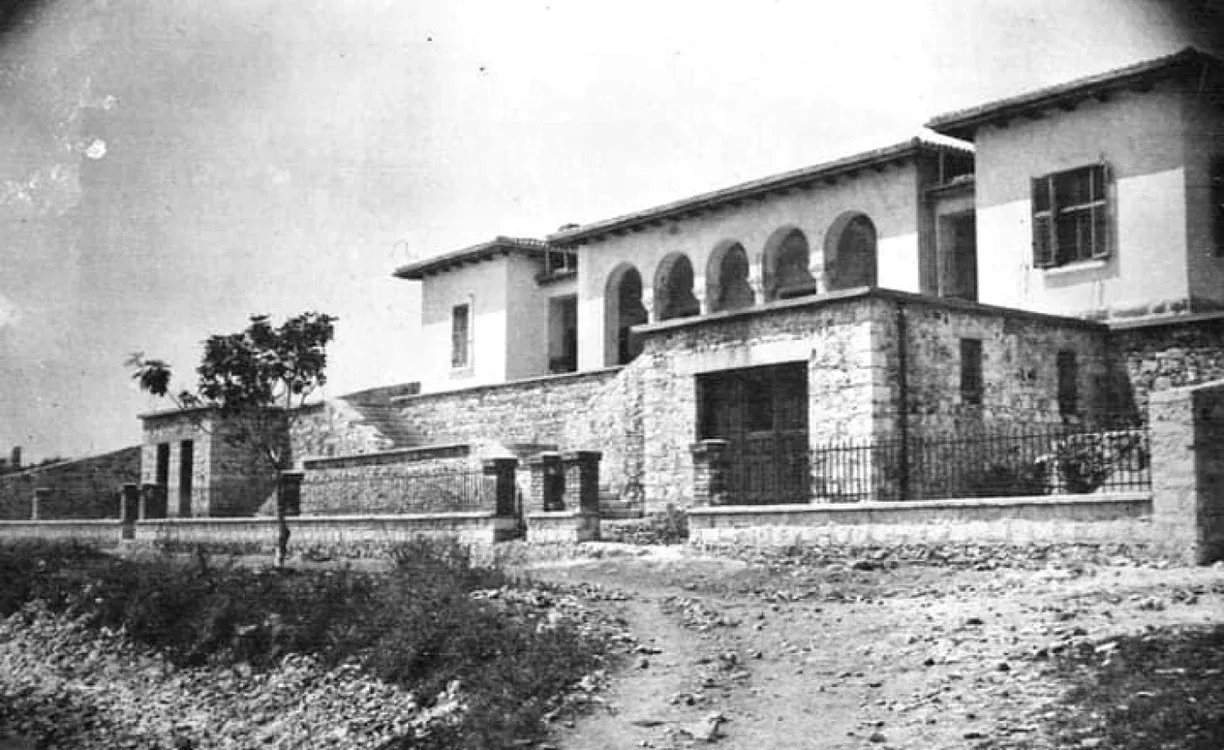
The Romanian Institute at Sarandë, 1930s. The Commons record gives the year 1937. Biblioteca Metropolitană București, via Wikimedia Commons, public domain.
How big it was
The square in the infobox is 5.46 kilometres on a side, a little over an hour’s walk. Somewhere inside it is the real plot.
-
A square of 29.8 km², 5.46 km on a side. The dot in the middle is the 373 m² plot. Monaco, at 2.08 km², is the dotted square. The infobox’s square: 29.8 km². Monaco, at 2.08 km², would fit inside it fourteen times.
On your screen the 373 m² plot is now about one pixel wide. Around it are 79,866 plots like it.
On a phone screen the plot is about one pixel wide. The infobox’s 29.8 km² is 39,933 times the whole 746.25 m² plot.
-
Vatican City, the smallest sovereign state in the world, covers 0.44 km². The dotted square has the same area. The infobox’s square would hold it nearly 68 times. In London terms, 29.8 km² is 2,980 hectares: about 21 times Hyde Park, which covers about 142.
-
A football pitch of 105 × 68 m. The 373 m² square sits at its centre. A football pitch, 105 by 68 metres, covers 7,140 m². Nineteen plots like this fit inside it.
-
The square has an area of 373.125 m²; the tennis court is drawn at the same scale. Here is the plot: 373.125 m², a square 19.3 metres on a side, about 1.4 tennis courts. It is what the Romanian state received on 13 August 1934, half of what Nicolae Iorga held at Sarandë.
In the sources examined, no territory appears. A plot and a house do.
One unsourced line
At 16:35 UTC on 23 August 2019, someone added one row to an English Wikipedia infobox: Area, 29.8 km². The edit summary was about something else. The number came with no source. Four days earlier the page had no area field at all; the word “concession” had been in its text since 2018.
Rebuilt and adapted from the revision of 23 August 2019. Wikipedia text is available under CC BY-SA 4.0; the page history names the authors. The surrounding rows are not reproduced.
A year and three months later, on 27 November 2020, the Romanian-language article received the same number, with a comma for the decimal point. That edit has no summary either.
On 8 February 2021 the English page was moved to “Romanian Institute in Albania”, with the summary “not a concession”, and within an hour the number was gone from it. The Romanian page kept it. Its last revision, of 19 March 2023, still has it when checked on 5 October 2026: almost six years.
Every revision, one by one, is at the end.
A plot for a historian
On 24 April 1932, Vasile Stoica, Romania’s envoy in Albania, telegraphs that Albania’s king and government have offered land at Sarandë, that the papers must be drawn up in the name of Nicolae Iorga, and that a power of attorney is needed to go further.
Iorga was, that day, prime minister of Romania and its most famous historian. In 1919 he had written a short history of Albania, in French.
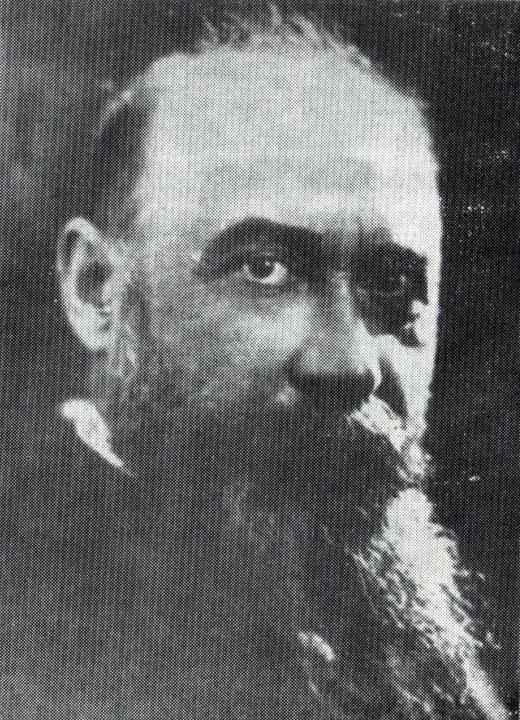
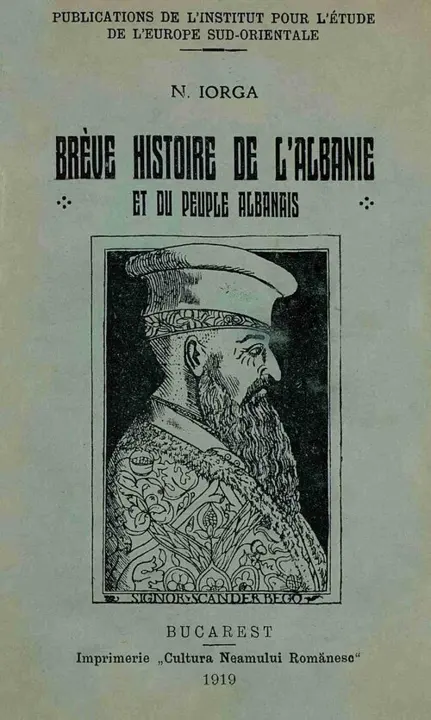
In his memoirs Iorga mentions “a little house on the Adriatic shore”, promised by the Albanians, that might be built “on the place given to me afterwards, at Santi Quaranta, by the nation’s king”. Santi Quaranta was the Italian name of Sarandë. Iorga calls it a little house. The building would be known as Casa Iorga, Iorga House.
The plot, according to the notes of the archaeologist Dumitru Berciu, measured 746.25 m². It was Iorga’s own, not the state’s. On 13 August 1934 he donated half of it to the Romanian state, on condition that an institute be founded there. Half is 373.125 m². The decree accepting the gift is numbered 2279/1934; the authentication number of the deed is printed two ways in the edition, 6006 and 60006.
The foundation stone was laid on 9 November 1936, and from 1 July 1937 construction began in earnest. The project is attributed to the architect Petre Antonescu; his plan, as the edition reports it, called for a building of 727.6 m² (33.30 × 21.85 m). On the ground it came out smaller: the second floor was never built, and the front toward the bay stayed at about two thirds of the plan. The Romanian Institute in Albania was created by decree-law on 25 July 1938; the Romanian Scientific Mission had existed since 13 July 1934.
Seventeen or 680
On 21 September 1937 an Albanian decree-law allowed the Albanian Red Cross to donate to “Professor N. Iorga, Romanian citizen” the land around the plot. How much land? In the transcription of the decree, 17 m². On the archive copy, in pencil, 680 m², and 680 appears in other notes by Berciu. The editors judge the second more plausible. The recipient was Iorga personally, not the state.
The squares have the areas written beside them, at one scale.
How it adds up
| The plot of 1932 | 746.25 |
| + the 1937 addition, as transcribed from the decree | 17 |
| = 746.25 + 17 | 763.25 |
| + the 1937 addition, pencilled on the copy | 680 |
| = 746.25 + 680 | 1,426.25 |
| Total written by Berciu in his notes | 1,424.26 |
| 1,426.25 − 1,424.26 | 1.99 |
Printed figures in the transcription · pencil on the archive copy, according to the editors · arithmetic done here. The original scans have not been seen.
The two figures do not agree, and neither does the total. Nothing that survives says which is the mistake, so they stay side by side.
The documents above come from the edition by Bogdan Tănăsescu and Emil Păunescu of the Romanian foreign ministry’s archive, and from Berciu’s notes; the originals have not been seen.
Spring 1939
On 7 April 1939, Good Friday, Italian troops land in Albania, at four ports. One of them is Santi Quaranta, where Iorga’s house stood.
Prime Minister Neville Chamberlain tells the House of Commons on 13 April: “The occupation of Albania began in the small hours of 7th April.” A photograph dated 15 May 1939 shows the house at Sarandë standing. The town comes to be called Porto Edda, after Mussolini’s eldest daughter.
On 18 April 1940 a Romanian consular report speaks of the “Romanian Institute at Porto Edda (Santi Quaranta)” and notes that the Institute has no Albanian authorisation.
On 1 August 1941 another consular report describes the building: an Italian military hospital, well kept. A decree of 13 May 1943 re-establishes the Institute, on paper.
In autumn 1948 a Romanian diplomatic visit finds Casa Iorga in decay, with a salon and five rooms. A recollection printed in 1991 puts about 20,000 volumes inside; no list from 1948 backs the count. Berciu remembers it differently: in 1942 the Italian army had occupied the house and “all inventory had disappeared”. The two accounts do not fit together, and the sources checked do not say what became of the books.
The house that waits
From 1 to 4 April 2026, a delegation of the Romanian Senate’s Legal Committee visited the house at Sarandë.
According to a Romanian parliamentary question of 2023, a military tribunal in Gjirokastër, a city in southern Albania, nationalised the property in 1944; the decision has not been found. AGERPRES, a Romanian news agency, reports that the property was sold to a private party in 1992.
The Romanian foreign ministry cites a final Albanian court judgment of 9 July 2007 and says, in a reply of 10 October 2023, that its execution is still under discussion. AGERPRES writes that the final judgments of 2007 recognise Romanian state ownership. The judgment’s text, the exact court and the case number have not been found.
In Albania, the chair of the Albanian legal committee, Ulsi Manja, reaffirmed the political will to carry out the judgment and spoke of how complicated the property regime is.
On 11 May 2026 Oana Țoiu, Romania’s interim foreign minister, said she had agreed with her Albanian counterpart, Ferit Hoxha, on “a roadmap” to settle the case “without further delay”. The house, AGERPRES writes, “has waited almost 20 years to be effectively returned”. The report gives no deadlines. Albania’s foreign ministry release on the same meeting does not mention Casa Iorga.
As of 5 October 2026, the public sources checked do not confirm that the property has been registered in the Romanian state’s name or handed over. A lack of confirmation does not prove that nothing has happened. What is disputed is ownership of a house and a plot of land; no act giving Romania sovereignty, jurisdiction or administration at Sarandë appears in the sources examined.
On Romanian Wikipedia, as of 5 October 2026, Romania still has 29.8 km² on the Ionian Sea. In the sources found, it is still waiting for a house.
For anyone checking
How the number spread
- 30 Oct 2018 · 18:18 UTC The English page appears, describing a “territory” and a “concession”. No area. en · 866498772
- 19 Aug 2019 · 07:20 UTC No area field. en · 911496038
- 23 Aug 2019 · 16:35 UTC + 29.8 km² earliest appearance found
Summary: “Expanded infobox; Added Romanian and Albanian versions of title.” en · 912156839 - 26 Nov 2020 · 21:00 UTC The Romanian article “Concesiunea română din Saranda” is created, without an area. ro · 13719299
- 27 Nov 2020 · 07:43 UTC + 29,8 in the infobox, no summary. Eight minutes later the comma becomes a full stop. ro · 13719554
- 8 Feb 2021 · 10:11 UTC The English page is moved from “Romanian concession in Sarandë” to “Romanian Institute in Albania”. Summary: “not a concession”. The revision still has 29.8. en · 1005567059
- 8 Feb 2021 · 11:12 UTC First English revision without the number. Summary: “details.” en · 1005575076
- 21 Mar 2021 · 04:04 UTC Adevărul, a Romanian daily, publishes “Teritoriul românesc de la Marea Ionică. Ce s-a întâmplat cu terenul dăruit lui Nicolae Iorga de Regele Zogu al Albaniei” (“The Romanian territory on the Ionian Sea. What became of the land King Zog of Albania gave Nicolae Iorga”). Today’s version, updated 2 August 2022, has no 29.8 km²; the 2021 text could not be seen. adevarul.ro
- 27 Dec 2021 · 21:08 UTC Last Albanian revision checked; its infobox has 29.8. sq · 2375540
- 19 Mar 2023 · 13:57 UTC Last revision of the Romanian article, seen on 5 October 2026. It has 29.8 and the concession framing. ro · 15607190
On 21 March 2021 Adevărul published an article by Dorin Țimonea about a “Romanian territory” on the Ionian Sea. Today’s version, updated on 2 August 2022, does not contain the figure of 29.8 km². It says Iorga donated half of a plot of almost 1,000 square metres to the state. Wikipedia is not mentioned.
Searches of books, newspapers and web archives found no older text carrying the number. The search is limited, so 23 August 2019 stays the earliest appearance found, not proof that nothing came before.
What is not known
- Where the plot lay: no address, no parcel number, no survey plan.
- How much land Iorga received in 1937: 17 or 680 m².
- The number of the 1934 deed: 6006 or 60006.
- What became of the library of about 20,000 volumes.
- The text of the 2007 judgment and of the 1944 decision: the court, the date, the case number.
- What Adevărul published on the day, in 2021.
- Whether any effective step of restitution was taken after May 2026: no public source confirms one.
For anyone who wants to correct the article
- Romanian Wikipedia
- The last revision, of 19 March 2023, has 29.8 in the infobox and the concession framing. Its opening lines say Romania administered a territory at Sarandë from 13 August 1934 to 7 April 1939. This is the state when checked on 5 October 2026.
- Albanian Wikipedia
- The last revision checked, of 27 December 2021, has 29.8 in the infobox.
- Wikidata
- The item Q97290762 has no area value. Among its unreferenced statements are the type “concession” and an owner and operator, the Kingdom of Romania. State when checked on 5 October 2026.
A text built on sources could say only what they say: a plot offered to Iorga personally in 1932; half of it donated to the Romanian state on 13 August 1934; an institute created in 1938; a house occupied by the Italian army; a property dispute in which Albania and Romania give different accounts. The sources below can be cited; the article itself stays with the people who edit it.
Sources
Wikipedia revisions
- en, 23 August 2019: 912156839; before it: 911496038.
- en, 8 February 2021: the move 1005567059; first revision without the number 1005575076.
- ro: 13719299, 13719554, 15607190. sq: 2375540. Wikidata: Q97290762.
Documents and history
- Bogdan Tănăsescu and Emil Păunescu, Dumitru Berciu și Institutul Român din Albania (2011), and its Albanian translation Dumitru Berçiu dhe Instituti rumun i Shqipërisë (2024): Albanian edition, Romanian edition. The source for the plot, the donation, the decrees, the consular reports and the 1948 visit.
- Romanian Academy, Yearbook of the Institute of Ethnography and Folklore, 2018: the donation of 13 August 1934.
- Nicolae Iorga, O viață de om așa cum a fost, Wikisource transcription.
- House of Commons, 13 April 1939.
- Radio Romania International, 80 years since the assassination of historian Nicolae Iorga.
The legal file and the press
- Question 10761A/2023 and the foreign ministry’s reply; question 5216A.
- Romanian Senate, release of April 2026.
- AGERPRES, 11 May 2026; the foreign ministry’s note on the meeting.
- Adevărul, 21 March 2021 (version updated 2 August 2022), by Dorin Țimonea.
- Reference sizes: IMSEE, Monaco in figures (2.08 km²); Vatican City State (0.44 km²); The Royal Parks (Hyde Park, 350 acres); ITF (tennis court, 23.77 × 10.97 m); UEFA (football pitch, 105 × 68 m).
Images, map, method
Photograph of the house: Biblioteca Metropolitană București, via Wikimedia Commons, public domain. The 1931 portrait and the 1919 title page: public domain, via Wikimedia Commons. Bay map: © OpenStreetMap contributors, ODbL. The infobox and the revision history: Wikipedia, CC BY-SA 4.0, adapted. Searches of the press, books and web archives were run on 5 October 2026 and are limited; a search with no result does not prove that nothing exists. All facts about the archive documents come from a published edition, not from the original scans.