mariuscomper.uk RO

7 December 1995 · the only probe ever sent into a giant planet

58 minutes inside Jupiter

A 337-kilogram probe hit Jupiter’s atmosphere at 170,700 kilometres an hour. It survived, opened a parachute and reported what it found for 58 minutes. Then the planet took it apart.

13 July 1995

Let go, five months out

Galileo, the spacecraft that had carried the probe for almost six years, released it 81.5 million kilometres from Jupiter. The probe had no engine and could not steer. It was set spinning and aimed, and the pull of the Sun and Jupiter did the rest.

It could not call home either. For 147 days the only thing running on board was a timer.

Six hours to go

The timer wakes it

The timer switched the probe on 600,000 kilometres from Jupiter. The batteries came up and the instruments began to warm and calibrate.

It was already moving at 76,700 kilometres an hour, and Jupiter’s gravity kept adding to that.

Three hours to go

Through the radiation belts

At 360,000 kilometres the first instrument started counting the charged particles trapped by Jupiter’s magnetic field, in a region no spacecraft had sampled before.

It found a belt of radiation that nobody knew about, ten times stronger than the belts around the Earth, some 50,000 kilometres above the clouds.

22:04 UTC · 0 s

The first air

Engineers started the clock 450 kilometres above the level where Jupiter’s air presses as hard as the air at sea level on Earth. The probe crossed that line at 170,700 kilometres an hour, about 47 kilometres every second, on a path 8.4 degrees below the horizontal.

That angle had been set five months earlier. A degree and a half shallower and the probe would have skipped back out into space. A degree and a half steeper and it would have burned up.

35 to 80 seconds

Twice as hot as the Sun’s surface

The probe met the thin upper air so fast that the gas ahead of it could not get out of the way. It was squeezed into a glowing layer at about 14,000 °C, roughly twice the temperature of the surface of the Sun.

The heat shield was built to burn away and take the heat with it. In two minutes it went from 152 kilograms to 70. The braking peaked at about 230 times the pull of gravity on Earth.

2 min 52 s

Parachute

The probe had slowed to about 1,600 kilometres an hour, slow enough for a parachute to survive. A small one pulled off the rear cover and dragged out the main canopy. Seconds later what was left of the heat shield dropped away.

It was now 23 kilometres above the sea-level mark, in air at −145 °C. The canopy slowed it to 430 kilometres an hour.

3 min 48 s

A signal goes up

Galileo, passing far overhead, picked up the probe’s radio signal and began to record it on tape. None of it could be sent on to Earth yet. The recording was played back over the following months.

The probe carried six instruments to measure the air around it: temperature and pressure, what the air is made of, cloud, light and lightning. It carried no camera. Nobody has seen what it fell through, and the sky in this scene is drawn, not photographed.

6 min 24 s · 1 bar

Sea level, with nothing under it

Here the pressure is the same as at sea level on Earth. The temperature is −107 °C.

Jupiter has no ground to stand on, so this level is the zero that heights are measured from. Below it the altitude is a negative number.

2 bar · 20 km down

The clouds that were missing

Three thick layers of cloud were expected on the way down: ammonia ice at the top, ammonium hydrosulphide below it, and water at the bottom, the densest of the three. The probe passed through thin haze where the first should have been and a faint layer near the sea-level mark. It never met a thick water cloud.

It had come down at the edge of a hot spot, a clearing where dry air is thought to sink. Clearings like it cover about one percent of Jupiter.

4 bar

A wind that does not die down

The orbiter tracked small shifts in the pitch of the probe’s signal, and from them how fast the wind was carrying it sideways. Below the cloud tops the wind rose quickly to 170 metres a second, about 600 kilometres an hour, and stayed that strong for as long as the probe could be followed.

Wind driven by sunlight should weaken with depth. This one did not, which points to heat from inside the planet as a large part of what drives it.

8 bar

What the air is made of

Almost all of it is hydrogen and helium. Helium came to 24 percent by mass, close to its share in the cloud of gas from which the Sun and the planets formed.

Argon, krypton and xenon were up to three times as plentiful as in the Sun, which no one had predicted. There was far less water than expected, and the lightning detector saw no flash anywhere near.

12 bar · 96 km down

Hotter with every kilometre

At twelve times sea-level pressure the air is at 84 °C. Jupiter is hot inside, and the air warms steadily on the way down.

The light is going too. Jupiter turns once in under ten hours, so the fall was carrying the probe toward the evening side. The flight plan expected twilight about forty minutes in.

61 min 24 s · 22 bar

The last signal

The probe was 146 kilometres below the zero mark. The air was at 153 °C and pressed 22 times as hard as at sea level on Earth, about what a diver would feel 210 metres down in the ocean. The heat reached the radio transmitter, and it failed.

The orbiter had been listening for just under 58 minutes. It turned away and fired its engine to become the first spacecraft in orbit around Jupiter.

About two hours later

What the heat did next

The probe went on falling in silence. No instrument recorded the rest. This is what the mission’s scientists worked out afterwards.

The parachute melted first, then the aluminium fittings. A couple of hours later the aluminium boiled away.

About eight hours later

Titanium

Four hours after that, the probe’s titanium shell had melted. Two hours more and the titanium evaporated as well, at about 1,700 °C and 5,000 times the pressure at the surface of the Earth.

Nothing was left to fall. NASA’s history of the mission says the probe had become “one with the atmosphere of Jupiter”.

How far in it got

At the equator Jupiter measures 71,492 kilometres from its centre to the zero mark. The last signal came from 146 kilometres below that: about one five-hundredth of the way in. At the scale of this picture the whole fall, from the first air to the last signal, is too short to see. The small circle shows it enlarged forty times.

It also fell into an unusual place. In 2020 the Juno spacecraft, measuring from orbit, found almost three times the Sun’s share of water at Jupiter’s equator. The probe seems to have sampled the dry air of a single clearing.
Still the only one

More than thirty years later, the Galileo probe is still the only spacecraft to have gone down through the air of a giant planet and reported what it found.

Every measurement ever taken from inside Jupiter comes from those 58 minutes.

Pass it on

If someone you know would like to fall into Jupiter, send them the page.

Sources and notes

The times, heights, pressures and temperatures are those NASA published for the probe’s entry and descent. Between the rows of that table the readout in the corner follows a smooth curve through them. The cloud bands seen from space are a real map of Jupiter, made from Cassini photographs in December 2000. Everything below the cloud tops is drawn: the probe carried no camera, and the colours of the air inside Jupiter are an informed guess. The melting of the probe after its last signal is what mission scientists worked out; nothing recorded it.

  1. Magalhães, J., Young, R. & Smith, M. (1996). “Galileo Probe Mission Events”. NASA Ames Research Center. Release on 13 July 1995 at 81,520,000 km; the timer; distances and speeds six and three hours before entry; entry at 450 km and 170,700 km/h on a path 8.4° below horizontal; the 1.5° margins; the signal ending 61.4 minutes after entry when heat made the transmitter fail.
  2. Meltzer, M. (2007). Mission to Jupiter: A History of the Galileo Project. NASA SP-2007-4231, chapters 5 and 8. Table 8.1 (times, altitudes, pressures and temperatures from entry to the last signal); gas near the probe at 14,000 °C; the heat shield going from 152 to 70 kg; parachutes at about 1,600 km/h and the slowing to 430 km/h; the missing clouds and the hot spot; helium at 24 percent; argon, krypton and xenon; no lightning nearby; internal heat and the winds; the melting and evaporation of the probe.
  3. NASA Science, “Galileo Jupiter Atmospheric Probe”. Mass of 337 kg, the six instruments, data returned for 58 minutes, peak deceleration of 228 g, the radiation belt about 50,000 km above the clouds.
  4. Atkinson, D. H., Pollack, J. B. & Seiff, A. (1998). “The Galileo probe Doppler wind experiment: Measurement of the deep zonal winds on Jupiter.” Journal of Geophysical Research 103 (E10), 22911–22928. Winds rising to 170 m/s at 4 bar and staying strong to nearly 21 bar; data sent to the orbiter for 57.5 minutes.
  5. NASA NSSDCA, “Galileo Probe Entry Timeline” (twilight expected 42 minutes after entry; the orbiter’s engine burn) and “Jupiter Fact Sheet” (equatorial radius of 71,492 km at the 1-bar level; a day of 9.9 hours).
  6. NASA (2020), “Findings From NASA’s Juno Update Jupiter Water Mystery”, on Li, C. et al., Nature Astronomy 4, 609–616. Water at the equator at almost three times the Sun’s share; the probe’s dry site.
  7. Wong, M. H. et al. (2024). “Multiple probe measurements at Uranus motivated by spatial variability.” Space Science Reviews 220, 15. The Galileo probe as the first and only entry probe to explore a giant planet’s atmosphere.
  8. Map of Jupiter: NASA/JPL/Space Science Institute, PIA07782, from Cassini images taken on 11 and 12 December 2000.
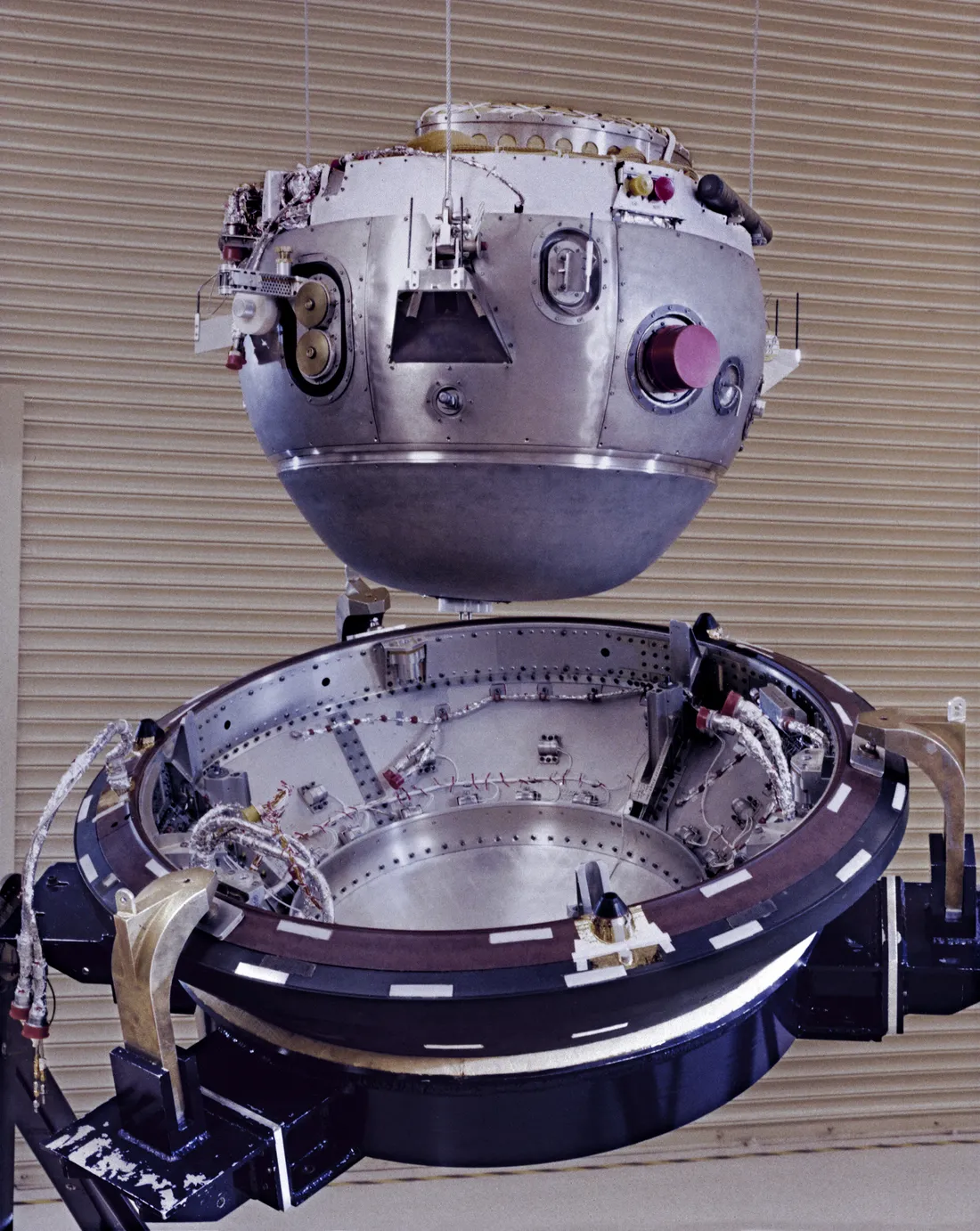
A rounded metal capsule covered in ports and instruments hangs above a wide, shallow bowl lined with wiring.
The descent module (top) above the shell that carried its heat shield, photographed in 1984. The module is the part that fell under the parachute. Photo: NASA Ames Research Center, AC84-0228-05, public domain.