Nubia, southern Egypt
Abu SimbelThe temples that moved
In the 1960s, two temples carved into a cliff were cut apart and rebuilt above the rising waters of Lake Nasser. The hill behind them was built too.
1964 — 1968
How do you move a temple carved into a mountain?
The rock around the temples was removed, the stone was cut into numbered pieces, and a new cliff was built on higher ground.
The Aswan High Dam would turn this stretch of the Nile into a reservoir. Abu Simbel stood in its path. Between 1964 and 1968, engineers moved the two temples to higher ground, preserving the stone façades and the rooms behind them. [3]

13th century BCE
Four faces, one king
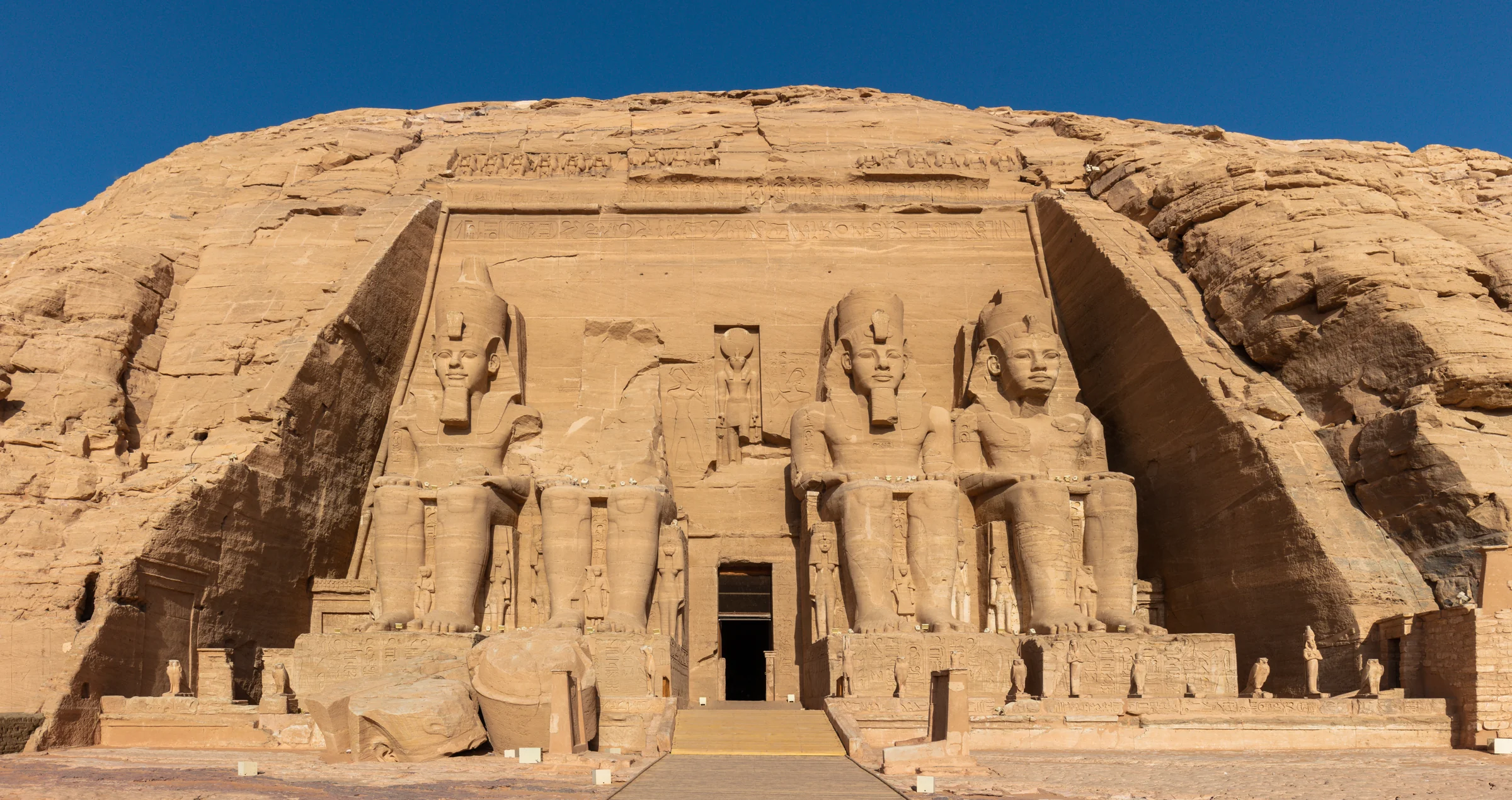
Every seated colossus on this façade represents Ramesses II. At about 20 metres tall, they dwarf the people at their feet. The temple continues deep into the rock behind them.
A second, smaller temple nearby is dedicated to the goddess Hathor and Queen Nefertari. Saving Abu Simbel meant saving both. [2]
1960
The water is coming
The reservoir behind the Aswan High Dam threatened to submerge the temples. Egypt and Sudan requested UNESCO’s help in 1959. An international campaign was launched on 8 March 1960.
The danger was not confined to these statues. Archaeological sites and inhabited Nubian villages lay in the reservoir’s path. [1]
The old site was threatened by the reservoir. The water level here is illustrative. Reservoir shown schematically
1964–1966
The cliff comes apart
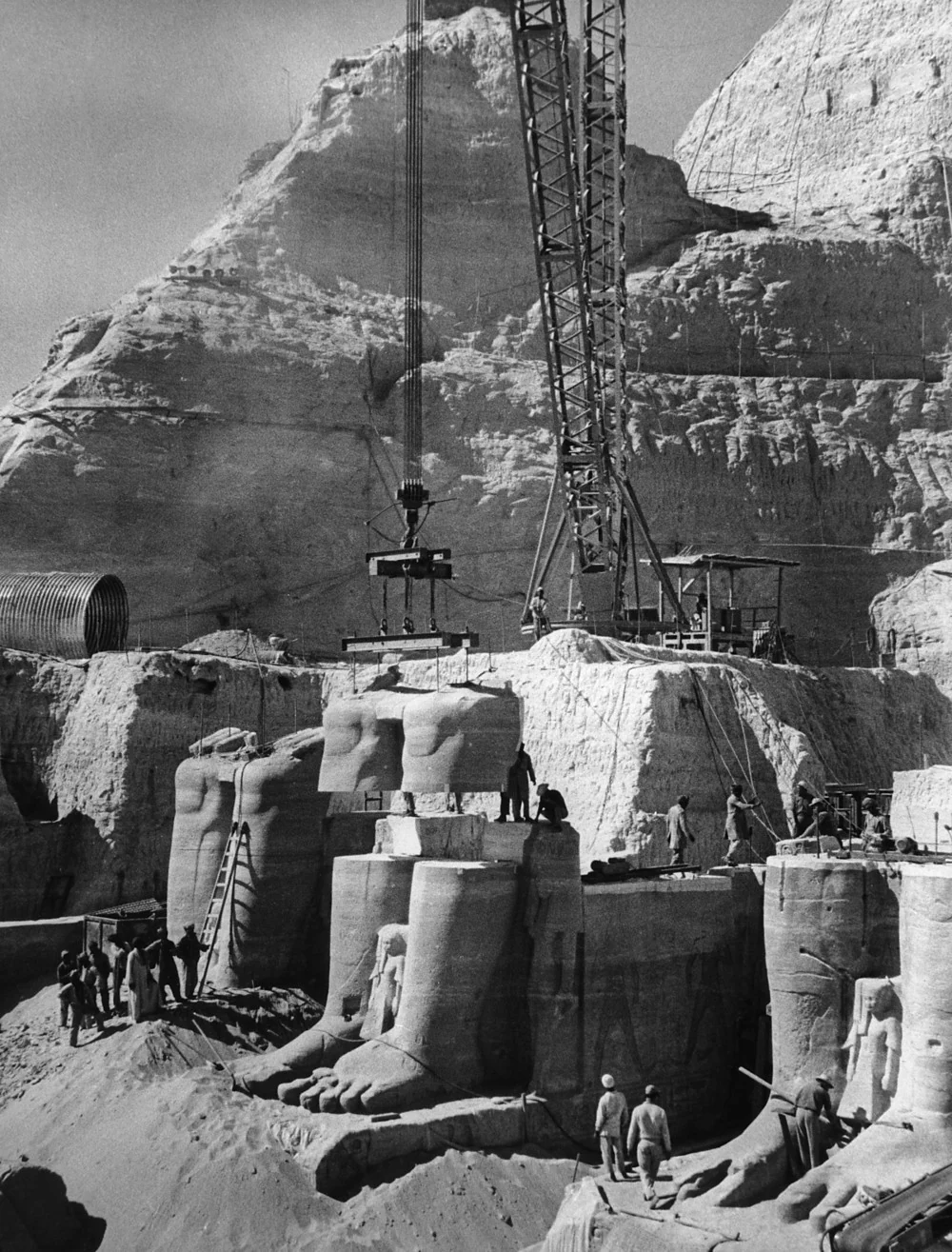
A temporary barrier held back the water while the rock above the temples was removed. The sandstone façades and interiors were then cut into more than a thousand blocks.
By spring 1966, the temples had been dismantled. This photograph from that year shows the scaffolding and cutting marks across the monumental façade. [1]

1967
A face hangs from a crane
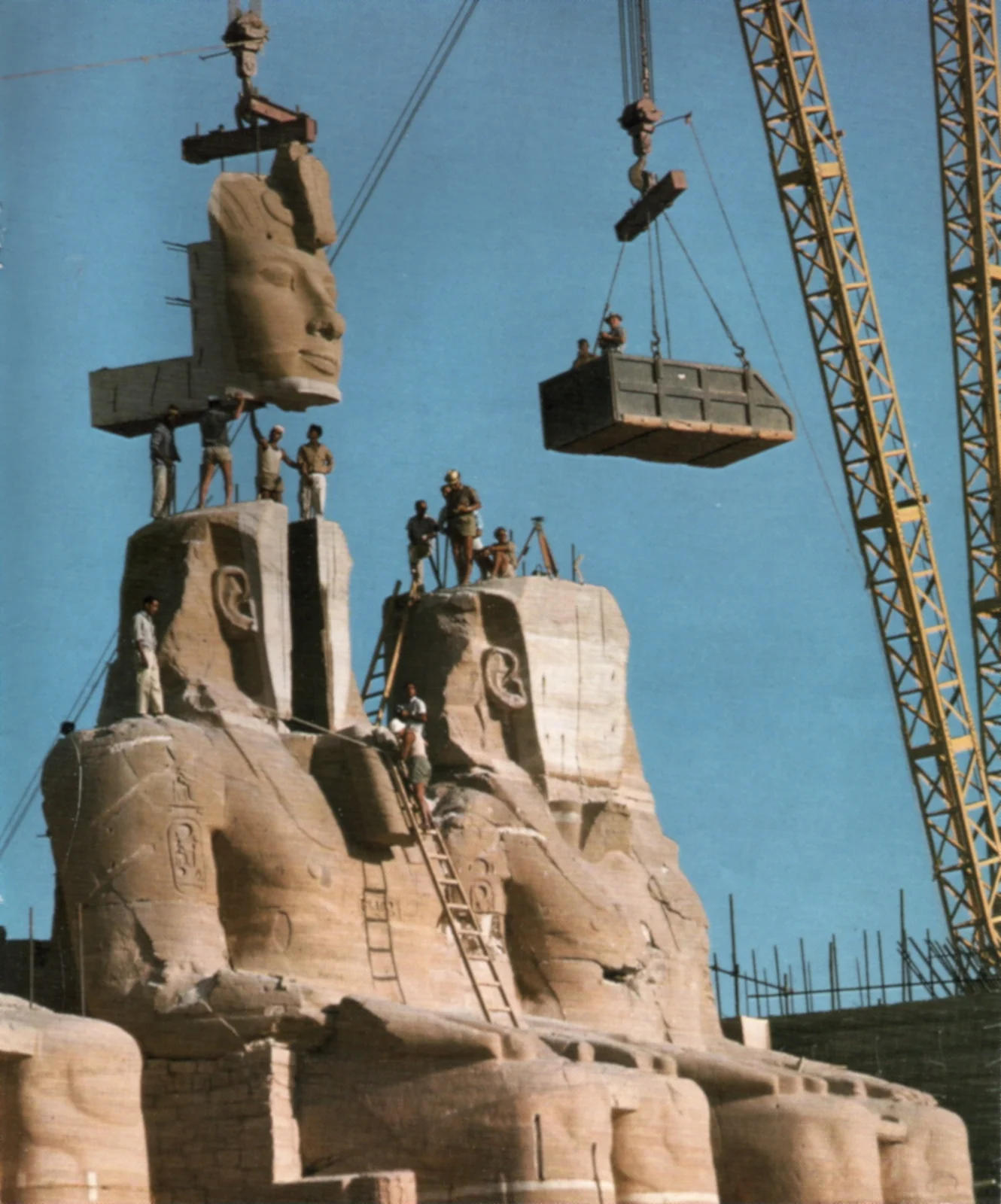
This photograph catches the reconstruction in one extraordinary piece: the face of Ramesses being lifted back into place.
The people below make the scale legible. The operation was not a new carving of the old temple: the ancient stone itself was being reassembled. [5]

1964–1968
Higher, and farther from the river
The engineering report gives a horizontal move of about 208 metres to the northwest. The Great Temple was raised 65 metres; the Small Temple, 67 metres.
The 3D reconstruction keeps those displacement distances. The cuts and transport paths are illustrative. UNESCO’s shorter account describes the move as 180 metres inland. [5]
The temple moves inland and uphill; its old position remains below. Schematic section · distances at one scale
1968
The new mountain is hollow
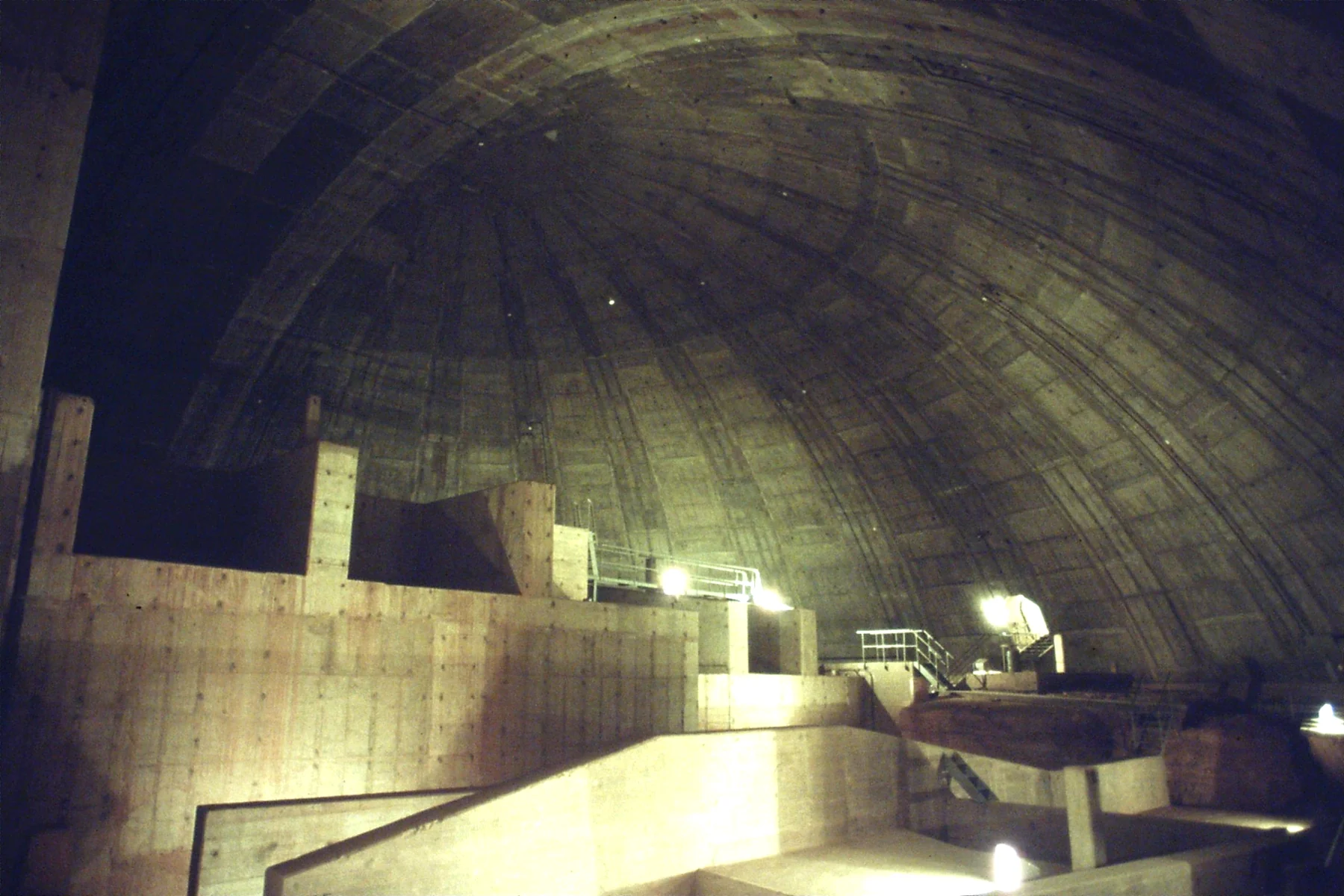
Reinforced-concrete domes carry the weight of the artificial hill above the rebuilt temples. The ancient rooms sit beneath that modern shell. The rebuilt temples were inaugurated on 22 September 1968.
From outside, the temples appear to emerge from rock. This photograph, taken inside the Great Temple’s dome in 1982, shows what the visitor usually cannot see. [5]

February and October
The sun still reaches the sanctuary
On some mornings in February and October, sunlight at sunrise can reach the sanctuary, about 60 m inside the cliff.
The festivals are held on 22 February and 22 October. Sunrise-angle measurements for 2018 indicated three mornings in each month, 20–22 February and 20–22 October, when light could enter the sanctuary. Weyburne argues that the effect is not confined to one day. [6]
The light follows the temple axis towards the sanctuary. Schematic plan. The beam shows the path of the light, not a calculated daily footprint.
What the 2018 study found
An alignment, not a proven birthday
The often-repeated claim that the dates mark Ramesses’ birth and coronation is not established by ancient records. Weyburne’s 2021 paper also gives no measured basis for attributing an exact one-day shift to the 1960s relocation. [6]
What the 2018 study found
The highlighted mornings belong to the two three-day windows discussed by Weyburne. This is a record of that study’s year, not a prediction for every year.
Abu Simbel
The move, without the text
Watch the two temples come apart and take shape again on higher ground. Drag the control through the reconstruction or play the complete sequence.
The original temple is carved into the cliff.
Nubia
The temples were saved. Nubian communities were displaced.
The rescue is a landmark of international conservation. It is also part of the history of Nubian communities displaced by the dam and the flooding of their villages. Saving the monuments did not preserve the inhabited landscape around them. [7]
Abu Simbel’s rebuilt cliff holds both stories: an ancient monument moved with extraordinary care, and a river valley that could not stay where it was.
Sources and photographs
Research
- UNESCO — Working together: Abu Simbel
- Ministerul Turismului și Antichităților / Ministry of Tourism and Antiquities — Abu Simbel
- UNESCO — International campaign to save the monuments of Nubia — chronology
- HOCHTIEF — 140 years of HOCHTIEF, p. 6
- ICOMOS / Lennart Berg — The salvage of the Abu Simbel temples
- Kyle Andrew Weyburne — ENiM 14 (2021), pp. 261–272
- UNESCO — Nubian cultural heritage, decision 8.COM/7.b.1
What the reconstruction shows
The 3D sequence uses the engineering report’s displacement: about 208 m northwest, with a rise of 65 m for the Great Temple and 67 m for the Small Temple. The relief is built from photographs, not a laser scan. Block divisions, room shapes, relative temple positions, terrain and transport paths are illustrative; the model does not reproduce all the historical blocks. Concrete shells and the artificial hill are simplified. The sunlight plan explains the path; it does not simulate an ancient sky or predict the illumination on a particular day.
Photographs
- The Small Temple, with the standing statues of Ramesses II and Nefertari.
Diego Delso, delso.photo · 2022 · CC BY-SA 4.0 - The Great Temple today, with the four seated colossi of Ramesses II.
Diego Delso, delso.photo · 2022 · CC BY-SA 4.0 - The Great Temple during dismantling, 1966.
UNESCO · 1966 · CC BY-SA 3.0 IGO - Ramesses’ face is lifted into place, 1967.
Per-Olow Anderson · 1967 · Public domain - Inside the concrete dome above the Great Temple, 1982.
E. Bonetti · 1982 · CC BY-SA 4.0

Images cropped and converted to WebP. Adaptations retain the original licenses.