The templates are being consulted on for medium-sized sites of up to 2.5 hectares in England.
PLANNING / ENGLAND · 29 AUGUST 2026
For residents, councillors, reporters and people reading s106 agreements.
An agreement closes with a letter.
For 10–49-home sites in England, MHCLG proposes that the owner asks for written confirmation that obligations have been discharged. Only then would the local land-charge entry be cancelled; for unspent contributions, the proposed period is five years, with accrued interest.
Short answerThis is a proposal, not law in force. It standardises the closing paperwork while keeping two triggers visible: the owner’s written request and the local authority’s confirmation.
MHCLG · published 25 August 2026 · consultation closes 20 October 2026
PAPER TRAIL / 01
standard form
≠ new law
draft templateproposal
01 / CONCLUSION
The form is national. The request is concrete.
The consultation proposes agreement templates, not an automatic list that closes every file. The obligations stay tied to the site and the local authority that administers them.
In the proposed wording, written confirmation that obligations are discharged begins with an owner’s request.
A consultation document can change. It does not say every council already follows this path.
02 / THE PATH
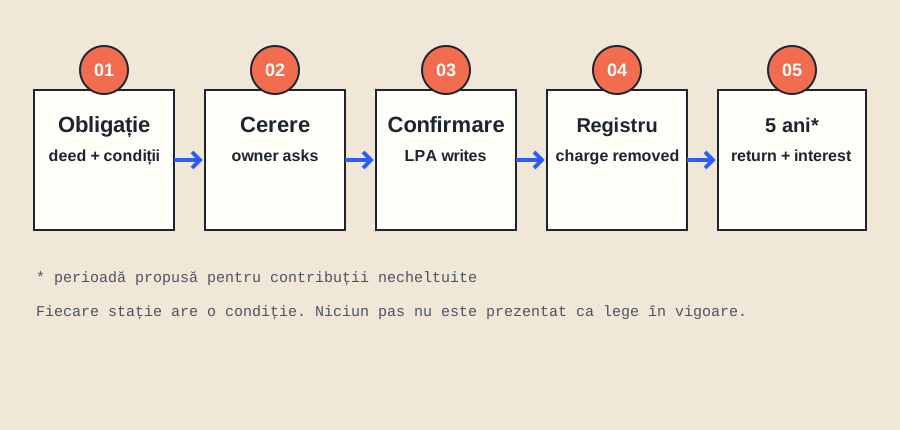
Five stations for one obligation
This translates the proposed order. Each station has an actor or condition; a public register is not turned into an automatic close button.
The obligation enters the deed
The contribution or condition is tied to the agreement and the land concerned.
The owner sends a request
The owner asks in writing for confirmation that one or more obligations have been discharged.
The authority confirms
The local authority would issue written confirmation once the obligation is satisfied.
The entry can be cancelled
After every obligation is satisfied, the authority would procure cancellation of the deed entries in the local land-charge register.
Unspent money comes back?
After the proposed period, a contribution not spent or committed would be repaid with accrued interest, on request.
03 / THE TRIGGER
Why does the first move matter?
In an agreement with public obligations, “closed” can mean several things: the obligation is met, the authority confirms it, and an entry is removed from a register. The proposal keeps those steps separate.
THE STARTING REQUEST
Owner → request → confirmation
The owner asks the local authority in writing to confirm that obligations have been discharged. That wording would leave a clear trail: who asked, which obligation was checked, and what answer followed.
WHAT THE TEXT DOES NOT SAY
It does not say “automatic”.
The proposal does not make the mere passage of time proof that an obligation has been met. Each site still has its deed, conditions and local check.
04 / THE CONTRIBUTION
Five years is not a universal due date
Schedule 3 proposes a rule for contributions received but not spent or committed within the specified period. Repayment would be triggered by an owner’s request and include accrued interest.
The contribution and accrued interest would be used for the specific purpose for which they were secured.
The consultation offers five years as the default period for repayment of an unspent or uncommitted sum.
Repayment is not presented as an automatic transfer: the proposed text links it to the owner’s written request.
Interpretation boundary
“Five years” describes the draft consulted on. It is not a guarantee that any unspent contribution is already repayable or that underspending proves wrongdoing.
05 / THE PUBLIC TRACE
What stays visible in the register?
The proposal links the document to the planning register and local land-charge register. Its aim is that a satisfied obligation does not remain attached to a future search after the right request and confirmation.
| Surface | What can be seen | What triggers the next step |
|---|---|---|
| The deed | Obligations, parties, contributions and purposes. | The obligation is agreed and tied to the land. |
| The confirmation | A written answer that one or more obligations have been discharged. | The owner’s written request and the authority’s check. |
| Local land-charge register | The deed entry and, once all obligations are satisfied, the proposed cancellation. | A request after every obligation has been satisfied. |
06 / WHAT STAYS LOCAL
A template does not replace the file
The consultation says standardisation can reduce drafting variation. It does not promise that every obligation, deadline or check will look identical on every site.
The object is a government consultation for England, not a rule for the whole UK.
Templates can be adapted to parties, land, phases and the local needs of an application.
The page shows no addresses, sums, owners or real entries and does not give legal advice.
The question left open
If the proposal becomes the standard form, how easily will the public be able to connect the written confirmation, the money and the register for a specific site? The answer depends on the final text and each authority’s practice.
07 / PROVENANCE
The document behind the trail
The source is an official consultation, not a press summary. The copy used for checking is archived locally and has a SHA-256 digest.
Primary source
- Standard planning agreements for medium-sized sitesMHCLG · published 25 August 2026 · England consultation, closing 20 October 2026
- Consultation pageContext, documents and questions for respondents
Fact register
- Purpose
- planning-agreement templates
- Scale
- 10–49 homes, up to 2.5 ha
- Period
- 5 years proposed for unspent sums
- Status
- proposal, not law in force