Marius Comper RO
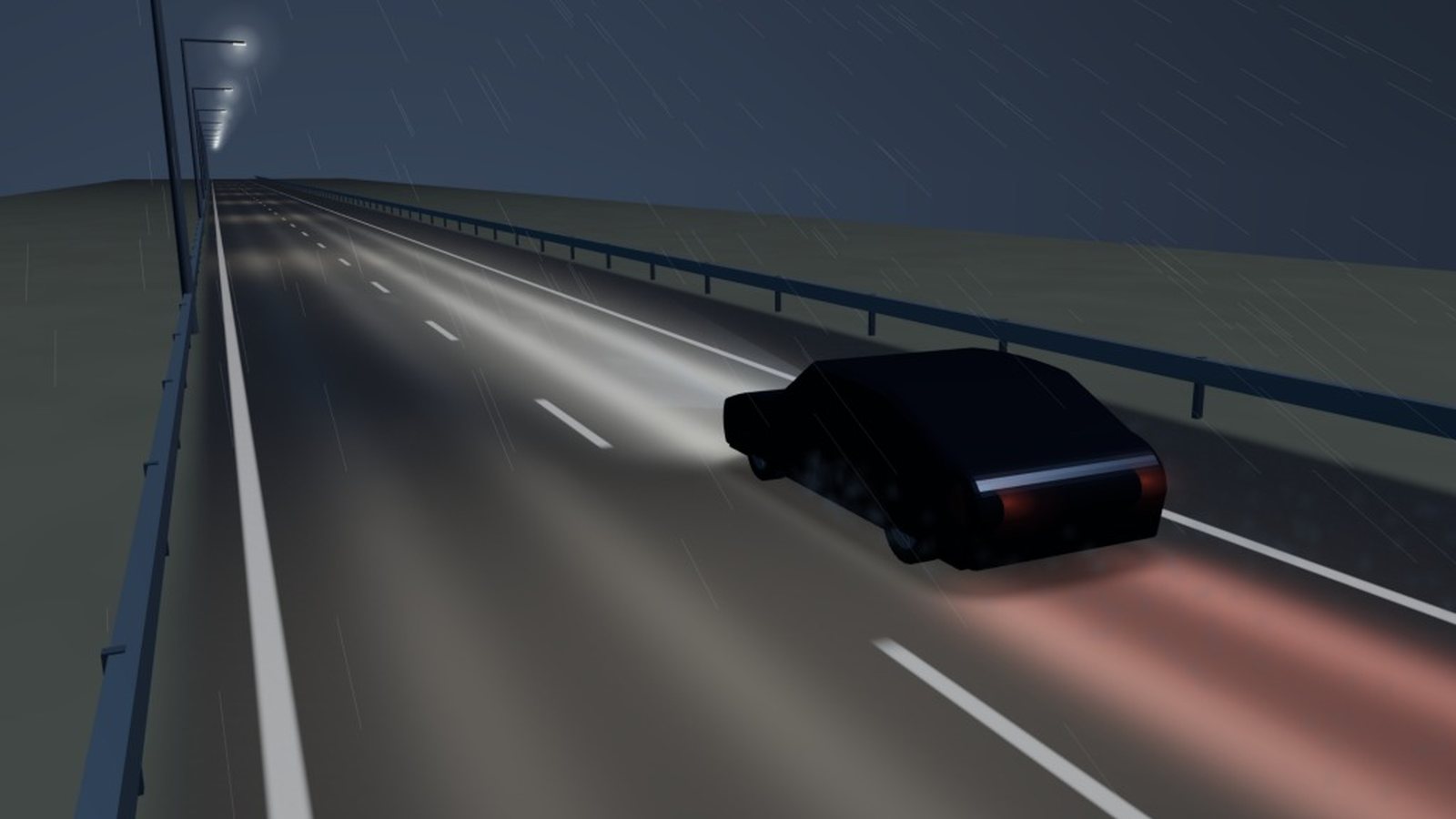
A car on a rainy motorway crossing a thin sheet of water in the wheel-track ruts.

Wet-road physics · aquaplaning

Aquaplaning: three millimetres of water under a car

On a rainy motorway, a thin sheet of water sitting in the wheel ruts can lift a 1.5-tonne car completely off the tarmac. Drop down beneath the tyre and watch what happens in the fraction of a second grip disappears.

At tarmac level

The three-millimetre mirror

Through the windscreen, a wet motorway looks uniform. The water that matters hides in the twin wheel-track ruts polished by lorries, where tarmac holds a 2 to 4 mm sheet.

At low speeds, rubber slices through the film with ease. As speed climbs, the water ahead of the tyre gains inertia: it must be pushed aside in an ever shorter slice of time.

Front-left tyre

A postcard clearing 25 litres every second

Everything connecting a 1,500 kg car to the road passes through four patches of rubber. At 2.2 bar, each tyre presses onto about 167 cm² of tarmac, roughly the area of a postcard.

To keep that footprint dry, the tread grooves must pump water sideways. Continental measurements show a new passenger tyre dispersing up to 30 litres per second at 80 km/h; in the model for a 205 mm tyre at 100 km/h, drainage reaches 25.1 L/s with 8 mm of tread.

NASA view from below

Three zones inside the contact patch

In 1963, at NASA Langley Research Center, Walter Horne and Robert Dreher ran tyres across a runway fitted with a thick glass plate and photographed the footprint from underneath. Their images showed the tyre lifting off progressively from front to back.

Physicist Desmond Moore divided the wet contact patch into three zones: a hydrodynamic water wedge building at the leading edge, a thin squeeze-film transition in the middle, and true dry rubber grip surviving only at the rear.

Zone 1 · water wedgeZone 2 · squeeze-filmZone 3 · dry grip

From 50 to 115 km/h

Water pressure rises with the square of speed

Double your speed and the hydrodynamic pressure pushing under the front of the tyre quadruples. The water wedge drives the dry boundary further and further back.

In the model, with 3 mm of tread in 3 mm of water at 2.2 bar, 69% of the patch still grips at 50 km/h. By 100 km/h dry contact falls to 0%: the tyre is riding entirely on water.

NASA TN D-2056 equation

Why a heavier car does not save you

The dynamic hydroplaning equation derived by Horne and Dreher at NASA hinges on a single main variable: tyre inflation pressure. In metric units, smooth-tyre dynamic onset is Vp = 63.44 × √p (km/h, p in bar; equivalent to 10.35 × √p in mph and 9 × √p in knots).

A heavier vehicle does not press harder per square centimetre: the tyre simply flattens wider until average ground pressure matches the air pressure inside. At 2.2 bar, the footprint grows from 167 cm² at 1,500 kg to 245 cm² at 2,200 kg, leaving the threshold right at 94.1 km/h.

In the model, 1.8 bar drops the threshold to 85.1 km/h, whereas 2.5 bar lifts it to 100.3 km/h and 2.8 bar to 106.1 km/h. On the road, use the pressure your carmaker specifies for the load. Too much air can also raise the risk of aquaplaning.

8 mm versus 1.6 mm

The legal minimum starves the drainage channels

Across the European Union, Romania and the UK (Construction and Use Regulations 1986, Reg. 27), the legal minimum tread depth is 1.6 mm across the central three-quarters. At 1.6 mm, model drainage capacity drops fivefold, from 25.1 L/s down to 5 L/s.

In 3 mm of water at 2.2 bar, the aquaplaning threshold falls from 109.1 km/h at 8 mm to 98.1 km/h at 4 mm and 89.8 km/h at 1.6 mm; in a 6 mm rut it drops to 80.4 km/h. At 100 km/h, a new tyre still keeps 15% dry contact where a worn one has lost the road.

Track measurements confirm the cliff edge. In ADAC testing, a new tyre floated from 87 km/h versus 63 km/h at 4 mm, with 7% longer wet braking from 80 km/h. In Tire Rack wet braking from 70 mph (113 km/h), stopping distance nearly doubled: 59.5 m at 7.9 mm, 88.4 m at 3.2 mm and 115.5 m at 1.6 mm. ADAC and Continental advise replacing summer tyres at 3 mm.
Exiting the puddle

The trap of turning the wheel

When the front tyres float, the steering goes eerily light and the car glides straight ahead no matter how far you turn the wheel. Instinct urges drivers to turn further or stab the brake pedal.

The snap comes at the puddle exit, when turned front tyres suddenly bite dry tarmac. In the 35 m puddle simulation at 100 km/h, holding 18° of steering whips the car into a 35° spin and 5.3 m lateral excursion. Slamming the brakes extends the slide and introduces 11.5° of yaw.

35-metre rut puddle

Set the road and choose your reaction

Adjust speed, tread depth, water film thickness and tyre pressure. Then compare all three reactions across the same 35 m puddle.

At the starting settings (100 km/h, 3 mm tread, 3 mm water, 2.2 bar), easing off the accelerator carries the car straight through to 90.2 km/h with 0° yaw.

100 km/h
3.0 mm
3.0 mm
2.2 bar

On the road, use the pressure your carmaker specifies for the load.

Illustrative physical model for a 35 m rut puddle followed by wet tarmac. The ghost paths show the other two driver reactions from the same entry point.

In heavy rain

Ease off the accelerator and hold the wheel straight.

If the steering goes light and engine revs flare on standing water, lift gently off the accelerator, keep the wheel pointed where you want to travel and wait for grip to return. Do not stab the brakes, and switch off cruise control in heavy rain (UK Highway Code Rule 227; ADAC).

Check cold tyre pressures and tread depth before long motorway trips: 1.6 mm is the legal penalty line, while real wet-weather margin fades around 3 mm.

Pass it on

Someone is driving on the motorway in the rain this week. Share the one habit that keeps a car straight in aquaplaning: lift off, hold the wheel steady, and do not slam the brakes.

Sources and method

Every equation, track measurement and legal limit comes from the primary sources below.

Tread depth: aquaplaning threshold and wet braking

Physical model at 2.2 bar (205 mm tyre) alongside published ADAC and Tire Rack measurements
Tread depthThreshold in 3 mmThreshold in 6 mmEvacuation (100 km/h)70 mph wet stop (Tire Rack)
8.0 mm (new)109.1 km/h97.7 km/h25.1 L/s59.5 m (at 7.9 mm)
4.0 mm (half-worn)98.1 km/h—12.5 L/s88.4 m (at 3.2 mm)
1.6 mm (legal minimum)89.8 km/h80.4 km/h5 L/s115.5 m (nearly double)

Tyre inflation pressure versus NASA smooth-tyre threshold

Horne & Dreher (1963), NASA TN D-2056: Vp = 63.44 × √p (bar)
PressureDynamic threshold VpNote
1.8 bar (underinflated)85.1 km/hAquaplaning below A-road speed
2.0 bar89.7 km/hWell below motorway cruise
2.2 bar (typical saloon)94.1 km/hContact patch: 167 cm² at 1,500 kg
2.5 bar (laden / motorway)100.3 km/h+6.2 km/h margin over 2.2 bar
2.8 bar106.1 km/h+21.0 km/h over 1.8 bar

The scene and simulator run an illustrative physical model grounded in NASA TN D-2056 (Vp = 63.44√p km/h for a smooth tyre), tread and water-film adjustments informed by Gallaway (1979), and Moore's three-zone contact patch (1975). Trajectories across the 35 m puddle are integrated numerically for a 1,500 kg passenger car; ADAC, Continental and Tire Rack figures come directly from published tests rather than the model. Below 0.8 mm of water, the road is treated as damp without full dynamic aquaplaning.

  1. Horne, W. B. and Dreher, R. C. (1963), Phenomena of Pneumatic Tire Hydroplaning, NASA TN D-2056, Langley Research Center: dynamic hydroplaning equation Vp = 10.35√p (mph, p in psi) / 9√p (knots) / 63.44√p (km/h, p in bar) and glass-plate footprint photography (Figs. 5–6). ntrs.nasa.gov
  2. Desmond F. Moore (1975), The Friction of Pneumatic Tyres, Elsevier, Amsterdam, ISBN 0-444-41323-5: three-zone wet contact patch model (sinkage/squeeze-film wedge, draping transition, actual dry contact).
  3. Ong, G. P. and Fwa, T. F. (2007), "Prediction of Wet-Pavement Skid Resistance and Hydroplaning Potential", Transportation Research Record 2005(1):160–171; and ASCE J. Transp. Eng. 133(10):590–598 (coupled 3D models of tread depth and water film thickness). api.crossref.org
  4. Continental technical guide on aquaplaning: a new passenger car tyre disperses up to 30 litres of water per second at 80 km/h; replacement recommended at 3 mm. www.continental-tires.com
  5. ADAC tread-depth test: new tyre floats from 87 km/h versus 63 km/h at 4 mm tread; wet braking from 80 km/h is 7% longer at 4 mm; replacement advised at 3 mm (summer) and 4 mm (winter). www.adac.de
  6. ADAC aquaplaning guidance: do not steer sharply, brake or accelerate; ease off and keep the steering wheel straight; switch off cruise control in heavy rain. Both underinflation and overinflation can increase the risk of aquaplaning. www.adac.de
  7. Tire Rack wet asphalt braking test from 70 mph (113 km/h, BMW 325i): 59.5 m (195.2 ft) at 7.9 mm (10/32"), 88.4 m (290.0 ft) at 3.2 mm (4/32") and 115.5 m (378.8 ft) at the 1.6 mm (2/32") legal limit. www.tirerack.com
  8. Council Directive 89/459/EEC (transposed in Romania via RNTR-1 / Order 2133/2005 and OUG 195/2002 Art. 112): 1.6 mm legal minimum tread depth across the central three-quarters main grooves. eur-lex.europa.eu
  9. Regulation (EU) 2019/2144 (General Safety Regulation): tyre pressure monitoring and safety requirements. eur-lex.europa.eu
  10. UK Road Vehicles (Construction and Use) Regulations 1986, Reg. 27(1)(f): 1.6 mm legal minimum across the continuous central three-quarters breadth. www.legislation.gov.uk
  11. UK Highway Code, Rule 227 (wet weather): stopping distances are at least double on wet roads; if steering becomes unresponsive, ease off the accelerator and slow down gradually. www.gov.uk