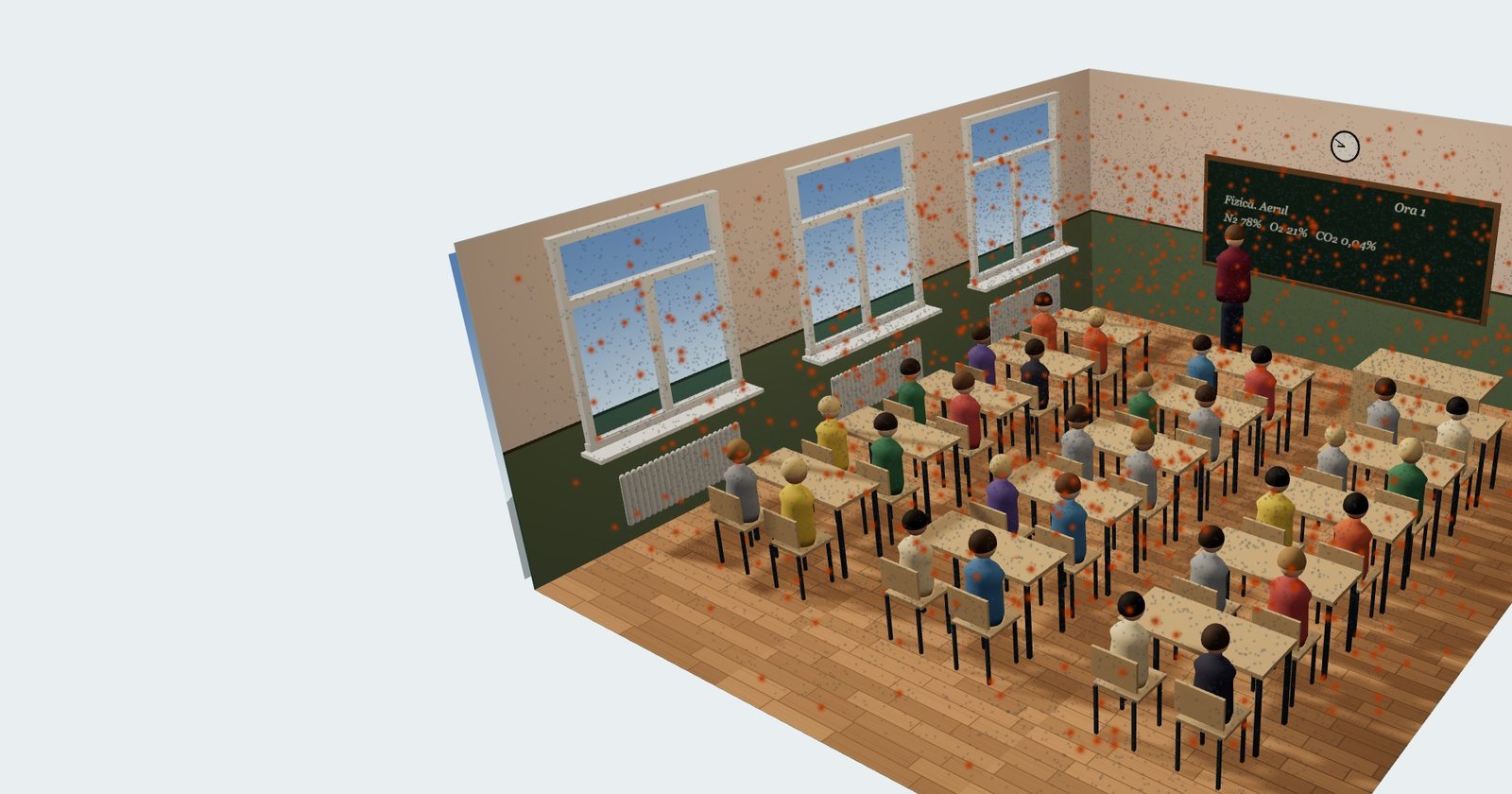
Thirty children, a closed room, fifty minutes. Every breath leaves something in the air that classmates will breathe in a little later. Follow one lesson from the ceiling down to a drop thinner than a hair.
Scroll
One breath
What a breathing child leaves behind
Outdoor air holds about 420 parts per million (ppm) of carbon dioxide. The air a person breathes out carries some 38,000 ppm more: close to a hundred times what went in.
At these levels CO₂ is not dangerous. It is a witness: it shows how much of a room’s air has been breathed before. A pupil aged 11 to 15 doing desk work gives off about 4.1 millilitres of CO₂ a second. Thirty pupils and a teacher in a closed 194 m³ room would raise the level by about 39 ppm every minute if no fresh air came in at all.
The lesson, minute by minute
The room fills up
Each dot in the scene is a speck of the room’s air. The lit ones have already been through someone’s lungs. Their share is exactly the model’s: one lit dot in 25 means 4%.
The windows are shut, but old frames let a little air in, about one air change an hour, as measured in Detroit classrooms where windows were rarely opened. By the end of the lesson the monitor on the wall reads around 1,760 ppm. That means 3.5% of every breath, nearly one breath in 28, has already come out of someone else in the room.
With tightly sealed double glazing, letting in even less air, the lesson ends near 2,170 ppm and 4.6%.
In real schools
What the measurements found
A team led by researchers at the Technical University of Civil Engineering in Bucharest measured CO₂ in the classrooms of eight Romanian school buildings, rural and urban. The average was 1,955 ppm, with building averages from 1,230 to 2,703 ppm.
The worst was a village school, the only renovated one of the eight, at 2,703 ppm. The authors suggest the tighter shell left by the thermal renovation as one explanation. The best were an old village school (1,404 ppm) and a university building (1,230 ppm), both with old wooden windows that do not seal.
The model in the scene, run for four lessons in a row with the room aired in the breaks, gives a morning average of 1,460 ppm with old frames and 1,850 ppm with sealed glazing. Both fall inside the range measured in those Romanian buildings.
It is not only a Romanian problem. The European SINPHONIE study, which included Romania, found average levels above 1,000 ppm in primary schools. Central and Eastern Europe and the south of the continent had a larger share of classrooms above 1,500 ppm. In 86% of measurements, ventilation fell short of the target of 4 litres a second per child.
A pupil who is ill
One sick child, the whole class
Now imagine Sam, in the third row, has come to school ill. He breathes like everyone else. Of the lit dots, one in 31, coloured pink here, came out of his lungs.
The calculation assumes the air mixes quickly in the room. By the end of the lesson, about one part in 880 of every breath, for every child in the room, is air Sam breathed out. It sounds small. But it adds up with every breath, lesson after lesson.
Right next to him, others get much more: his breath reaches them before it mixes. The calculation in the scene leaves that part out and shows only what the whole class gets from the shared air.
In micrometres, time slowed a thousand times
Why the virus stays in the air
Talking, coughing or simply breathing sends out drops of every size. Big ones, like the 100-micrometre drop on the left, fall from mouth height to the floor in about 5 seconds.
Small ones float. A 10-micrometre drop needs about 8 minutes to sink a metre and a half, a 5-micrometre one half an hour, a 2-micrometre one more than three hours. Long before that, the air currents in the room have carried them everywhere, just like the CO₂.
That is why CO₂ can stand in for the virus in the calculation: the finest drops go where the breathed air goes.
A 2-micrometre nucleus
How much it matters, uncertainty and all
A dried drop two micrometres wide can carry virus particles. A coronavirus particle is 60–140 nanometres across, about a twentieth of the drop’s width.
The chance of infection depends on how many infectious particles the sick person gives off, and that is what science knows least. For COVID-19, one widely cited study puts it at 0.32 to 76 “infectious doses” an hour for an infected person talking non-stop (5th to 95th percentile): a spread of more than two hundred times. Breathing quietly, more than ten times less.
With those figures, if Sam spent a full week in class, five lessons a day, talking the whole time, the calculation gives between 0.2 and about 23 of the other 30 people in the room infected through the shared air. For a quiet class, the value a UK study used gives about 0.6; for a noisy one, about 2.7. These are not forecasts. The model ignores that the virus settles and loses its strength in the air, and assumes everyone else can be infected, so if anything it overestimates.
Sturdier is the comparison, which does not depend on how many particles the sick child gives off: in this model, the same class with the windows ajar all lesson (three air changes an hour) breathes 46% less of Sam’s exhaled air than with old frames shut; with sealed glazing shut, 39% more. Counting the virus that settles or decays, the gaps shrink to about 38% and 26%.
For measles, no window is enough. Its virus is so contagious that, by Rudnick and Milton’s calculations, no realistic ventilation stops it spreading. There, the vaccine is what helps.
Five minutes with a window open
What five minutes with a window open changes
At minute 25 the teacher opens the windows wide. Cold outdoor air comes in low, and the warm, breathed air goes out high. In five minutes the monitor falls from 1,230 to about 1,060 ppm.
How far it falls depends on the wind and how cold it is outside. With windows and door wide open, a lecture room in Spain measured 4.7–7.9 air changes an hour. In Milan classrooms, where windows were open for only part of the day, daily averages ran from 2.8 to 12.9. With values from 3 to 13, after five minutes the monitor would read, as an illustration, anywhere between 1,220 and 810 ppm.
Then the windows close and the room fills again. At the end of the lesson the monitor reads 1,550 ppm, against 1,760 with no airing. Five minutes helps, but it does not last a whole lesson.
Germany’s environment agency advises airing with windows wide open at least every 20 minutes, for 3–5 minutes in winter, and for the whole break. Romanian rules also ask for airing during breaks, with the pupils out of the room.
Your classroom
Put your own classroom in the scene
Choose how many pupils, how big the room is and what you do with the windows. The lesson starts from fresh air; the clock runs 150 times faster.
In the chart, the thin line is the lesson with old frames shut, for comparison.
Air is treated as well mixed, with a 3.2 m ceiling and 420 ppm outdoors. Air changes an hour: 0.3 (sealed), 1 (old frames), 3 (the Romanian standard, assumed for windows ajar), 6 (wide open). In a real room, wind and the temperature difference can move these figures a lot.
What the rules say
What English schools are told
In England, the guidance for school buildings asks that in naturally ventilated classrooms the daily average stays below 1,500 ppm and does not go above 2,000 ppm for more than 20 minutes in a row. The Department for Education calls under 800 ppm good, 800 to 1,500 adequate and over 1,500 poor.
Between 2021 and 2023 the government sent schools more than 300,000 CO₂ monitors, so teachers could see when to open a window. A room like the one in the scene, shut for a whole lesson, ends in the “poor” band.
Romanian rules ask for at least three air changes an hour in classrooms, airing in every break with the pupils out, and 5–8 m³ of air per person. They set no CO₂ limit. At three air changes an hour, the same lesson would end near 1,140 ppm.
To remember
The air in a closed classroom belongs to everyone.
A window left ajar all lesson does more than five minutes of airing. A break with the windows wide open and the pupils outside clears the room.
And when a child is ill, the best place for them is at home.
Pass it on
A parent, a teacher, a head teacher. Tell them one thing: a window left ajar all lesson matters more than five minutes of airing.
Share
Sources and method
Every number in the story comes from one of the sources below or from the calculation described here.
The scene is a simple model of a classroom with well-mixed air, not a measurement. The room is 194 m³ (7.2 × 8.4 × 3.2 m), with 30 pupils aged 11–15 and a teacher, and 420 ppm outdoors. CO₂ rises with what people produce and falls with the air coming in: 0.3 air changes an hour for sealed windows (the low end of outdoor-air rates measured in non-residential buildings, cited by Rudnick and Milton), 1 for old frames (the middle of values measured in Detroit classrooms where windows were rarely opened), 3 as Romanian rules require (assumed for windows ajar, not measured), 6 for windows wide open. The rebreathed fraction is f = (C − 420)/38,000. The risk uses the Wells–Riley equation in Rudnick and Milton’s form, P = 1 − exp(−f̄·q·t/n), over 25 lessons in a week, without the virus settling or decaying. Drop fall follows Stokes’ law, for water at 20 °C.
Rudnick and Milton (2003), "Risk of indoor airborne infection transmission estimated from carbon dioxide concentration", Indoor Air 13: the rebreathed fraction f = (C − C₀)/Cₐ, Cₐ ≈ 38,000 ppm for an adult doing office work, the Wells–Riley equation in that form, emission rates for measles, influenza and colds, outdoor air in non-residential buildings (0.3–2.9 air changes an hour, schools towards the top). stacks.cdc.gov
Persily and de Jonge (2017), CO₂ generation rates by age and activity level (Table 2; here: ages 11–15, light seated work). tsapps.nist.gov
Catalina, Ghita, Popescu and Popescu (2022), "Survey and Measurements of Indoor Environmental Quality in Urban/Rural Schools Located in Romania", IJERPH 19: CO₂ measured in eight schools, average 1,955 ppm (Table 9). doi.org
SINPHONIE, executive summary (European Commission, JRC, 2014): primary schools in 23 countries, Romania included; classroom CO₂ levels and ventilation. publications.jrc.ec.europa.eu
Romanian Health Ministry Order 1456/2020, hygiene rules for schools: Art. 10 (ventilation, airing during breaks) and Art. 24 (5–8 m³ of air per person). legislatie.just.ro
Xia et al. (2024), Frontiers in Public Health: naturally ventilated Detroit classrooms where windows were rarely opened: 0.58–1.38 air changes an hour measured. doi.org
Aguilar et al. (2021), Sensors 21: a lecture room in Granada, windows and door open, 4.7–7.9 air changes an hour measured from the fall in CO₂. doi.org
Ferrari et al. (2023), Heliyon 9: six classrooms in Milan, daily averages of 2.8–12.9 air changes an hour, with windows open for part of the day. doi.org
Buonanno, Morawska and Stabile (2020), Environment International 145: SARS-CoV-2 emission rates (Table 2), 5th to 95th percentile for an infected person speaking continuously: 0.32–76 quanta an hour. doi.org
Vouriot et al. (2021), Indoor Air 31: CO₂ monitored in 45 UK classrooms, airborne infection risk over a school week, 1 quantum an hour for a quiet class, 5 for a noisy one. doi.org
Zhu et al. (2020), NEJM 382: coronavirus particles are 60–140 nm across. doi.org
German Environment Agency (Umweltbundesamt), "Richtig Lüften in Schulen" (2021): airing with windows wide open at least every 20 minutes, 3–5 minutes in winter, the whole break. www.umweltbundesamt.de
Building Bulletin 101 (2018), the design guide for ventilation in schools in England, as summarised by the CIBSE Journal: daily average below 1,500 ppm in naturally ventilated classrooms, not above 2,000 ppm for more than 20 consecutive minutes. www.cibsejournal.com
Department for Education, ventilation guidance: under 800 ppm good, 800–1,500 ppm adequate, over 1,500 ppm poor. www.gov.uk
University of Cambridge (January 2022): more than 300,000 CO₂ monitors sent to schools in England. www.cam.ac.uk