How old the Colți lump is
The geopark says 25 million, Kraków 38.5–70. A published dating of the deposit itself is missing; until then, the number stays open.
Colți, Buzău county
For almost 200 years, people have dug a resin millions of years old, with insects inside it, out of the hills at Colți. The short answer is no. And the amber itself hides a surprise: it is Baltic amber's cousin, changed by the mountains' heat.
Start the clockThe DNA clock
Every creature keeps its instructions in DNA. After death, the instructions break, piece by piece. Scientists measured the rate of DNA decay in ancient bones: half is lost every 521 years. Turn back time and see how many of the million pieces remain.
Before you turn back time: after 10,612 years, how many of the million pieces remain?
Not one whole piece. Halving every 521 years leaves a fraction of a piece after 10,612 years. And no ancient DNA was found in the real bee of that age.
0
The clock in brief: starting with a million pieces of DNA and halving every 521 years, this many remain:
| Years back | Pieces left |
|---|---|
| 0 | 1,000,000 |
| 60 | 923,278 |
| 521 | 500,000 |
| 10,612 | 0.74 — not one whole piece |
| 40,000 | 0 |
| 25,000,000 | 0 |
| 44,100,000 | 0 |
| 70,000,000 | 0 |
In 2013, a team in Manchester looked for DNA in two bees trapped in copal, a younger resin that has not fully fossilised into amber. One was under 60 years old; the other was 10,612 years old. With the best methods of the time, they found ancient DNA in neither. Their conclusion: ancient DNA is even less likely to survive in amber millions of years old. Penney et al. 2013, PLOS ONE
The 521-year decay rate was measured in 158 bones from moa, New Zealand's giant flightless birds. Nobody has measured the pace in amber, because nobody has found DNA to measure. The clock above shows what would happen if the pace were the same. Allentoft et al. 2012
The clock is a calculation, not a measurement made in amber.
At true scale
A 3.5 kilogram lump, as heavy as three and a half litres of milk, is the largest of its kind, in the words of the Buzău museum director. And the creatures in resin fit in a cube smaller than a peppercorn.
3½ litres of milk = the 3.5 kg lump; resin cube, magnified 10 times.
A woman from Colți found the lump in a stream bed and kept it by the door for decades, as a stop. The burglars who broke into her house stole her gold jewellery and left the lump there.
After the woman's death, a relative sold the lump to the Romanian state. Specialists in Kraków said it was true amber, 38.5–70 million years old, and the Buzău museum director believes it the largest piece of its kind. It is a national treasure today. El País, 2024
At the other end of the scales sit the creatures in resin. Each bee in the Manchester study fit, resin and all, in a resin cube of about 4 cubic millimetres.
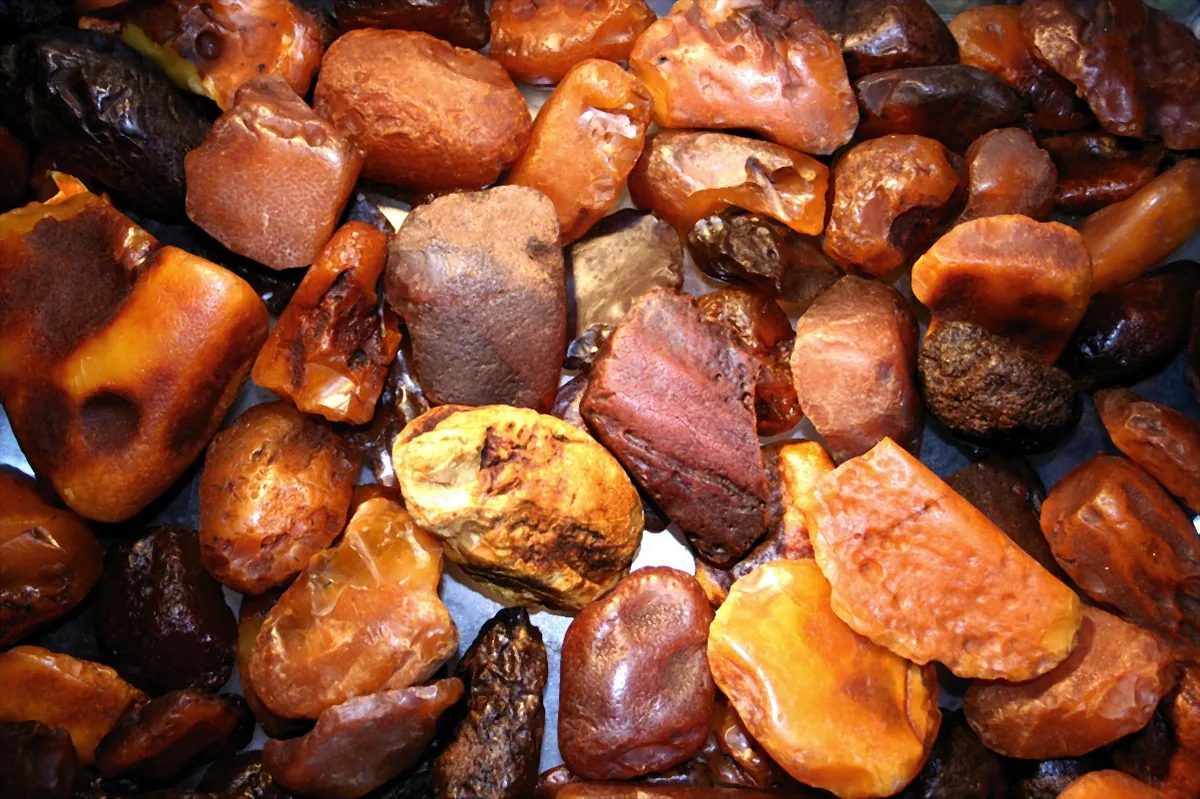
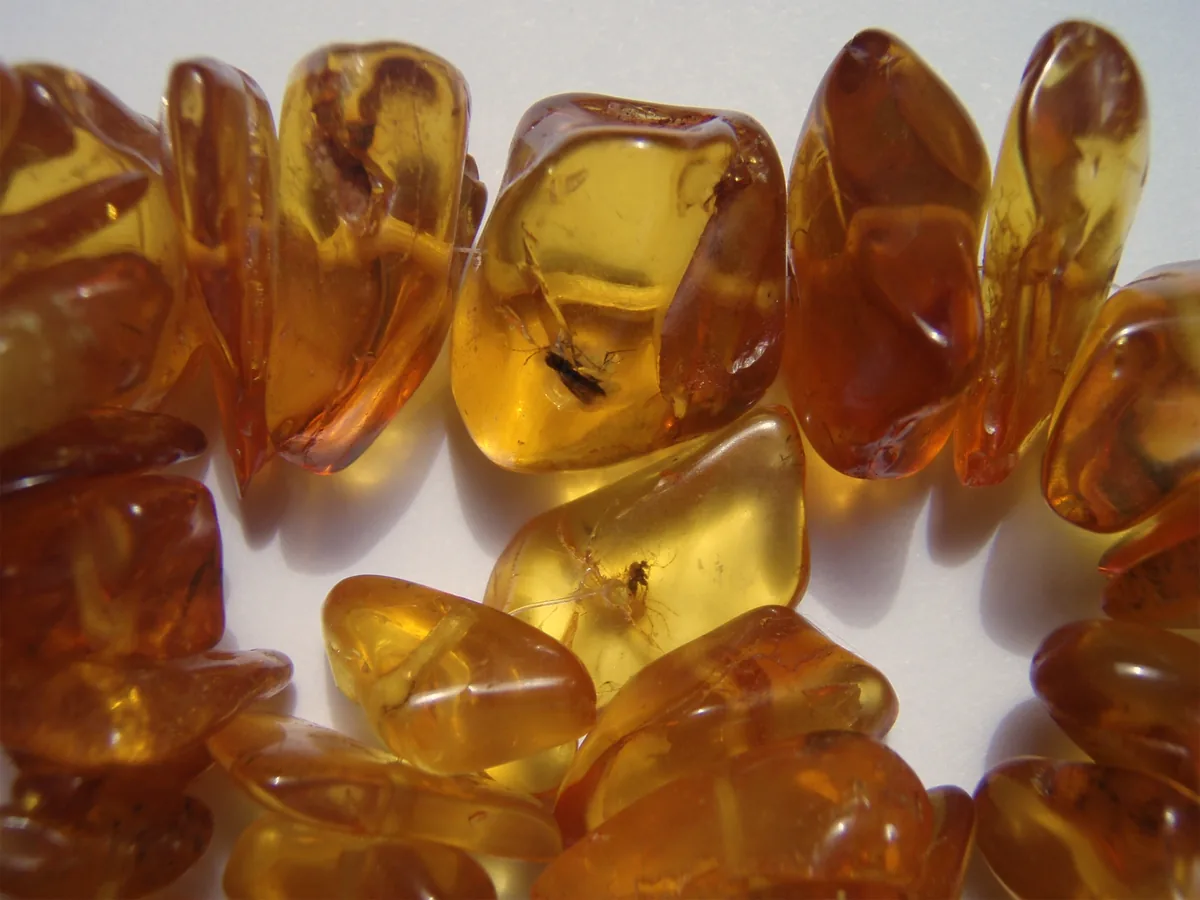
The Baltic cousin
For a century, chemists called the resin from Colți rumanite and kept it apart from Baltic amber. In 2000, three researchers showed it is the same resin, changed by heat.
Is rumanite different from Baltic amber?
The same resin. What sets them apart is heat, not the tree the resin flowed from. Helm had told them apart in 1891 with what was known then; the new chemistry joined them back. Stout et al. 2000
The Baltic: succinite
Colți: rumanite, succinite changed by heat
Of the whole weight of Baltic amber, between one and eight parts in a hundred are succinates; hence the name succinite. There is very little free acid, though: only 50–400 parts in a million of amber. Wolfe et al. 2009
The tree is not certain either. A team that read infrared fingerprints proposes conifers of the Sciadopityaceae family, with a living relative found today only in Japan. A Viennese chemist says naming a single tree is still a delicate matter.
Laboratories tell resins apart by their infrared fingerprint: each tree family leaves its own trace. The ROMANIT project, of Romania's National History Museum, set out between 2007 and 2010 to establish the criteria that separate Romanian amber from Baltic amber.
How old is it?
Three numbers circulate for the age of the amber from Colți. All come from serious sources. None is certain.
How old is the amber from Colți?
Nobody knows exactly. 25 million is the geopark's number; 38.5–70 is the Kraków range, and 44 falls inside it. The upper end is almost twice the lower end. The rock it was found in is Oligocene, and the resin may be older than the rock it sits in today.
Select a dot for its name.
1578
Prince Mihnea and Lady Neaga give the church at Aluniș land where “amber shards of rare beauty” are found. The first mention.
1828
The first amber diggings at Colți: rough ditches, shafts and galleries.
1837
The Russian count Demidov writes about the amber of the Sibiciu and Bou valleys.
1867
Amber is Romania's symbol at the Paris World's Fair.
1890
Grigore Ștefănescu, the first Romanian geologist to speak of Buzău amber.
1891
Oscar Helm describes the resin of the Romanian Kingdom as “Rumänite”, distinct from Baltic amber.
1902–1937
Engineer Dumitru Grigorescu develops organised mining.
1924–1935
The best years: 67 to 130 kg a year, that is 804–1,560 kg in 12 years.
1947–1950 · 1980–1983
The last attempts at industrial mining.
1980
The county museum opens the exhibition with over 270 pieces at Colți.
2000
Stout, Beck and Anderson show rumanite is thermally altered succinite.
2007–2010
The ROMANIT project looks for the criteria separating Romanian from Baltic amber.
2013
The Manchester team finds no ancient DNA even in the 60-year resin.
2024
The press writes about the 3.5 kg doorstop lump; the piece is a national treasure at Buzău.
Between 1924 and 1935, Colți yielded 67 to 130 kilograms a year — 804 to 1,560 kilograms in 12 years. The mine at Kaliningrad dug 400 tonnes in 2015 alone: about 1,100 kilograms on an ordinary day, some eight times more than the best Colți year.
What the sources cannot say
Here is where what is known about the amber from Colți ends.
The geopark says 25 million, Kraków 38.5–70. A published dating of the deposit itself is missing; until then, the number stays open.
The lists online show spiders, beetles, reptiles and bird feathers, citing no paper. In Baltic amber, 98% of creatures are insects — but that is another deposit. For Colți, the catalogue is missing.
The newest proposal says Sciadopityaceae, with a living relative found today only in Japan. Other chemists say naming a single tree is still a delicate matter.
The paper describing the infrared method could not be read for this page, with access blocked. Its conclusion — the same resin, changed by heat — comes from the 2000 paper, read through its record and the studies discussing it.
The game
Every answer is proven by a study. Eight out of eight makes you a museum piece.
Every question, with answers:
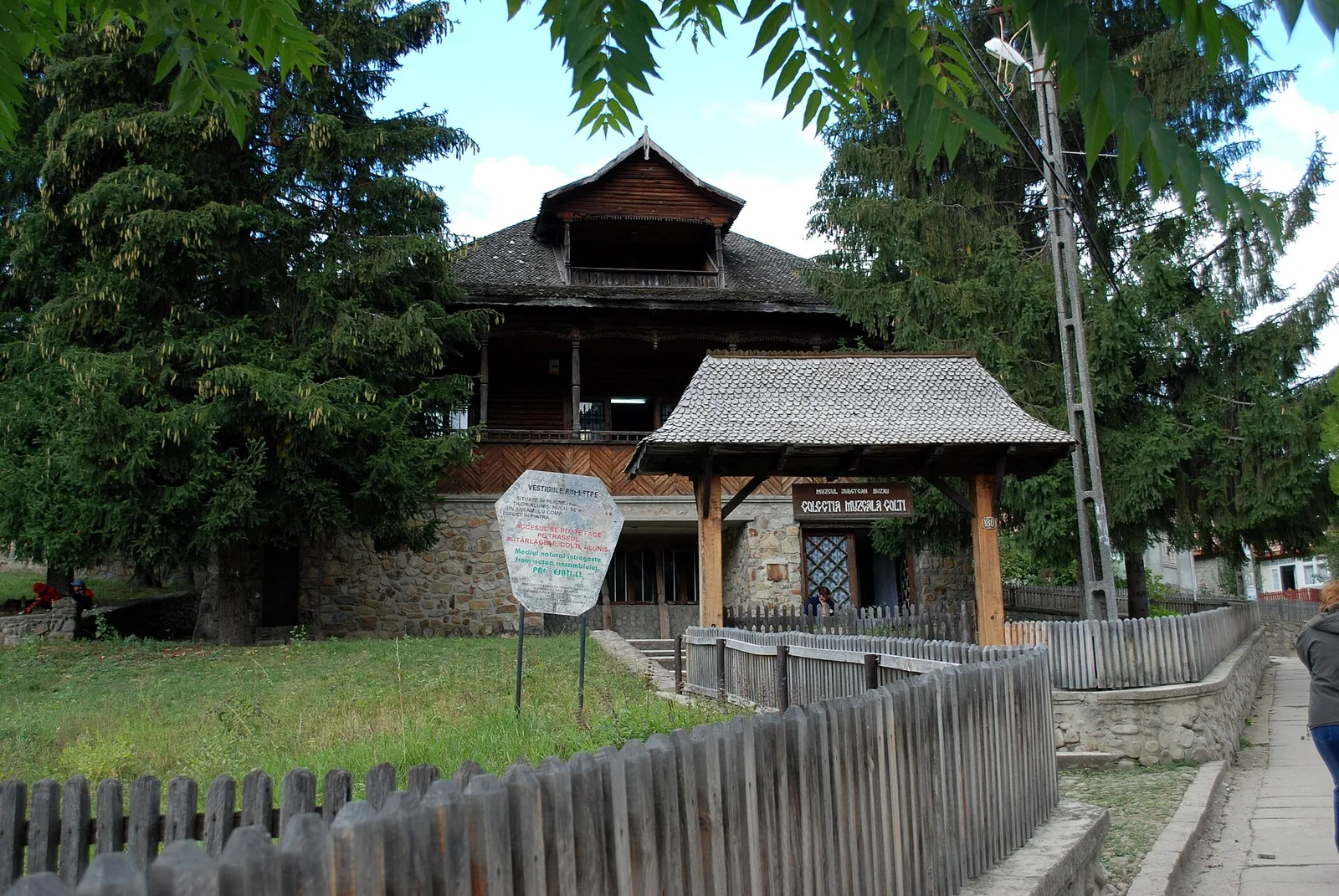
To see
Three stops, all in and around Buzău county.
Sources and method
We read seven studies: the 2013 paper that found no DNA in copal, the half-life measurement, the 2009 proposal about the Baltic tree, Vávra's chemistry of amber, the history of Romania's deposits and two papers about rumanite. Every number comes with its study.
The derived numbers are simple sums: the Colți–Yantarny distance from coordinates, the DNA curve from the half-life, the production totals from the yearly figures.
Two texts could not be read directly: the 2000 rumanite paper, behind a paywall, and the 2009 study on telling the ambers apart by infrared, with access blocked. We cite them only through studies discussing them.
Ages and records are told with their source beside them, and where the sources disagree, the page shows the disagreement as such.