Suceava · Voroneț · Dragomirna · 1614–1617
The metropolitan in the pictures, the painter in the colophon
Anastasie Crimca, Metropolitan of Moldavia, is often called the first Romanian self-portraitist. In the Gospel book he commissioned he kneels beside each evangelist. Near the end of the same book, inside a gold frame, the scribe and the painter are named.
Move the light across the page · Shift + ← or →: turn pages · L: magnifier
Warsaw, National Library of Poland, Rps 12690 IV
The Warsaw Gospels
The book's parchment leaves measure 36 by 25 centimetres and are bound in red velvet with metal corners. The National Library of Poland catalogues 308 leaves; the historian Alexandru Pascal, who in 2025 published the fullest inventory of the books Crimca commissioned, counts 319. It holds the four Gospels in Church Slavonic, the liturgical language of Moldavia at the time, and, according to Pascal, 345 miniatures: the evangelist portraits and scenes spread through the text. The opening pages of the Gospels also carry interlaced headpieces.
It was commissioned by Anastasie Crimca, Metropolitan of Suceava (the see of Moldavia, the principality in today's north-east Romania and Moldova) from 1608 to 1617 and again from 1619 until his death on 19 January 1629. Crimca came from a wealthy Suceava family that included merchants; a record from 1767 still mentions "Crâmca's Lane". With the Stroici brothers he founded the monastery of Dragomirna, near the town, and gave it manuscripts. Its main church, finished in 1609, is reported to be about 42 metres high and 9.5 metres wide.
Today the book is in Warsaw. The National Library of Poland makes 628 images of it available in the public domain; the originals reach over 6,500 by 8,400 pixels. The book above shows all of them, in the library's order, as lighter copies, and for 13 pages the magnifier opens high-resolution copies.
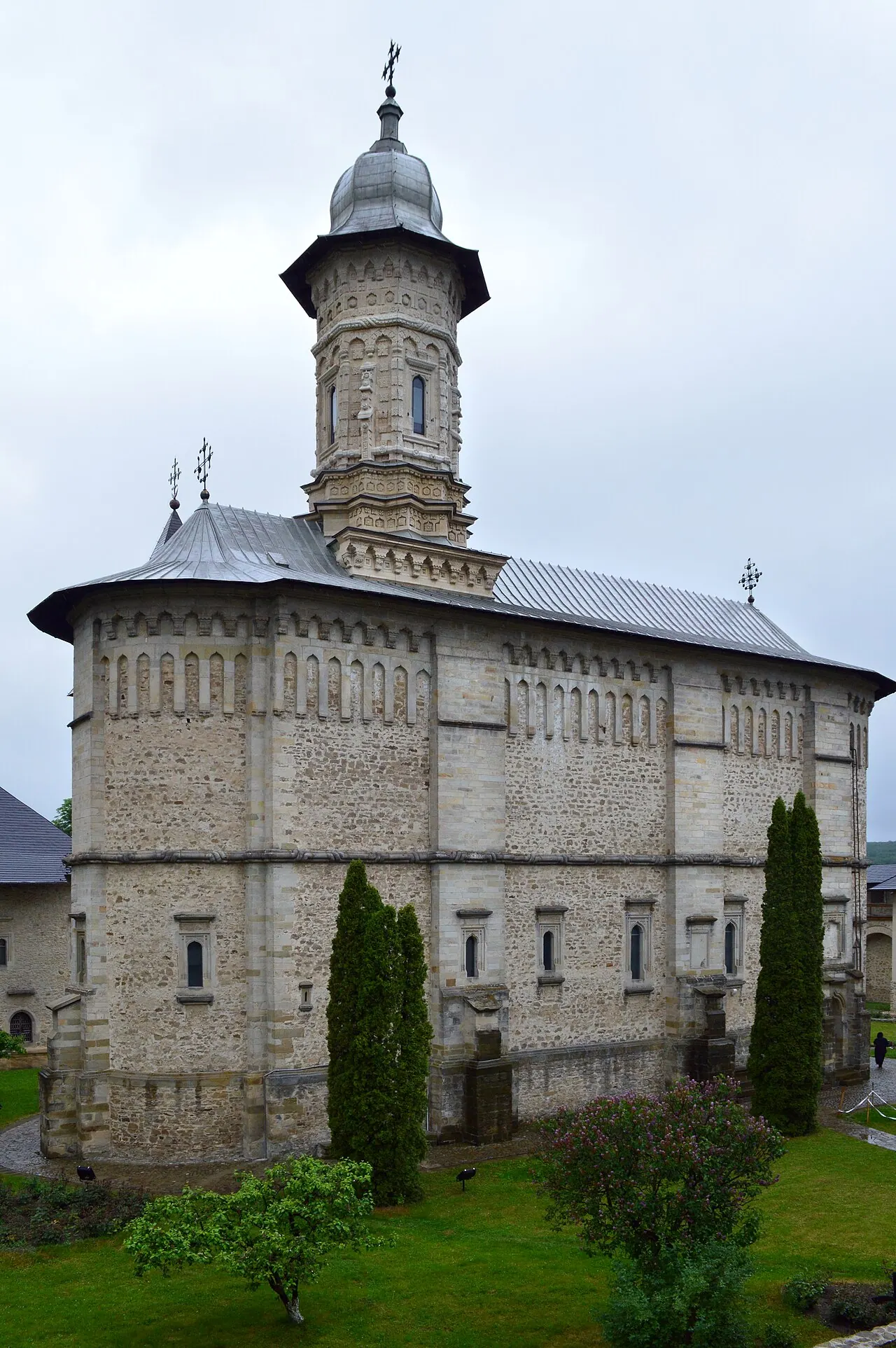
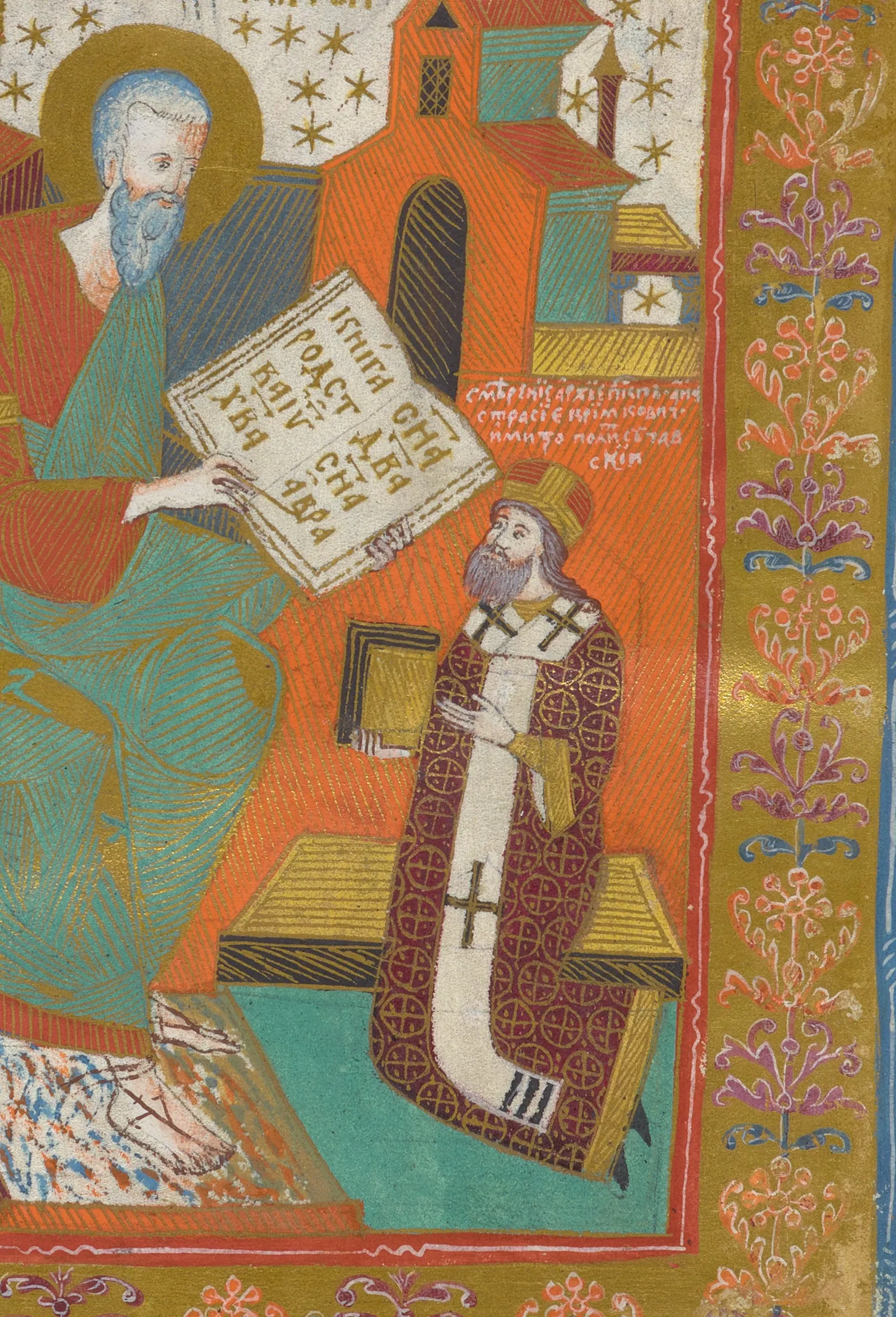
Image 14 · St Matthew
The kneeling metropolitan
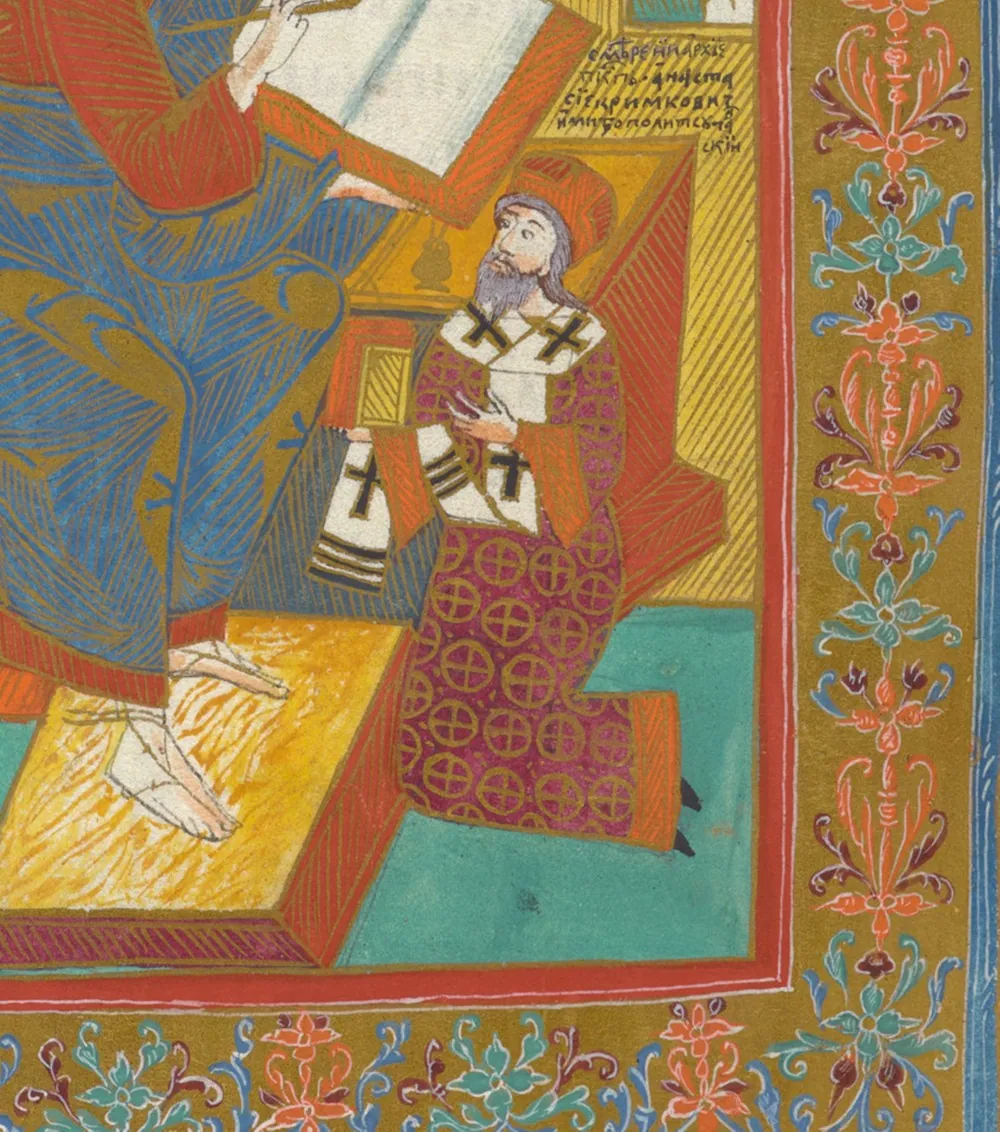
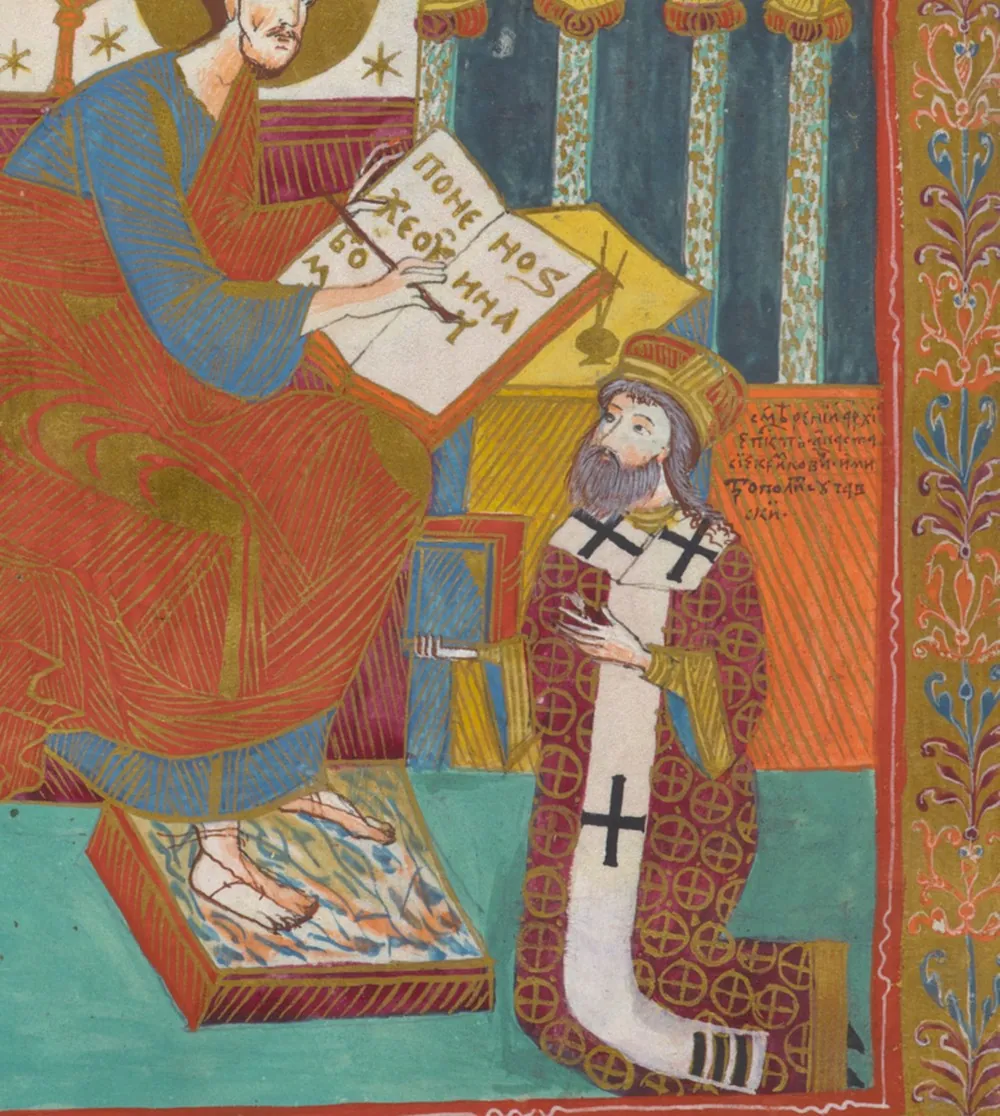
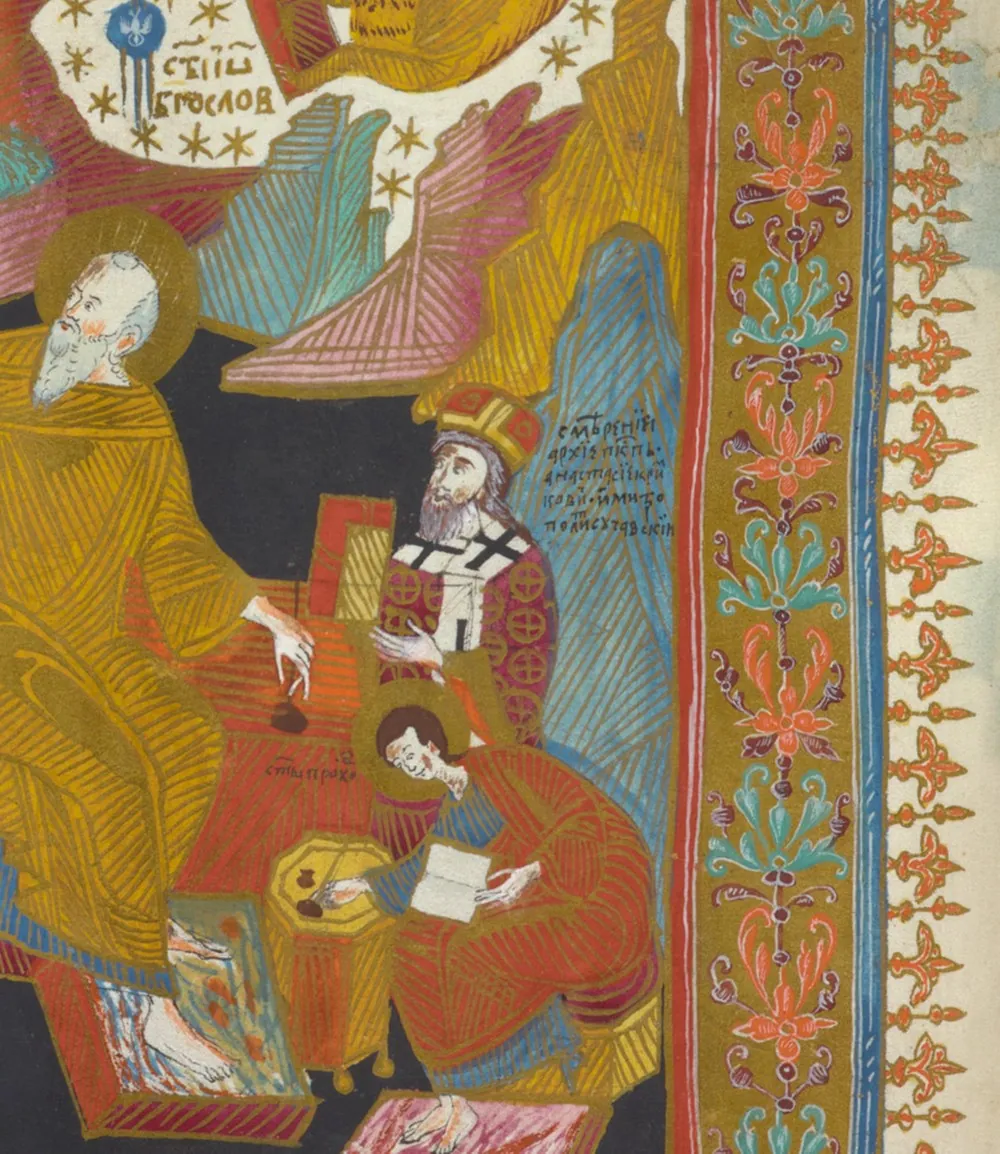
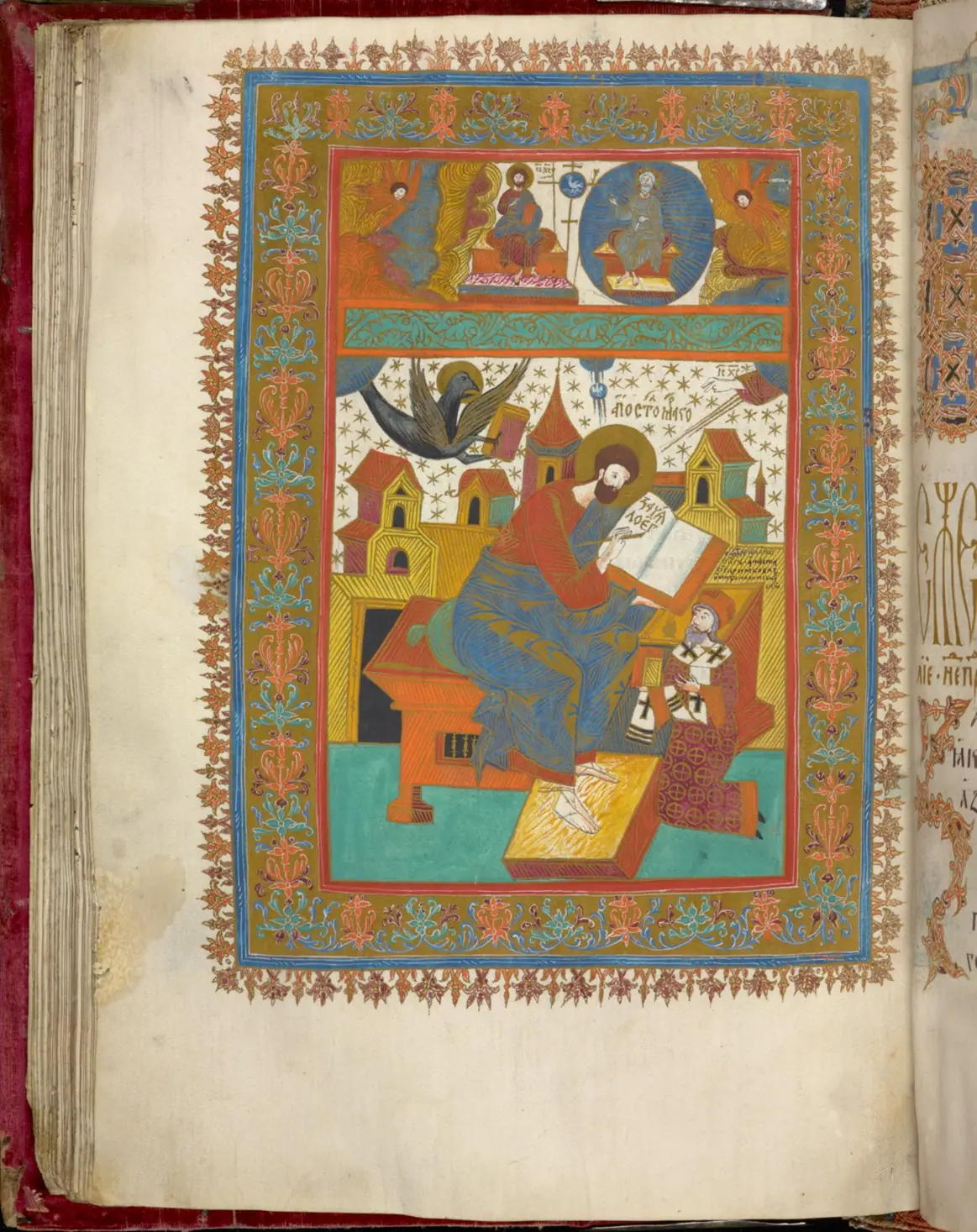
On the page with St Matthew, at the lower right, a bearded bishop kneels holding a book bound in red. The white inscription above names him: "the humble archbishop Anastasie Crimcovici, metropolitan of Suceava". The same figure, with the same cross on his vestment, kneels beside Mark, beside Luke and beside John. On another page Crimca kneels facing his parents, Ioan and Cristina, below a large gold frame left empty.
Portraits like these appear in several books Crimca commissioned. They gave rise to a legend, repeated in popular histories of painting and in church publications: that the Metropolitan wrote and painted his manuscripts himself and was "the first Romanian self-portraitist". The legend leans on the wording of his dedications. The dedication of the 1609 Gospel book kept at Dragomirna says that Anastasie "made and painted it, fitted it with a metal cover and gilded it".
"Съи тетроеѵгль сътвори и живописа, и ѡкова, и позлати смѣренїи архїепскпъ Анастасїе Кримкович […]""This Tetraevangelion was made and painted, fitted with a metal cover and gilded by the humble archbishop Anastasie Crimcovici […]" — the dedication of the Dragomirna Gospel book, 1 September 1609, as transcribed by Pascal.
But in the language of founders, a prince "built" a church that masons raised; a metropolitan "made" a book that others wrote and painted, at his command and with his gift. Pascal found no documentary evidence that the Metropolitan copied or painted these manuscripts, or that he painted his own portraits. The Warsaw book goes further: it names the people who did the work.
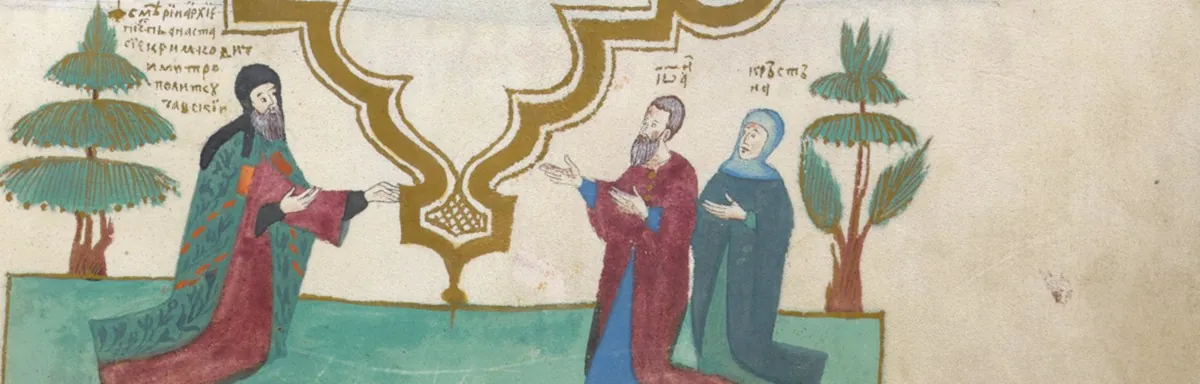
Voroneț, 1614
Teofil, the scribe from Voroneț
The text was written by a monk of the Voroneț monastery, Teofil, in the upright, rounded letters of Moldavian books of the time, with titles and initials in gold and red. He finished copying on 14 September 1614, at Crimca's command.
Teofil was not from Dragomirna. The copyists who left their names in Crimca's books came from several places, and Pascal argues that the work was organised differently from a Western scriptorium with scribes, painters and binders from one house. Of those who worked for Crimca in his lifetime, only the monk Pahomie can be placed at Dragomirna with certainty. In 16th-century Moldavia travelling painters decorated books that had already been written; some manuscripts of the period still have empty spaces where miniatures were meant to go.
In the Warsaw book, the spaces were filled. Miniatures appear throughout the text, from Christ's baptism in the Jordan to scenes of healing and parables, and on some pages Teofil's writing stops twice for someone else's brush.
The measurement
How much of the book is gilded?
The estimate uses 618 images of the book's interior, from image 2 to image 619. On each, the pixels were sorted into gold, colour, ink and bare parchment. The edge under the book is the result, page after page, like a closed book seen from the side.
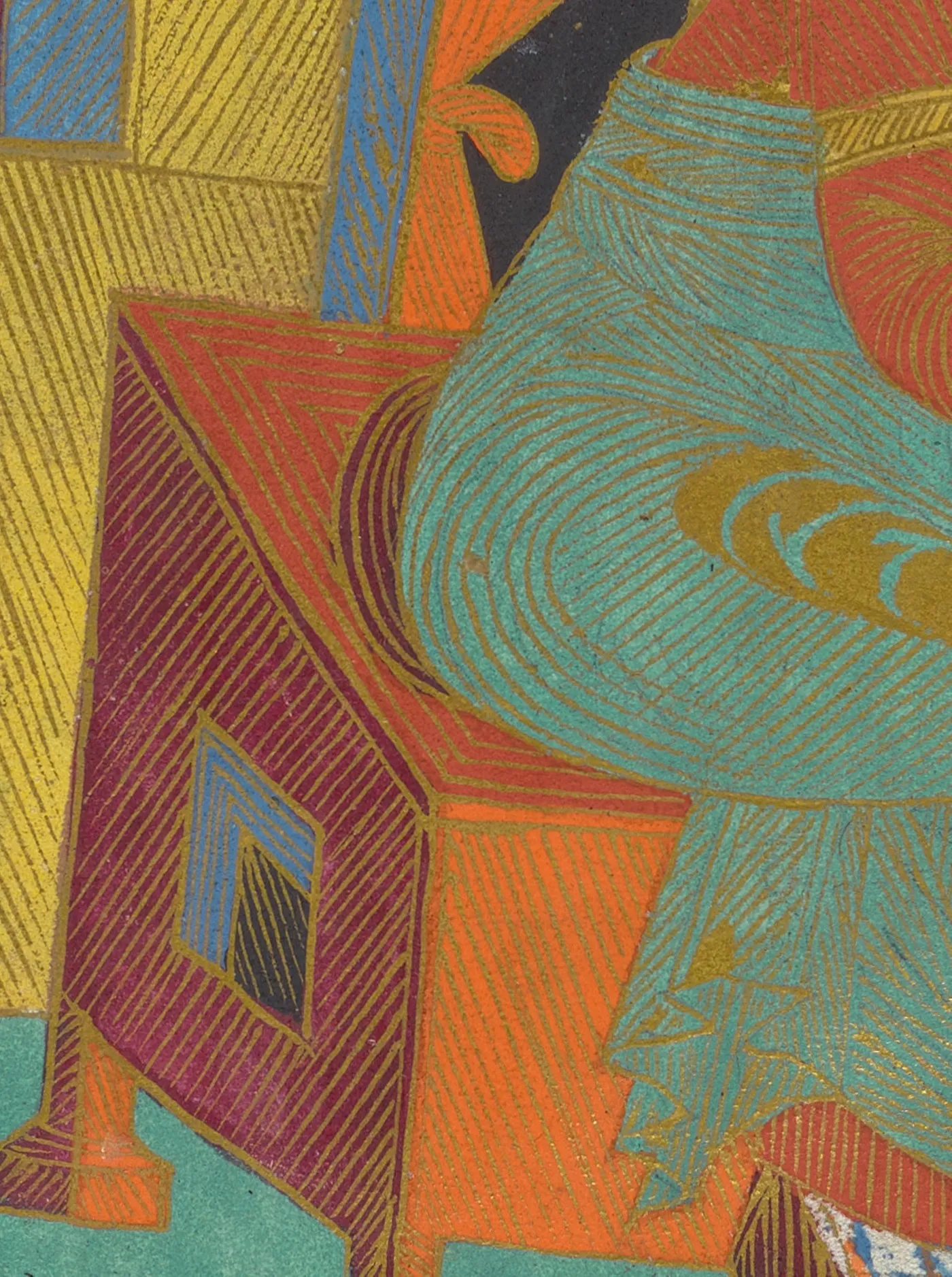
Gold covers about 2.1% of the area analysed (range 1.7%–2.5%). Gathered together it would make about 1.2 square metres, a sheet the size of a small door, spread over pages 36 centimetres tall.
The surprise is where it sits. The four evangelist pages, with the kneeling Metropolitan, are among the most gilded in the book, yet together they hold only 4.5% of the gold identified in the images. The richest 12 pages hold 12%. The rest is spread through the book: in 549 of the 618 images at least 0.5% of the area is classified as gold, and an ordinary text page (one without a large miniature, under 6% gold) has about 1.8%, in initials, titles, haloes and the fine hatching on the robes of the small figures. Half of the gold lies on 132 pages; the other half on the remaining 486. These proportions come from the raw classification, before correction.
The colophon ties the gold to the painter: Ștefan painted the holy icons and gilded the book.
The pages with the largest gilded area
 19.1% · image 180 of 628
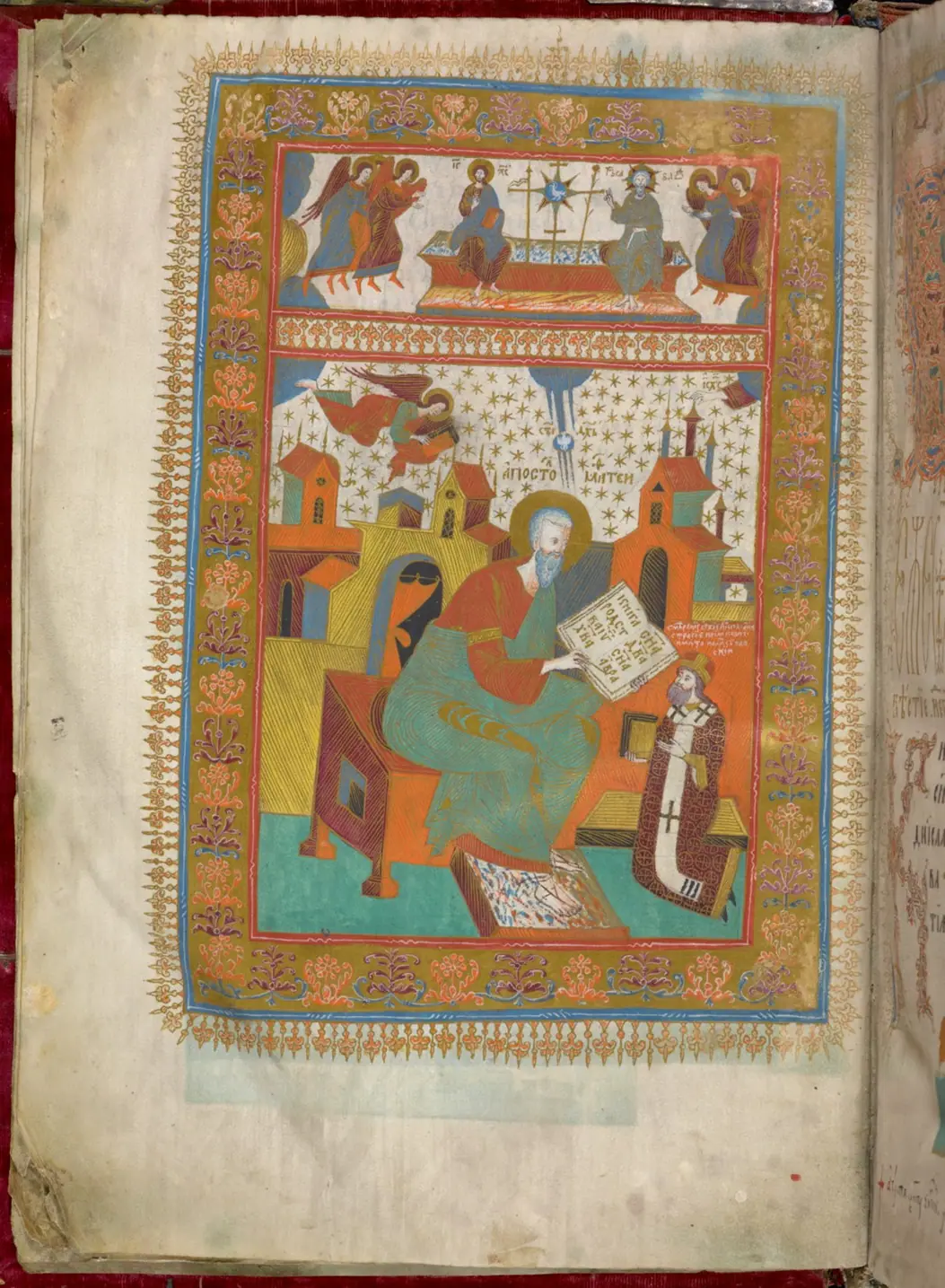 20.0% · image 14 of 628
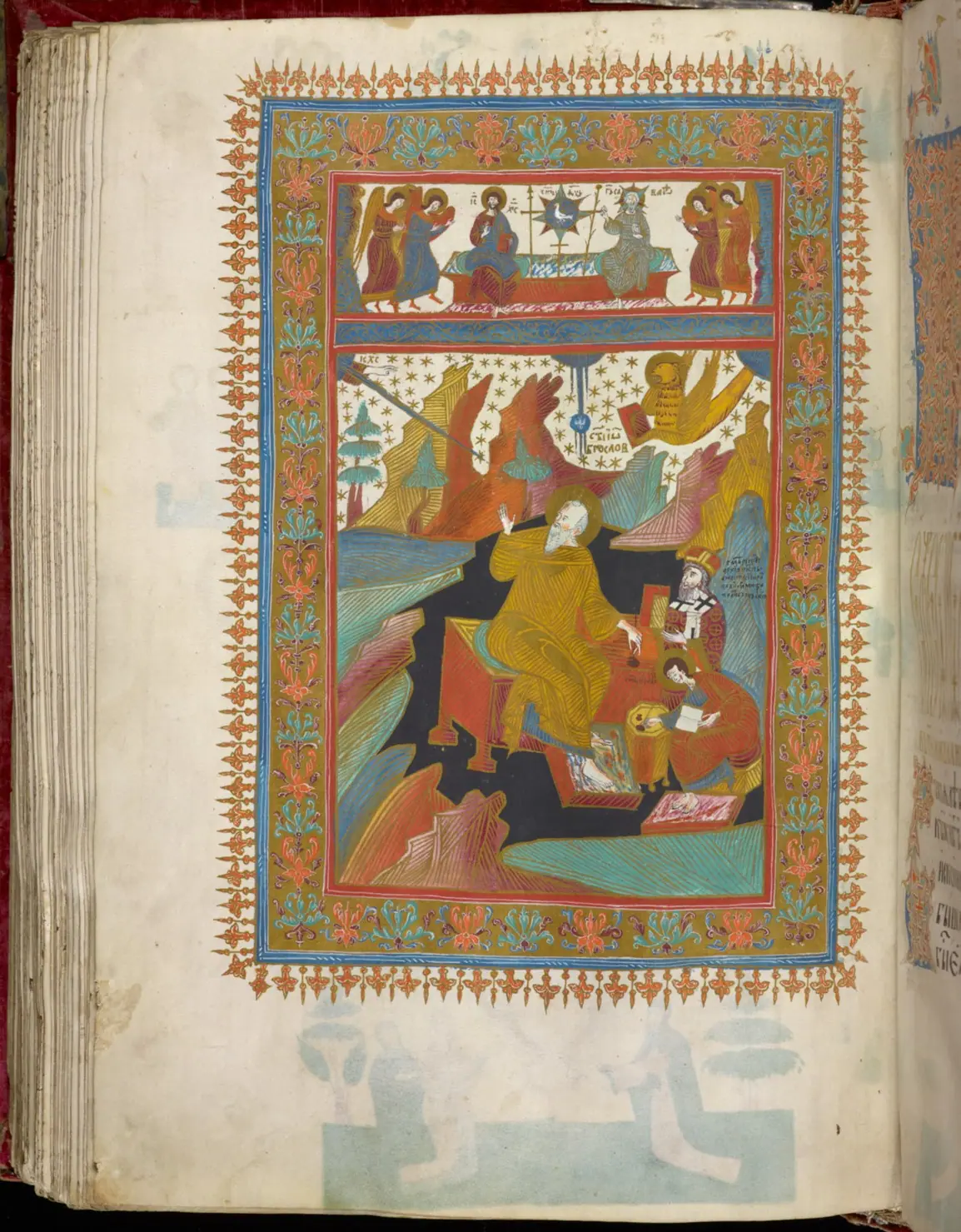 16.3% · image 460 of 628
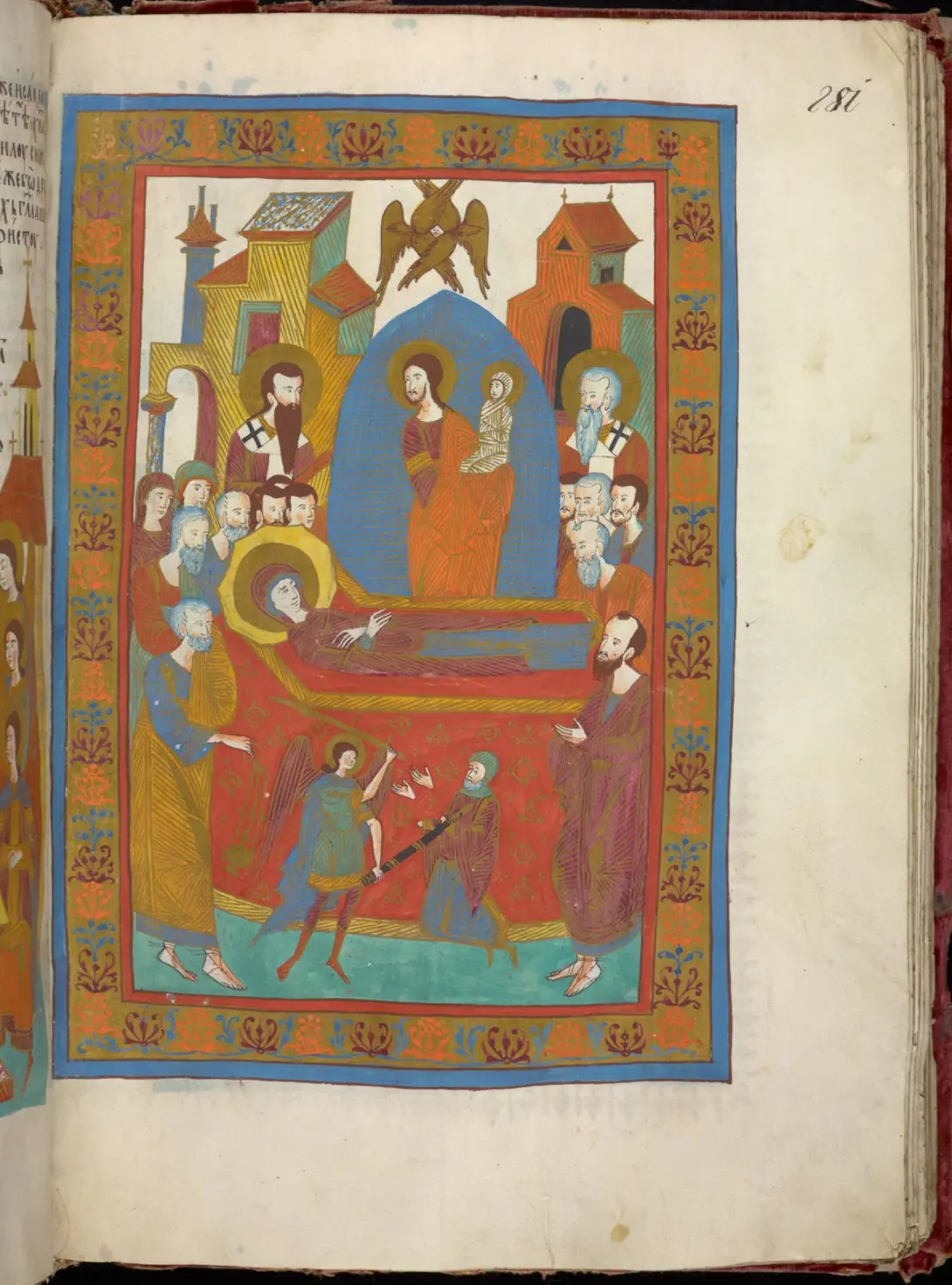 16.9% · image 287 of 628
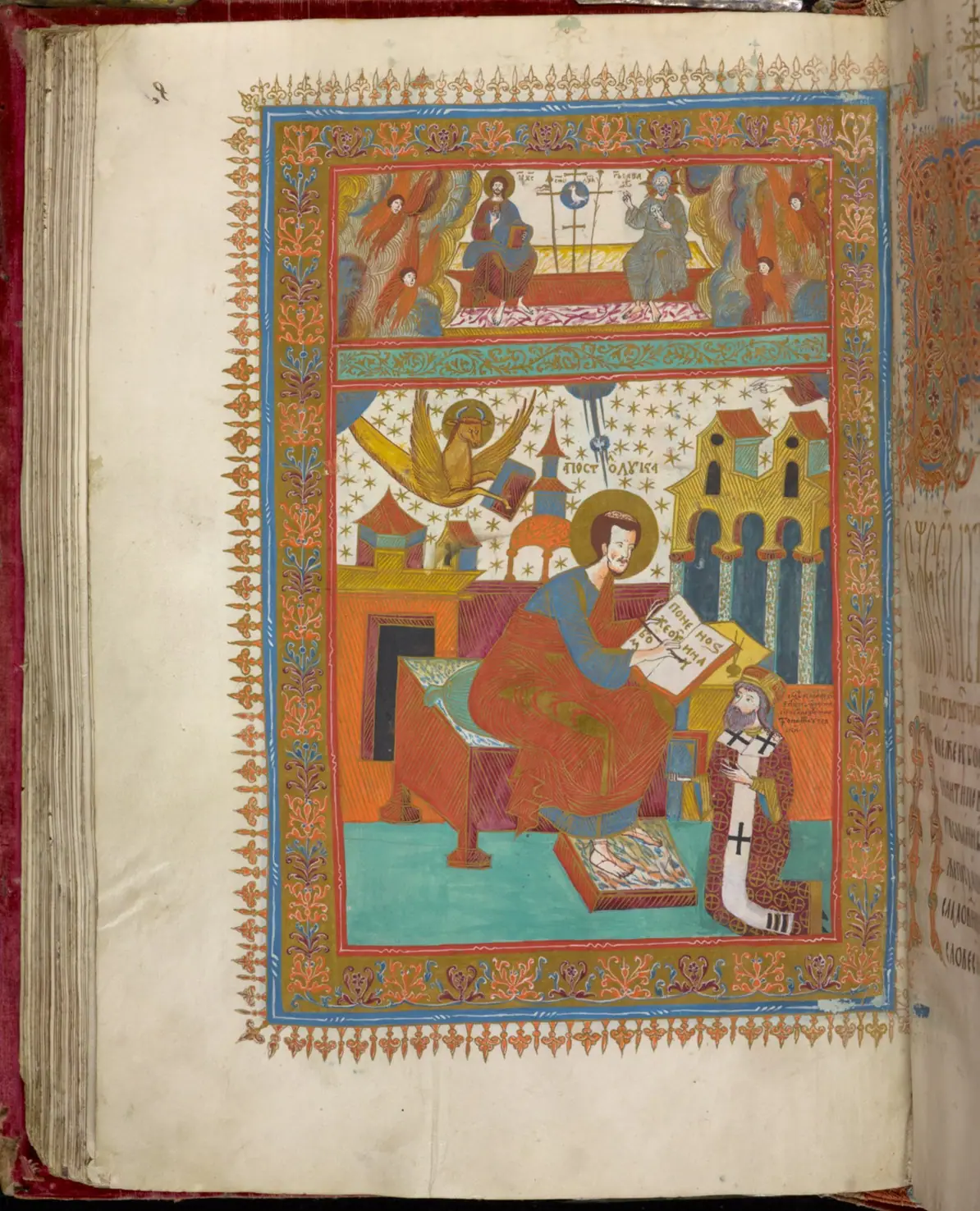 15.0% · image 288 of 628
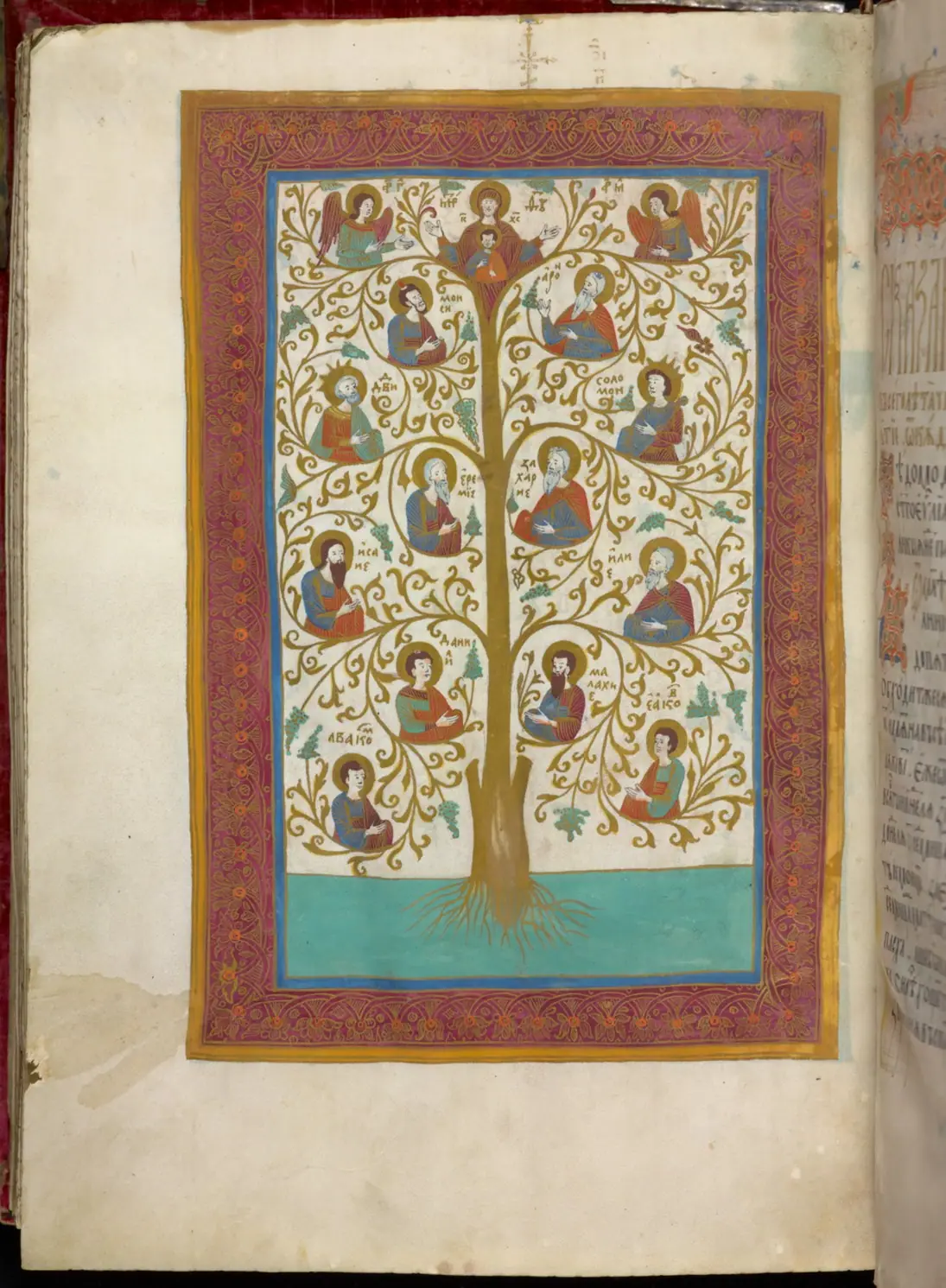 15.0% · image 588 of 628
How the gilded area was estimated
The images come from the Warsaw library at 1,600 pixels tall. On each, the page was found automatically (without the black background or the edge of the facing page), 2.5% of each margin was set aside, and the image was halved in size before analysis. Pixels were classed in the CIELAB colour space by fixed rules: gold shows in a photograph as a dull olive-yellow (hue between 68° and 100°, chroma above 24, medium lightness); the bright yellow of paint is excluded. The rest is split into colour, ink and parchment.
Then 144 points, picked at random on pages picked at random, were checked by eye, separately for each category the analysis assigned; 136 could be judged (8 could not be told). The points were classified at the same scale but with a simpler reduction. Of the points called gold, 40 of 54 were gold (74%); of those called colour, one in 48; of parchment and ink, none of 34. The raw share, 2.6%, was corrected with these rates, and the range reflects the uncertainty of the check. The calculation assumes no gold was missed in parchment and ink, since none was found in the 34 points checked.
The photographs cannot reliably distinguish gold leaf from powdered gold used as paint, so the page speaks only of area covered. The area in square metres assumes pages of 36 by 25 centimetres. Images 2–619 include the inside covers and an inserted document; left out are the closed binding, the photographs of the spine and edges, and the papers at the back (images 1 and 620–628).
1653 · 1658 · Lviv · Warsaw
The theft and the ransom
In 1653, in a war over the Moldavian throne, the Cossacks of Tymofiy Khmelnytsky, son of the Ukrainian hetman, held the citadel of Suceava and plundered the monastery of Dragomirna. They took the Gospel book. Pascal records at least eight manuscripts from his inventory taken then by Tymofiy's men.
The chamberlain (cămăraș) Iane Hadâmbul bought it back and returned it to the monastery on 8 August 1658. The note recording this, in Romanian written in Cyrillic, runs along the bottom of the pages numbered 9 to 14, shown in images 15 to 20, below the text and miniatures.
The book did not stay home. Pascal traces it to the monastery of Krekhiv in Galicia; in Lviv it passed through the Brotherhood Museum and the university library before reaching Warsaw. Crimca's other books are scattered too. Of the manuscripts in the first 37 entries of Pascal's inventory, 17 are now in Russia, 13 in Romania, two each in Poland and Ukraine and one in Vienna; for two, the present location is unknown.
| Country | Manuscripts | |
|---|---|---|
| Russia | 17 | |
| Romania | 13 | |
| Poland | 2 | |
| Ukraine | 2 | |
| Austria | 1 | |
| Location unknown | 2 |

Image 613 · the colophon
What the colophon says
Near the end of the book, after the tables of readings for the year, a thin gold frame encloses nine lines. Move the light across it: first the frame catches, then the initials.
The text has two parts, with two dates. First the scribe: the book was written at the Metropolitan's command by the hand of Teofil of Voroneț, on 14 September 1614. Then the painter: the servant of God Ștefan, a painter from the market town of Suceava, painted the holy icons and gilded the book, and the painting was completed in the year 7125 from the creation of the world, that is, between September 1616 and August 1617.
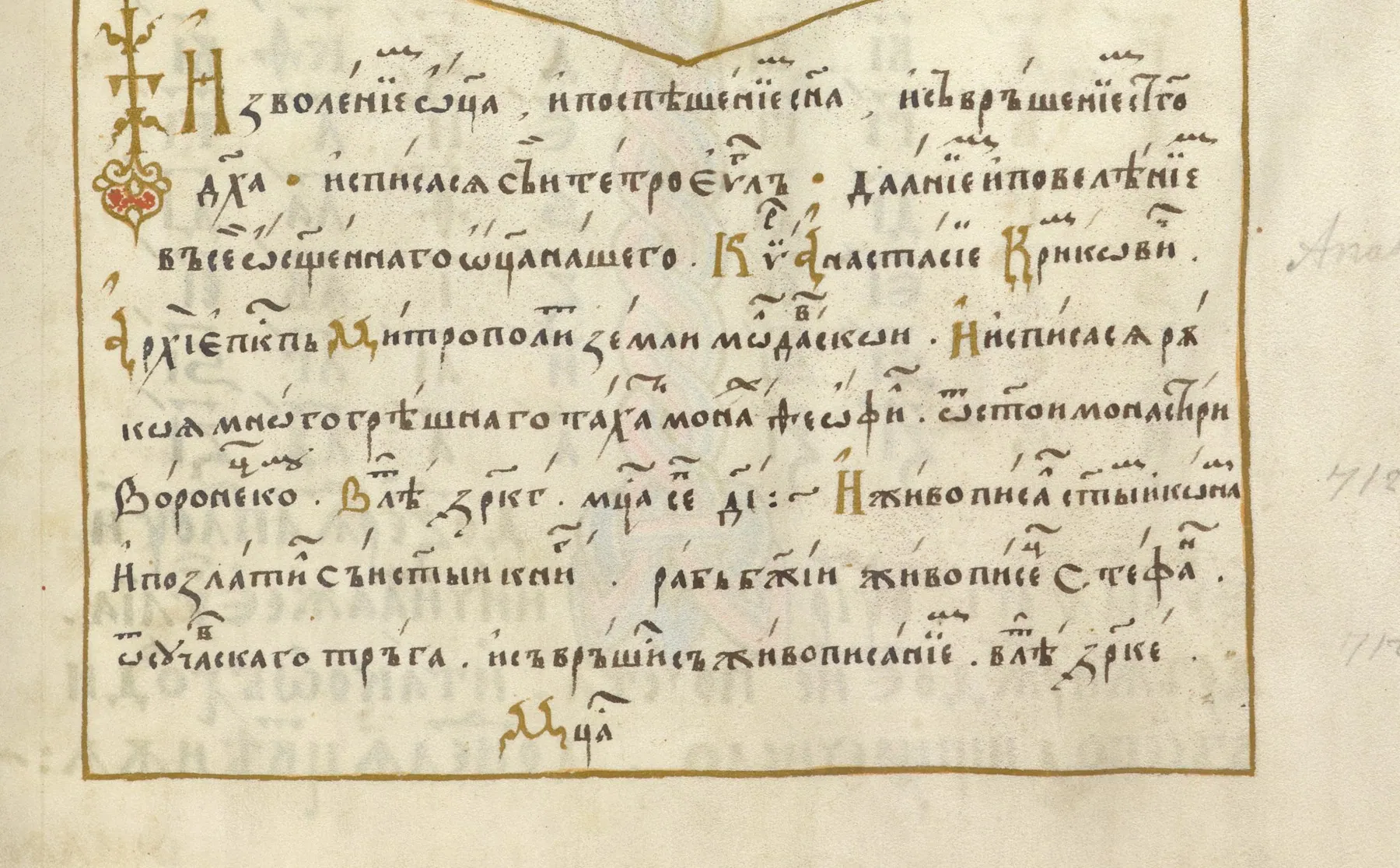
- Изволенїем Ѡц҃а, и поспешенїм Сн҃а, и съвръшенїем Ст҃го Дх҃а. исписасѧ съи тетроvглъ.
By the will of the Father, with the help of the Son and through the work of the Holy Spirit, this Gospel book was written
- даанїем и повеленїем въсеѡсщ҃еннаго ѡ҃ца нашего. кvр Анастасїе Кримкѡвич. архіепскпь митрополит земли Мѡлдавскѡи.
with the support and at the command of our most holy father, Kyr Anastasie Crimcovici, archbishop and metropolitan of Moldavia.
- и исписасѧ рѫкѡѧ мнѡгогрѣшнаго тахати монах Ѳеѡфил. ѿ ст҃ои монастири Воронецкомꙋ. в лѣт ҂зр҃кг. мсца сеп д҃і.
It was written by the hand of the unworthy and sinful monk Teofil of the holy monastery of Voroneț, in the year 7123, on 14 September [1614].
- и живописал ст҃ым икѡнам и позлатил съи ст҃ыи книг. рабь Бж҃іи живописец Стефан. ѿ Сꙋчавскаго тръга.
The servant of God, Ștefan, a painter from the market town of Suceava, painted the holy icons and gilded this holy book.
- и съвръшис живописанїем. в лѣт ҂зр҃ке. мсца
The painting was completed in the year 7125 [1616–1617], in the month of… (the line stays empty)
After the abbreviation for "month", the line is empty. The month and day were never written in. In the margin, a later hand noted in pencil 7123 = 1614 and 7125 = 1617. Between the scribe's last letter and the end of the painting, two years passed, perhaps nearly three.
Crimca commissioned the book and appears in its miniatures, kneeling beside the evangelists; beside Matthew he holds a book bound in red. The colophon names the man who painted the holy icons and gilded the manuscript: Ștefan, a painter from the market town of Suceava.
Sources
The facts above come from these works and from the manuscript itself; the gold figures are measured on the library's images.
- Alexandru Pascal, "О корпусе славянских рукописных книг, созданных по заказу молдавского митрополита Анастасия Кримки (Предварительные материалы)" [On the corpus of Slavonic manuscript books made to the order of Metropolitan Anastasie Crimca], in Arkheograficheskii ezhegodnik for 2024, Moscow, 2025, pp. 186–220: inslav.ru (PDF) — the inventory of manuscripts, the dedications, the Warsaw colophon, the theft of 1653.
- Polona, record and images of the manuscript: polona.pl; copies of some pages on Wikimedia Commons: Category:Evangelie (BN Rps 12690 IV).
- Ștefan S. Gorovei, case study on Dragomirna monastery, in Patrimoniul nostru istoric: academia.edu — Iane Hadâmbul, the reading "тахати", the miniature with the parents, the book's route through Lviv.
- Émile Turdeanu, "Le métropolite Anastase Crimca et son œuvre littéraire et artistique (1608–1629)", Revue des études slaves 29, 1952, pp. 54–70; Ștefan S. Gorovei, "Anastasie Crimca. Noi contribuții", Mitropolia Moldovei și Sucevei 55, 1979 (the inventories of 22 and 27 manuscripts; A. I. Yatsimirsky had counted 14).
- "Memoria Bisericii în imagini: Dragomirna lui Anastasie Crimca", Ziarul Lumina: ziarullumina.ro — the church's dimensions.
Images and type
- The Warsaw Gospels (Tetraevangelion, 1614–1617), National Library of Poland, Rps 12690 IV: all 628 images, through the Polona IIIF service; public domain.
- Church of the Descent of the Holy Spirit, Dragomirna: photograph by DimiTalen, 2017, Wikimedia Commons, CC0.
- Type: Brygada 1918, Sofia Sans Condensed and Ponomar (SIL Open Font License).