Skier’s added stress vs the snow’s own: small double
30–35°35–40°40–45°>45°
Făgăraș, Romania · avalanches
The hidden layer
On the slopes above Bâlea Lake, in Romania’s Făgăraș mountains, snow lies in layers, one for each snowfall. Sometimes a thin, fragile one is left between them. Go down through the snow to it, then under the avalanche, where the minutes are counted.
Scroll
The Bâlea cirque from above
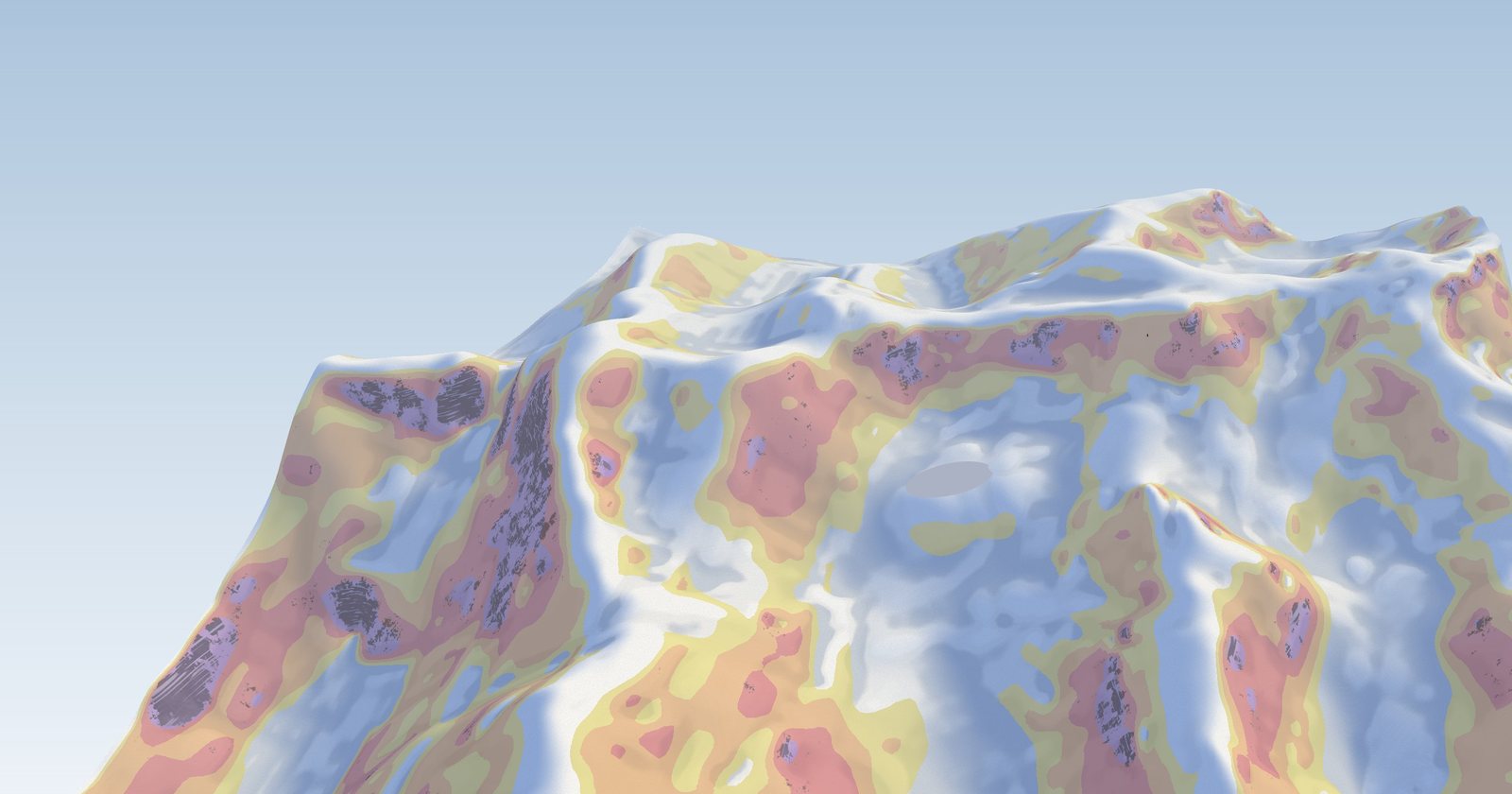
Where a slab can start
The colours show steepness: yellow from 30°, orange from 35°, red from 40°, violet above 45°. A slab avalanche needs a slope of at least about 30°.
In 617 human-triggered avalanches in Switzerland, the slope in the starting zone was typically 38°; in four cases out of ten, 40° or more.
The relief is real, from an elevation model of about 30 m, placed on a 16 m grid. Short, steep features, a cornice or a gully, do not show in it.
A north-facing slope
A skier on a 38-degree slope
The slope above the lake, at about 2,280 metres, looks like any other: white, smooth, quiet. What matters cannot be seen from above.
Over ten winters studied in Switzerland, nine in ten people killed by avalanches during recreation off controlled pistes (touring and off-piste skiing) were caught by an avalanche they or someone in their group had triggered.
In section
Every snowfall leaves a layer
The snow on a slope is not one block. Every snowfall, every day of wind, sun or hard frost leaves a layer with its own grains.
Some layers turn into large crystals with flat faces: faceted grains or depth hoar. Most weak layers behind human-triggered avalanches are made of crystals like these.
Higher up, wind blows and deposits the snow into a wind slab, cohesive, that can break away in one piece.
A slab on its own is not the problem. The problem is a weak layer beneath it.
Magnified, millimetre by millimetre
The slab rests on the tips of feathers
Under particular weather, hoar grows on the snow surface: crystals as thin as feathers. If snow falls on them, they are buried still standing.
In human-triggered avalanches in Switzerland, more than nine in ten weak layers identified were made of large crystals with flat faces: surface hoar, faceted crystals or depth hoar. These persistent layers last, and most fatal avalanches start in them.
Above, the rounded grains of the slab are welded together. Below, in the drawing, is a refrozen crust. Between them, the weak layer can collapse all at once.
Under the skis
The skier’s weight reaches down
The colour on the cut face shows how hard the skier pushes the snow downslope, on top of the weight of the snow above. The effect fades fast with depth. In Föhn’s classic static model (1987), 30 cm below the skis (measured perpendicular to the slope) the skier adds 113% of the stress the snow itself causes, at half a metre 41%, at one metre only 10%.
That is why skiers rarely trigger avalanches when the weak layer is deeper than about a metre. If the layer fails, the crack does not stay under the skis: it runs through it, under the slab, at 36–49 metres a second in field measurements, and the slab breaks away at the top along a sheer wall.
The release, in real time
The slab sets off downhill
Large dry-snow avalanches come down at 50 to 200 km/h. In the Swiss data, a slab triggered by people is typically 50 metres wide, 80 metres long and 45 centimetres thick at the fracture.
In the scene, a slab of that size sets off from the real slope above the lake. The motion is a simple friction model, not a reconstruction of any particular avalanche; the blocks reach about 80 km/h.
Your turn
Change the slope and the snow
Choose the steepness, how much new snow has fallen and how much wind has blown. The scene rebuilds the slab and shows how much of the skier’s weight reaches the weak layer.
This page is not an avalanche forecast. Whether a real slope is stable depends on layers you cannot see from above.
Wind
A simplified drawing: one weak layer, a slab of average density, a skier as a load spread along a metre of ski. It does not say whether a real slope is safe: neither the angle nor the snow seen from above can say that.
Under the avalanche
A metre under the snow
Someone completely buried has head and chest under the snow and can barely breathe. In Switzerland, half of those completely buried were at most 80 centimetres down; in Canada, at most a metre.
An air pocket in front of the mouth helps, especially if rescue takes longer than a quarter of an hour.
The burial clock
The first minutes decide
In Swiss data from 1981–1998, of those completely buried in open terrain, 91% were alive after 18 minutes. At 35 minutes, 34% were: most die of suffocation. The curve then flattens until about 90 minutes; after that, cold and ever poorer air take those still alive, and from 130 to 190 minutes 7% were alive.
The chart shows a later study: a larger Swiss dataset that includes those years, analysed differently, beside data from Canada, from 1980–2005. In Canada the curve first steps down in the opening minutes, from injuries, then falls earlier, after about 10 minutes, and more steeply; almost one in five deaths there was caused by injuries. The authors recommend getting a buried person out ideally within 10 minutes.
Drag the clock to see the odds fall.
Who digs
Help comes from those already there
In the first 10–15 minutes, a buried person depends on those already beside them. A mountain rescue team has to be called first, then climb up.
That is why everyone in a group carries an avalanche transceiver, a probe and a shovel. The transceiver finds the buried person’s signal, the probe pins down where and how deep, the shovel gets them out.
Scotland and Romania
Forecasts and deaths in the hills
In Scotland, the Scottish Avalanche Information Service forecasts avalanche danger daily for six areas through the main winter season, on the same five-level European scale. In the 15 winters to 2023/24 its reports list 23 deaths in human-triggered avalanches, eight in 2012/13 alone, four of them in one party on Bidean nam Bian in Glencoe.
Romania’s worst avalanche fell here, at Bâlea Lake, on 17 April 1977: 23 dead, 7 adults and 16 children from the Brukenthal German high school in Sibiu. The skiers cracked the surface slab, which slid on a frozen crust. In the Făgăraș, from 1963 to 2015, avalanches killed 76 people, and more have died since in the Retezat and Călimani (2017), the Bucegi (2018 and 2026) and again at Bâlea Lake (2024). Romania’s weather service publishes a snow and avalanche bulletin for nine massifs, from the Bucegi and Făgăraș to the Rodna and Vlădeasa, on the same scale; for 22–24 November 2026 it gave the Făgăraș above 1,800 m moderate danger (2). A national yearly count of avalanche deaths does not appear in the Salvamont, IGSU or ANM publications consulted.
1Low
2Moderate
3Considerable
4High
5Very high
To remember
An avalanche starts in a layer you cannot see.
Before a winter outing, read the avalanche forecast and go with people who know the mountain. Everyone carries a transceiver, a probe and a shovel, and knows how to use them. If an avalanche takes someone, the first minutes belong to those beside them.
Pass it on
Someone is heading for the hills this winter. Send them the story of the hidden layer.
Share
Sources and method
Every number in the story comes from one of the sources below.
The Bâlea cirque relief comes from Terrarium elevation tiles (zoom 14, SRTM-based), resampled to a 256 × 256 grid over 4.2 km and lightly smoothed; slope angle is computed on that grid. The release zone is picked automatically: a 38° north-facing slope above the lake. The avalanche in the scene is a Voellmy friction model (μ = 0.3, ξ = 2,000 m/s², flow depth 1.5 m) on the real relief, illustrative, not a calibrated simulation. The skier’s load follows Föhn’s model (1987), as given by Schweizer (1997): a 500 N/m load on an elastic half-space, compared with the stress along the slope from a 200 kg/m³ slab (ρ·g·D·sin ψ, depth D measured perpendicular to the slope). The chart curves are read from Figure 1 of Haegeli et al. (2011), to about ±1 minute and ±2 percentage points; the 91%, 34% and 7% in the text come from Brugger et al. (2001), a smaller Swiss sample that overlaps the chart’s. This page is not an avalanche forecast and does not say whether any slope is safe.
Brugger et al. (2001), "Field management of avalanche victims", Resuscitation 51: Switzerland, 1981–1998; completely buried in open terrain (638): 91% alive at 18 minutes, 34% at 35 minutes, 7% from 130 to 190 minutes. pubmed.ncbi.nlm.nih.gov
Haegeli et al. (2011), "Comparison of avalanche survival patterns in Canada and Switzerland", CMAJ 183: 301 complete burials in Canada and 946 in Switzerland, 1980–2005; the chart curves are read from Figure 1; median depths, causes of death. pmc.ncbi.nlm.nih.gov
Procter et al. (2016), Resuscitation 105: Austria and Switzerland, 2005–2013; an air pocket helps especially beyond 15 minutes. pubmed.ncbi.nlm.nih.gov
Schweizer and Lütschg (2000), human-triggered avalanches in the Swiss Alps, ISSW: ten winters; nine in ten victims caught by avalanches they or their group triggered; medians: 38°, 50 × 80 m, 45 cm; the weak layers. www.slf.ch
Schweizer, Bartelt and van Herwijnen (2015), "Snow Avalanches", chapter 12 of Snow and Ice-Related Hazards, Risks and Disasters: the threshold of about 30°, slab thickness, persistent layers, speeds of 50–200 km/h. www.slf.ch
Bergfeld et al. (2022), "Crack propagation speeds in weak snowpack layers", Journal of Glaciology 68: mean crack speeds of 36–49 m/s measured in the field. www.cambridge.org
Schweizer (1997), SLF report on the stability index: Föhn's (1987) model, the skier as a 500 N/m load on an elastic half-space. www.slf.ch
McClung and Schweizer (1999), Journal of Glaciology 45: skiers rarely trigger avalanches with the weak layer deeper than a metre. doi.org
European Avalanche Danger Scale (EAWS): the five levels. www.avalanches.org
EAWS glossary (Romanian): the Romanian terms for surface hoar, depth hoar, faceted crystals and weak layer. www.avalanches.org
ANM (Romanian weather service), snow and avalanche bulletin for 22–24 November 2026: massifs covered, the danger in Făgăraș, the snow at Bâlea-Lac. www.meteoromania.ro