Cell engineering / oncology / autoimmune disease
Diseases treated once, not every day
Most chronic illness is managed with a pill, an infusion, or an injection that never stops. A small number of diseases are now being treated the opposite way: engineer a patient's own immune cells once, let them do the rest. The idea started in blood cancer. In September 2026, two unrelated papers — one in lupus, one in a toddler's liver cancer — tested how far it reaches.
A patient with systemic lupus erythematosus. Left alone, lupus is a lifetime disease: immunosuppressants, flares, kidney damage, a medication schedule that never has an end date, because the immune system that attacks the body's own tissue never stops being made the same way. In September 2026, a Chinese biotech reported that 6 of 10 evaluable lupus patients who received three weeks of an antibody infusion were in remission a year later — off the drug entirely, a year after the last dose.
In Texas, a 3-year-old boy had metastatic hepatoblastoma, a liver cancer that had stopped responding to chemotherapy. He received two infusions of engineered immune cells. A year later, the cancer was gone.
Neither case is a cure announced to the public with confidence. One is an uncontrolled trial of 12 people; the other is a single child. But both trace back to the same idea, discovered by accident in leukemia a decade ago: some diseases can be reset by a short, intense intervention instead of suppressed for life. This piece traces that idea from its origin in leukemia to what these two 2026 papers actually show.
The mechanism
Turning a patient's own cells into a weapon
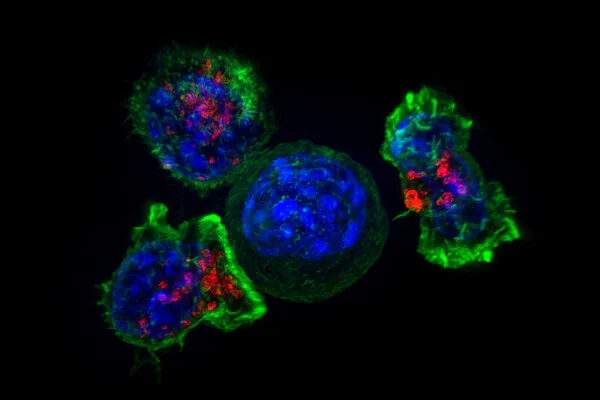
CAR-T — chimeric antigen receptor T-cell therapy — does not add a drug to the body. It rebuilds part of the immune system, outside the body, then puts it back in.
Apheresis
Blood is drawn from the patient and passed through a machine that keeps the white blood cells, including T cells, and returns the rest.
Genetic engineering
A disarmed virus inserts a new gene into the T cells, instructing them to build a chimeric antigen receptor: a lab-designed sensor that recognizes one target — usually a protein called CD19, found on the surface of B cells, including most B-cell cancers — fused to the internal machinery that fires up a T cell once it makes contact.
Growing the batch
The engineered cells are multiplied for one to a few weeks in culture until there are enough — hundreds of millions — to treat the patient.
Lymphodepletion
Days before infusion, the patient receives chemotherapy (usually fludarabine and cyclophosphamide) not to fight the disease but to clear out existing immune cells, so the new ones have room to expand and are not immediately suppressed by the body's own regulatory cells.
Infusion and expansion
The engineered T cells are infused back into the patient, where they multiply on their own — sometimes a thousandfold within two weeks — find any cell carrying the target protein, and kill it.
The receptor itself has gone through several redesigns since the 1990s. Early ("first-generation") versions could recognize a target but barely activated the cell. Nearly every CAR-T product used today is "second-generation": the sensor is fused to one additional signal — usually from a protein called CD28 or one called 4-1BB — that keeps the T cell dividing and surviving instead of switching off after a few kills. The most recent designs, called "armored" or fourth-generation CARs, go a step further and make the engineered cell secrete its own growth signals — cytokines such as IL-15 or IL-21 — so it keeps working even inside tissue that would normally exhaust it. That specific design is what put a 3-year-old's liver cancer into remission; more on that below.
Where it already works
Blood cancer, in real trial numbers
The first CAR-T product was approved for a child who had already relapsed twice. Ten years later, six products are approved, all for blood cancers — because CD19 (or a related target, BCMA) sits on the cancer cells and on healthy B cells alike, and losing your B cells for a while is a survivable trade.
Emily Whitehead, age 6, becomes the first child treated with CD19 CAR-T at Children's Hospital of Philadelphia after two leukemia relapses. She develops a severe cytokine storm, is placed in a medically induced coma, and wakes up in remission on her seventh birthday — the case that pushed doctors to try tocilizumab, an arthritis drug, against the storm.
The FDA approves Kymriah (tisagenlecleucel), the first CAR-T therapy and the first gene-transfer therapy ever approved in the United States, for B-cell leukemia in patients up to 25 who had relapsed or stopped responding to treatment. The pivotal trial infused 75 patients; 81% went into remission.
Yescarta is approved for adult large B-cell lymphoma after at least two prior treatments had failed. In its pivotal trial, 101 patients were treated; 83% responded, 58% completely.
Abecma and later Carvykti are approved for multiple myeloma, targeting BCMA instead of CD19. In Carvykti's trial, 97 heavily pretreated patients were infused; 98% responded. Five years later, a third of them were still alive and progression-free with no further treatment.
The FDA orders a class-wide warning on all approved CAR-T products after 22 cases of secondary T-cell cancers — some fatal — were reported across everyone treated so far. The rate is still unknown; the warning stands regardless.
The FDA lifts the mandatory monitoring program (REMS) for CD19 and BCMA CAR-T products, judging that oncology centers now manage the therapy's short-term risks routinely. Long-term safety studies stay required.
None of this is free of cost, in either sense of the word. The infusion itself frequently triggers cytokine release syndrome — the same storm that nearly killed Emily Whitehead — as billions of activated T cells flood the bloodstream with inflammatory signals. It happens in roughly eight or nine of ten patients after some products, though a severe (grade 3 or higher) case is much less common and is now treated routinely with tocilizumab and steroids. A smaller share of patients develop neurological symptoms, from confusion to seizures, usually reversible. Every infusion requires a hospital equipped to manage both, which is why CAR-T is available only at specialist centers, not any oncology clinic.
Then there is manufacturing. Each dose is personal: a patient's own cells, engineered for that patient alone, batch-tested, and shipped back — a process that typically takes two to five weeks from blood draw to infusion, during which an aggressive cancer keeps growing. List prices for the approved products run from roughly $370,000 to $475,000 for the cell product alone, before hospitalization; that figure moves as new products launch and should not be read as a current fixed price.
The new frontier
If it can reset a cancer-fighting cell, can it reset an immune system?
Lupus, and diseases like it, happen when the immune system's B cells start manufacturing antibodies against the patient's own tissue. Standard treatment suppresses that process — for life, because the flawed B cells keep regenerating. In 2021, a German team at Erlangen tried something else: instead of suppressing the B cells, they used CD19 CAR-T to wipe them out completely, the same tool built for leukemia, aimed at a disease that isn't cancer at all.
Five patients with severe, drug-resistant lupus received a single CAR-T infusion. Their B cells vanished — and came back weeks later behaving differently: naive, with no memory of attacking the patient's own body. All five reached remission without any further lupus medication. A larger 2024 follow-up, 15 patients across lupus, scleroderma and inflammatory myositis, found the same pattern: every one of the eight lupus patients reached full clinical remission after one infusion. A newer 24-patient basket trial confirmed the safety profile held at scale, with a handful of pre-infusion flares as the main complication.
The single-cell sequencing behind these results is what makes "reset" more than a nice word: the interferon signature that drives lupus — a chronic false alarm spread across B cells, T cells and the innate immune system — falls across all of those cell types after the B cells regrow, not just in the B cells that were targeted. Something about deep depletion appears to let the whole system restart its calibration, not just remove the cells doing the damage.
CAR-T for lupus works, in these small studies — but it still needs everything blood-cancer CAR-T needs: chemotherapy first, a specialist center, weeks of manufacturing, a price closer to the cancer indication than to a monthly immunosuppressant. That gap is what a bispecific antibody called A-319 tried to close.
A-319: the same effect, without building a new cell
A-319 is not CAR-T. It is a manufactured antibody with two arms: one grabs a patient's own T cells by a receptor called CD3, the other grabs CD19 on B cells, physically forcing the two into contact so the T cell kills the B cell — the same kill mechanism as CAR-T, achieved without engineering or growing any new cells. Because it's a standard drug, not a personalized cell product, it can be manufactured in advance and shipped anywhere.
Twelve patients with active lupus received three weeks of A-319 infusions, after a week of lower priming doses, in a phase 1 trial published in Nature Medicine on 10 September 2026. Safety was the actual goal of the trial, and on that count it did well: no deaths, no severe cytokine release syndrome, no severe neurological events; 11 of the 12 patients had a mild, grade-1 reaction that needed no treatment. Efficacy was a secondary, exploratory measure — of the 10 patients still evaluable at 12 months, 8 reached low lupus disease activity and 6 met the stricter definition of remission, alongside falling autoantibody levels and less protein leaking into the urine, a marker of kidney damage.
Sequencing showed the same pattern seen after CAR-T: suppressed interferon signatures across B cells, T cells and myeloid cells, and a B-cell population that came back looking newly made rather than recycled. If that holds up in a larger trial, it would be evidence that the "reset," not just the depletion, is the active ingredient — and that it might not require a bespoke cell product to trigger it.
The harder problem
Why this barely works yet against solid tumors
CD19 sits on the surface of essentially every B cell, cancerous or not, which is why targeting it works so cleanly: the CAR-T cells can't miss, and losing all your B cells for a while is tolerable. Solid tumors — lung, liver, brain, pancreas — offer none of that. Their surface markers vary from cell to cell within the same tumor, letting a fraction of cells escape untouched; and the tissue around the tumor actively suppresses T cells, starving them of oxygen and flooding them with signals that make them stop working within days of arrival.
One response has been to engineer the T cell to resist that exhaustion rather than only recognize the tumor better. That is what happened to a 3-year-old boy with hepatoblastoma, a liver cancer that had already stopped responding to chemotherapy and had spread. Doctors at Baylor College of Medicine and Texas Children's Hospital gave him two infusions of T cells engineered to recognize glypican-3, a protein common on hepatoblastoma cells, and additionally modified to manufacture two of their own growth signals, interleukin-15 and interleukin-21, once inside the body.
Reported in the New England Journal of Medicine in September 2026: complete regression, holding for at least 12 months. Laboratory work behind the design, published years earlier, found the reason the added cytokines matter — they keep a protein called TCF-1 switched on inside the T cells, which keeps a fraction of them in a less-mature, longer-lived state instead of burning out after their first few kills.
An earlier, related design — the same target, armored with IL-15 alone, tested in adults with several GPC3-positive solid cancers — had already shown a 66% disease-control rate and a 33% response rate, with cytokine release syndrome as the main toxicity, managed with a built-in genetic safety switch that can shut the cells down if needed. The pattern across both is consistent: giving the cell its own fuel, not just a better target, is what's moving solid-tumor CAR-T from failure to occasional success.
Where it's headed
Cheaper, faster, and eventually made inside the body
Every barrier described above — cost, weeks of manufacturing, chemotherapy first, specialist centers only — traces back to one design choice: each dose is built from that one patient's own cells. Three lines of research are trying to remove that constraint.
| Approach | What changes | Status, 2026 |
|---|---|---|
| Allogeneic ("off-the-shelf") CAR-T | Cells come from a healthy donor, gene-edited to avoid attacking the patient and to avoid being rejected, then banked and shipped like any other drug. | No product approved yet; Allogene's cema-cel in a late-stage trial for lymphoma. |
| In vivo CAR-T | A lipid nanoparticle or viral vector is injected directly into the patient and builds the CAR inside T cells that never leave the body — no apheresis, no lab, no waiting weeks. | Early-stage human trials only; Capstan Therapeutics' lead program began phase 1 in mid-2025. |
| CAR-NK cells | Uses natural killer cells, often from banked donor cord blood, instead of T cells — they don't need to be matched to the patient and appear less likely to trigger cytokine storms. | Early trials promising: one cohort of 11 patients saw 8 respond with no severe cytokine release syndrome at all. |
None of these has yet matched standard CAR-T's track record in blood cancer. What they share is the goal that would matter most for reach: making the "reset" available as something closer to an ordinary drug — refrigerated, pre-made, given at an infusion center rather than a transplant unit — the same logic A-319 is testing with an antibody instead of a cell.
Closer to home
Can a patient in Romania get this?
For blood cancer, yes, and it's funded. For lupus, solid tumors, or any next-generation approach described here, not yet.
Romania's national health insurer, CNAS, reimburses CD19 CAR-T through its oncology medicines program, at Institutul Clinic Fundeni in Bucharest, for the same two indications approved elsewhere: relapsed leukemia in patients up to 25, and relapsed large B-cell lymphoma in adults. According to CNAS's own 2023 activity report, 10 patients were treated that year — one more than the 9 the program had budgeted for — at an average cost of roughly 1.49 million lei per patient, close to €300,000, for a total program spend of nearly 14.9 million lei. Patients' blood is collected in Romania and sent abroad for manufacturing, then returned for infusion; a second center, in Iași, was reported accredited by the end of 2024.
What isn't established: whether CD19 CAR-T for lupus, the A-319 antibody, or any solid-tumor "armored" CAR-T is available to Romanian patients through any pathway, funded or not. None of these appeared in the sources checked for this piece, and no announcement was found stating otherwise — which means the honest answer, for now, is that they aren't known to be, not that they've been ruled out.
Method
How this was reported
Every efficacy figure above is given with the number of patients it was measured in and the phase of the trial that produced it, because a percentage without those two numbers can't be judged. The two anchor 2026 studies — the A-319 lupus trial and the hepatoblastoma case — are published in subscription journals; the lupus trial's numbers come from its own public abstract, read directly, and the hepatoblastoma case's core facts (patient age, treatment, and outcome) come from the paper's public abstract, with mechanism details drawn from earlier, openly available research on the same cell design. Where a figure could only be confirmed through trade or institutional reporting rather than a scientific paper — including the Romanian CNAS spending figures, drawn directly from CNAS's own 2023 report — that is stated beside the figure.
iTabMed, the manufacturer of A-319, employs several authors of the trial paper, some of whom hold equity or patent interests in the drug; that is disclosed in the paper itself and repeated here because it bears on how the trial's own efficacy claims should be weighed, not because it invalidates them.