mariuscomper.uk
ENROIT

Italy, 1923–1960 · a map, town by town

The 2,094 Italian towns abolished under Mussolini, and the 898 that came back

On 6 February 1926 Nervi, a seaside town near Genoa, stopped being a town: a decree made it a district of the city. Italy is divided into comuni, each a town or village with its own town hall. Between 1923 and 1935 Mussolini’s government abolished 2,094 of them and attached each to a neighbour. The houses and the people stayed; the town hall did not. 898 have come back since, most of them just after the war.

Each light is one of the 2,094 towns. It goes out on the day the town was abolished and comes back on the day it returned. The dates come from the official list kept by ISTAT, Italy’s statistics office.

Start with:

6 February 1926

Genoa takes nineteen towns in one day

Nervi was not alone. On the same day Sestri Ponente, San Pier d’Arena (Sampierdarena), Pegli, Voltri and fourteen more towns around Genoa lost their town halls and became districts of the city. Nervi has now been part of Genoa for a hundred years. None of the nineteen came back.
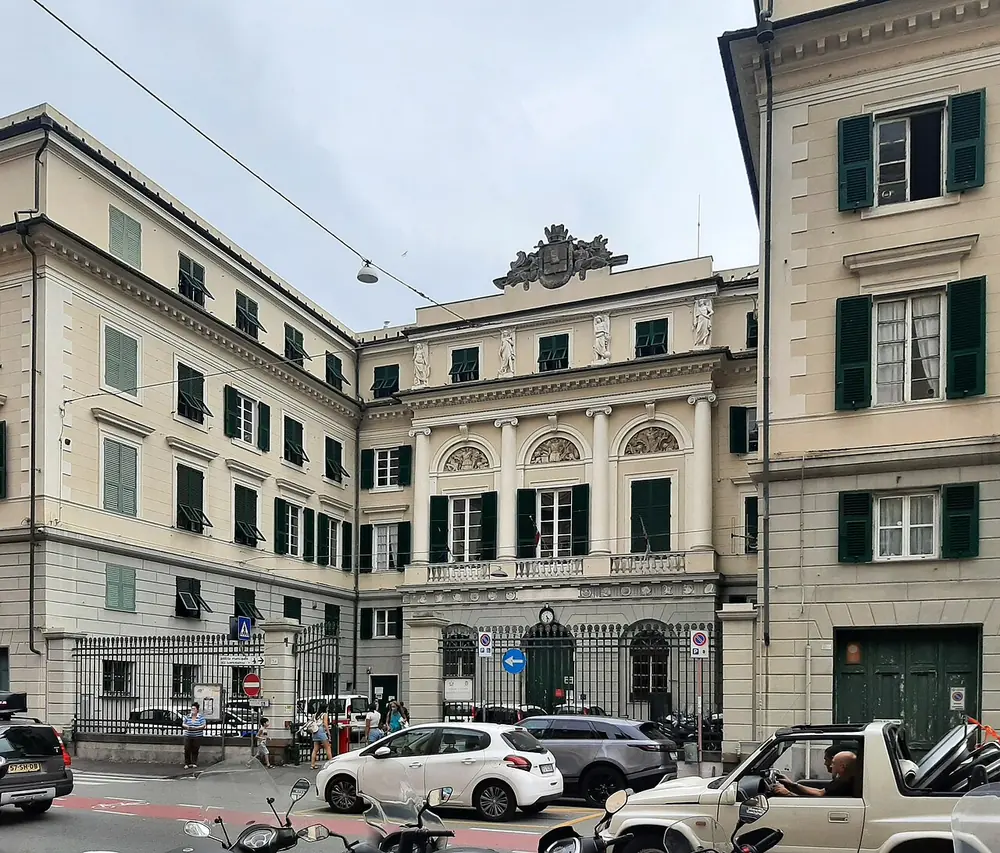
The former town hall of Sampierdarena, now a district of Genoa
The former town hall of Sampierdarena, now a district of Genoa. Photo: FC-1982, Wikimedia Commons, CC BY-SA 2.0.

Other big cities did the same: Milan took 11 towns on 14 October 1923, Naples 8, Trento 11, Bergamo 4. Of the 53 towns these five cities took, none came back.

12 May 1928

54

towns abolished on a single day

The government said it wanted bigger, stronger units in place of small, poor ones that could not pay for public services; historians also see a drive to tighten the state’s control (Negro 2021; ISTAT). In March 1927 Italy had 9,067 comuni; by June 1929 it had 7,309 (Negro 2021); the net fall is smaller than the number abolished because some mergers created new comuni and some towns were restored. Of the 2,094 abolitions on this map, 1,952 fell in the three years 1927–29, and 1,250 in 1928 alone: more than three a day. The busiest day was this one.

14 June 1928

The name nobody chose

Sometimes a merger erased every old name. A decree signed by the king on 26 April 1928 joined Cavallasca, Drezzo and Parè, three villages near Como, into one comune with an invented name: Lieto Colle, “happy hill”. It took effect on 14 June. On 10 November 1956 the three became separate comuni again. Drezzo and Parè merged again in 2014, Cavallasca in 2017. Lieto Colle was one of 273 comuni created between 1923 and 1935 with a name of their own; 81 had been dissolved again by 1960.

1944–1953

Coming back: 29 towns on 15 March 1947

Mussolini fell in 1943 and the war ended in 1945. Some towns had already been restored under the regime itself: 89 before 1944, 24 of them in 1937. After the war they came back in a flood: 202 in 1946, 283 in 1947, 65 in 1948, and on 15 March 1947 alone, 29. From 1944 on, 809 came back.

Mostly a government decree named the town and it was a comune again; in the regions with a special statute, which have extra powers of their own, it could be a regional law (three of the decrees are among the sources). The official list does not record who asked or whether residents were consulted. From 1953 a law, no. 71, let residents ask for it themselves: three voters in five had to sign. 173 of those 809 came back from 1953 on.

21 March 1928 – 15 May 1946

A valley that came back whole

The Aosta valley, in the Alps, speaks French as well as Italian. On 21 March 1928 the city of Aosta took eight towns around it: Charvensod, Gignod, Gressan, Jovençan, Pollein, Roisan, Saint-Christophe and Sarre. All eight became towns again on the same day, 15 May 1946. Genoa, which took nineteen, gave none back. The names were erased too: a decree signed by the king on 22 July 1939 gave 32 towns of the Aosta province Italian forms, and Courmayeur became Cormaiore; it was Courmayeur again on 30 January 1946.

7 March 1928 – 20 September 1952

Same day, same neighbour, different ending

Take one case. On 7 March 1928 Pieve di Bono, in the Giudicarie valleys of Trentino, took nine towns. On 20 September 1952 four came back: Bersone, Daone, Praso and Prezzo. Agrone, Cologna, Creto, Por and Strada did not. Same neighbour, same day, same valley: nothing we measured tells the four from the five. All four merged again: Bersone, Daone and Praso into Valdaone on 1 January 2015, Prezzo with Pieve di Bono on 1 January 2016, as Pieve di Bono-Prezzo.

What the numbers show

Taken by a big city, you rarely came back

A town merged into the main city of its province came back in 15% of cases (25 of 172). One merged into any other comune came back in 45% (873 of 1,922). The rings on the map mark the 172 that a provincial capital took.

a provincial capital15% · 25/172
any other comune45% · 873/1,922

Share that came back at any time.

Distance to the city did not explain it: the test is below.

We looked for this after the distance test below failed, so it describes the data and is not a test we had set in advance. Main city of its province: a provincial capital today that was already the capital of its province on the day of the merger, by the province recorded in the official list. A province is an area about the size of a county.

14 June 1928 – 10 December 1991

Sixty-three years, and the bells

Monserrato, next to Cagliari in Sardinia, was merged into the city on 14 June 1928. In 1991 it voted on leaving Cagliari, on 21 April, and the parish priest rang the bells of Sant’Ambrogio to announce the result, a campaigner later recalled. A regional law followed in November and the comune was re-established on 10 December 1991.

Italians have a word for loyalty to your own town, from the bell tower that stands in its square: campanilismo. The map stops in 1960, when almost every return had already happened, so Monserrato’s light is still dark here.

1960

1,214 lights dark

The map stops in 1960 with 1,214 lights dark. 18 came back later, Monserrato among them, so 1,196 are still out, each with its line to the town that took it. Look up any town.

What we tested, and what failed

Did distance matter? We could not show that it did

We expected distance to matter: the farther a village lay from the town that took it, the likelier it would come back. Before looking at any result we wrote the test down: fit it on Piedmont, Lombardy and Liguria, check it on the other regions, and count it as shown only if distance made our guesses about which towns came back clearly better: by at least 0.03 on a scale where 0.5 is a coin toss and 1 is always right. It did not: on the regions the model had not seen, adding distance made the guesses worse, by 0.089.

1.0–1.6 km40% · 109/274
1.6–2.2 km34% · 94/274
2.2–2.9 km48% · 132/274
2.9–4.0 km49% · 135/274
4.0–18.2 km38% · 105/274

Share that came back between 1944 and 1960, from the nearest fifth of villages to the farthest.

Distance is between today’s positions of the old centre and the neighbour’s centre, for the 1,370 comuni with both known, after leaving out those restored before 1944, those divided among several neighbours and those within a kilometre of the neighbour’s centre.

How many went the same day

A town merged alone came back in 51% of cases. One of five or more merged the same day into the same neighbour came back in 26%. Unlike distance, this was already known on the day of the merger.

merged alone51% · 226/444
merged with 1 other50% · 365/734
merged with 2–3 others38% · 213/560
merged with 4 or more others26% · 94/356

Share that came back, by number merged into the same neighbour on the same day.

Did coming back make a town hold on?

A comune that fought its way back might be expected to refuse a merger later. Since 1991, 348 comuni have been merged away, 322 of them since 2013. 87 of the comuni that came back from 1944 were among them, and 43 of those 87 merged again with the same neighbour that had taken them in 1928.

For a fair comparison we set returned comuni against never-abolished ones of the same province, size and mountain or lowland: 53 of 315 returned comuni merged, against 62 of 742 comparable ones. Odds ratio 1.55, 95% interval 0.95 to 2.53. The result we had set out to find, that returned comuni merge less often, did not appear.

Only provinces and size bands with both kinds of comune could be compared, which is why 315 of the 798 returned comuni that still existed in 1991 enter the comparison. The interval includes no difference at all, and the comparison could not tell a drop of a fifth from no change, so as a test it says little. Coarser groups (region and size only) point the other way: 1.66 (95% interval 1.09 to 2.52). Size is Wikidata’s population around 2011, not 1991. The register lists mergers that went through, not those voters refused.

How far to trust this page

A comune is the Italian municipality: a town or village with its own administration and town hall. Abolished means it lost both by decree and was merged into one or more neighbours. Dates are the days the change took effect in the register of ISTAT (SITUAS); decrees can be dated earlier.

We started from the law, not from the data: law no. 71 of 1953 covers comuni abolished after 28 October 1922, so the window runs from that day to the end of 1935. The register lists 2,200 abolitions in it. We left out 94 whose territory was ceded to Yugoslavia or France in 1947, 7 comuni the regime itself created, and 5 (Filago, Tortolì, Caravino, Prato allo Stelvio, Morgex) whose name carries on in the merged comune and that we count neither as abolished nor as returned. That leaves 2,094.

We checked 40 of them against independent sources. 17 were confirmed, 9 could not be confirmed online and 14 differed: 9 were divided among several neighbours (the page now lists every receiver), 3 have a placeholder code in the register and were classified by hand, and 2 differ in a date or in coming back inside a combined comune.

1,905 of 2,094 old centres (91.0%) are on the map: 1,208 from Wikidata coordinates joined by cadastral code, 525 from GeoNames, 139 from OpenStreetMap and 33 from other Wikidata places, the GeoNames, OpenStreetMap and label matches accepted only inside the territory of the comune that took it, the Wikidata points only within 50 km of its centre. The others appear in the lists only. A light shows the village today, not the town hall of the 1920s, and the place we could find is not always the old seat. We checked 60 centres picked at random against Wikipedia, gazetteers, GeoNames and OpenStreetMap: 60 lay within 3 km of a place of that name, though some of those pages reuse the same underlying coordinates.

The page does not claim that returns were votes, that pride caused them, or that it measures campanilismo: it counts what the state did and undid. It uses no populations of the 1920s comuni, because the census volume gives them at 1981 boundaries and folds the never-returned into their neighbours. Only the distance test and the test after 1991 were written down before the results; the size patterns were found afterwards. The count of comuni between 1927 and 1929 from Negro (2021) is the independent check on the total.

The full list of the comuni, with dates and what became of each

Sources

  1. ISTAT, SITUAS: lists of comuni suppressed, constituted, with territorial changes and renamed, 1861–2026 (licence CC BY 4.0). SITUAS
  2. ISTAT, legal notice: content licensed CC BY 4.0. ISTAT
  3. Wikidata: coordinates and cadastral codes of places and comuni, population (CC0). Wikidata
  4. GeoNames and OpenStreetMap contributors: place names and positions (CC BY 4.0; ODbL). GeoNames
  5. ISTAT, administrative boundaries 1 January 2025; NOAA ETOPO 2022, 60 arc-second relief. ETOPO 2022
  6. Law 15 February 1953, no. 71 (Gazzetta Ufficiale 7 March 1953): re-establishment of comuni suppressed after 28 October 1922 when three electors in five ask. Law 71/1953
  7. Decree of 7 June 1945, no. 470 (Sorbo Serpico, Petruro), Gazzetta Ufficiale 28 August 1945. Decree 470/1945
  8. Decree of 20 September 1946, no. 284 (Torre San Giorgio), Gazzetta Ufficiale 12 November 1946. Decree 284/1946
  9. Decree of 6 March 1948, no. 407 (Marrubiu), Normattiva. Decree 407/1948
  10. Negro, Chiara (2021), on the 1927–29 reform of comune boundaries and the Alpine valleys: 9,067 comuni in March 1927 and 7,309 in June 1929. Negro 2021
  11. ISTAT, structure and dynamics of Italy’s administrative units, 1861–2017 (p. 42, on the centralising reforms). ISTAT, units
  12. Royal decree 22 July 1939, no. 1442: Italian forms for the names of 32 comuni of the province of Aosta (Wikisource, public domain). R.D. 1442/1939
  13. Gazzetta Ufficiale 30 May 1928: decree of 26 April 1928 joining Cavallasca, Drezzo and Parè as Lieto Colle. Gazzetta 1928
  14. L’Unione Sarda, interview with Marco Badas on the autonomy of Monserrato (recollection of 21 April 1991); Wikipedia, Monserrato (CC BY-SA). L’Unione Sarda