Bucharest · autumn 1981
Dinner on a card
A punched piece of cardboard decided who ate and how much. Behind it stood a decree with prison terms, a queue that never ended, and a reckoning of 2,800–3,000 calories a day. This is the story of a dinner paid for with paper, not money.
The counter §
The oil smells of empty glass and shop floor. The woman ahead of you slides her card across the counter; the clerk studies it, turns it over, brings the stamp down and inks in the month: collected. Only then does the oil flow into the bottle brought from home — the bottle you have carried since morning, from the first queue.
In the autumn of 1981, food cards return to Romania: bread, milk, oil, sugar, meat. They had been abolished in 1954, with free trade; now the party leadership orders the rationing of bread, milk, sugar, meat and meat products. Without a card you buy nothing. With a card — you are not sure you buy anything.
Historian Corina Buțea, “Ideea de coadă în memorialistică”, STUDIUM VII/2014. Sources ↓
The paper §
In a flat drawer, between bills and prescriptions, lies the family's stack of cards: cardboard rectangles with boxes and columns, one for each month. The children know them by heart — the colour, the stamp, the row of holes where the stub tore off at the shop.
Romania had been here before. From 1949, rationed foods sold on cards coloured by each person's work, until the Council of Ministers decision of 26 December 1954 abolished them and opened free trade. In 1981 the paper returns — this time as individual or family cards. The change that matters: holding one “in no way guaranteed obtaining those foods”.
The 1949–1954 cards, by colour (six types)
- Type A · violet
- Exceptional labour: underground work, pilots, mechanics, stokers.
- Type B1 · brown
- Very heavy labour: iron, steel and heavy metallurgy.
- Type B · red
- Heavy labour: metallurgy, oil, chemicals, glass, rubber, cement, printing, transport, textiles, paper, leather, timber, food, state farms, telecoms, health, roads and bridges, bricks and tiles.
- Type C · blue
- Ordinary labour: all other professions.
- Type D1 · green
- Pensioners, war invalids, orphans and widows, over-14s, tuberculosis patients, the urban needy.
- Type D2 · orange
- Children under 14 and pregnant women.
After Valentin Vasile, Caietele CNSAS 1/2009, p. 244, via Buțea 2014. The colours and categories of the 1981 cards are undocumented.
The decree §
On 9 October 1981 the Official Gazette publishes a short text with teeth. The frightening word is “stockpiling”: anything above one family's monthly needs becomes a crime. You have three days to carry the surplus back to the shop — after that, the pantry can send you to prison.
Decree no. 306 of 9 October 1981 punishes as speculation, with 6 months to 5 years in prison, buying for stockpiling — above one family's monthly needs — six products: oil, sugar, flour, cornmeal, rice, coffee, plus any other foods whose hoarding harms fellow buyers. Vegetables, potatoes and fruit for winter are exempt. The same sentence covers bread bought to feed animals, and the clerk who sells above the set quantities.
The decree ties each person to their shop: sugar and oil sell only to those domiciled or employed in that locality, and in large towns the people's councils assign shops per zone, for “rhythmic sale” and thinner crowds. Foods from these offences were confiscated.
Decree 306, in short
60 months
one month of provisions above the family's needs could cost up to 5 years in prison — 60 times the month that ruined you. And the deadline for surrendering the surplus: 3 days.
Decree text, art. 1–4, via LegisRO. Confiscation: art. 6. Sources ↓
The queue §
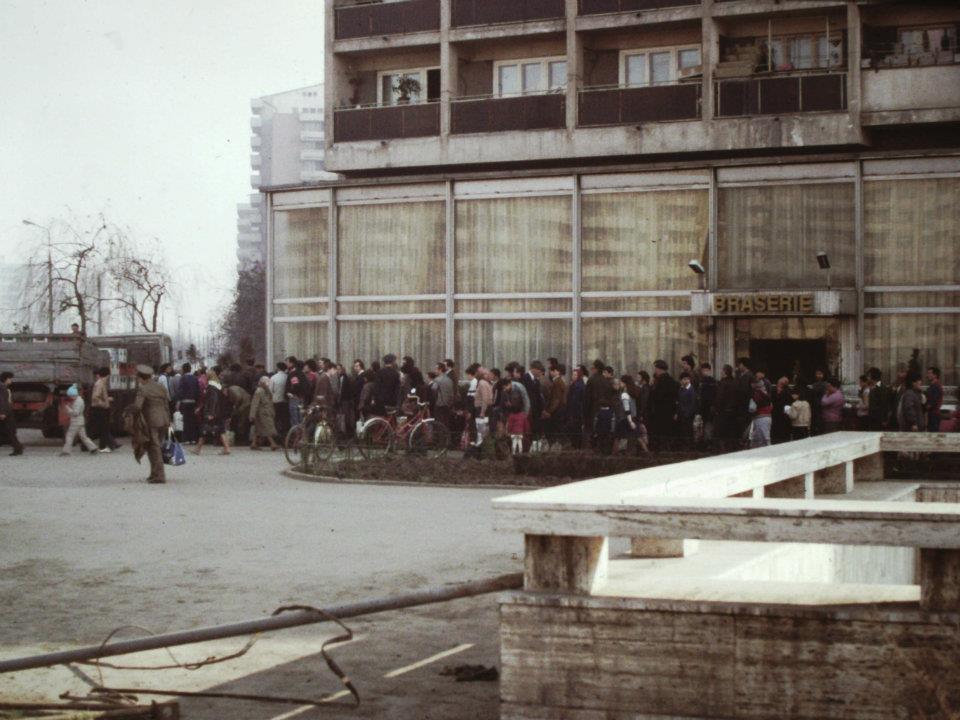
At the shopping complex the queue forms before opening: pensioners, women, men, children, each with the string bag and the carrier — the permanent accessories after 1980, so no chance is missed. Between spouses there is an unwritten rule: whoever finds it, buys it. Free time melts here, after a legal working week of 46 hours.
Sociologist Pavel Câmpeanu saw the waiting line as a spontaneous grouping for “competition under uncertainty”: everyone wants the same good, supply falls short. Opinions and life stories change hands in the queue — a “small society”, as Adrian Neculau called it — but hatred, greed and violence surface here too. The clerk with the briefcase stands behind the street sweeper; nobody yields their place to anybody.
“You queued, they gave you milk, oil, sugar, rice on the card and wrote on the card that you had collected it for that month. The worst of it was that you had to queue there too!”
Testimony quoted by Buțea 2014 (translation)
In Brașov, women interviewed in 2003 remember different details: with a child beside you, you got a double portion — “and kids, you'd borrow them”. Potatoes made both the first course and the second. And in the countryside, especially for cooperative farmers, oil, sugar or even bread came harder still than in town.
Câmpeanu 1994 and Neculau 2004 via Buțea 2014; Jill Massino interviews, Brașov, 2003. Sources ↓
The arithmetic §
On squared paper a housewife divides the month into portions: how many days, how many mouths, how many grams a day per person. The state keeps parallel books, with a whole programme: “rational eating”, fixing each citizen's annual quantities for 1982–1985 — then cutting them to a ceiling of 2,800–3,000 calories a day, on the pretext that the population eats too much.
In February 1982 rationing arrives with a price rise: up 35% on 220 foods. Less food on the card, dearer food on the shelf. Reckon your own family's weekly budget below, at the programme ceiling — the figures are the historians', the multiplication is yours.
The family budget, at the ceiling
78,400–84,000 calories
4 people × 7 days × 2,800–3,000 calories: a whole week of dinners, lunches and breakfasts put together.
The rational-eating programme ceiling, after Buțea 2014. How many grams of bread or oil the ceiling meant per product is unknown from accessible sources: undocumented.
The network §
The telephone rings short: “something came in at the complex”. She grabs bag and carrier and runs — but not to any shop: to hers, the assigned one. Meanwhile the friend at the dairy has already set aside, for the right people, what never reaches the shelf. That was provisioning: half queue, half pile — connections that opened the shop's back door.
“Everyone managed, everyone had relations”, a Brașov woman remembers. But the network had edges it never reached: in the countryside, cooperative farmers struggled hardest for oil, sugar, bread. And when card rationing reached the mining zones too — the only ones exempted alongside Bucharest — the Motru miners walked out of their shift straight into the street, on 19 October 1981, after 4 p.m.: the decree cut family provisioning for precisely them, the 11,000 commuters on 87 routes who bought for those back home.
Motru, 19 October 1981
126 commuters per route
11,000 people on 87 routes from Gorj and neighbouring counties — that many bought for their families when the decree tied them to their domicile. The miners' revolt, in the CNSAS study.
The queue map: market Bucharest §
The decree divided large towns into zones, with assigned shops for sugar and oil. The map below lays over Bucharest the historic market network — the halls and marketplaces where townspeople met peasants bringing produce — and the place of the one photographed queue in this story: Bucur Obor, 1 May 1986.
Testimonies: Massino 2003; Motru: the CNSAS study; markets: Ion Mincu 2018. Sources ↓
The table: seven evenings on the card §
On the kitchen table lie the card, the pen and tomorrow's bag. One week left to get through — seven evenings, seven decisions. Every good choice earns the stamp; every mistake teaches you the decree or the queue. At the end, the verdict: did you feed the family, or did the paper beat you?
Evening 1 of 7
The neighbour's litre
Sources and reckonings §
Every number in this story has a document behind it. The derived reckonings are simple multiplications and divisions, redone at publication: 4 people × 7 days × 2,800 = 78,400 and × 3,000 = 84,000; 5 years × 12 = 60 months; 11,000 ÷ 87 ≈ 126.
- Corina Buțea, “Ideea de coadă în memorialistică”, STUDIUM VII/2014 — the autumn-1981 cards, the rational-eating programme (2,800–3,000 calories), the February 1982 price rise (+35%, 220 foods), HCM 26 December 1954, the 1949 card types, the 46-hour week, “pile”, bag and carrier. Article text (PDF, in Romanian)
- Decree no. 306 of 9 October 1981, art. 1–4, 6 — speculation and its sentence (6 months–5 years), the six products, the 3-day deadline, assigned shops, bread fed to animals. Decree text (in Romanian)
- CNSAS, “Revolta minerilor de la Motru din 19 octombrie 1981” — rationing extended to the mining zones, Bucharest excepted, 11,000 commuters on 87 routes, the demonstration after 4 p.m. CNSAS study (in Romanian)
- Jill Massino, oral-history interviews, Brașov, summer 2003 (S., M., E.) — borrowed children, potato meals, “everyone had relations”. Testimonies (PDF)
- “The Marketplace Project: The architecture of the ordinary”, Ion Mincu Press, Bucharest, 2018 — the Obor, Traian, Matache and Amzei halls; the Gemeni, Vitan, Norilor and Cotroceni marketplaces. Volume (PDF)
- The queue photograph: Bucur Obor, 1 May 1986, Library of Congress, Country Studies: Romania (1989) — public domain. Original file
.jpg)
What is not known: how many grams of each product one person received in the ’80s (undocumented in accessible sources), and what colours or categories the 1981 cards had (undocumented).