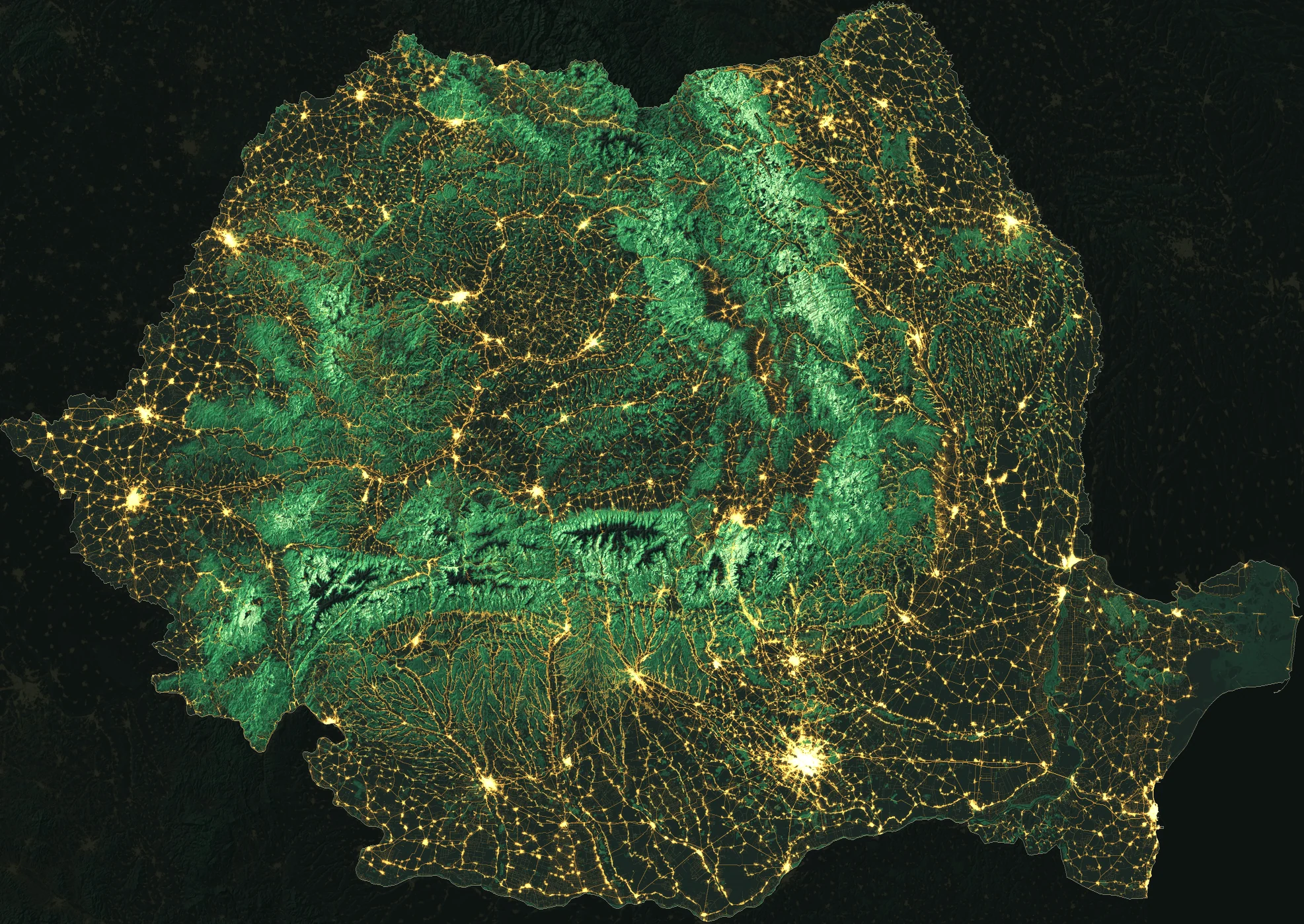
living plants buildings and roads
A country’s mass, on the scale
What Romania weighs: everything built, set on a scale against everything that grows
Romania’s houses, apartment blocks, roads and railways weigh 4.43 billion tonnes. All its trees, grass and crops, roots included, weigh 1.73 billion. Without the water in them, the way scientists weigh the planet, the built side weighs 2.6 times as much (1.1 to 4.1, depending on the values chosen).
The map is made of these two masses: green is the mass of living plants, gold is everything poured, laid or paved. For any town or commune, the scale shows how much of the surrounding greenery it would take to balance what has been built there.
#On one pan: 4.43 billion tonnes of buildings and roads
Buildings weigh 3.19 billion tonnes. Their volume, modelled by the European Commission’s Joint Research Centre from satellite maps of built-up area and building height, is 9.3 cubic kilometres: houses, blocks of flats, warehouses, schools and hospitals. A cubic metre of building holds on average 344 kilograms of concrete, brick, steel, glass and wood.
The other 1.23 billion tonnes are roads and railways: asphalt and the layers of stone and sand beneath it, over 388,000 kilometres of road and 20,000 kilometres of railway, tram and metro line. National and county roads and some communal roads weigh 667 million tonnes, streets and village lanes 272 million, field and forest tracks, mostly gravel or earth, 146 million, motorways 51 million, and railways, trams and the Bucharest metro 96 million.
That is 232 tonnes built and 91 tonnes of plants per person.
#On the other pan: 1.73 billion tonnes of life
Nearly all of the weight is in trees. Their trunks, branches, leaves and roots weigh 1.64 billion tonnes without water. Grass, pasture and field crops add only 88 million: a hectare of meadow holds a few tonnes of grass, a hectare of beech forest a few hundred tonnes of wood.
The tree mass comes from the European Space Agency’s satellite biomass map for 2020, and it falls within the range implied by Romania’s forest statistics, about 1.5–2.2 billion tonnes depending on the conversion factors. In villages and towns, where the satellite map sees few trees, their mass was worked out from the tree crowns seen from above.
#Put the water back in the wood and the scale nearly balances
A living tree is roughly half water. On an ordinary scale it weighs nearly twice as much. Counted that way, the built side is only 1.3 times heavier. With the lowest values for buildings and roads and the highest for plants, the scale would even tip towards the trees.
The reference study uses dry mass but also shows the wet case, where the planet’s crossover comes only in the 2030s. In Romania, with or without the water, the built side stays heavier in the central estimate.
Weigh the water in the plants too
#Where the plants weigh more
In 571 of the country’s 3,181 communes and towns, the plants outweigh everything built. 8.7% of Romanians live there. In 133 of them the result holds in all three variants tested. In 1,879 places, home to 79% of Romanians, the built side is heavier in all three; in the other 1,169, the difference is too small to be sure.
By county, only four have more plant mass than construction: Caraș-Severin, Harghita, Covasna and Hunedoara. In Caraș-Severin, the greenest, what is built weighs about half as much as the plants (0.52), but with the biomass map’s own errors the range runs from 0.2 to 1.8.
#Bucharest needs everything that grows within 148 kilometres
The capital’s buildings, streets, metro and railway lines weigh 284 million tonnes. The city’s plants, trees, parks and grass, weigh 1.1 million.
To fill the other pan you have to gather all the greenery around it, ring by ring, out to 148 kilometres (between 111 and 173, depending on the values chosen): across the Vlăsia and Bărăgan plains, up into the forests of the Subcarpathians and the Bucegi mountains. Only what grows on Romanian territory is counted.
#What your town weighs
Type a name or tap the map. One pan takes everything built in the chosen commune or town; the other gathers the greenery around it, ring by ring, until the scale balances. You can drag the edge of the ring yourself.