Romanian blocks of flats, 1960–1995 · calibrated on Finnish and Estonian measurements
The clock inside Romania’s concrete blocks of flats: the year carbonation reaches the steel in balconies and facades
CO₂ from the air works into concrete a millimetre at a time. When the front reaches the reinforcement, the steel rusts and cracks the concrete in front of it. Pick the part of the building, the year and the city: see when it happens.
Part of the building
still alkaline (pink with phenolphthalein)carbonatedintact steelrusting steelcrack▲ the front┆ average depth of the steel
share of bars the front has reachedshare of bars with cracks of at least 0.3 mm in the concrete beside themband: good ↔ porous concrete
The result for your block
For a 1975 block in Bucharest, under the balcony, typical concrete: the front reaches the first bars around 1990, and the first visible cracks, 0.3 mm wide, appear around 2015.
| porous concrete | typical concrete | good concrete | |
|---|---|---|---|
| Front reaches the first bars* | 1982 | 1990 | 2022 |
| First 0.3 mm cracks* | 2007 | 2015 | 2047 |
| 1 mm cracks: pieces may fall* | 2042 | 2050 | 2082 |
* the year the threshold is reached at 10% of the bars. The years come from a calculation for the chosen conditions, not a forecast for any particular building; earthquake safety is a separate question.
How many homes are in concrete buildings from those years
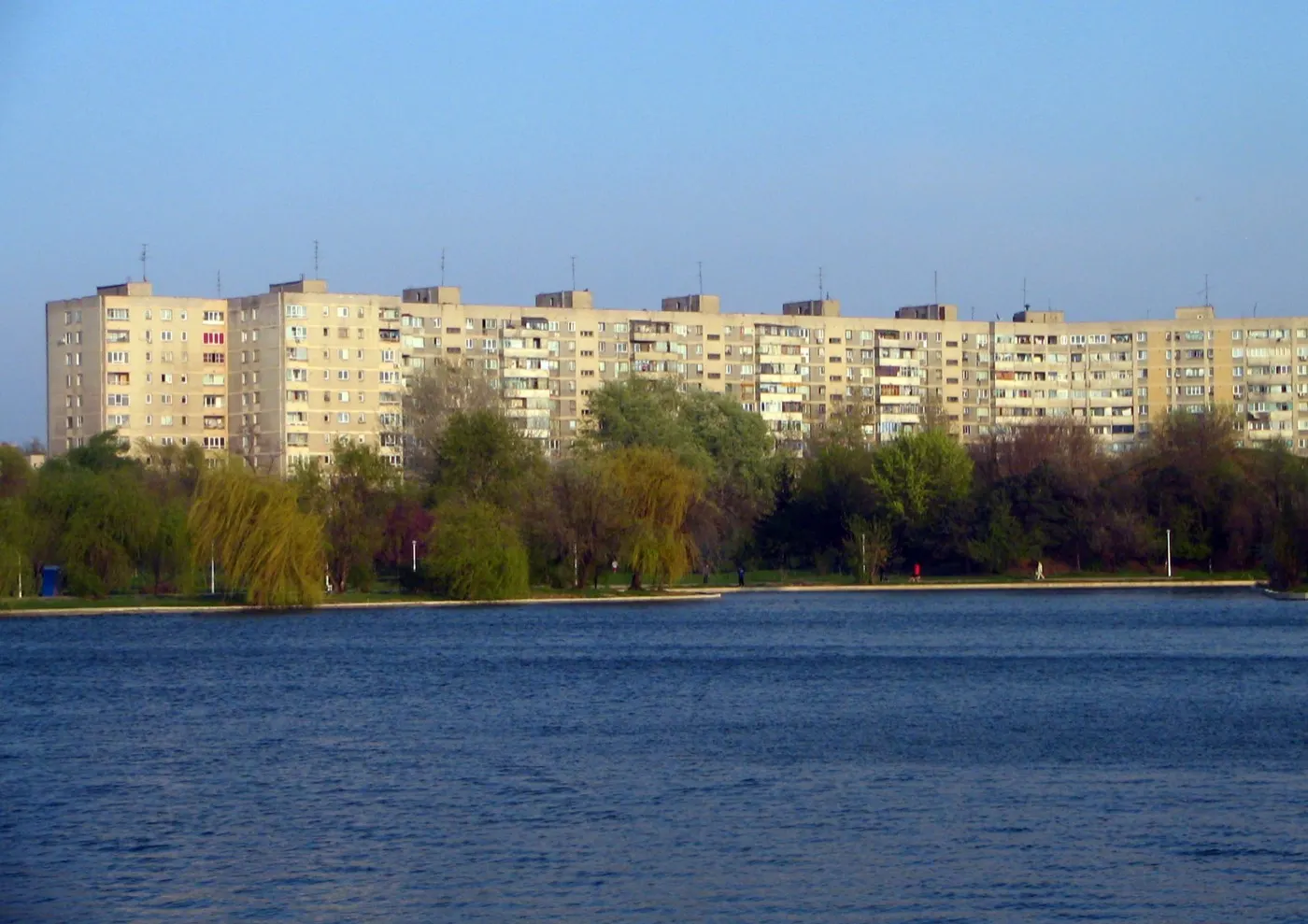
At the 2021 census Romania had 171,275 apartment blocks. 123,954 of them went up between 1961 and 1990: 48,866 with walls of prefabricated units, 59,378 in reinforced concrete cast on site.
Counted by home, in blocks and houses alike: 2,948,767 dwellings, about 30% of all 9,929,935, are in buildings of those years with walls of reinforced concrete or prefabricated units. Carbonation happens in precast and site-cast reinforced concrete alike; in both, what matters is the thickness of concrete over the steel and how often the surface gets wet.
What happens inside the wall, in three stages
- Fresh concrete is strongly alkaline. In it, a thin film forms on the steel and keeps rust away.
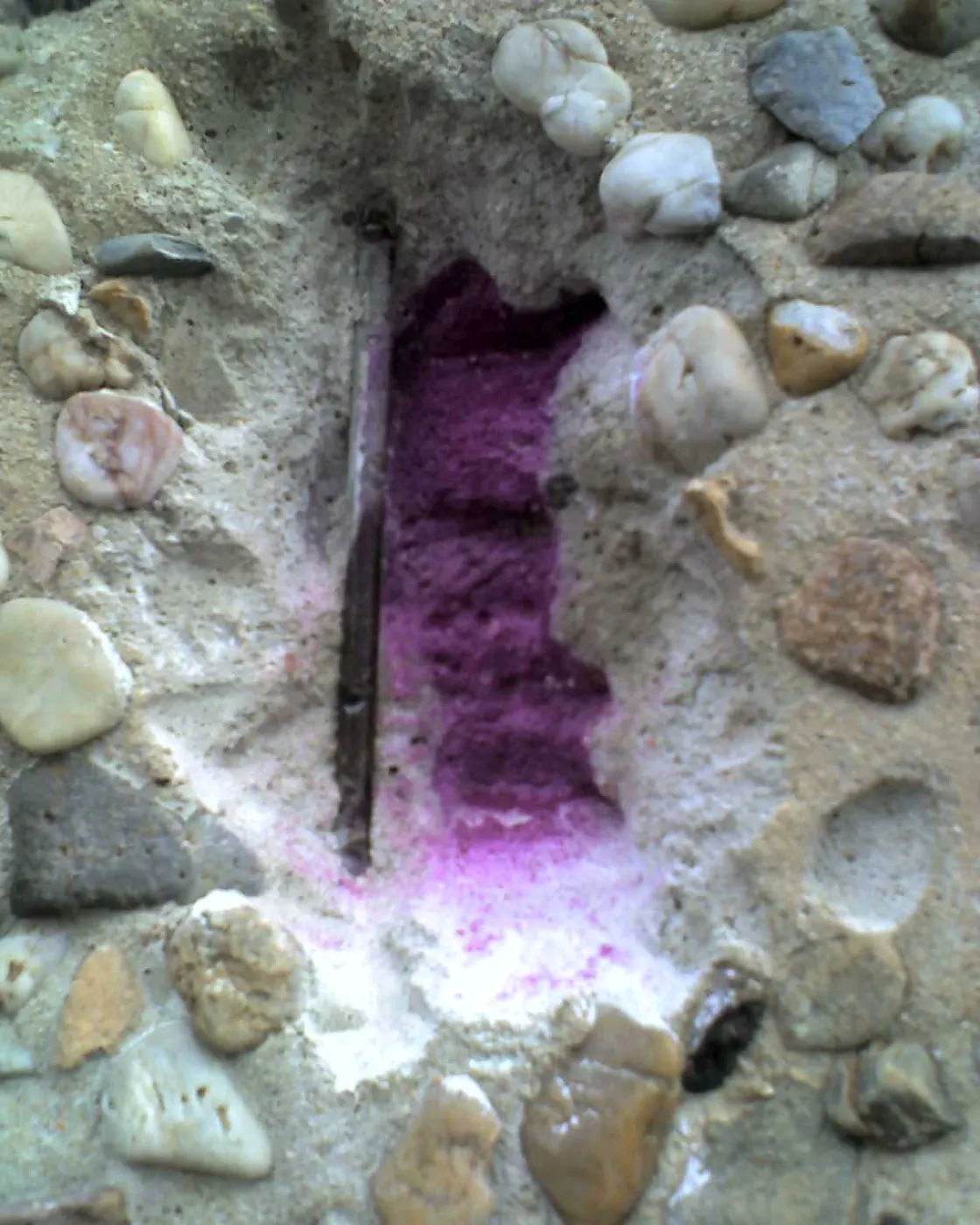
- CO2 from the air enters through the pores and reacts with the lime in the cement paste. Alkalinity falls from the surface inwards, along a front that slows down as it goes. Engineers reveal it by spraying a fresh break with phenolphthalein, the indicator from the chemistry lab: concrete that is still alkaline turns pink, carbonated concrete stays grey.
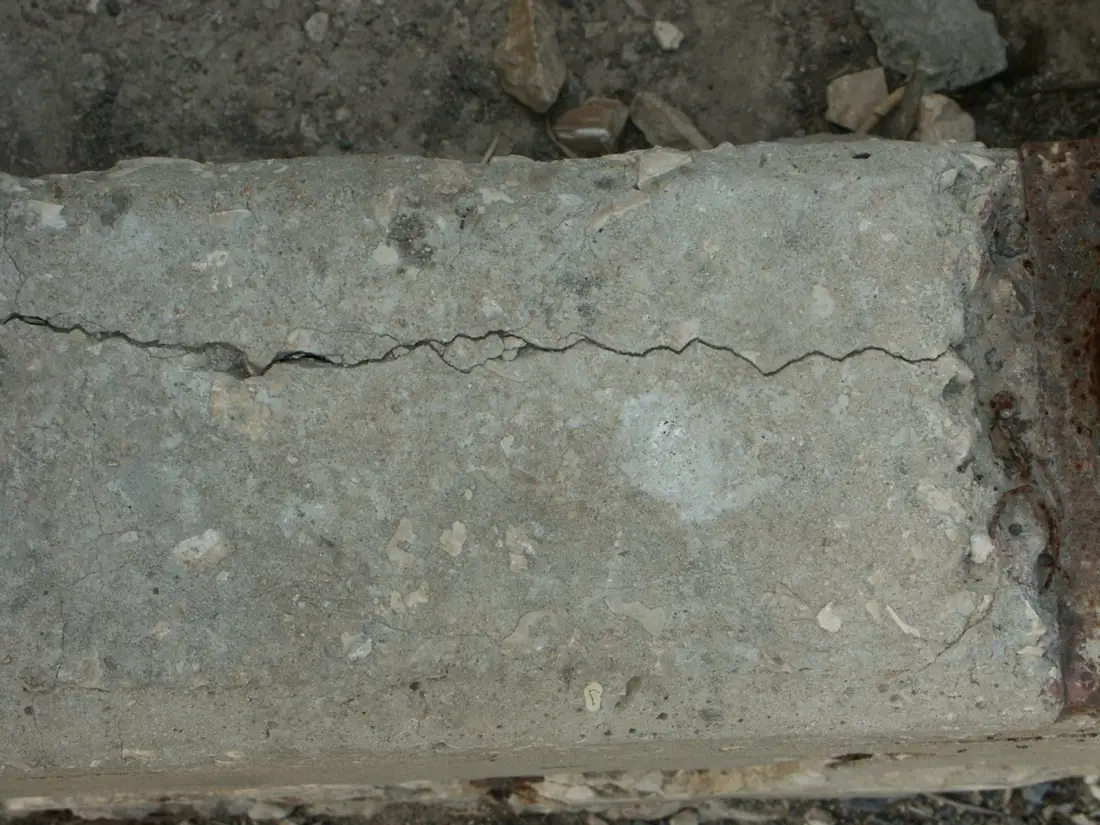
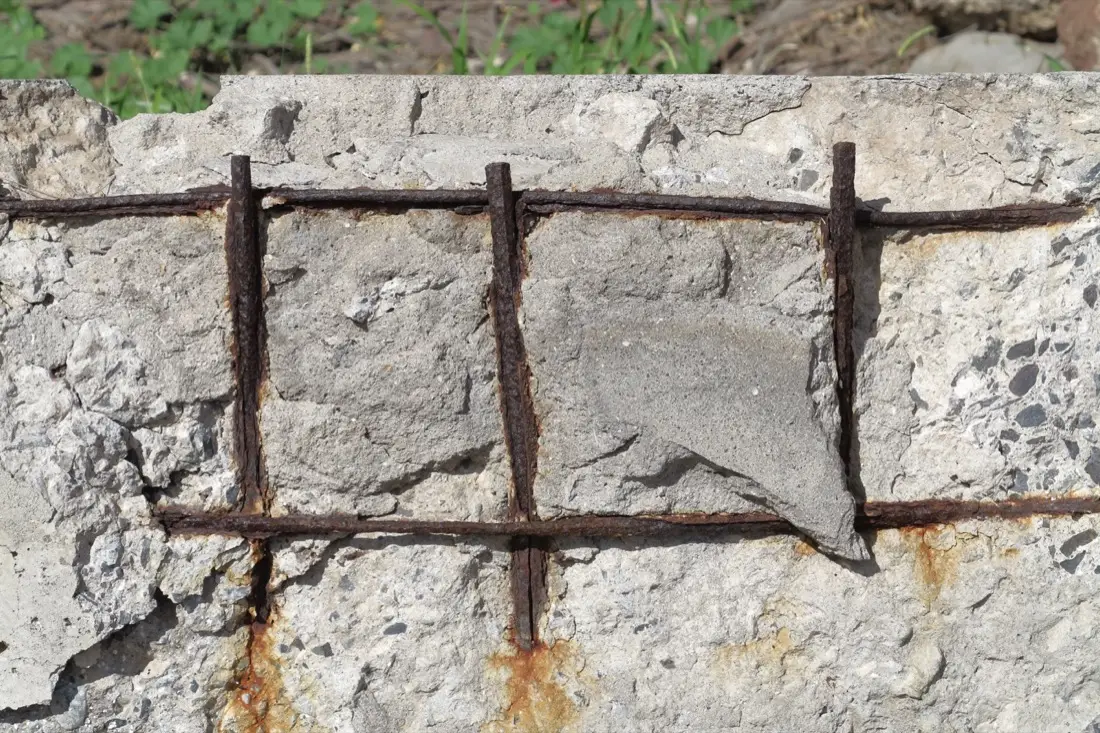
- Once the front reaches the steel, the protective film breaks down. If the concrete is also damp, the steel rusts. Rust takes up more room than the steel it came from, pushes from inside, cracks the concrete in front of it and eventually breaks it off.
Why the underside of the balcony goes first
Carbonation and rust need opposite conditions. CO2 moves fast through dry concrete and slowly through wet concrete, because water blocks the pores; steel, on the other hand, rusts only when there is moisture. The underside of a balcony has both: it is sheltered from rain, so it dries and carbonates fast, yet the outdoor air is damp enough for steel to rust. On precast balconies in Finland the carbonation coefficient averaged 3.08 mm/√year on the underside and 1.21 mm/√year on the rain-washed top: at the same age, a front about two and a half times deeper underneath.
A wall inside the flat is the opposite: warm, dry air with more CO2 than outdoors (370–3,900 ppm was measured in bedrooms of Estonian blocks) carbonates it fastest, but without moisture the steel barely rusts. The facade sits in between: rain slows the front, and once the front reaches the steel the same rain speeds up the rust.
Under the balcony
Facade
Interior wall
For the year, city and concrete cover chosen above, without insulation. Dark line: share of bars the front has reached. Rust-coloured line: share of bars with cracks of at least 0.3 mm. Vertical line: 2026.
A few millimetres of concrete matter more than the city’s air
The calculation shows that the date of the first cracks depends mostly on how much concrete covers the steel. For a 1975 Bucharest block, underside of the balcony, typical concrete, the chart shows how many years each change moves the first 0.3 mm cracks.
The thickness of concrete over the steel varies even within one slab, whether it was cast in a factory or on site. On one slab a bar can sit, say, 12 mm below the surface and its neighbour 35 mm, and the front reaches the first decades before the second. That is why the calculation draws seven bars at different depths: the ones near the surface rust first.
In Finland, a large part of the reinforcement in the panels studied had less concrete over it than the codes required. No data on this thickness are published for Romanian blocks; the slider above changes the average used in the calculation.
What the polystyrene on the facade does
A team from Estonia and Finland ran an hour-by-hour computer simulation of the moisture in concrete facades 30–50 years old, before and after insulating them with polystyrene, mineral wool or PIR. Without insulation, humidity in a rain-beaten facade kept climbing close to 100%, and three to six years passed from the arrival of the front to a 0.3 mm crack. With insulation the concrete dried out within a year or two, and corrosion slowed so much that cracks stayed below 0.3 mm over the simulated period.
The same team flags one risk: a very wet wall covered with insulation that does not let vapour out. The calculation here lets carbonation carry on unchanged under the insulation, because measurements do not say clearly whether it slows it, and stops the rust from the year of insulation, for the facade only: no comparable simulation exists for balcony undersides. On the facade of a 1975 Bucharest block, the calculation estimates that by 2100 the concrete has cracks of at least 0.3 mm beside about 70% of the bars without insulation, and beside 8% if the block was insulated in 2015.
Between 2009 and 2014 the national and regional programmes together insulated about 2,578 blocks, and Romania’s recovery plan aimed for another 1,733, according to figures compiled by Radio Free Europe in 2022.
Signs to look for, and whom to tell
Tell the building administrator or the chair of the owners’ association. Romania’s construction quality law requires owners to carry out maintenance and repairs on time, keep the building’s technical record (cartea tehnică) and monitor how it behaves over time (Law 10/1995, art. 27). How serious the damage is and what repairs it needs can only be set by a certified technical expert (expert tehnic atestat) after examining the building; this calculation does not replace that assessment.
Earthquake safety is a separate question with different criteria. For Bucharest, the list of buildings assessed and classed by seismic risk is on the map of buildings at seismic risk.
- Rust stainsBrown streaks on the surface of the concrete, especially under balconies and at slab corners.
- Straight, parallel cracksCracks that often follow the line of the bars beneath.
- Concrete that sounds hollowTapped lightly, it sounds different from around it: a sign the surface layer may have come away from the concrete behind.
- Exposed steel, fallen piecesThe layer has already gone. Keep people clear of the area beneath until it is repaired.
How reliable is the calculation
The depth of the front comes from the carbonation model of the International Federation for Structural Concrete (fib, Bulletin 34, 2006), used in durability design: the depth of the front grows with the square root of time, faster in dry air with plenty of CO2, slower when the surface is often wet. For atmospheric CO2 the calculation uses the Mauna Loa record to 2025 (317 ppm in 1960, 427 ppm in 2025), then the IPCC’s middle scenario SSP2-4.5 (603 ppm in 2100). For each city, humidity is the mean of hourly readings for 2006–2020, and the number of days with at least 2.5 mm of rain is the 1991–2020 annual mean, from weather-station data archived by NOAA; Timișoara’s rain days come from the Arad station.
The quality of the concrete is not known for any particular block. It is set so that the calculation reproduces the rate measured on precast balconies and facades of the same era in Finland: “typical concrete” uses the mean measured coefficient, “porous” and “good” raise and lower it by one standard deviation. The rain-washed top of the balcony played no part in that choice and serves as a check.
On Estonian facades of the same type, 30–50 years old, the front was typically found at 10–40 mm; for the facade the calculation gives 6.4–17.2 mm at 30 years and 8.3–22.1 mm at 50 years, towards the low end of that range. The top of the balcony, used as the check, comes out at 0.7 mm/√year against a measured 1.21 ± 1.11: inside the range, but about 40% under the mean.
Once the front reaches the steel, rust grows at the rates in the Spanish Structural Code: 2 µm a year where sheltered from rain, 5 µm a year where the concrete is wetted and dried. For a heated room the calculation uses the zero rate of the European DuraCrete report; the Spanish code gives 1 µm a year for the class that groups dry and permanently wet concrete. The first crack opens when the steel has lost 7.53 + 9.32 × (cover/diameter) micrometres (Alonso and colleagues, 1998) and then widens by 0.01 mm per micrometre (CONTECVET manual); at 1 mm, a model used in the literature treats the concrete as spalling. On a wet facade with typical cover that means about 13 years from the arrival of the front to a 0.3 mm crack. The Estonian–Finnish simulation for rain-beaten facades found three to six years, so on the walls most exposed to rain the cracks may come sooner than the calculation shows.
What the calculation leaves out
No published measurements of carbonation or cover are available for Romanian blocks; both come from Finland and Estonia. The calculation ignores salt (chlorides), freeze–thaw, paint or render on the concrete, construction cracks and water standing on balconies. These factors can change how fast the damage proceeds. Bars are 8 mm in diameter. Under insulation, carbonation carries on as before and the rust stops; the calculation applies this to the facade only.
Sources
- Carević, V., Ignjatović, I. (2022). Limit values of accelerated carbonation resistance to meet EC2 durability requirements. Building Materials and Structures 65: 1–6 (fib model, parameters). scindeks-clanci.ceon.rs
- Georgescu, D. P., Apostu, A., Gavrilescu, R. (2011). Romanian Journal of Materials 41(3): 219–228 (fib carbonation resistance table). solacolu.chim.upb.ro
- Lahdensivu, J. (2012). Durability properties and actual deterioration of Finnish concrete facades and balconies. Tampere University of Technology, tables 5.5–5.10. trepo.tuni.fi
- Ilomets, S., Kalamees, T., Agasild, T., Õiger, K., Raado, L.-M. (2011). Durability of concrete and brick facades of apartment buildings built between 1960–90 in Estonia. XII DBMC, Porto. www.irbnet.de
- Kalamees, T. et al. (2011). Technical condition of prefabricated concrete large panel apartment buildings in Estonia. XII DBMC, Porto. www.irbnet.de
- Ilomets, S., Kalamees, T., Lahdensivu, J., Klõšeiko, P. (2016). Impact of ETICS on corrosion propagation of concrete facade. Energy Procedia 96: 67–76. trepo.tuni.fi
- Alonso, C., Andrade, C., Rodríguez, J., Díez, J. M. (1998). Factors controlling cracking of concrete affected by reinforcement corrosion. Materials and Structures 31: 435–441. www.rilem.net
- Andrade, C. (2019). Propagation of reinforcement corrosion: principles, testing and modelling. Materials and Structures 52: 2. doi.org
- DuraCrete (2000). Modelling of degradation, report BE1347/R04-05, Table 2 (zero rate in dry concrete). www.scribd.com
- CONTECVET. Manual for assessing corrosion-affected concrete structures, Annex F (crack widening). studylib.es
- Spanish Structural Code, Annex 12, Table A12.4.1 (corrosion rates in carbonated concrete). cdn.mitma.gob.es
- Hájková, K., Šmilauer, V., Jendele, L., Červenka, J. (2016). ECCOMAS Congress 2016 (1 mm crack width for spalling). files.eccomasproceedia.org
- NOAA Global Monitoring Laboratory: Mauna Loa annual mean CO₂, 1959–2025. gml.noaa.gov
- IPCC AR6 WGI, Annex III, Table AIII.2 (SSP2-4.5). www.ipcc.ch
- NOAA NCEI: GHCN-Daily (daily precipitation) and ISD (hourly data), stations Bucharest-Băneasa, Cluj-Napoca, Iași, Timișoara, Constanța, Craiova, Galați, Sibiu, Bacău, Arad. www.ncei.noaa.gov
- Romanian National Institute of Statistics, 2021 census, tables 7.9 and 8.2. www.recensamantromania.ro
- Radio Free Europe Romania (29 September 2022): figures on thermal rehabilitation programmes. romania.europalibera.org
- Law 10/1995 on quality in construction, republished 2016, art. 27. legeaz.net