mariuscomper.uk Română

What a bee sees

A poppy is red to you. To a bee it is something else

A bee sees ultraviolet, blue and green, but no red. The meadow poppy looks ultraviolet to her, and her world is blurrier than yours. Look at the meadow through her eyes.

See the meadow like the bee

Guess first

Can the bee see red?

The poppy is red, and bees visit it all summer. Pick one before you read on.

The bee has no receptor for red, but red is not invisible to her.

Her eye holds three receptors: ultraviolet, blue and green. Red fires none of them strongly, so a red flower without ultraviolet looks dark to her. Even so, bees find red flowers; it just takes them longer.

A red poppy in bloom, photographed close, with red petals and a dark middle.
A red poppy, the flower that looks ultraviolet to bees. Petals measured in Germany and Austria reflect plenty of red, but also ultraviolet.Image: David Perez, source, CC BY 3.0

The meadow in two views

Six flowers, seen by you and by the bee

Pick whose eyes look. The bee's colours are computed from the petals' measured spectra, by the false-colour photography rule: ultraviolet shown as blue, blue as green, green as red.

Common poppy
Cornflower
Red clover
Daisy
Dandelion
Yarrow

The left discs show indicative shades; the bee's discs are computed from spectra.

The line shows the measured spectrum, from 300 to 700 nm. The shaded bands are the bee's three colours: ultraviolet, blue, green.

The poppy petal Papaver rhoeas
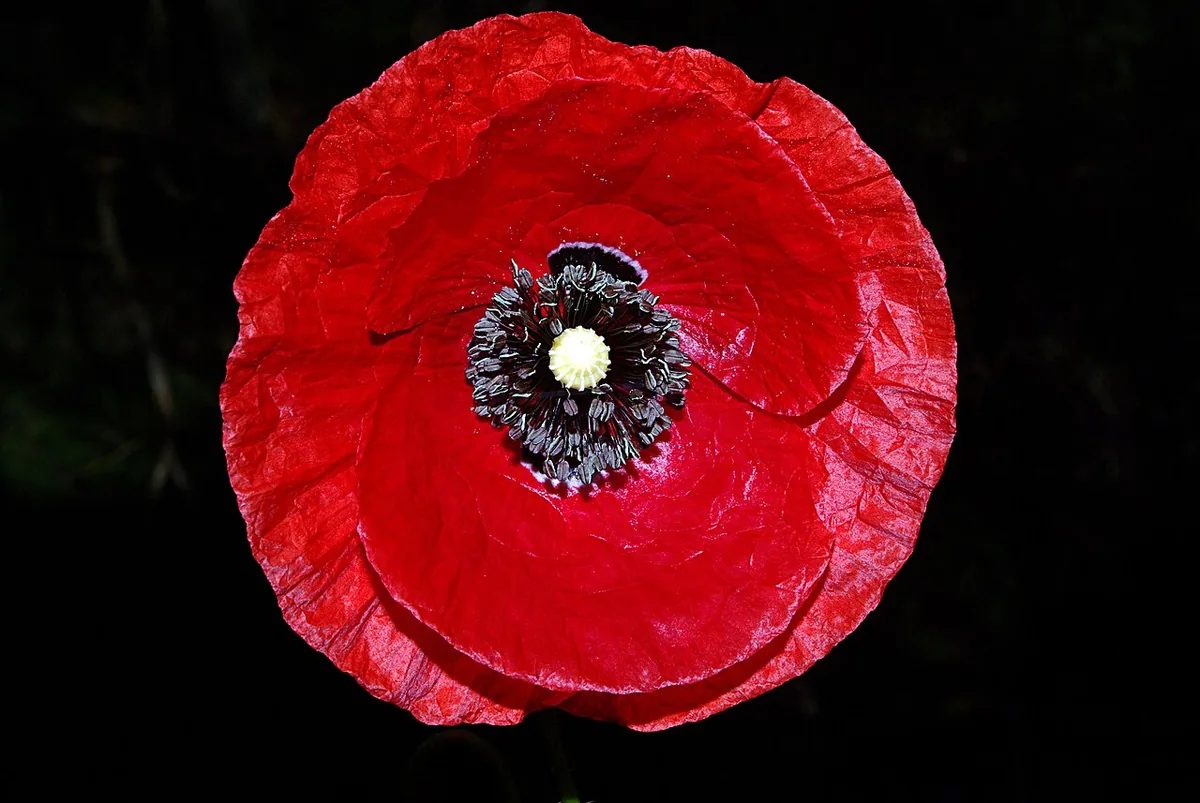
A red poppy in bloom, photographed close, with red petals and a dark middle.

Image: David Perez, source, CC BY 3.0

Your eyes: red The bee's eyes: ultraviolet

The left discs show indicative shades; the bee's discs are computed from spectra.

030%60%300400500600700nm
The petal reflects half the red (50%), but also ultraviolet (13%). the spectrum in the FReD database 2184.

The cornflower's middle Centaurea cyanus

A blue cornflower in bloom, photographed close.

Image: Robert Flogaus-Faust, source, CC BY 4.0

Your eyes: blue The bee's eyes: ultraviolet-blue

The left discs show indicative shades; the bee's discs are computed from spectra.

030%60%300400500600700nm
The petal's blue (31%) comes with ultraviolet (13%). the spectrum in the FReD database 2538.

The clover head Trifolium pratense

A pink-purple head of red clover, photographed close.

Image: Robert Flogaus-Faust, source, CC BY 4.0

Your eyes: purple The bee's eyes: blue

The left discs show indicative shades; the bee's discs are computed from spectra.

030%60%300400500600700nm
The human purple hides a little blue (11%) and almost no ultraviolet (1%). the spectrum in the FReD database 1654.

The daisy's petals Bellis perennis

A small white daisy with a yellow middle, photographed close.

Image: August Geyler, source, CC BY-SA 4.0

Your eyes: white The bee's eyes: blue-green

The left discs show indicative shades; the bee's discs are computed from spectra.

030%60%300400500600700nm
The petal's white is really blue-green (44-48%), with a little ultraviolet (5%). the spectrum in the FReD database 3126.

The dandelion's tips Taraxacum officinale

A yellow dandelion in bloom, photographed close.

Image: Agnes Monkelbaan, source, CC BY-SA 4.0

Your eyes: yellow The bee's eyes: ultraviolet-green

The left discs show indicative shades; the bee's discs are computed from spectra.

030%60%300400500600700nm
The yellow reflects green (31%) and ultraviolet (10%). the spectrum in the FReD database 1255.

The yarrow head Achillea millefolium

The white flower head of yarrow, photographed close.

Image: Petar Milošević, source, CC BY-SA 4.0

Your eyes: white The bee's eyes: blue-green

The left discs show indicative shades; the bee's discs are computed from spectra.

030%60%300400500600700nm
The white is greenish blue-white (26-41%), with almost no ultraviolet (1%). the spectrum in the FReD database 1387.

The eye

Three receptors, 5,375 facets, three simple eyes

Inside each of the 5,375 facets sit nine seeing cells, and above them, on the crown, three more small eyes read the sky's light.

humansthe bee344436544300400500600700nm
Schematic drawing: the peaks sit at about 340, 430 and 540 nm. The top band shows what humans see, the bottom one what the bee sees.

You share blue and green. The difference sits at the ends: you see red, the bee sees ultraviolet. Each sees a piece of the world the other never suspects.

Through a strip along its top, the eye draws compass information from the sky's polarised light. The three simple eyes on the crown see shapes poorly and sense light well.

How many facets does a worker bee's eye have?

5,375 in the worker, 9,993 in the drone.

Each facet is one pixel: the more of them, the clearer the image. The drone has almost twice as many facets as the worker, and his eyes meet on the crown.
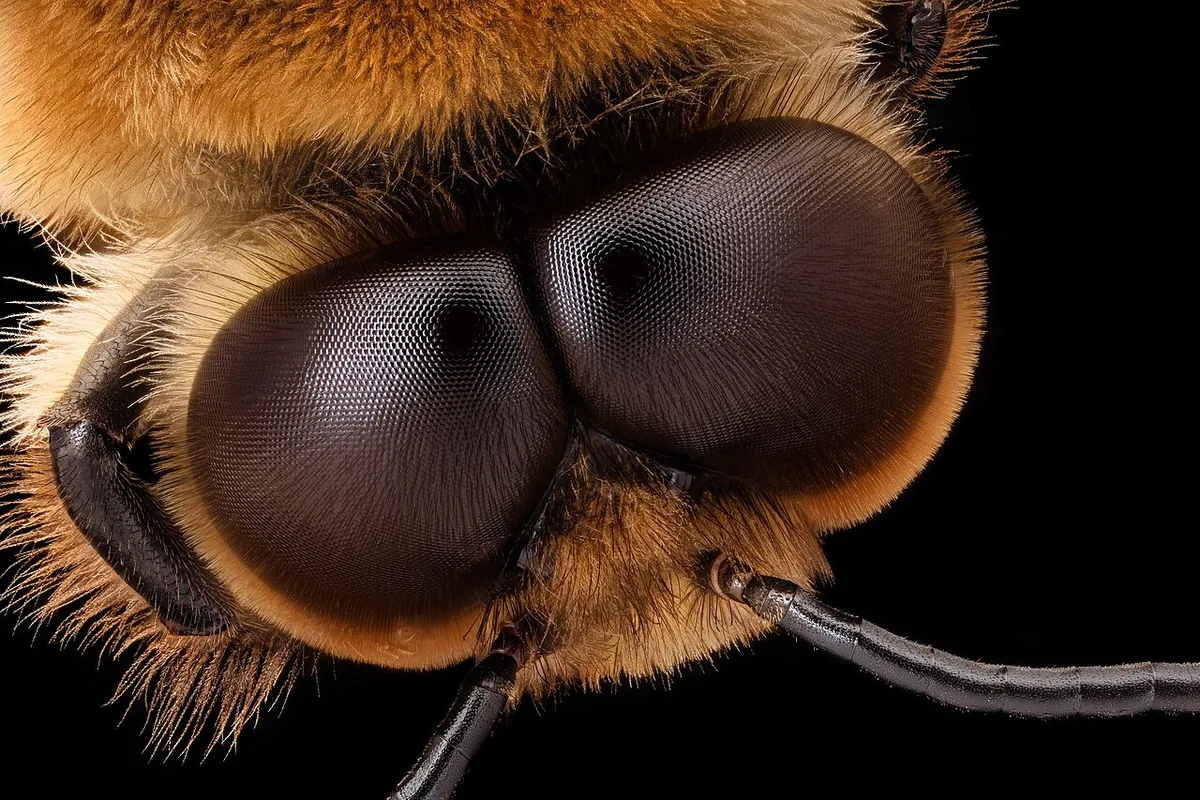
Close-up photograph of a bee's head: two large faceted eyes and, between them on top, three small shiny simple eyes.
A bee's head, magnified: two faceted eyes and, between them on top, the three simple eyes.Image: USGS Bee Inventory and Monitoring Lab from Beltsville, Maryland, USA, source, Public domain

How blurred her world is

To catch a disc's colour, the bee needs it to cover 15° of her view: a 16 cm plate held at arm's length. She glimpses its shape from 5°, about a 5 cm plate.

Her clock, though, runs faster than yours: she catches 100 flickers a second, where your film looks smooth.

The guides

The flower lights its own middle

The dandelion's tips and the green cup beneath them wear two different bee colours. Patterns like these guide the bee toward the flower's middle.

Tips: ultraviolet-green Cup: green

The flower's tips (yellow to you, ultraviolet-green to the bee) and the green cup beneath them (green to both of you) are two different signals. The difference points the way to the middle.

Many flowers wear such an ultraviolet eye: the middle absorbs ultraviolet while the petals reflect it. Look for flowers with a dark middle in ultraviolet photographs and you find them everywhere.

Ultraviolet is the bee's third colour, beside blue and green. Talk of an ultraviolet signal says more than the measurements show.

Game

True or false?

Eight statements about the bee's eyes. Some sound like stories and are true.

The eight statements and their answers:

  • True. Bees see ultraviolet light, which your eye cannot see. Bees see ultraviolet and humans do not. In return, humans see red better than bees. Lunau & Camargo 2025, Plant Biology
  • False. Red is invisible to bees. Red is not invisible, only hard to find: bees need more time to discover red flowers than other ones. Rodriguez-Girones & Santamaria 2004, PLoS Biology
  • True. The red poppy looks ultraviolet to bees. The poppy petal reflects plenty of red, but also ultraviolet, and its bee category is ultraviolet. That is how bees find the poppy. the FReD database, spectrum 2184
  • False. Every red poppy in the world reflects ultraviolet. In the eastern Mediterranean poppies absorb ultraviolet and are pollinated by beetles that see red. Only the western poppies reflect ultraviolet and go with bees. Lunau & Camargo 2025, Plant Biology
  • True. A worker bee's eye has more than 5,000 facets. The worker has 5,375 facets in each eye; the drone has almost twice as many: 9,993. Kelber & Somanathan 2019, Insects
  • False. Bees see more sharply than you. For its colour to register, a disc must cover 15° of her view: a 16 cm plate held at arm's length. Hempel de Ibarra, Vorobyev & Menzel 2014
  • True. Red flowers made for birds look black to bees. Red bird-pollinated flowers often absorb ultraviolet, so they look black to bees. Bees sometimes visit them to steal nectar, without pollinating them. Lunau & Camargo 2025, Plant Biology
  • True. Bees learn blue-violet colours fastest. After a single rewarded encounter, bees already recognise blue-violet well. Other colours take more tries. Hempel de Ibarra, Vorobyev & Menzel 2014

What the sources cannot say

Where the measurements end

The sums above run on measured spectra and on papers read in full. Here is where they may go wrong:

  • Romanian poppies were never measured.

    The poppy spectra come from Germany and Austria. Nobody measured Romania's, and the page says only what it knows.

  • The green peak is 544 or 556.

    Studies give different values for the green receptor's peak. The page writes about 540, which covers both.

  • The bee's colours are a model.

    The discs and false-colour flowers translate receptor signals into human colours. They show what the bee tells apart, not what she feels.

  • One spectrum appears twice.

    Poppy records 2125 and 2184 carry nearly the same spectrum: one measurement published in two papers. The page uses it once.

  • The 100 flickers come from the lab.

    The 100 Hz threshold was measured in free-flying bees, under laboratory conditions.

Sources

How we know all this

Flower colours come from the FReD database, which publishes reflectance spectra measured between 300 and 700 nm. A program written for the page split each spectrum into four bands and translated the bee's three bands into human colours by the false-colour photography rule: ultraviolet shown as blue, blue as green, green as red.

Eyes and receptors come from four papers read in full: receptors and the 5° and 15° thresholds from the 2014 synthesis, facets from the 2019 synthesis, the three ocelli from the 2013 paper, and the poppy and the ultraviolet flowers from the 2025 synthesis. The hard-to-find red comes from the 2004 paper on bird flowers.

Two things you will not find here, for want of a good source: the spectrum of a Romanian poppy and a map of every meadow flower in bee view. The last would need spectra FReD does not hold.

Eyes and receptors

  • Peitsch, D., Fietz, A., Hertel, H., de Souza, J., Fix Ventura, D., Menzel, R. (1992). The spectral input systems of hymenopteran insects and their receptor-based colour vision. Journal of Comparative Physiology A 170. rezumatul, prin citare — the bee's three receptor peaks, 344, 436 and 544 nm (read through citing works)
  • Hempel de Ibarra, N., Vorobyev, M., Menzel, R. (2014). Mechanisms, functions and ecology of colour vision in the honeybee. Journal of Comparative Physiology A 200. textul integral liber — trichromacy, the 5° and 15° thresholds, colour learning, pattern vision
  • Kelber, A., Somanathan, H. (2019). Spatial Vision and Visually Guided Behavior in Apidae. Insects 10:418. textul integral liber — 5,375 worker facets, 9,993 in the drone, the polarised-light compass
  • Streinzer, M., Brockmann, A., Nagaraja, N., Spaethe, J. (2013). Sex and Caste-Specific Variation in Compound Eye Morphology of Five Honeybee Species. PLoS ONE 8:e57702. textul integral liber — the three ocelli on the crown of the head

Flowers and false colours

  • Arnold, S. E. J., Faruq, S., Savolainen, V., McOwan, P. W., Chittka, L. (2010). FReD: The Floral Reflectance Database. PLoS ONE 5:e14287. textul integral liber — the spectra of the page's six flowers, measured between 300 and 700 nm
  • Lunau, K., Camargo, M. G. G. (2025). Bees, flowers and UV. Plant Biology 27. textul integral liber — the poppy as a bee-ultraviolet flower, eastern and western poppies, ultraviolet guides
  • Lunau, K., Verhoeven, C., Ren, Z.-X. (2018). False-colour photography: a novel digital approach to visualize the bee view of flowers. Journal of Pollination Ecology 23. textul integral liber — the false-colour rule: ultraviolet shown as blue, blue as green, green as red

The red

  • Rodriguez-Girones, M. A., Santamaria, L. (2004). Why Are So Many Bird Flowers Red? PLoS Biology 2:e350. textul integral liber — red is not invisible to bees, only hard to find