Weather records in Caraș-Severin county: the hottest and coldest days measured, year by year since 1961
The records are those measured at the county’s long-running ANM weather stations; stations that are not in the open data may hold other extremes. County averages and values for villages are estimates from the 1 km grid.
On the mountain
Stations above 1,000 m are counted apart, so that they do not take every cold record.
#Which were the warmest years in Caraș-Severin county?
Averaged over the whole county, as estimated from the weather service’s grid, the warmest year of 1961–2025 was 2024 (12.44 °C) and the coldest 1980 (8.23 °C). The top five: 2024 (12.44 °C), 2023 (11.69 °C), 2019 (11.61 °C), 2025 (11.50 °C), 2018 (11.35 °C). The annual mean temperature was 9.26 °C in 1961–1990 and 10.47 °C in 1996–2025.
The hottest day, by the average high over the whole county: 24 July 2007 (38.6 °C). The coldest night, by its average low: 24 January 1963 (−22.8 °C). The wettest day: 30 July 1971, with 82.9 mm on average over the whole county.
The wettest year: 2005 (1164 mm); the driest: 2000 (504 mm). On average 806 mm fell a year in 1961–1990 and 842 mm in 1996–2025.
#Where is it coldest and where warmest in Caraș-Severin county?
Among its 306 towns and villages, by the 1991–2020 average of the weather service’s grid:
- Coldest January nights: Camena (Cornereva), with a mean low of −6.3 °C. The mildest: Broșteni (Oravița), −1.5 °C.
- Hottest July days: Topleț, with a mean high of 30.9 °C. The coolest: Gărâna (Brebu Nou), 21.2 °C.
- Most precipitation a year: Gărâna (Brebu Nou), 1065 mm. The least: Liubcova (Berzasca), 641 mm.
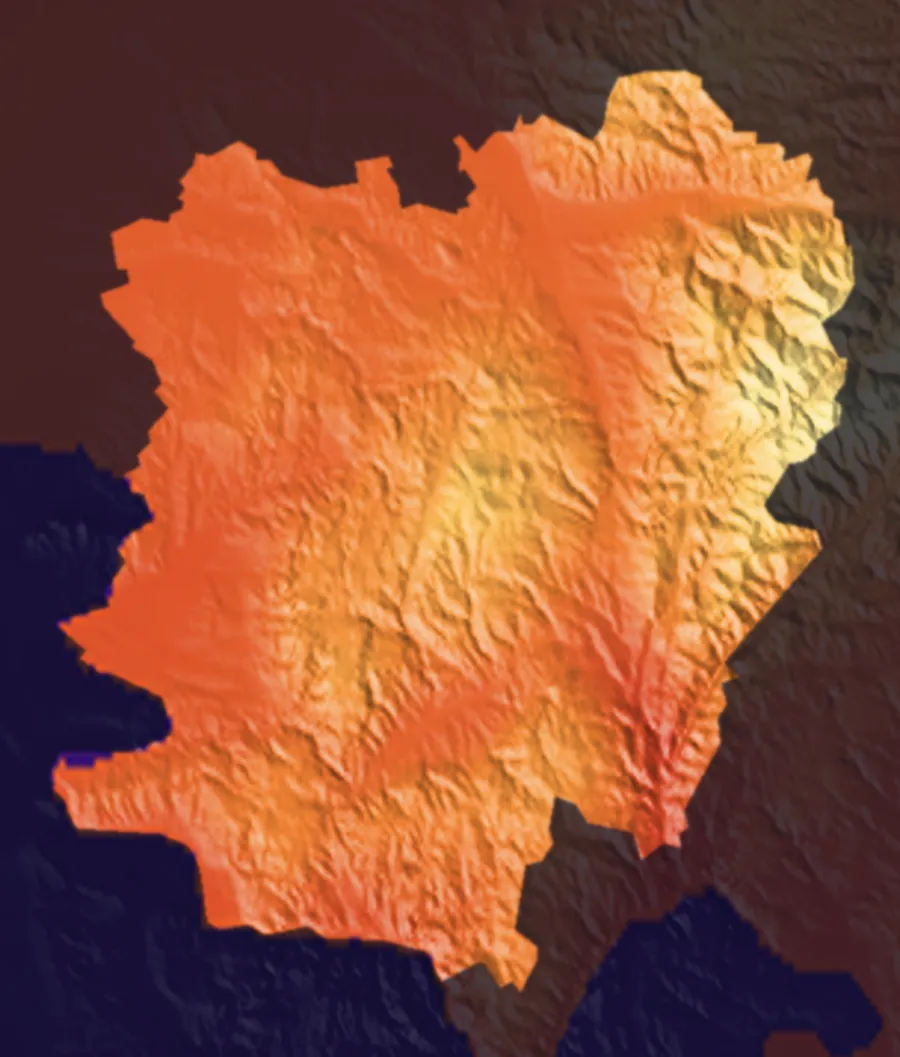
#Which weather stations are in Caraș-Severin county?
| Station | Altitude | Measures since | Highest | Day | Lowest | Day |
|---|---|---|---|---|---|---|
| Bozovici | 256 m | 1950 | 41.8 °C | 24 July 2007 | −30.8 °C | 13 January 1985 |
| Băile Herculane | 190 m | 1921 | 43.0 °C | 12 August 1921 and 24 July 2007 | −23.0 °C | 18 January 1945 and 8 January 1947 |
| Caransebeș | 241 m | 1921 | 40.3 °C | 24 July 2007 | −32.2 °C | 11 February 1929 |
| Moldova Veche | 82 m | 1964 | 44.0 °C | 24 July 2007 | −20.9 °C | 13 January 1985 |
| Oravița | 309 m | 1922 | 42.0 °C | 29 June 1938 | −23.6 °C | 24 January 1942 |
| Reșița | 279 m | 1979 | 40.3 °C | 26 July 2025 | −21.4 °C | 8 January 2017 |
| Cuntu | 1456 m | 1956 | 29.5 °C | 24 July 2007 | −25.4 °C | 17 January 1963 |
| Semenic | 1432 m | 1956 | 29.4 °C | 24 July 2007 | −24.5 °C | 17 January 1963 |
| Țarcu | 2180 m | 1961 | 23.1 °C | 24 August 2007 | −34.4 °C | 3 January 1979 |
#A paragraph ready to quote
In Caraș-Severin county, Romania, at the long-running ANM weather stations, the highest temperature measured is 44.0 °C, at Moldova Veche (24 July 2007), and the lowest −32.2 °C, at Caransebeș (11 February 1929). As an average over the whole county, estimated from the weather service’s 1 km grid, the warmest year of 1961–2025 was 2024, and the annual mean temperature rose from 9.26 °C in 1961–1990 to 10.47 °C in 1996–2025. Source: Romania’s National Meteorological Administration (ANM), open data (CC BY 4.0), processed at mariuscomper.uk/ce-vreme-era. Measurements to 15 November 2026.
Every county and station · The weather on any day, in any town