The sky 100,000 years ago
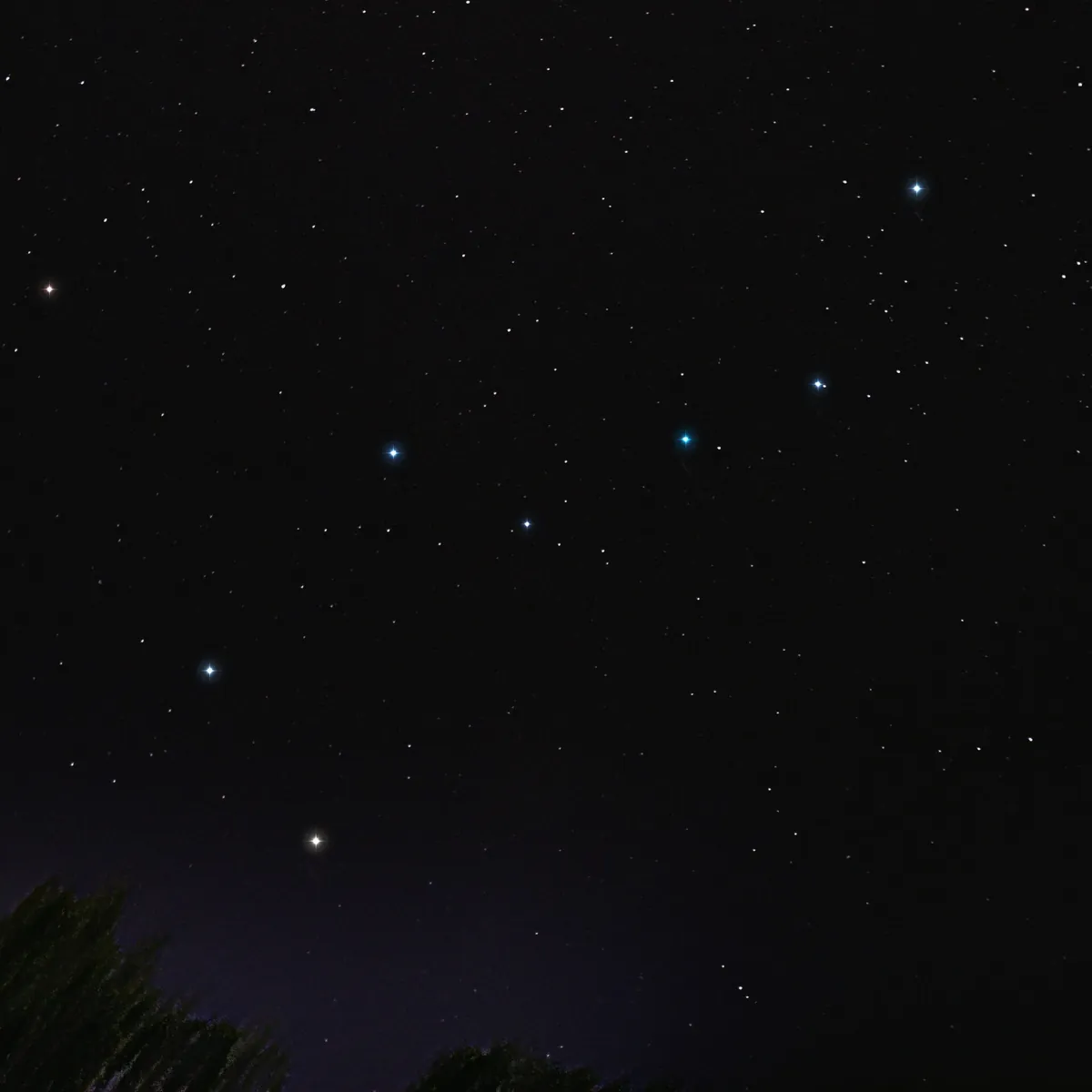
The Plough didn't look like this 100,000 years ago
100,000 years ago, the Plough's bowl gaped almost twice as wide as today. Drag time backwards and forwards: three sky shapes shift, Polaris loses the pole, and the people who looked up then come into view.
Turn back timeGuess first
Which shape survives 100,000 years?
Three sky shapes, three different fates. Pick one before you touch the slider below.
Orion wins; Cassiopeia loses the most.
Over 100,000 years into the past or the future, Orion shifts by only 0.4°, the Plough by 3.5° into the past and 3.4° into the future, and Cassiopeia by 7.7° into the past and 3.6° into the future. Orion's stars are much farther away, so their motion barely shows. Check for yourself with the slider.
Your sky, at the controls
Move 200,000 years with one finger
The slider moves the sky between 100,000 years ago and 100,000 years from now. The stars move to the Hipparcos satellite's measurements, and the bottom row tells you which star holds the pole in the chosen year.
Year
Pole star Polaris 0.7°
The drawings keep one orientation at every year, so you see the shape, not the turning of the sky. The brighter the star, the bigger the dot; the colour shows surface temperature, from blue to orange.
Every star goes its own way through the galaxy. The Sun watches from one corner, so their paths show as a slow slide across the sky: proper motion. The Hipparcos satellite measured it for over a hundred thousand stars.
Cassiopeia breaks down the most because Schedar, the star at the W's corner, sprints 15° on its own in a hundred thousand years. In the Plough the bowl nearly tears: Dubhe leaves one way, Alkaid the other. Orion escapes by being far: Rigel moves only 0.04° in all that time.
Five fly together
Two of these stars are strangers. Which?
The arrows show where each Plough star is headed in the next 20,000 years. Five go one way, two go the other. Pick the two.
Dubhe and Alkaid are the strangers.
The other five were born together, 400–500 million years ago, from one and the same cloud. They have flown the galaxy together ever since, like a flock. Dubhe and Alkaid merely happen to stand in the same direction, seen from Earth.
In 1869 Richard Proctor first noticed that the Plough's stars, with two exceptions, all head for the same point. The modern check came in 2003: a team led by Jeremy King sifted some 220 stars and kept about 60. The flock's centre is some 80 light-years away.
The wandering pole
The Pole Star is only today's tenant of the pole
Earth's axis wobbles like a spinning top and turns full circle in about 25,771.5 years. The celestial pole wanders with it, and every few thousand years another star stands nearest to it.
The bright dot shows where the pole stands in the year picked with the slider.
In the picked year, the pole stands nearest to Polaris 0.7°.
Polaris has not always been the pole star and will not stay it. Its best pass in recent millennia comes right now: in the year 2100 it will stand only 0.46° from the pole.
In 100,000 years the axis turns almost four full circles: 3.88. 100,000 years ago the pole stood 4.9° from Polaris, and in 100,000 years it will stand 2.9° from Thuban. Here is the sequence of passes, worked out from the same data:
Thuban · c. 2,800 BC · 0.15°
The tightest pole–star fit in the whole sequence.
Kochab · c. 1,100 BC · 6.5°
In its time the navigator Pytheas said the pole had no star.
Polaris · today, nearest in 2100 · 0.46°
48th by brightness in the catalogue, famous for standing still.
Errai · c. 4100 · 1.8°
From Cepheus, a modest third-magnitude star.
Alderamin · c. 7500 · 2.2°
Also from Cepheus, after Errai.
Deneb · c. 10,200 · 6.7°
Too far to hold the pole alone; Delta Cygni helps.
Delta Cygni · c. 11,550 · 2.1°
The pole's reserve: only 2.1° off.
Vega · c. 13,700 · 4°
The northern sky's second-brightest star; it last held the pole around 12,000 BC.
Tau Herculis · c. 18,200 · 0.6°
Then the sequence starts over, past Thuban.
Who looked up
100,000 years ago, other eyes watched this bowl
Modern humans had already appeared, but their bulk was still in Africa. In Europe, under this sky, the people were Neanderthals.
Neanderthals lived from about 400,000 to 40,000 years ago, across Europe and Asia. When the Plough's bowl looked like the drawing above, they were this sky's people almost everywhere.
People like us had evolved in Africa more than 300,000 years earlier; a few groups had already reached Europe, but their wide spread was still tens of thousands of years off. The sky they would find here was this one.
Game
True or false?
Eight statements about the sky. Some sound like stories and are true.
The eight statements and their answers:
- True. 100,000 years ago, the Plough's bowl gaped almost twice as wide as today. The Dubhe–Merak span was 9.47° then, against 5.37° today. The bowl has narrowed by nearly half. Hipparcos positions + this page's sums
- False. All seven stars of the Plough travel through space together. Five travel together, but Dubhe and Alkaid are farther off and move another way. Richard Proctor noticed this back in 1869. King et al. 2003, Astronomical Journal
- True. In 100,000 years, Orion will look almost the same as today. Its stars are much farther away, so the shape shifts by only 0.4° in a hundred thousand years. Of the three shapes, Orion's survives best. Hipparcos positions + this page's sums
- False. The Pole Star is the brightest star in the sky. 47 other catalogue stars outshine it. Polaris is only 48th. It is famous for standing almost still, not for shining bright. the Hipparcos catalogue, via VizieR
- True. About 5,000 years ago, the pole star was Thuban, not Polaris. Around 2800 BC the celestial pole passed within 0.15° of Thuban, in Draco. The tightest pole–star fit in the whole sequence. this page's sums, cross-checked with published tables
- False. Sirius belongs to the Plough's group. It was long believed, but the group is 400–500 million years old and Sirius is too young. It moves the same way by coincidence. King et al. 2003, Astronomical Journal
- True. In about 12,000 years, Vega will be the pole star. Around the year 13,700 the pole will pass 4° from Vega, the second brightest star in the northern sky. It held the job once before, around 12,000 BC. this page's sums, cross-checked with published tables
- True. 100,000 years ago, Neanderthals lived in Europe. Neanderthals lived from about 400,000 to 40,000 years ago, across Europe and Asia. Most modern humans were still in Africa then. Natural History Museum, Londra
What the sources cannot say
Where the sums end
The sums above run on straight lines, and the universe is not made of straight lines. Here is where they may go wrong:
Stars do not quite go straight.
The sums carry them on at today's speed, but the galaxy's gravity bends their paths, and some stars circle in pairs. At the 100,000-year scale the bending is small for the stars here, except for Arcturus, which would fly 46.5° in a straight line: the simple sum is no good for it.
The pole does not go quite round.
The sums walk it around a perfect circle, while the true circle slowly tightens and loosens. The sequence's years may therefore sit a few hundred years off; the order of the stars and the distances stand.
Missing speeds are set to zero.
For 18 of the 31 stars no approach-or-recede speed was found. Zero was assumed, which changes only the star's distance, not its direction in the sky.
Brightnesses are today's.
In 100,000 years the distances shift a little, and the brightnesses with them, but for the Plough's stars by at most 0.12 magnitudes: too little to see by eye. The drawings keep today's measured brightnesses.
The flock's age has two values.
The 2003 study gives 500 ± 100 million years; a newer method, from 2026, gives about 400. The page writes 400–500, which covers both.
Sources
How we know all this
Star positions, distances and motions come from the new reduction of the Hipparcos catalogue (van Leeuwen, 2007), read through the VizieR archive of the Strasbourg astronomical Data Center. Star names and radial velocities come from the same centre's SIMBAD database. The precession cycle of about 25,771.5 years and the axial tilt are NASA's values.
From these data, a program written for the page carried each star backwards and forwards at its measured speed and walked the pole around the precession circle. The years at which the pole passes each star come out of this sum, and they match the published tables: Polaris in 2100 at 0.46°, Thuban around 2800 BC at 0.15°, Vega around 13,700 at 4°.
Two things you will not find here, for want of a good source: a map of the whole sky at 100,000 years (the catalogue lacks speeds for all the faint stars) and an exact date for modern humans' arrival in Europe. The London museum gives only rough markers: first excursions more than 200,000 years ago, wide spread within the past 60,000 years.
The stars and their motion
- van Leeuwen, F. (2007). Validation of the new Hipparcos reduction. Astronomy & Astrophysics 474. CDS catalogue I/311 — positions, parallaxes and proper motions of every star on the page
- ESA (1997). The Hipparcos and Tycho Catalogues. ESA SP-1200. CDS catalogue I/239 — the first Hipparcos reduction; its documentation states the RA motion includes the cosine of declination
- SIMBAD astronomical database, Strasbourg astronomical Data Center. simbad.cds.unistra.fr — radial velocities and star names
- King, J. R., Villarreal, A. R., Soderblom, D. R., Gulliver, A. F., Adelman, S. J. (2003). Stellar Kinematic Groups. II. A Reexamination of the Membership, Activity, and Age of the Ursa Major Group. The Astronomical Journal. doi:10.1086/368241 — group membership (about 60 out of some 220 candidates) and its age, 500 ± 100 million years (abstract read, on the university page)
Precession and the pole star
- NASA Science: Milankovitch (Orbital) Cycles and Their Role in Earth's Climate. science.nasa.gov — the axial precession cycle of about 25,771.5 years
- NASA Earth Observatory: Milutin Milankovitch (Steve Graham, 2000). earthobservatory.nasa.gov — today's axial tilt, 23.5°, and its swing between 22.1 and 24.5°
- Pole star — the table of pole transits, citing Norton's Star Atlas and Star Tales. wikipedia.org — cross-check of the years computed here (secondary source)
Who looked up
- Natural History Museum, London: When and how did modern humans spread out of Africa. nhm.ac.uk — modern humans evolved in Africa more than 300,000 years ago
- Natural History Museum, London: Who were the Neanderthals. nhm.ac.uk — Neanderthals, from about 400,000 to 40,000 years ago, across Europe and Asia