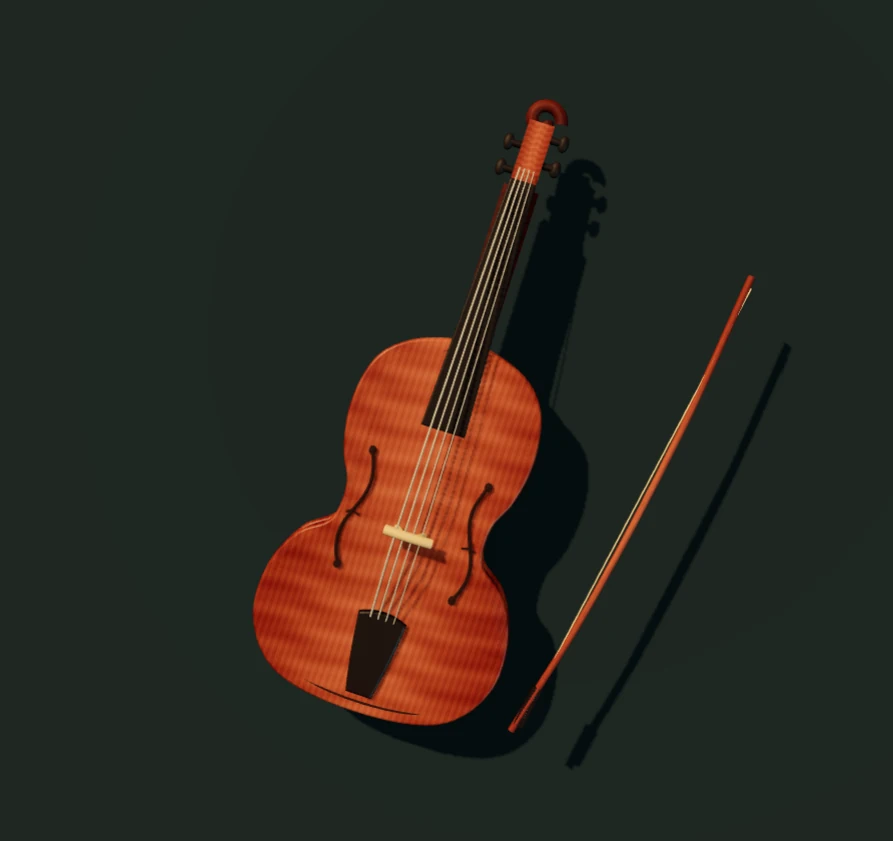
In Oaș Country, fiddle players adapted the violin for a higher register. Field research describes the strings tuned a fifth higher than usual. Look inside the instrument and hear the difference between the two pitches. 12
The bridge is the piece of wood supporting the strings. The researcher Corina Iosif describes a lower bridge, moved towards the fingerboard. The position of the tailpiece, where the strings are fastened at the lower end, changes too. 1
Look at the two positions in the model. The distances are illustrative. They show the direction recorded in the research.
Inside the soundbox
A small piece between two plates
Inside the body, a wooden cylinder supports the front and back plates. It is called a soundpost. The field account also describes moving it when adapting the violin for the higher register. 1
The account of the ceteră records these changes together. The short tones below isolate the difference between the two tunings so you can hear it.
Listen to the comparison
What a fifth sounds like
Choose a string and play its standard pitch, then the pitch a fifth higher. In this comparison, A₄ is 440 Hz and E₅ is about 659.3 Hz. The higher tone makes more oscillations in the same second.
The tuning in the model sets the frequency. The sound of a real fiddle also depends on wood, strings and how the bow is drawn.
Synthesized tones let you compare pitch. See the recording collection’s launch notes at the end.
Fiddle, zongoră and voice
The melody alongside the accompaniment
The heritage inventory describes a fiddler from Negrești-Oaș accompanied by a zongoră, a guitar. In the field account, voices and instruments belong to the same dance. Listen for what the accompaniment repeats and where the melody changes. 12
In the model, all four strings move by the same interval. That makes the change in pitch between tunings easier to hear.
Negrești-Oaș · Oaș Country Museum
The people who played
The Oaș Country Museum in Negrești hosted the launch of Glasuri și cetere din Oaș. Recorded players named at the launch include Gheorghe “Goreu”, Vasile Frățilă “Toderel” and Vasile Batin “Tompoșel”. 34
The reference tone makes an interval audible. The recordings preserve the songs and the way each player performed them. 4
Sources and model
The model shows the described construction and directions of movement schematically. The sound comparison uses equal temperament with A₄ = 440 Hz and a transposition of seven semitones. The tones are synthesized.