The stag's antlers: about a metre of new bone every summer
Every spring the stag sheds his crown of bone — and by late summer he wears a new one, about a metre long. Below, grow it month by month beside a silhouette of your own height, learn what a single June day adds, and see what the tines do — and don't — say about his age.
The slider walks through one year of a prime stag, from March to February. The antler grows life-size beside a human silhouette — type your height so the silhouette matches your stature. But first, a question with stakes.
Guinness World Records says some antlers grow 2.5 cm a day. Is that the red deer's rate?
Move the slider toward the summer months or press “Play the months” — the day's rate appears here.True scale: the silhouette, the antler and the shoulder line (137 cm, after the British Deer Society) share one scale.
The model's steepest slope is in June — the peak-rate month, which the slider names for you.
How long the antler is at each month's end
Cumulative length of one prime stag's antler, in centimetres. The curve is schematic, anchored at 0 cm at the start of March and 100 cm at the end of growth (Langbein 2017); the usual length is 70–80 cm (the Slovak forest atlas).
Guinness gives up to 2.5 cm a day for deer antlers in general; its example — a 36 kg rack grown in one summer — is a moose's. The red deer's own rate is lower — the slider shows it.
Scroll and the picture walks through the stag's year, from March to February. The drawings are schematic: the same antler, in five stages.
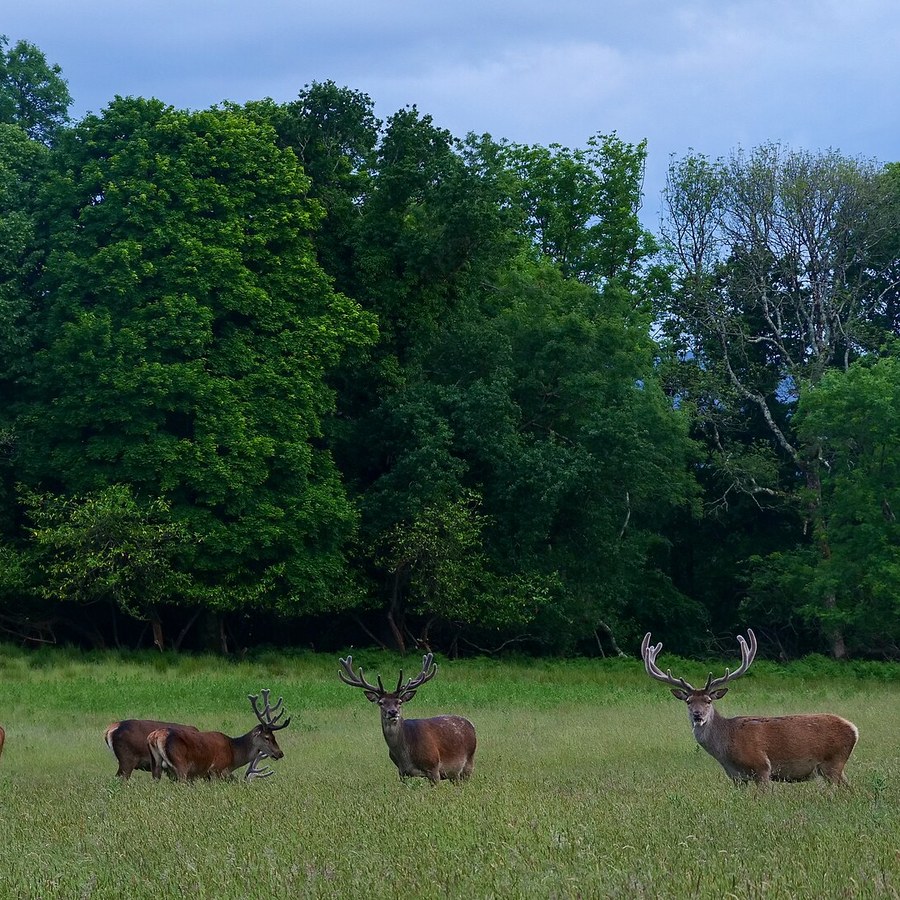
Red deer stags with antlers in velvet, Killarney National Park, Ireland. Photo: Robert Leane, CC BY-SA 4.0, via Wikimedia Commons.
March · casting
Step 1 of 5 · March · casting
The crown falls
When testosterone falls after winter, the bone under the antlers is resorbed and each antler drops off its pedicle. Prime stags cast first, from March; young stags follow into April. What stays on the skull are the pedicles — the bone knobs the next set grows from.
Step 2 of 5 · April–July · velvet
The great growth
From each pedicle springs a new antler, wrapped in velvet: living skin, rich in blood vessels. The antler lengthens through its tips and thickens around its shaft, and in the fastest weeks it adds whole centimetres.
Step 3 of 5 · August · cleaning
The velvet goes
In late summer, testosterone rises, growth stops and the bone mineralises fully. The velvet dies and falls in strips, leaving bare bone, ready to fight.
Step 4 of 5 · September–October · the rut
The rut
In autumn the deer gather on the rutting grounds: the stags roar, size each other up and clash antlers over the hinds. It is the season the antlers earn their keep — and the season the stag is dangerous to people.
Step 5 of 5 · November–February · the winter crown
Winter with antlers
After the rut, the antlers stay on the skull all winter: hardened bone, no velvet, no growth. When winter ends, testosterone falls again and the cycle restarts.
The stages follow the Deer Initiative guide (casting from March, clean from August) and Langbein's Exmoor notes.
A stag's antler is bone from base to tip — and the only mammalian organ that fully regenerates every year. A prime stag may grow around 5–9 kg of new bone in one summer (Langbein 2017).
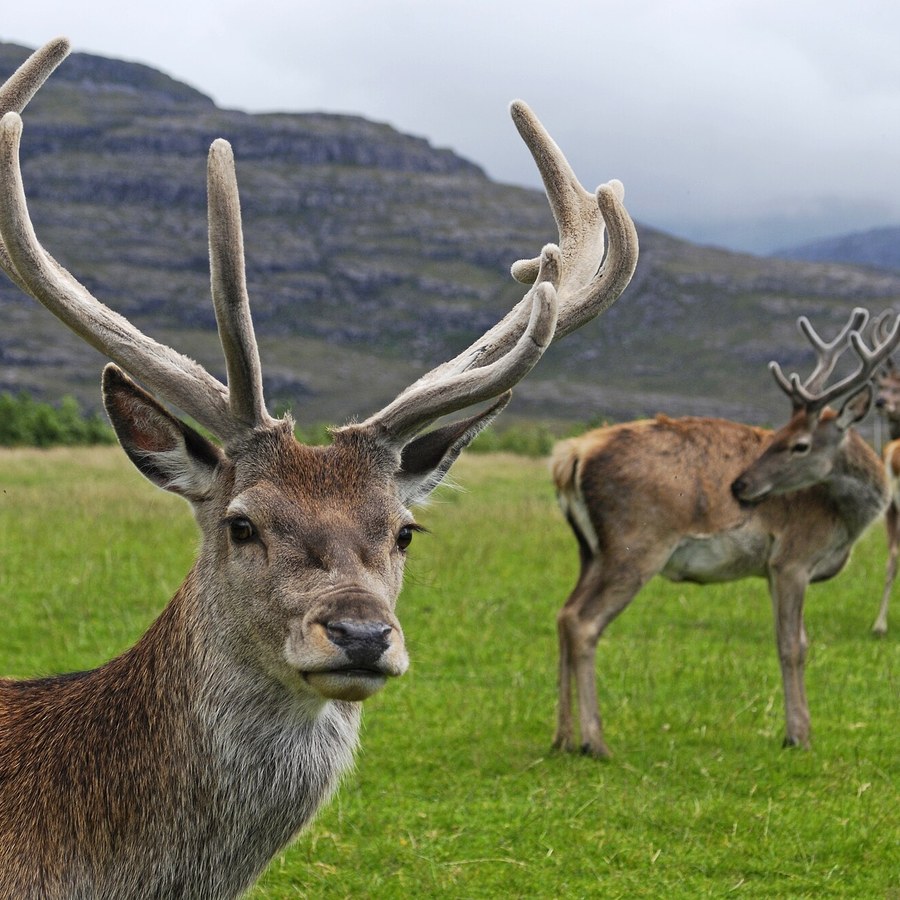
A red deer stag with antlers in velvet, Glen Torridon, Scotland. Photo: Mehmet Karatay (derivative: Massimo Catarinella), CC BY-SA 3.0, via Wikimedia Commons.
Bone, not horn
Antlers are outgrowths of the frontal bone, grown from two knobs called pedicles. A horn instead wraps its bony core in a keratin sheath: the difference is in the make-up.
Velvet is living skin
While they grow, antlers wear a thin skin threaded with blood vessels and nerves — and the nerves grow along with the antler (Li et al. 2007). When growth stops and the bone has mineralised fully, the velvet dies and falls in strips.
They fall in spring, when testosterone is low
After winter, when testosterone is low, bone-eating cells (osteoclasts) thin the bridge under the antlers, right on the pedicle. When the bridge weakens enough, the antler comes away and drops.
What the page's sources don't say: the daily rate in young or old stags — the figures here are for stags in their prime — and why some antlers grow crooked or uneven.
The idea that you count the tines and learn the age is old and tempting — and, taken literally, false. Three sources, one conclusion:
Bartosiewicz, 2021 tines are “not characteristic of any particular year of life” in grown stags
Langbein, 2017 “at best an imprecise indicator of age”
Deer Initiative, 2008 “some indicator of age”: yearlings wear spikes, the crown comes later
How old is a stag with 12 tines?
So: yearlings usually wear simple spikes; beam tines typically develop from the second head onwards, followed soon after by the crown of top points; and in very old stags antlers may shrink — but the exact tine count is no identity card.
Better clues come from beam width and the antler's base — not from counting tines.
The rut is the season the antlers earn their keep — and the season in which people must be kept well away from deer.
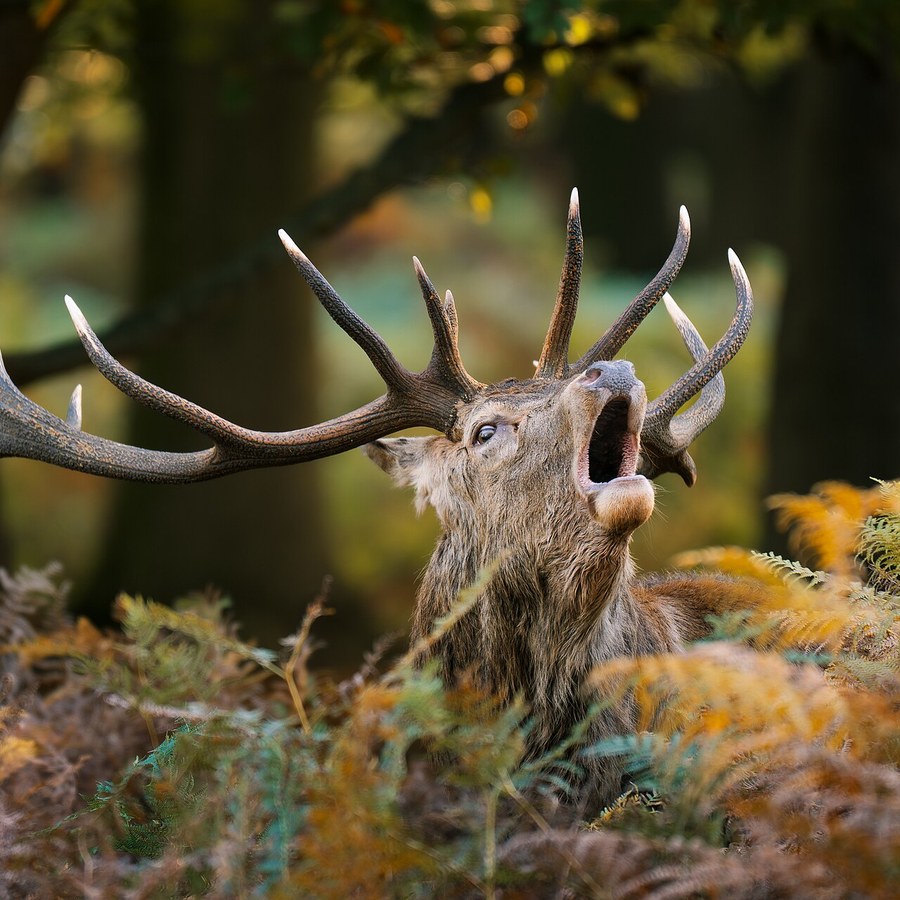
A red deer stag roaring in Richmond Park, London, October 2025. Photo: Julian Herzog, CC BY-SA 4.0, via Wikimedia Commons.
During the rut, the stag guards his hinds and fights his rivals; a person who gets too close can be badly hurt.
The official rule announced by the Royal Parks for the rut, in the parks where red deer live: at least 50 metres between you and the deer. In the Richmond Park manager's words: “it is critical that people keep at least 50m away from deer to avoid spooking them”.
On Exmoor, where the deer are wild, the advice runs further still: a couple of hundred metres, and never between two stags.
This is the season: on Exmoor, the rut runs from the last week of September through October, peaking in the middle weeks of October. In the Carpathians, Conservation Carpathia reported in September 2024 that the season had already begun. If you hear roaring, stop, listen — and don't go closer.
In the Carpathians, September brings the rut: Fundația Conservation Carpathia wrote in September 2024 that “the deer's mating season has begun — it is also called «boncănit»”.
“Boncănit” means, in DEX, both the stag's roar and the mating season. So if you are in the mountains in October: ears open for roaring, eyes on the panorama — and a long distance. The antlers you see grew this summer, centimetre by centimetre; in spring they fall and the story restarts.
Walk out in October to a clearing at the forest's edge, stand still and listen from afar — without going anywhere near the deer: the rut is the sound of the season the stag grew his antlers for.
Fast enough to give the slider above something to show: a prime stag's antler goes from stump to a metre in a single summer, and the model's fastest month is June. The exact rate of a peak day appears when you move the slider.
Why do antlers fall every year?
After winter, when testosterone is low, osteoclasts eat away the bone under the antlers, on the pedicle. When the bridge thins, the antler drops — and the cycle restarts with a new one.
Do the tines tell the stag's age?
Not exactly. Tine counts broadly rise with age, but they are not characteristic of any particular year of life (Bartosiewicz, 2021) — at best an imprecise indicator of age (Langbein, 2017).
What are antlers made of?
Bone, all through: outgrowths of the frontal bone, grown from pedicles. While they grow they wear velvet — living skin, rich in blood vessels.
Is the stag dangerous during the rut?
Yes. London's Royal Parks ask, in their rut warning, for at least 50 metres between visitors and deer, because a stressed deer can seriously hurt or even kill. On Exmoor the advice is a couple of hundred metres.
When is the rut in the Carpathians?
In autumn: the mating season starts in September — Fundația Conservation Carpathia announced it in September 2024. On Exmoor, the rut runs from the last week of September through October.
The monthly growth curve is schematic: the shape and the months are illustrative choices, the anchors come from sources — 0 cm at the start of March, 100 cm at the end of growth (Langbein 2017), a daily rate from the growth phase (Li et al. 2007). The human silhouette and the antler share one scale; the default height is 170 cm.
The photographs are red deer verified against Wikimedia Commons categories and descriptions; each caption carries its licence. The antler drawings are schematic, not casts.
The Guinness figures (2.5 cm a day for antlers in general, 36 kg on a moose) appear only for comparison. No moose, wapiti or other-species figure enters the deer's curve.
The page carries no trophy scores and no hunting advice, by construction.
What the page doesn't say: the daily rate in young or old stags, and why antlers grow crooked (see above).