ITU-R M.1677-1 · Fibonacci timing · 14 parallel languages
International Morse code, measured to the dot: why it fits German best and how one letter slows down the rest
Under international telegraph rules, the number of dot-dash patterns at each duration follows the Fibonacci sequence. Yet when Friedrich Gerke overhauled American Morse in Hamburg in 1848, he placed the letter O at three dashes (11 units) — leaving German at +3.01% above the mathematical optimum while English (+5.39%), Spanish (+9.94%), and Polish (+15.18%) pay the penalty.
Why dot-dash slots follow the Fibonacci sequence
Every dot costs 1 unit and every dash costs 3, with a 1-unit gap between pulses. Adding a dot makes a pattern 2 units longer; adding a dash makes a shorter pattern 4 units longer — the exact Fibonacci recurrence F(n) = F(n−1) + F(n−2), giving 1, 2, 3, 5, 8, 13, and 21 slots.
Fourteen languages on the same text: the Universal Declaration of Human Rights
Comparing identical translations across 14 European languages shows how strongly the share of letter O (---, 11 pulse units) predicts excess transmission time (r = 0.67). German sits closest to its own mathematical optimum.
| # | Language | ITU u/letter | Opt. u/letter | Excess | Letter O | Best single swap |
|---|---|---|---|---|---|---|
| 1 | German | 9.196 | 8.927 | +3.01% | 2.1% | N ↔ T (−34%) |
| 2 | French | 9.424 | 8.970 | +5.05% | 6.5% | H ↔ O (−53%) |
| 3 | Dutch | 9.373 | 8.919 | +5.08% | 5.2% | O ↔ U (−38%) |
| 4 | English | 9.844 | 9.341 | +5.39% | 8.1% | M ↔ O (−47%) |
| 5 | Turkish | 9.435 | 8.922 | +5.74% | 1.6% | L ↔ T (−34%) |
| 6 | Swedish | 9.708 | 9.098 | +6.71% | 5.1% | A ↔ E (−28%) |
| 7 | Romanian | 9.402 | 8.743 | +7.54% | 4.8% | H ↔ O (−29%) |
| 8 | Italian | 9.623 | 8.886 | +8.29% | 9.0% | H ↔ O (−44%) |
| 9 | Hungarian | 9.750 | 8.960 | +8.81% | 5.8% | O ↔ U (−23%) |
| 10 | Czech | 10.612 | 9.707 | +9.32% | 9.4% | O ↔ T (−41%) |
| 11 | Spanish | 9.926 | 9.029 | +9.94% | 9.4% | O ↔ T (−41%) |
| 12 | Portuguese | 9.841 | 8.925 | +10.26% | 10.9% | O ↔ T (−47%) |
| 13 | Finnish | 9.315 | 8.430 | +10.50% | 5.5% | A ↔ E (−37%) |
| 14 | Polish | 10.995 | 9.546 | +15.18% | 10.0% | O ↔ T (−40%) |
From Vail’s 1838 typecase to Gerke (1848) and Shannon (1948)
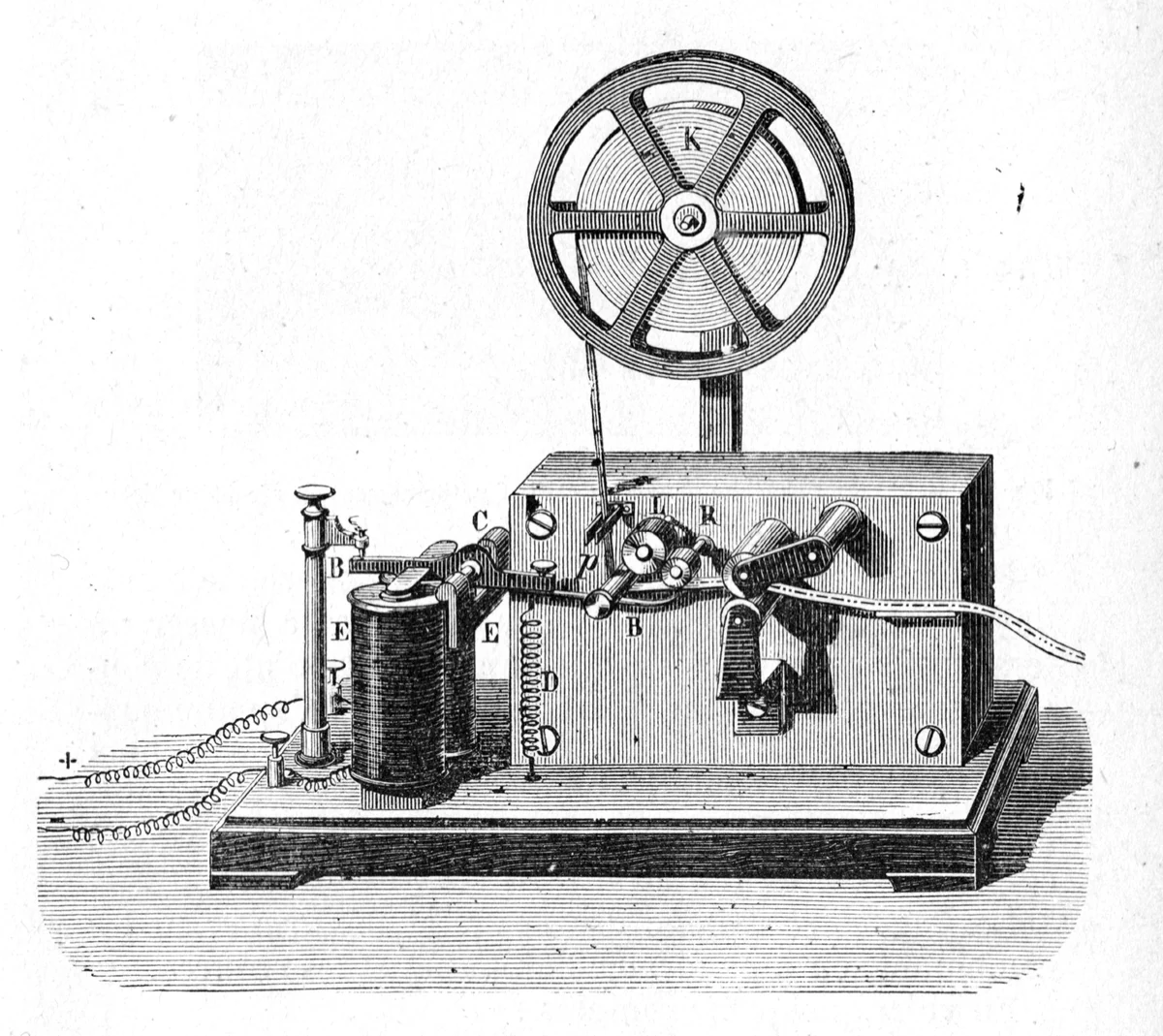
In 1838, Alfred Vail visited a printing shop to count how many metal sorts a compositor kept for each letter — roughly 12,000 for E, 9,000 for T, and 8,000 each for A, I, N, O, and S. On the May 24, 1844 Washington–Baltimore line, O was a quick pair of spaced dots (· ·). That speed came at a cost: internal spaces inside letters broke down over noisy wires.
Four years later, in Hamburg, Friedrich Clemens Gerke redesigned eleven letters for the Hamburg–Cuxhaven telegraph line. He abolished every internal space and variable-length dash, turning O into ---. For German, where O makes up just 2.1% of letters, the trade was nearly painless (+3.01% excess on UDHR; +2.48% in Kafka’s Die Verwandlung). For English (O = 8.1% on UDHR, 7.5% in Austen’s Pride and Prejudice), swapping O and M alone eliminates 47% of the gap. For Spanish (9.4% O) and Portuguese (10.9% O), swapping O and T removes 41%–47%.
Shannon’s 1948 telegraph channel
In A Mathematical Theory of Communication (1948), Claude Shannon used telegraphy to define channel capacity: 0.539 bits/unit under his discrete timing model (0.578 bits/unit under ITU timing). On UDHR, German reaches 0.438 bits/unit, Romanian 0.409, and English 0.417.

Method, sensitivity, and primary sources
Every duration follows Recommendation ITU-R M.1677-1: dot = 1 unit, dash = 3, intra-character gap = 1, inter-character gap = 3, inter-word gap = 7 (PARIS + word gap = 50 units; at 20 WPM, 1 unit = 60 ms). The fair optimal baseline assigns the 26 shortest dot-dash patterns of up to four elements to each language’s 26 letters by frequency, keeping five-element digits (0–9) untouched.
Two independent checks confirm the pattern: Google FLEURS transcripts (3.23 million characters across seven languages, where Romanian runs at 9.555 u/letter vs English 9.889) and Project Gutenberg literary prose (Kafka +2.48%, Austen +4.05%, Cervantes +11.12%). Switching German umlauts to digraphs (ä→ae, ö→oe, ü→ue) keeps German first at +2.99%. Note that Gerke’s 1848 design prioritized human legibility and resistance to line noise over pure compression.
- ITU-R M.1677-1 (10/2009) — International Morse code
- Claude E. Shannon (1948) — A Mathematical Theory of Communication, Bell System Technical Journal
- Unicode Consortium — Universal Declaration of Human Rights in XML (14 parallel translations)
- Conneau et al. (2022) — FLEURS: Few-shot Learning Evaluation of Universal Representations of Speech
- Library of Congress / Wikimedia Commons — The First Telegraph (May 24, 1844)