Stellar-mass standardisation is handled before age effects are interpreted.
COSMOLOGY / MNRAS · 29 AUGUST 2026
For science readers, cosmology students, and reporters translating supernova claims.
The correction narrowed the cosmic story.
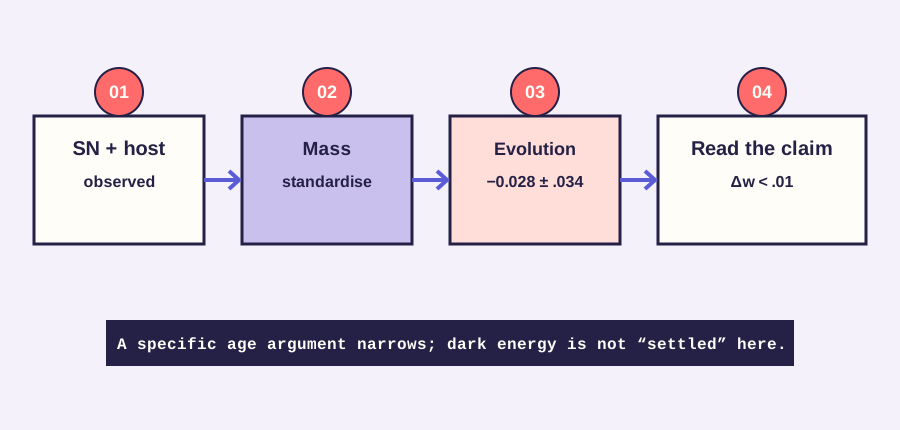
An MNRAS reanalysis applies the usual host-galaxy stellar-mass standardisation and says the cosmic “reversal” argument does not hold. The measured evolution is −0.028 ± 0.034 mag z−1, and the inferred change in w is below 0.01.
Short answerThe correction weakens one progenitor-age argument. It is not a model-independent verdict on dark energy and it does not turn the paper into a new survey.
What changes after the correction — and what remains open?
MNRAS · peer-reviewed reanalysis · values reported in the article
CALIBRATION PATH / 01
mass → evolution
Δw < 0.01
method firstone argument
01 / CONCLUSION
The big story gets narrower.
The paper does not say the cosmic question disappears. It says an explanation based on redshift evolution in supernovae loses support after the standard host-mass correction.
The DES-SN redshift evolution reported in the article is consistent with zero within the published uncertainty.
The conclusion concerns a progenitor-age argument, not every hint about dark energy.
02 / THE CORRECTION
Mass and age are not the same variable.
More massive galaxies tend to be older too, but the correlation does not let you treat a galaxy’s age as the age of the supernova progenitor.
Supernova + host
The observation comes with properties of the supernova and its host galaxy.
Mass standardisation
The known stellar-mass correction for the host enters the standard analysis.
Age stays a question
The age of a galaxy’s stars is not automatically the age of the system that produced the supernova.
03 / THE MEASUREMENT
Three numbers keep the story bounded.
These are the values reported by the reanalysis, not results recalculated by this page.
Magnitudes per unit redshift for the reported evolution of the mass effect.
The inferred shift in w when the measured evolution is included.
The range by which the paper says the progenitor-age difference was overstated.
How to read ±0.034
The central value is small relative to the reported uncertainty. This page does not turn it into proof that every environmental effect is absent.
04 / THE DISTINCTION
The host is not the progenitor.
This is the hinge: an estimate of a galaxy’s stellar population does not directly fix the age of the binary system that produced a Type Ia supernova.
| Term | What it describes | What we cannot assume |
|---|---|---|
| Host mass | An empirical property used in supernova standardisation. | That it is only a proxy for progenitor age. |
| Host age | An estimate of the galaxy’s stellar history or observed population. | That it is the age of the system that produced each supernova. |
| Progenitor age | The age of the system before the Type Ia explosion. | That it can be obtained by simply substituting host age. |
05 / LIMITS
What stays open?
A reanalysis can close a weak link without closing the whole field.
The paper reanalyses the argument with the supernova context and corrections it describes.
This page does not say every dark-energy model has been confirmed or ruled out.
Separating host properties from progenitor properties remains a modelling and observation problem.
Editorial boundary
The safe conclusion is narrow: the specific progenitor-age argument is weakened by the standard correction. That is all.
06 / PROVENANCE
One paper, one verification path.
The controlling source is the locally archived MNRAS article, checked by SHA-256. Media summaries are not used for the decisive numbers.
Primary source
- MNRAS 549(3), stag797Popovic et al. · reanalysis of the host-galaxy mass correction
Fact register
- Evolution
- −0.028 ± 0.034 mag z−1
- Δw
- < 0.01
- Age
- 3–5× overstated
- Boundary
- one argument, not all