One drop, from cloud to ground
No raindrop has ever looked like a teardrop
While it is small, it is a perfect sphere. As it grows, the air flattens its belly into a bun. The giants, a few millimetres across, break apart in mid-air. Pick a size and look.
See the shapesGuess, then look
Which of these is a raindrop?
Three drawings, one question. Choose before you read on.
The sphere and the bun. The teardrop never falls from clouds: it happens at taps, where water thins before it lets go, and on windows, where drops run down the glass.
Which of the two stays in the air depends on size: small drops are spheres, drops past a millimetre flatten out. Drag the slider and watch the change.
A flattened bun.
The air presses the drop's belly and spreads it wide. The crown stays domed.
At 2 millimetres, the drop is a flattened bun falling at 6.5 metres per second, or 24 kilometres per hour. Height over width: 0.91.
Shapes follow the Pruppacher–Beard equilibrium relation, checked against real rain. A real drop wobbles around the drawn shape.
0.5 mm7 km/h
1 mm14 km/h
2 mm24 km/h
4 mm31 km/h
6 mm34 km/h
Two forces fight over the drop. Surface tension, the thin skin of water, pulls it into a ball. The air it falls through presses from below and spreads it. While the drop is small, the skin wins. As the drop grows, it falls faster, the air presses harder, and the belly flattens.
Photographs of real rain, taken in 1959 with two cameras watching the same patch of air, show the change number by number: at 2 millimetres, height is still 93% of width; at 4 millimetres, 81%; at 6 millimetres, 68%.
Book illustrations lie because they paint something else: the teardrop at the tap, where water thins before it lets go, or the streaks on a window. The meteorologist Alistair Fraser put it bluntly: real raindrops barely resemble the popular fantasy, except in the moment they stop being raindrops and splatter on glass.
30 kilometres per hour?
How fast does a giant drop fall?
A 4 mm drop, among the largest in ordinary rain. Pick a speed before you learn the answer.
How fast does it fall?
31 kilometres per hour. That is what the formula fitted to the 1949 Gunn and Kinzer measurements gives: 8.7 metres per second for a 4 mm drop.
But 30 kilometres per hour is the speed of the giants. An ordinary 1 or 2 mm drop falls at 14 to 24 kilometres per hour, and drizzle barely reaches 7 kilometres per hour.
In 1949, Ross Gunn and Gilbert Kinzer weighed more than 1,500 drops in fall, from barely visible specks to drops so large they break apart on their own. The measurement error stayed under 0.7%. The speeds on this page come from the formula Atlas and colleagues fitted to their data.
A drop does not accelerate forever: the air brakes it harder and harder until it falls at a steady pace, the terminal velocity. In a 25-metre fall column, drops of 2.5 to 4 mm reached it after about 10 metres.
Shape matters to everyone measuring rain from far away. Radars look at drops from the side and read their height and width: the flatter the drop, the richer the rain. Satellites measure the same way, from space.
From dust to rain
How small does a drop begin?
One raindrop packs a million cloud droplets into a single 2 mm sphere. The ladder below shows the journey, from a speck of dust to rain.
- 0.2 µmCondensation nucleus
- 20 µmCloud droplet
- 100 µmLarge cloud droplet
- 0.5 mmDrizzle
- 2 mmOrdinary rain
- 6 mmLargest in nature
How many fit in your glass?
Pick a glass and a drop size. The count is worked out on the spot, from the volume of a sphere.
A 200 ml glass holds almost 48,000 drops of 2 mm. At 1 mm, the count passes 380,000.
A cloud is made of droplets about 20 micrometres across, too light to fall. For rain to start, they must join and grow until weight beats air. Under 0.5 mm, falling water is called drizzle, and drizzle is not rain.
Disdrometer readings, from a kind of drop counter, show the average diameter sitting near 1.2 to 1.7 millimetres; the values come from a climatology taken in Busan, South Korea. Giants of 4 mm and up read well on a chart, but in the air they are rare.
Large drops do not last
Why do giant drops break up?
Flattening has a limit. Past it, the drop's belly hollows out, swells like a bag and bursts into small drops.
Once the radius passes about 4 millimetres, the hollow in the drop's base grows explosively into a bag with a ring of water, which then breaks into small drops. That is how the meteorologist Alistair Fraser described the breakup. In diameter, that means about 8 millimetres: the ceiling physics sets for a drop.

In real rain the ceiling sits lower. In Jones's 1959 photographs almost nothing passes 5.5 millimetres, and the largest drop caught measured 6.4 millimetres. Drops of 8 or 9 millimetres, held in the Mainz wind tunnel or dropped from a bridge 80 metres above a disdrometer, are already falling apart.
Game
True or false?
Eight sentences about drops. Some sound like stories and are true.
The eight sentences and their answers:
- True. A small drop, 1 millimetre across, is an almost perfect sphere. Up to about 1 millimetre, surface tension holds the water in a ball. Photographs of real rain give 0.93 for the height-to-width ratio in 2 mm drops. Jones 1959, J. Meteor.
- False. A raindrop is teardrop-shaped. The teardrop happens at taps and on windows. A freely falling drop never looks like that: it is a sphere, a bun, or a breakup in progress. Fraser, quoted by USGS
- False. Every raindrop falls at 30 kilometres per hour. Only 4 mm giants reach 31 kilometres per hour. An ordinary 1 or 2 mm drop falls at 14 to 24 kilometres per hour. Atlas et al. 1973, from Gunn and Kinzer 1949
- True. The bigger the drop, the flatter it is. Measurements on about 115,000 drops show the height-to-width ratio falling as diameter grows, as the Beard and Chuang model says. Thurai and Bringi 2005, J. Atmos. Ocean. Tech.
- False. Ordinary rain holds drops 1 centimetre across. Almost nothing above 5.5 mm has been found in real rain. The 9 mm drops were made artificially, for measurement, and they break up. Thurai and Bringi 2005, J. Atmos. Ocean. Tech.
- True. A large drop reaches full speed after about 10 metres of falling. In a 25-metre fall column, drops of 2.5 to 4 mm had reached the speed they never exceed by about 10 metres. Andsager et al. 1999, J. Atmos. Sci.
- True. A 200 ml glass holds tens of thousands of drops. Almost 48,000 of them at 2 millimetres. At 1 millimetre, over 380,000. computed from the sphere volume
- False. A drop keeps its shape as it falls. No large drop sits still: it wobbles between wide and tall around its equilibrium shape. The average of the wobbles is exactly the shape drawn on this page. Jones 1959, J. Meteor.
Sources
Where it all comes from
The shapes on the page follow the equilibrium relation between diameter and the height-to-width ratio, measured in a wind tunnel by Pruppacher and Beard and confirmed in real rain by Jones's 1959 photographs. Speeds come from the formula of Atlas and colleagues, fitted to the 1,500-plus drops Gunn and Kinzer weighed in 1949. Every derived number is computed from the quoted inputs.
Where only an abstract could be read, the list below says so. So does every disagreement between sources: the sphere-to-bun threshold, the largest drop size, and how much wobbling rounds the average shape. In each case the page shows the range and leaves the disagreement visible.
The drop drawings simplify the equilibrium profile. The photographs show resting drops, and the captions say where they sit.
Shape
- Fraser, A. B., “Bad Rain”, Pennsylvania State University, quoted by the USGS Water Science School, “Are Raindrops Shaped Like Teardrops?”. usgs.gov — the teardrop myth, the sphere, the bun, the bag with its ring of water
- NASA Global Precipitation Measurement, “The Shape of a Raindrop”, 7 March 2011. gpm.nasa.gov — the flattened base, breakup near 4 millimetres
- NASA Scientific Visualization Studio, “Anatomy of a Raindrop” (SVS 11288), narration by Ryan Fitzgibbons. svs.gsfc.nasa.gov — how radar reads the flatness
- Jones, D. M. A. (1959). The shape of raindrops. J. Meteor. 16, 504–510 (ISWS Circular 77). PDF — the ratio table from real rain, the absence of a static shape, the 5.5–6.4 mm ceiling
- Gorgucci, E. et al. (2006). What is the shape of a raindrop? J. Atmos. Sci. 63. doi:10.1175/JAS3781.1 — the Pruppacher–Beard relation, slope 0.062 per millimetre (full text read; equations are images)
- Beard, K. V., Chuang, C. C. (1987). A new model for the equilibrium shape of raindrops. J. Atmos. Sci. 44, 1509–1524. doi:10.1175/1520-0469(1987)044 — the reference model from Laplace's equation (abstract only)
- Thurai, M., Bringi, V. N. (2005). Drop axis ratios from a 2D video disdrometer. J. Atmos. Ocean. Tech. 22, 966–978. doi:10.1175/JTECH1767.1 — 115,000 drops, 1.5–9 mm, agreement with Beard–Chuang (tables could not be opened)
- Szakáll, M. et al. (2009). A wind tunnel study on the shape, oscillation, and internal circulation of large raindrops. J. Atmos. Sci. 66. doi:10.1175/2008JAS2777.1 — multimode oscillation, the average equal to equilibrium
Speed
- Gunn, R., Kinzer, G. D. (1949). The terminal velocity of fall for water droplets in stagnant air. J. Meteor. 6, 243–248. doi:10.1175/1520-0469(1949)006 — over 1,500 drops weighed in fall, error under 0.7% (abstract only)
- Atlas, D., Srivastava, R., Sekhon, R. S. (1973). Doppler radar characteristics of precipitation at vertical incidence. Rev. Geophys. 11, 1–35, formula as quoted by Jeon et al. (2016). hess.copernicus.org — the speed formula used on the page
- Andsager, K., Beard, K. V., Laird, N. F. (1999). Laboratory measurements of axis ratios for large raindrops. J. Atmos. Sci. 56, 2673–2683. doi:10.1175/1520-0469(1999)056 — full speed reached after 10 metres of falling (abstract only)
Sizes
- NASA Langley, “Cloud Droplets and Rain Drops” classroom sheet (S'COOL). PDF — the size ladder, from nucleus to raindrop
- NOAA National Weather Service, glossary: “drizzle”. weather.gov — drizzle means drops under 0.5 mm
- Jeon, H. et al. (2016). Climatological characteristics of raindrop size distributions in Busan. Hydrol. Earth Syst. Sci. 20, 193–209. hess.copernicus.org — mean (mass-weighted) diameter in rain, 1.2–1.7 mm (one climatology, Busan)
The drawings
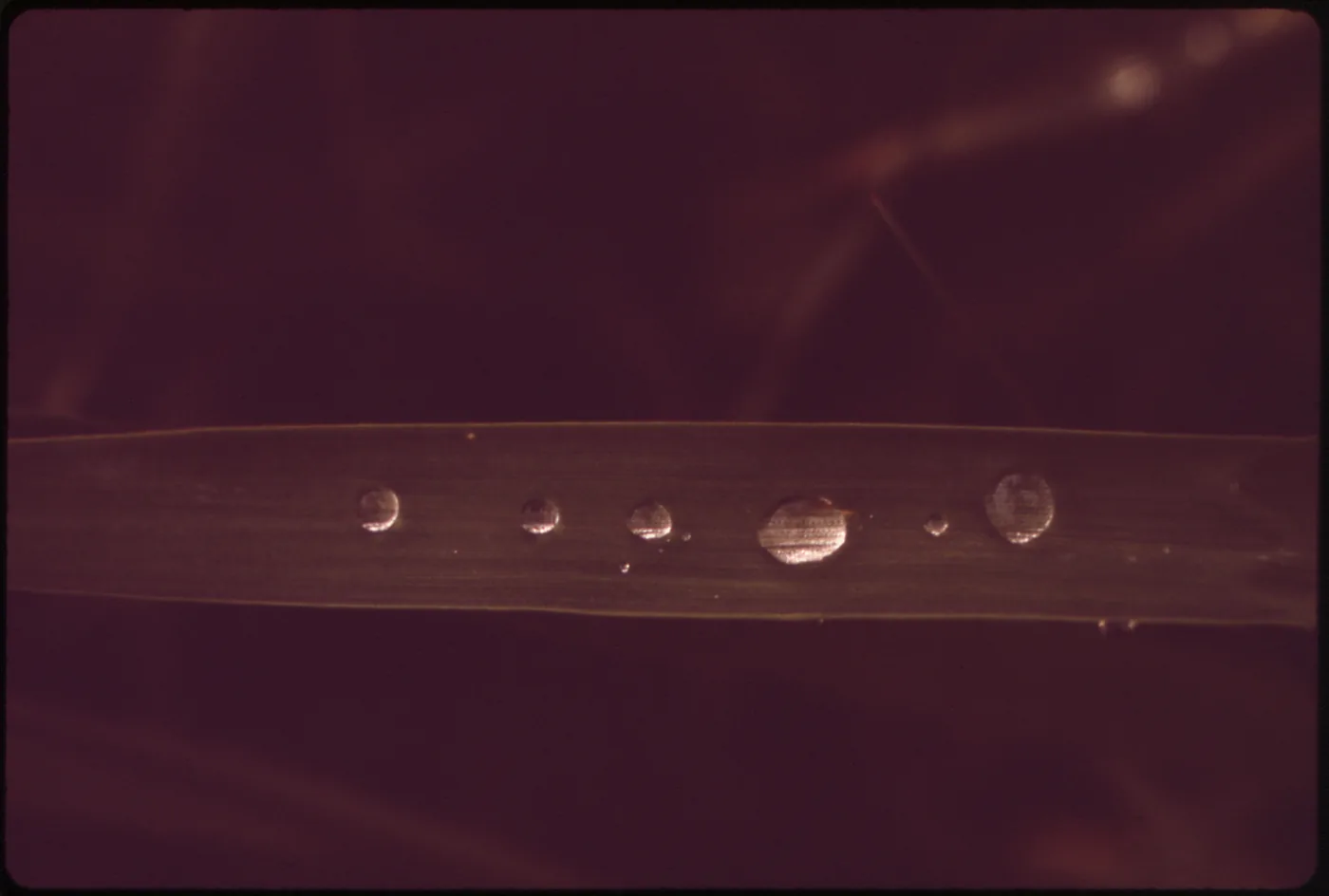
Drop profiles, the speed curve and the size ladder are drawn from the numbers above. Both photographs are public domain, from the American national archives via Wikimedia Commons.