Ernst Chladni, Leipzig, 1787
What a sound looks like
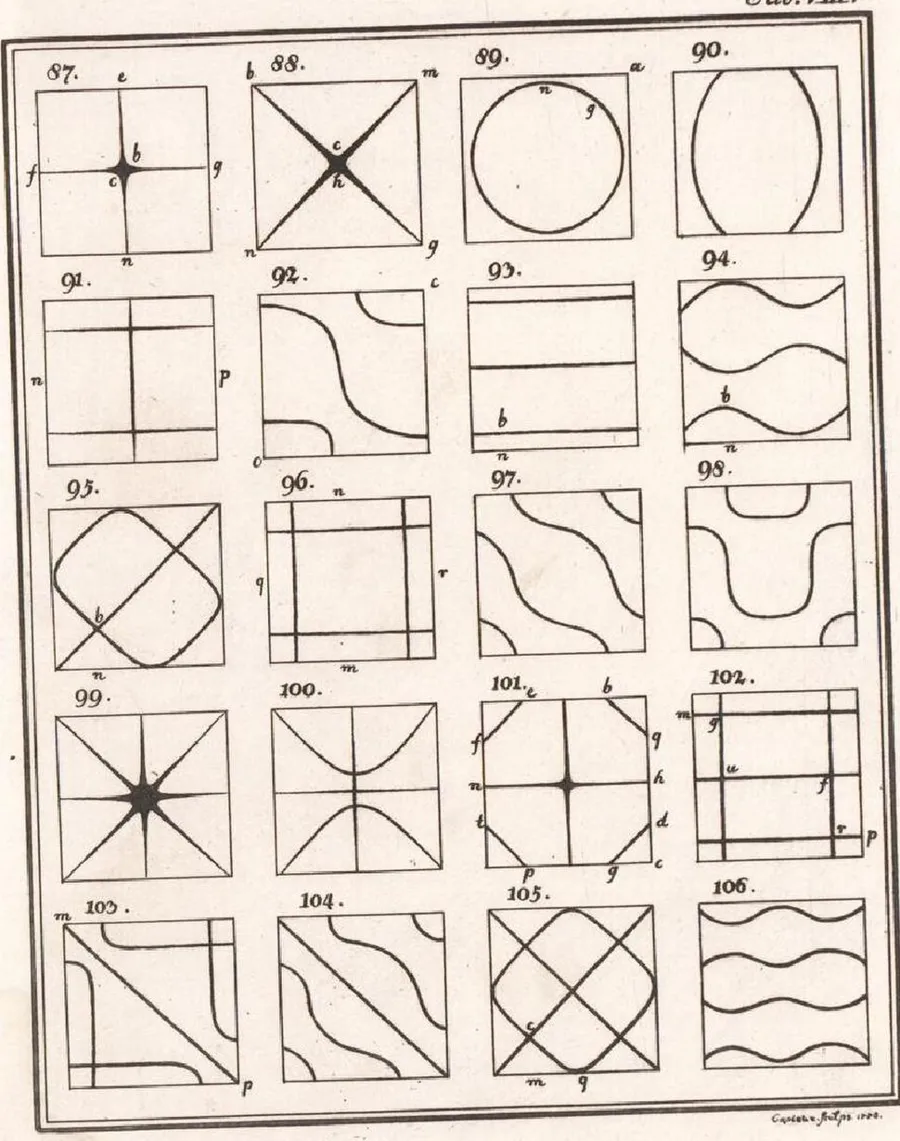
In 1787 Ernst Chladni drew a violin bow across the edge of a brass plate strewn with sand. The sand leapt and gathered into lines. His plate is here: bow it, or sing to it.
The plate needs a newer browser to ring. Chladni’s own figures are below.
The curve shows how hard the plate shakes at each frequency. The sand only jumps on the peaks, above the thin line.
Press Bow, then the arrows: they jump to the notes the plate answers. Drag the bow along any edge. Tap the plate to rest a fingertip there, the way Chladni held his plates.
Find Chladni’s figures
Chladni’s 1787 book holds more than a hundred figures, engraved on 11 plates. The eight below are notes of the plate on this page. Press a figure: the bow moves close to its note, and you take the last step, with the arrows or the frequency strip. When the sand draws it, the card turns gold and keeps your plate beside Chladni’s engraving.
Sometimes the sand draws the figure turned by 90 degrees, or a variant. That depends on where you bow and where you hold a finger, just as it did for Chladni. If a note won’t catch, move the bow to another edge: a bow placed on one of the figure’s lines can’t start it.
Found: 0 / 8
The emperor, the prize and the woman who won it
Chladni, born in Wittenberg in 1756, had studied law and knew Georg Christoph Lichtenberg’s figures: powder spread over electrified cakes of resin, which stayed in the shape of the discharge. He wondered whether sound leaves a trace too. Robert Hooke had noticed something similar in 1680, but Chladni was the first to study the figures systematically. He held a brass plate in a clamp, sprinkled it with sand and drew a bow across the edge. In 1787 he published Entdeckungen über die Theorie des Klanges (“Discoveries on the theory of sound”) in Leipzig, with eleven plates of figures.
The figures made him famous. On a February evening in 1809, at the Tuileries Palace, Chladni showed them to Napoleon, with Laplace present. The next day the emperor gave him 6,000 francs to have his treatise on acoustics translated into French. The Institut de France set a prize question: give the mathematical theory of the vibrations of elastic surfaces, and compare it with experiment.
When the deadline passed in 1811, a single memoir had arrived: Sophie Germain’s, who had taught herself mathematics from her father’s books. It had errors, and no prize was given. Lagrange, one of the judges, corrected her calculations and proposed an equation that, he thought, might describe the figures. In 1813 her memoir received an honourable mention. On 8 January 1816, at the third attempt, Sophie Germain won the prize, the first woman to win one from the Paris Academy of Sciences. She did not attend the ceremony.
Her theory could not yet reproduce the figures. The correct conditions for a free edge were written by Gustav Kirchhoff in 1850. Chladni’s square plate with free edges stayed unsolved for more than another half-century, until Walther Ritz, a Swiss physicist ill with tuberculosis, published a method in 1909 that computed its figures one by one. He died that same year, aged 31. A modern version of his method computes the plate on this page too.
Why the sand runs to the lines
When the plate sings, most of it rises and falls tens to thousands of times a second, depending on the note. Along certain lines, though, it doesn’t move at all, because there one part of the plate is going up while the other goes down. These are the nodal lines.
Wherever the plate accelerates harder than gravity, grains are thrown into the air and land a little way off, at random. On the nodal lines nothing throws them any more, so they stay. After a few seconds of random jumps, most of the sand ends up on the lines. The plate on this page imitates the process: each grain takes random jumps, longer the more the plate beneath it out-accelerates gravity.
Very fine powder does the opposite. In 1831 Michael Faraday saw lycopodium dust gather in the middle of the most violently shaking regions, carried by air currents above the plate. In thin air the effect vanished. And when the plate accelerates less than gravity, the sand stops jumping and rolls towards the parts that move most.
What the page computes
A square brass plate 25 cm across and 2 mm thick, with free edges: Young’s modulus 117 GPa, density 8,530 kg/m³, Poisson’s ratio 0.34. Its 90 notes are computed with a modern version of Ritz’s method, from 625 functions. For a square plate with a Poisson’s ratio of 0.3, the first five frequency parameters (the frequency written without units) come out exactly as in the published table: 13.468, 19.596, 24.270, 34.801, 34.801.
The bow drives the plate at the frequency you choose. Each note of the plate answers more strongly the closer the frequency is to it and the further the bow is from its lines. A fingertip is approximated as local braking. The sound is a synthesised tone at the bow’s frequency, louder when the plate resonates; it is not a recording of a real plate. With the microphone, the pitch of your voice is estimated on your own phone or computer; nothing is recorded and nothing leaves it.
Sources
- Ernst Florens Friedrich Chladni, Entdeckungen über die Theorie des Klanges, Leipzig, 1787, with 11 engraved plates. Scan on Wikimedia Commons (public domain); the figures on this page are from plates VIII and IX. commons.wikimedia.org
- H.-J. Stöckmann, “Chladni meets Napoleon”, European Physical Journal Special Topics 145 (2007): 15–23. The evening at the Tuileries, February 1809, from Chladni’s own account. doi.org
- MacTutor History of Mathematics (University of St Andrews), biography of Sophie Germain: the three memoirs and the prize of 8 January 1816. mathshistory.st-andrews.ac.uk
- Wikipedia, “Sophie Germain” and “Gustav Kirchhoff” (the free-edge conditions, 1850). en.wikipedia.org
- Walther Ritz, “Theorie der Transversalschwingungen einer quadratischen Platte mit freien Rändern”, Annalen der Physik 28 (1909): 737–786. doi.org
- Michael Faraday, “On a peculiar class of acoustical figures…”, Philosophical Transactions 121 (1831): 299–340. archive.org
- H. J. van Gerner et al., “Inversion of Chladni patterns by tuning the vibrational acceleration”, Physical Review E 82 (2010): 012301. doi.org
- Y. Narita, Table 1: frequencies of the square plate with free edges (ν = 0.3), EPI International Journal of Engineering 5 (2022): 26–36. doi.org
- AZoM, cartridge brass (70% copper, 30% zinc): Young’s modulus 117 GPa, density 8.53 g/cm³, Poisson’s ratio 0.34. www.azom.com
- APS News, “The First Experiments that Inspired 18th Century ‘Chladni Figures’” (Hooke, Lichtenberg). www.aps.org