On many Romanian beaches, the water that waves pile up runs back out to sea through a narrow lane. Swim straight for the beach against it and you can stay in one place for minutes. Come down to the water line and try it yourself.
Scroll
The beach from above
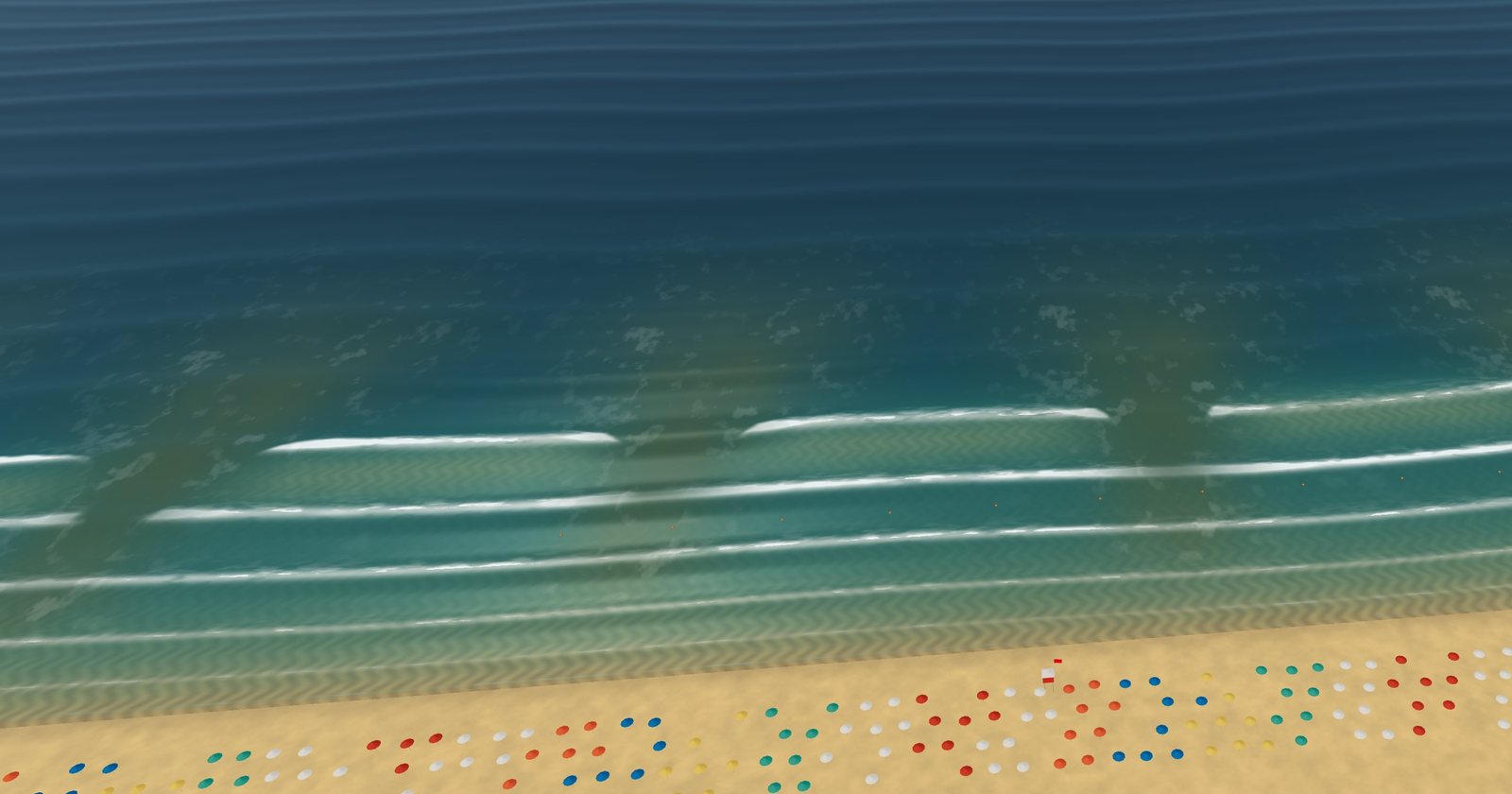
Waves break on a sandbar
A few dozen metres out, the seabed rises into a sandbar. There the water gets too shallow for the wave, and the wave breaks into foam.
The bar has gaps. The water is deeper there, and waves roll on without breaking.
Seen from the beach
The spot that looks calmest
From the sand, the lane between two strips of foam looks like the calmest place to go in. The US National Weather Service describes exactly this: a path of darker water between breaking waves that seems calm but has a choppy, rippled surface.
That is where the current runs out. It is easier to see from high up than from the beach.
Below the surface
Water piles up behind the bar and looks for a way out
Waves breaking on the bar push water toward the beach and raise its level in the trough between the bar and the sand. In the gap, waves break later and raise the water less.
Water flows from high to low: along the beach toward the gap, and from there out to sea. The bigger the waves, the faster the current.
From above, sped up
A river running out to sea
The bright threads are moving water. Currents come along the beach from both sides, meet in the gap and leave together through a narrow neck, then spread out beyond the waves.
Much of the water does not leave for good. It comes back over the bar and goes round again. On a Californian beach, drifters released in rips left the surf zone at a rate of only 19% an hour. Swimmers who let the current carry them went round in loops of about seven minutes; one went round twice.
The beach in the scene is a drawing, not a real place: rips 125 m apart, with speeds within the measured range.
The neck of the current
Faster than you swim
On the beaches gathered in a 2006 review, rip currents had mean speeds of 0.2 to 0.65 m/s, with peaks of 1–2 m/s.
At Eforie Nord on the Romanian coast, in October 2021, University of Bucharest researchers released GPS drifters into rips. They averaged 0.22–0.39 m/s and topped 1.6 m/s, in waves only half a metre high.
In the scene, with 1.2 m waves, the fastest point of the neck runs at 0.8 m/s, toward the top of the measured range: 50 metres a minute. Just to stay in place you would have to swim that fast, without a break.
At the water line
You swim for the beach and it never gets closer
The swimmer in the scene heads for the beach at 0.5 m/s, without stopping. The current carries them faster than they can swim.
After 10 minutes of effort they are about 89 metres further from the beach than where they started. That is the trap: the harder you fight, the sooner you tire, while the current carries you further out.
Your turn
Choose what you do
You start from the same spot, in the neck of the rip. Pick the waves, how fast you swim and what you do. The clock shows real time; the scene runs ten times faster.
Below 0.4 m, in the scene, waves stop breaking on the bar and the current disappears. Raise the waves and see what changes.
A simplified drawing, matched to speeds measured on real beaches: one rip, symmetrical, no tiredness. On a real beach the current pulses, can lean to one side and can stop.
Three paths, one start
What people found when they tried
At Shelly Beach in Australia, competent surf swimmers wearing GPS units tried 185 escapes from rip currents. Swimming parallel to the beach failed in 12% of attempts, floating in 32%. Those who swam parallel got out in 2.2 minutes on average, counting a short float first; those who floated, in 3.8.
Swimming parallel failed when people swam against the current flowing along the beach into the neck. Floating failed when the rip carried them beyond the waves or kept them going round.
On another Australian beach, most failures came in a rip between sandbars, especially when floating. A 2016 review cites model runs in which the best choice at one rip was the worst at a rip nearby. No method works every time.
The Romanian coast
Rip currents on the Black Sea
University of Bucharest researchers found rip currents on more than half of Romania's tourist beaches. At Eforie Nord, the worst-affected stretch, they counted about ten per kilometre.
In summer 2025, according to Romania's emergency service (IGSU), 18 people drowned in the sea along the coast and 72 were rescued. In summer 2024, 21 died. The emergency service's season tallies do not break deaths down by cause, so they do not say how many were caused by currents.
On Romanian beaches a red-and-yellow flag means lifeguards are on watch. A yellow flag beside it means swimming is not advised; a red one means conditions do not allow anyone in the water.
Florin Tătui, the University of Bucharest researcher who measured the rips at Eforie Nord, says these currents carry you out along the surface; they do not drag you under. His advice: never swim against the current; float, and swim parallel to the beach until you no longer feel pulled out, and only then head in.
In Britain the RNLI gives the same advice: "If you can, wade or swim parallel to the shore until free of the rip and then head for shore." It also says not to swim against the current, and to float first if you need to: "Once your breathing is under control, call for help or swim to safety."
Worth remembering
If the sea pulls you out, do not fight it.
Save your strength. Float to get your breath back, swim parallel to the beach until you are free of the current, then head in. Raise a hand and shout for help.
And swim where there are lifeguards, when no red flag is flying.
Pass it on
Someone is going to the sea this summer. Tell them one thing: if the sea pulls them out, swim along the beach, not against the current.
Share
Sources and method
Every number in the story comes from one of the sources below.
The scene is a simplified model drawn to agree with measurements, not a forecast and not a real beach. Seabed: a 1-in-40 slope and a sandbar 80 m out, with gaps 125 m apart. Waves break when their height reaches 0.78 of the depth, so below 0.4 m they do not break on the bar and no current forms. Current speed grows with the waves and levels off around 1 m/s, between the 0.2–0.65 m/s means and the 1–2 m/s peaks in the literature; with half-metre waves it gives 0.22 m/s, at the low end of the Eforie Nord drifter means, where rips also ran with 0.36 m waves. The current pulses slowly, so some floaters leave and others come back. The swimmer never tires, and "safe" means water under 1.2 m deep, outside the gap. The percentages and times from the trials come from the studies, not the model.
MacMahan, Thornton and Reniers (2006), "Rip current review", Coastal Engineering 53: site mean speeds of 0.20–0.65 m/s, maxima of 1–2 m/s, rip spacing (Table 3). fileserver-az.core.ac.uk
MacMahan et al. (2010), Marine Geology 268: drifters in rips at Sand City, Monterey Bay; 19% surf-zone exits per hour; a swimmer carried by the current, two loops of about 7 minutes. calhoun.nps.edu
McCarroll et al. (2014), "Evaluation of swimmer-based rip current escape strategies", Natural Hazards 71: 185 trials at Shelly Beach, Australia; 12% failure swimming parallel and 32% floating; 2.2 and 3.8 minutes on average. doi.org
Van Leeuwen et al. (2016), Natural Hazards 81: 100 escape attempts at North Cronulla, Australia, on beaches with other sandbar types. doi.org
Castelle et al. (2016), "Rip current types, circulation and hazard", Earth-Science Reviews 163: rip types, hourly exit rates from 0 to 100%, why both strategies can fail. pure.plymouth.ac.uk
Winter et al. (2012), observations at Egmond aan Zee: waves breaking on the bar raise the water level in the trough; speed grows with wave height. repository.tudelft.nl
RORIP project, University of Bucharest, final scientific report (2022): GPS drifters at Eforie Nord, October 2021. ro-rip.unibuc.ro
Tătui et al. (2022), "Rip currents on the Romanian Black Sea coast: distribution, characteristics and dynamics", ICG 2022 abstract. meetingorganizer.copernicus.org
US National Weather Service: what a rip current looks like from the beach. www.weather.gov
RNLI: what to do if you are caught in a rip; Float to Live. rnli.org
Romanian Government Decision 1136/2007 on lifeguard services, Art. 20 (beach flags). www.legex.ro
IGSU summer 2025 coastal figures, as reported by Digi24 (5 September 2025). www.digi24.ro
ISU summer 2024 coastal figures, as reported by Cotidianul (6 September 2024). www.cotidianul.ro
Florin Tătui on rip currents and what to do when caught, Edupedu (11 July 2023). www.edupedu.ro
Constanța lifeguard Culea on beach flags, G4Media (23 August 2023). www.g4media.ro