Marius Comper
RO

Mauren, Liechtenstein, 1948 · A masterwork of micromechanics

The Curta Calculator

In 1948, inside a converted ballroom in Liechtenstein, production began on a cylinder 53 mm wide and weighing 230 grams. Inside, over 600 parts added, subtracted, multiplied, and extracted square roots without a single battery.

Vienna, 1937–1938

The pocket-machine problem

Before 1938, mechanical desk calculators weighed as much as typewriters because every decimal column needed its own Leibniz stepped drum.

Austrian engineer Curt Herzstark inverted the layout: instead of lining up eight parallel stepped drums side by side, what if one central stepped drum sat in the middle with every input shaft arranged around it in a circle?
1943–1945

Buchenwald

After the Nazi annexation of Austria, the Herzstark family factory was seized, and in 1943 Curt Herzstark was arrested and deported to Buchenwald concentration camp.

Camp authorities allowed him to reconstruct the miniature calculator drawings from memory, imagining it as a post-war trophy. Herzstark refined the production blueprints until liberation on 11 April 1945 and walked out with the complete design.

1948–1972

Contina AG Mauren

Backed by Prince Franz Josef II, Contina AG launched production in 1948 in Mauren, Liechtenstein. The first model, Curta Type I, measured 53 mm in diameter, 85 mm tall, and weighed just 230 grams.

Until around 1972, Contina built roughly 80,000 Type I and 60,000 larger Type II machines—about 140,000 precision mechanical calculators before electronic pocket units displaced them.

17 top windows

Anatomy of the cylinder

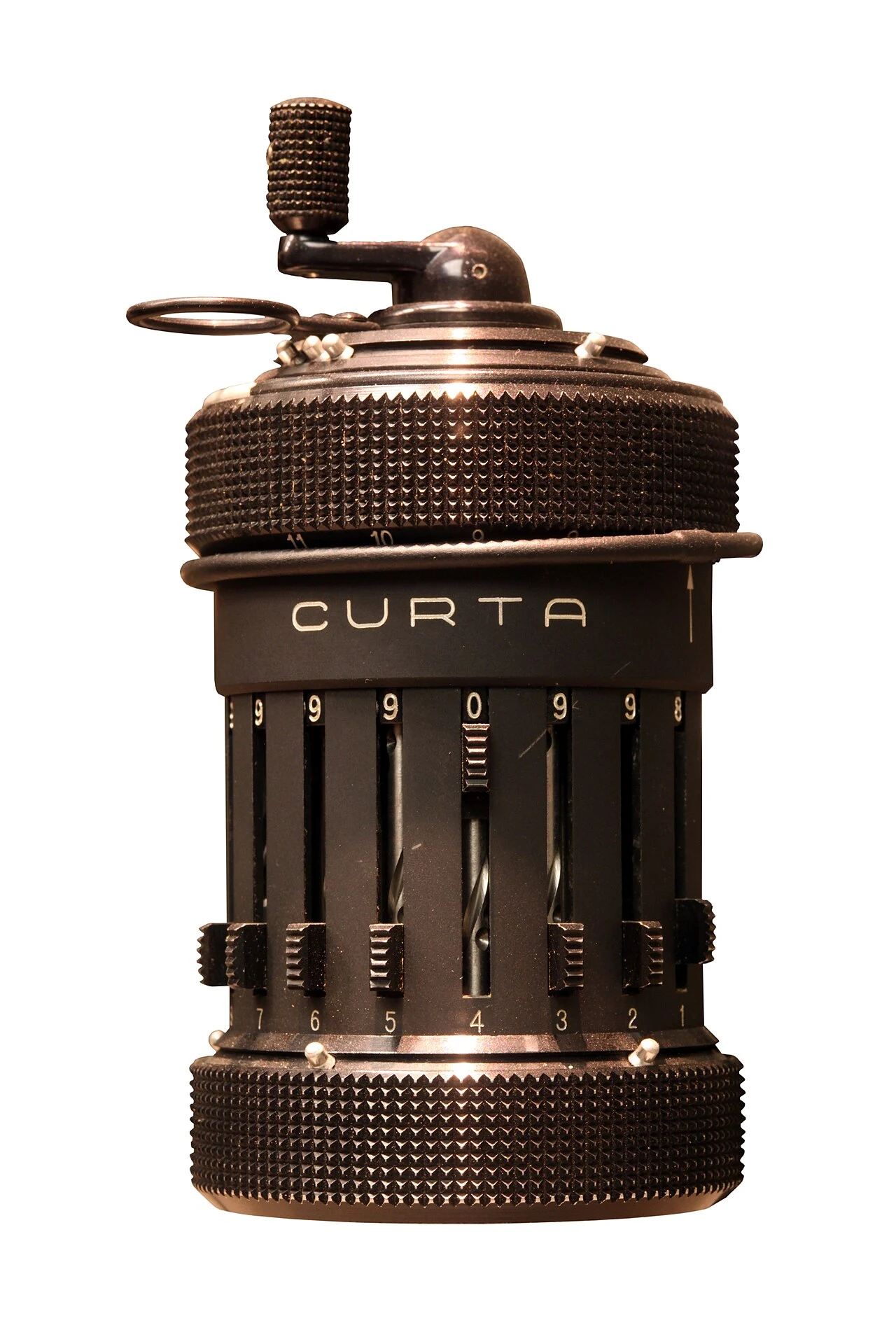
Along the matte-black anodized body of the Curta Type I, 8 setting sliders travel vertically from 0 to 9. On top, the rotating carriage displays 11 black result windows and 6 silver revolution-counter windows.

Every millimeter works: the knurled upper ring shifts the carriage across 6 decimal positions, the top crank drives the entire gear train, and the folding clearing lever resets registers in one sweep.

Drag the cylinder to orbit · crank and slide from the workbench below

Over 600 parts

Opening the shell

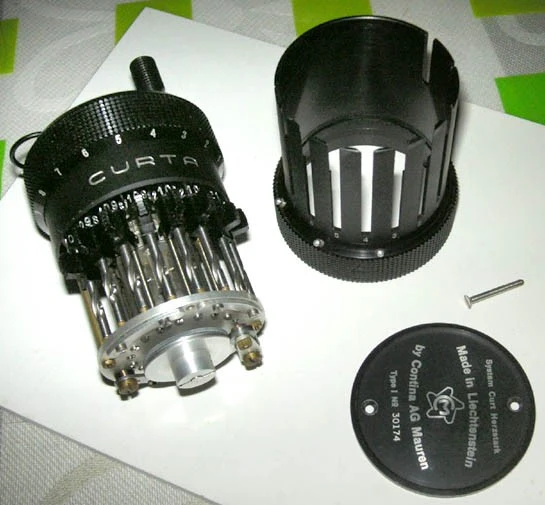
Splitting open the outer cylinder reveals the spine of the machine: eight vertical steel transmission shafts arranged in a ring around one central drum.

Unlike bulky desktop machines, every shaft carries a 10-tooth transmission gear that slides up and down in lockstep with its external setting slider.

8 vertical shafts

Input

Sliding a lever to 5 drops its internal transmission gear directly opposite the 5-tooth tier of the central stepped drum.

Eight independent sliders let you dial in any integer up to 99,999,999 before turning the crank once.

Heart of the machine

The central stepped drum

The central drum carries nine stacked additive tooth tiers (1 to 9 active teeth). On a single turn of the crank, each transmission shaft picks up the exact number of pulses selected on its slider.

That single drum replaces seven heavy parallel drums from a traditional Leibniz calculator: all eight columns read the same rotating cylinder simultaneously.

3 mm crank lift

Subtraction without borrowing

A Curta never turns backward to subtract. Instead, pulling the crank up by 3 millimeters lifts the central drum to engage a second, inverted set of teeth.

Every higher column meets 9 − N teeth (9's complement), while the units column catches one extra tooth (10 − N). Thus 1,000 − 358 becomes 1,000 + 99,999,999,642 = 642 mod 10¹¹—exact subtraction via addition.

Perimeter carry ring

Ripple carry

Whenever a result wheel rolls past 9 to 0, a small cam arms a sliding carry lever around the upper ring. Later in the same crank turn, that lever nudges the next higher wheel forward by one step.

When consecutive wheels sit at 9, a single +1 ripples across every neighboring digit in one smooth rotation: 99,999,999 + 1 fires eight consecutive carries to reach 100,000,000.

6 positions · 1× to 100,000×

Multiplication

To multiply 358 × 47, set 358 on the sliders, turn 7 times at position 1 (units), lift and rotate the carriage to position 2 (tens), and turn 4 times: 11 cranks yield 16,826.

Skilled operators used shortcut subtraction: 47 = 50 − 3, so 5 additive cranks at P2 minus 3 subtractive cranks at P1 reach the exact same 16,826 in just 8 turns.

One full sweep

The clearing ring

The folding clearing lever beneath the carriage swings outward. One full 360° sweep engages combs on all 11 result wheels and 6 counter wheels, snapping every digit back to zero.

Operators could clear the result alone, the counter alone, or both registers together in under two seconds.

1950–1972

The navigator's tool

Inside a bouncing rally car on gravel stages, electronic calculators did not exist and slide rules were impossible to read. The Curta worked upside down, sideways, and in heavy vibration without missing a tooth.

Nicknamed the 'pepper grinder' and 'math grenade', it remained standard gear for surveyors, engineers, and motorsport navigators into the early 1970s.

Multiply, subtract, square root

Herzstark's legacy

Using Töpler's odd-number subtraction sequence, a practiced operator even extracted square roots: for √2, the steps yield 1.41421 (141,421² = 19,999,899,241).

Although Contina ended production around 1972, nearly every surviving Curta still calculates with the same crisp click it had on day one.

Curta Type I mechanical calculator (1948), Musée des Arts et Métiers, Paris. Photo: Rama, Wikimedia Commons, CC BY-SA 3.0 fr.
Disassembled Curta showing the central stepped drum, transmission shafts, and carry mechanism. Wikimedia Commons, Public Domain.

Curta workbench

Calculate on the 3D model

Enter up to 8 digits, pick a carriage position (P1–P6), switch between addition and the 3 mm subtraction lift, and turn the crank—every revolution animates the drum, gears, and carry cascade.

Current result: 0. Choose a worked demo or crank once to watch the stepped drum and carry cascade.

Share

Send this 3D Curta reconstruction or copy the direct link.

Data and sources

All dimensions, register capacities, and worked arithmetic examples below come from Contina AG specifications, Curt Herzstark's patents, and museum records:

Parameter / DemoVerified valueTechnical note
Curta Type I (1948)53 × 85 mm · 230 gOver 600 precision parts inside anodized barrel
Registers8 / 6 / 11 (17 windows)8 sliders, 6 revolution counter, 11 result
Complement subtraction3 mm crank lift9 − N teeth plus 1 extra units tooth for 10's complement
1,000 − 358642 (mod 10¹¹)1,000 + 99,999,999,642 = 100,000,000,642 → 642
Carry cascade99,999,999 + 18 consecutive carries rippling to 100,000,000
358 × 47 (shortcut)16,826 in 8 cranks5 add turns at P2 and 3 sub turns at P1
Total production (1948–1972)~140,000 units~80,000 Type I and ~60,000 Type II by Contina AG
  1. Smithsonian National Museum of American History & Computer History Museum — Curta Type I and Type II physical specs.
  2. Curt Herzstark patents (US 2,525,352) and Rick Furr's The CURTA Calculator Page (vcalc.net) — stepped-drum complement geometry.
  3. Photographs: Curta Type I (Rama, Musée des Arts et Métiers, CC BY-SA 3.0 fr) and disassembled Curta (Wikimedia Commons, Public Domain).