Applied Physics · IEC 60098 · 500× Microscope
The vinyl record under a microscope: how half a kilometre of single groove holds a stereo orchestra
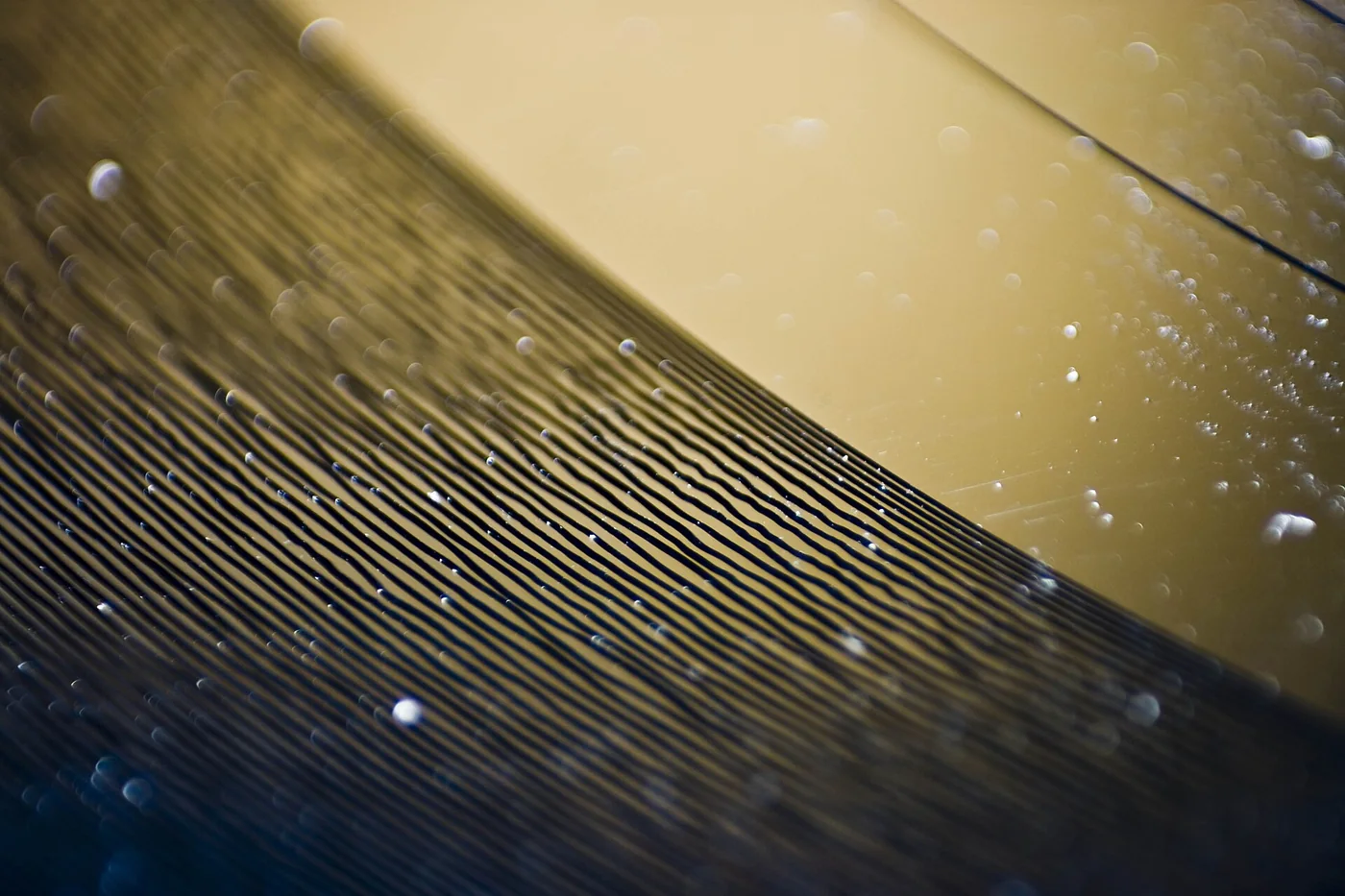
Across one 12-inch, 22-minute vinyl LP side, the diamond stylus travels a single unbroken spiral 475.5 metres long. Drag the tonearm inward, switch RIAA off, or swap stylus profiles to see and hear how sound degrades toward the label.
Clean groove: walls stay safely inside the available pitch.
A single 475.5-metre thread, wound at 8.55 turns per millimetre
Under the IEC 60098 standard, recorded audio on a 12-inch LP occupies an annulus between an outer radius of 146.05 mm and an inner radius of 60.325 mm. Spinning at 33⅓ rpm, a 22-minute side cuts 733.3 revolutions into a continuous groove 475.5 metres long (while a 25-minute side stretches to 540.3 metres).
Because angular velocity stays fixed, linear groove speed drops proportionally with radius: from 509.8 mm/s at the outer rim to 210.6 mm/s beside the label — a 2.42× slowdown. A 12-inch 45 rpm maxi-single boosts linear velocity by 35.0% everywhere on the disc, giving high frequencies more physical room.
| Format | Groove length | Mean pitch | Speed (out → in) | Speed ratio | 10 kHz wavelength |
|---|---|---|---|---|---|
| 12" LP · 33⅓ rpm (22 min) | 475.5 m | 116.9 µm | 509.8 → 210.6 mm/s | 2.42× | 51.0 → 21.1 µm |
| 12" Maxi · 45 rpm (12 min) | 350.1 m | 158.8 µm | 688.2 → 284.3 mm/s | 2.42× | 68.8 → 28.4 µm |
| 7" Single · 45 rpm (4.5 min) | 87.9 m | 149.0 µm | 396.5 → 254.4 mm/s | 1.56× | 39.7 → 25.4 µm |
| 10" Shellac · 78.26 rpm (3.2 min) | 131.1 m | 285.2 µm | 975.7 → 390.3 mm/s | 2.50× | 97.6 → 39.0 µm |
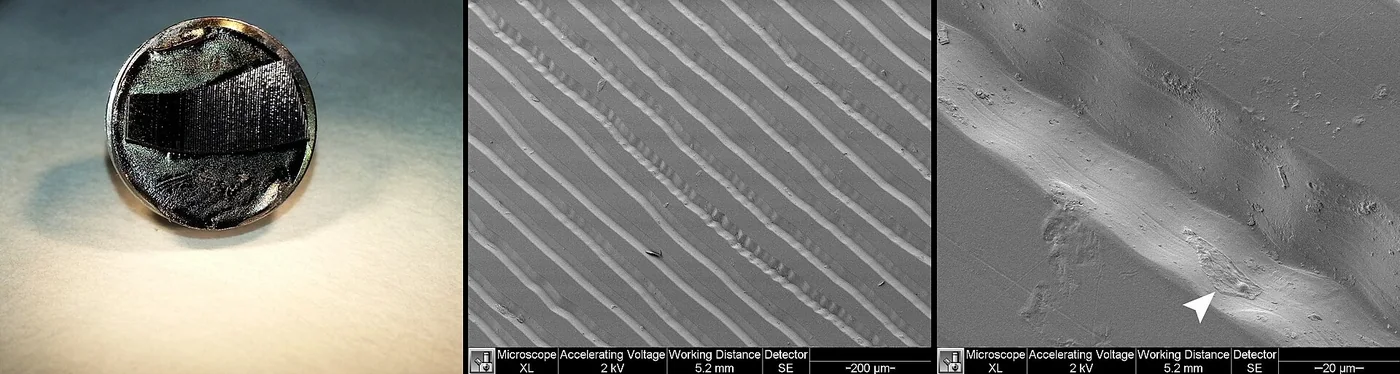
How two independent audio channels fit inside one V-shaped cut
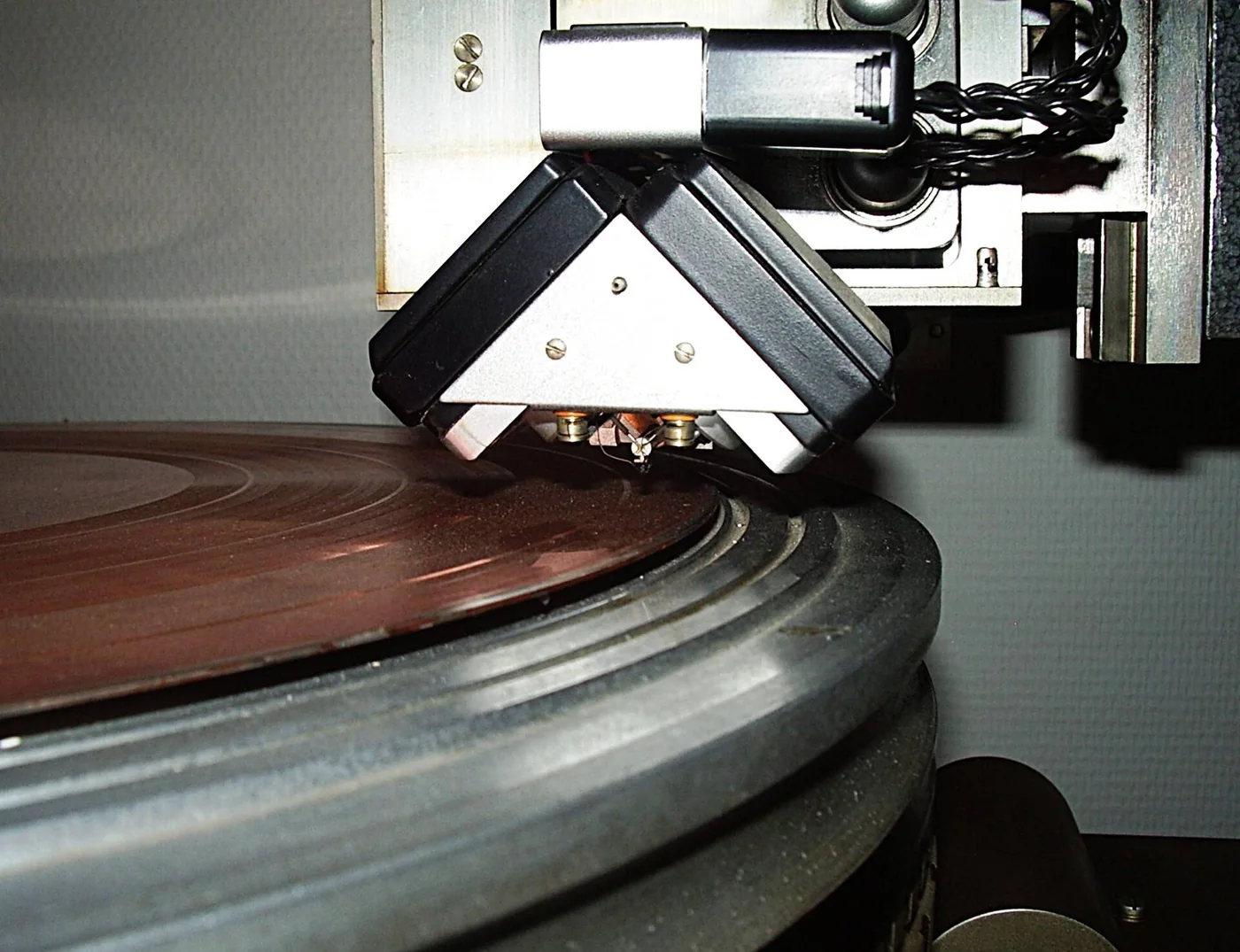
In British Patent GB 394,325 (filed 1931, accepted 1933), EMI engineer Alan Dower Blumlein proposed modulating the two walls of a 90° V-groove tilted at ±45° to the disc surface. The inner wall carries Left; the outer wall carries Right. Stylus motion resolves into lateral displacement (L + R) and vertical displacement (L − R).
That geometry explains a classic mastering constraint: in-phase mono bass moves the cutter strictly side-to-side, keeping groove depth steady. Anti-phase bass (L = −R) drives purely vertical excursion, lifting the stylus toward the rim until it risks jumping out of the groove.
Stylus tracks both 45° walls cleanly.
Without RIAA equalization, a 12-inch LP would hold barely 4.8 minutes per side
At constant modulation velocity, mechanical groove displacement scales inversely with frequency (A = v / 2πf). Across 20 Hz to 20 kHz, that spans 1,000 to 1: a 30 Hz bass note at reference level (3.54 cm/s rms, or 5 cm/s peak per wall) demands 530.5 µm peak-to-peak — 4.5× wider than a 22-minute LP's entire 116.9 µm groove pitch.
The RIAA curve attenuates bass by -19.27 dB at 20 Hz and boosts treble by +19.62 dB at 20 kHz (a 38.89 dB total tilt), compressing the 20 Hz–20 kHz mechanical displacement span from 1,000 : 1 down to 11.4 : 1.
Why sibilance gathers near the label — and how a MicroLine tip clears it
In 1941, W. D. Lewis and F. V. Hunt proved that a spherical stylus of radius r riding a sinusoidal wall traces an asymmetric locus — rounding crests and sharpening troughs. On a 45° stereo wall, that asymmetry injects even (H₂) and odd (H₃) harmonics that scale inversely with the square of linear groove velocity.
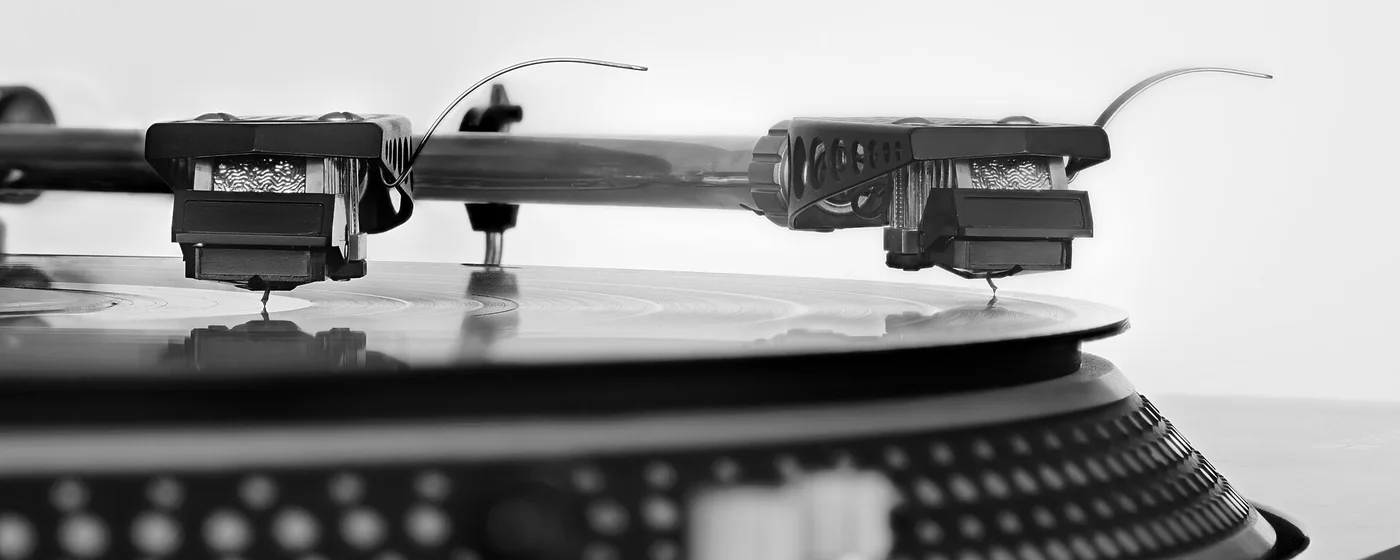
At the inner groove (60.33 mm), an 8 kHz tone packs into a wavelength of just 26.3 µm. A standard 18 µm conical tip generates 22.25% geometric THD, an elliptical tip (7.6 µm) drops to 10.45%, and a 2.5 µm MicroLine diamond falls to 3.49% — 6.4× cleaner.
Meanwhile, a pivoted tonearm cannot stay tangent across the disc. H. G. Baerwald (1941) solved the minimax alignment for IEC dimensions: two zero-error null radii at 66.00 mm and 120.89 mm, capping maximum tracking error at 1.90°.
Mastering calculator: choose format, side duration, level, and stylus
Safe pitch · Clean inner track
From Edison's cylinder to Blumlein's 45°/45° stereo groove
- 1877Thomas Edison records sound onto a tin-foil cylinder (vertical hill-and-dale modulation).
- 1887Emile Berliner patents the flat gramophone disc with lateral modulation (US 372,786).
- 1931–33Alan Dower Blumlein formulates 45°/45° two-channel stereo groove geometry (British Patent GB 394,325).
- 1932Nathan Mischonzniky brings Kristall presses to Bucharest, founding Electrecord, Romania's flagship record label.
- 1941W. D. Lewis and F. V. Hunt derive tracing distortion theory; H. G. Baerwald solves minimax tonearm null points.
- 1948–49Columbia introduces the 33⅓ rpm microgroove LP; RCA introduces the 7-inch 45 rpm single.
- 1954–58RIAA equalization is standardized (IEC 98 / 60098); Westrex ships the 45°/45° stereo cutterhead; Electrecord begins pressing vinyl discs in Bucharest in 1956 and 30 cm LPs in 1958.
Method & limits: Spiral arc lengths use exact Archimedean integration at constant mean pitch (modern preview lathes vary pitch dynamically with programme loudness). Tracing distortion is computed from the rigid-sphere contact envelope along a single 45° wall at the IEC 3.54 cm/s rms (5 cm/s peak) reference level per wall, omitting elastic PVC wall deformation.
- IEC 60098:1987 — Analogue audio disk records and reproducing equipment (radii, speeds, and RIAA 3180 / 318 / 75 µs constants).
- P. C. Goldmark, R. Snepvangers, W. S. Bachman (1949) — The Columbia Long-Playing Microgroove Recording System, Proc. IRE 37(8).
- A. D. Blumlein (1931/1933) — British Patent 394,325 (45°/45° stereo geometry).
- W. D. Lewis, F. V. Hunt (1941) — A Theory of Tracing Distortion in Sound Reproduction from Phonograph Records, JASA 12(3), pp. 348–365.
- H. G. Baerwald (1941) — Analytic Treatment of Tracking Error and Notes on Optimal Pick-Up Design, J. SMPE 37(12), pp. 591–622.
- C. C. Davis, J. G. Frayne (1958) — The Westrex Stereo Disk System, Proc. IRE / JAES.
- Electrecord (Bucharest, 1932–1958) — history of Romania's national record label (1932 Kristall presses, 1956 vinyl discs, 1958 30 cm LPs).