Marius Comper RO

Neuroscience, in plain words

What dopamine actually does

It is called the pleasure molecule. In experiments, though, many of the neurons that release it respond to something else: the gap between what you expect and what you get. Here you can train a model of one.

Where it lives

One neuron, branched like a city

Most of the neurons that make dopamine sit deep in the brain, in the midbrain: in the substantia nigra and the ventral tegmental area. There are only a few hundred thousand, and the number falls with age: in one study, one side of the substantia nigra held 36% fewer of them in people aged about 88 than in people aged about 20.

The axons of those in the substantia nigra reach the striatum, a structure in the middle of the brain, and branch enormously there. For a single human neuron of this kind, one estimate gives 1 million to 2.4 million synapses and some 4.5 metres of branches.

The estimate is extrapolated from rat neurons to the size of the human striatum.
Rudow et al. 2008 · Bolam and Pissadaki 2012

How rare

One dot in more than two hundred thousand

An adult brain has about 86 billion neurons. The midbrain dopamine neurons, on both sides, number a few hundred thousand: added together, post-mortem estimates give 260,000 to 485,000.

If each dot on the screen stood for 400,000 neurons, the whole brain would be 215,000 dots, and all the midbrain dopamine neurons would take up roughly one.

What they lack in number they make up in reach: by the estimate above, each forms more than a million synapses.

Azevedo et al. 2009 · Cha et al. 2023

What the molecule does

How a neuron releases dopamine

When an impulse reaches an axon branch, it can trigger dopamine release at particular sites along it. The molecule spreads, binds to receptors on neighbouring neurons and changes how they respond. Then transporters pull it back into the terminal.

At rest, dopamine neurons fire slowly and irregularly: a few impulses a second. Sometimes they fire short bursts; in rats, the impulses within a burst are typically about 70 milliseconds apart. Bursts, not the resting rhythm, turned out to be the key to the story below.

Schultz, Apicella and Ljungberg 1993 · Grace and Bunney 1984

What was measured

The monkey, the light and the juice

In the 1980s and 1990s, Wolfram Schultz's team recorded dopamine neurons in monkeys while the animals received drops of juice. Each tick in the picture is an impulse; each row, a trial.

Juice given unexpectedly, outside the task, activated 45 of the 61 neurons tested that way. Once the monkeys had learned that a visual cue announced the juice, many neurons responded to the cue, and responses to the expected juice became rare.

The third panel shows what happens when the expected juice does not come. When the monkeys made a mistake and got no juice, firing fell below its resting level in 28 of the 40 neurons analysed, starting on average 99 milliseconds after the juice would have come and lasting on average 401 milliseconds.

Not every neuron behaves this way: in another study, after learning, 14 of 163 still responded to the juice. The rows in the picture are generated by a model, following the pattern of these recordings.

lightjuicewhen it is missing

Hollerman and Schultz 1998 · Schultz, Apicella and Ljungberg 1993 · Schultz, Dayan and Montague 1997

Your turn

Train a dopamine neuron

Press "Light, then juice" a few times, or start the automatic trials. At first the impulses gather after the juice. After about 20 trials in which juice follows the light, the burst appears after the light.

Then try "Light, no juice": firing falls around the time the juice was expected. "Juice, no light" produces a burst again, because it is unexpected. Juice that comes late produces a pause at the usual time and a burst at the new one, as Hollerman and Schultz found in monkeys.

If juice comes on only half the trials, the model ends up responding to both the light and the juice. In monkeys, the more likely the reward, the stronger the response to the cue and the weaker the response to the reward when it arrived.

Trials: 0 · how much the model expects juice: 0%

Montague, Dayan and Sejnowski 1996 · Fiorillo, Tobler and Schultz 2003

Correlation or cause

When light switches on dopamine neurons

The burst comes with learning, but does it cause it? In 2013, researchers genetically modified rats so that certain dopamine neurons could be activated by pulses of blue light delivered through an optical fibre.

They switched the light on exactly as the animals received a sweet solution, in situations where they would normally not learn a new cue. Tested later with that cue alone, the stimulated rats sought the reward more than controls. The authors interpreted the result as the effect of an artificial surprise.

The evidence is in rats, with artificial stimulation. It shows that activating these neurons can produce learning, not that every natural signal is a prediction error.

Steinberg et al. 2013

Pleasure or desire

You can want something more without liking it more

If dopamine were pleasure, without it nothing would please. In one experiment, rats with damaged dopamine pathways stopped eating on their own but kept their characteristic mouth and tongue movements in response to a sweet taste. In another, these reactions persisted after dopamine was depleted by up to 99% in two striatal regions.

In the opposite direction, mice genetically modified to have more dopamine in their synapses ate 21% more chow per day on average. In a separate test, they paused an average of 1.3 times per trial on the way to food, against 15.2 times in ordinary mice. Their reactions to sweetness were not stronger.

The authors interpreted these behaviours as signs of wanting the reward and of reacting to its taste. In people, the evidence is far more indirect.

Berridge and Robinson 1998 · Berridge, Venier and Robinson 1989 · Peciña et al. 2003

How much it rises

How much dopamine levels rise

A chart goes round with percentages for food, sex, cocaine and methamphetamine. It has no known source; the numbers seem gathered from different studies, on different animals, with different methods.

What was measured, in separate rat experiments, in the nucleus accumbens: dopamine rose by 37% while the animals pressed a lever for food, and by 95% during the first bout of mating.

In another experiment from 1988, at the doses tested, cocaine raised it to 3.5 times its resting level and amphetamine to 10 times. Cocaine blocks dopamine reuptake; amphetamine makes the transporter push it out of the cell. Each result depends on the conditions of its experiment.

Hernandez and Hoebel 1988 · Fiorino, Coury and Phillips 1997 · Di Chiara and Imperato 1988

What shows in people

Dopamine in the human brain

In people, dopamine release is usually estimated with PET scanning. Dopamine and a radioactive tracer, raclopride, compete for the same receptors; when the brain releases dopamine, less raclopride binds. Direct measurements with microelectrodes have been made only during brain surgery.

In a 2011 study of eight people who felt chills to their favourite music, raclopride binding was 6.4–9.2% lower, depending on the striatal region, than during neutral music. In 1998, in eight men, the average fall in the ventral striatum was 13% during a video game, with large differences between people.

PET percentages describe changes in tracer binding, so they show dopamine release only indirectly, and cannot be compared with the rat figures.

Salimpoor et al. 2011 · Koepp et al. 1998 · Kishida et al. 2016

Myths

The "dopamine hit" from a phone has not been measured

So far, no published study appears to have measured dopamine release in a person's brain while they used their phone. The closest, on 22 adults, found that people with a larger share of social-app interactions had a lower capacity to make dopamine in part of the striatum. That is an association, not an effect of phone use.

Nor does "dopamine fasting" have any proven effect on dopamine. The clinical psychologist Cameron Sepah, who popularised the term in 2019, has said its aim is not to lower dopamine and that the name is misleading; it is a way of limiting certain impulsive behaviours.

The same goes for cold water: in one study of young men, blood dopamine rose after an hour in 14 °C water, but an earlier study with a similar protocol had found no significant rise. Both measured dopamine in the blood; the effect on the brain is unknown. What studies show about cold and health.

Westbrook et al. 2021 · Šrámek et al. 2000 · Janský et al. 1996

When neurons die

Dopamine loss in Parkinson's disease

In Parkinson's disease, the dopamine neurons of the substantia nigra die gradually. Slowness of movement, stiffness and, in some people, tremor appear only after part of them is gone.

How large a part? One study estimated that about a third of the substantia nigra's neurons had been lost when these signs appeared. Another found a marked fall in dopamine markers in the putamen soon after diagnosis. The often-quoted 80% referred to the amount of dopamine in the striatum and rested on little data. Diagnosis is made by clinical assessment.

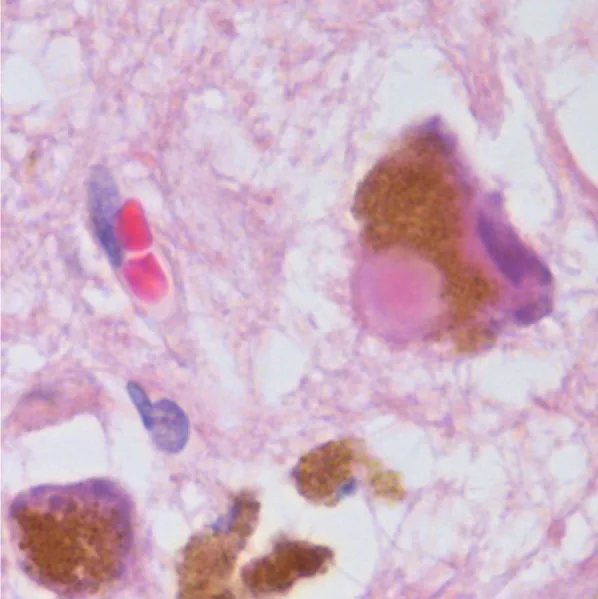
The picture shows a neuron with a Lewy body, neuromelanin outside cells and immune cells that have taken up the pigment. Neuromelanin gives the substantia nigra ("black substance") its name.

Tissue from the substantia nigra of a person with Parkinson's under the microscope: a neuron with dark brown pigment and a round pink Lewy body
Substantia nigra in Parkinson's disease: a neuron with a Lewy body and released neuromelanin. Werner, Heyny-von Haussen, Mall and Wolf, Wikimedia Commons, CC BY 2.0 (cropped)

Cheng, Ulane and Burke 2010 · Kordower et al. 2013 · Fearnley and Lees 1991

The treatment

The detour that gets dopamine into the brain

Dopamine in the blood does not cross the blood–brain barrier in amounts useful for treatment. Levodopa, the molecule the body makes it from, does, and in the brain it is converted to dopamine and can ease movement symptoms.

In 1957, Arvid Carlsson, Margit Lindqvist and Tor Magnusson showed that DOPA, the precursor of dopamine, could reverse the loss of movement caused by reserpine in mice and rabbits. In 1967, George Cotzias and colleagues reported improvements in patients given a mixture called DL-DOPA, and in 1969 with levodopa. Carlsson shared the 2000 Nobel Prize with Paul Greengard and Eric Kandel. Today, doctors adjust the dose to the effects and side effects.

Arvid Carlsson, in glasses and a grey jacket, speaking at a science festival
Arvid Carlsson at the Göteborg Science Festival, 2011. Photo: Vogler, Wikimedia Commons, CC BY-SA 3.0 (cropped)

DeMaagd and Philip 2015 · Carlsson, Lindqvist and Magnusson 1957 · Cotzias, Van Woert and Schiffer 1967 · Cotzias, Papavasiliou and Gellene 1969

What is not known

What remains unresolved

The prediction-error idea remains the textbook reference. In 2022, Huijeong Jeong, Vijay Namboodiri and colleagues proposed another explanation: in mice, dopamine release in the nucleus accumbens would reflect how strongly the preceding cues point to the likely cause of a reward.

In 2025, Lechen Qian's team obtained results that a temporal-difference learning model explains, provided it accounts for the intervals between trials. Which explanation applies under which conditions remains open.

Jeong et al. 2022 · Qian et al. 2025 · Gershman et al. 2024

Your neuron

What your neuron learned

On the left are your first trials, on the right the most recent. After enough trials of light and juice, the burst appears after the light, and the expected juice barely changes anything.

That is the best-documented role of dopamine bursts: they signal how wrong an expectation was, and correct it. Dopamine also has other roles, in motivation and in movement.

Common questions

Is dopamine the pleasure hormone?
Not quite. In rats, reactions to a sweet taste (mouth and tongue movements) stay almost unchanged even when dopamine in the striatum is depleted by up to 99%. Dopamine seems tied mainly to motivation, learning and movement.
What is a prediction error?
The difference between the reward you get and the reward you expected. In many experiments, an unexpected reward produces a burst of impulses in dopamine neurons, a predicted one almost nothing, and a missing one a brief pause.
Do phones give you "hits of dopamine"?
No published study appears to have measured dopamine release in a person's brain while they used a phone or social media. The phrase is a metaphor.
Does "dopamine detox" lower dopamine?
There is no evidence that it does. The psychologist who popularised the term says its aim is not to lower dopamine and that the name is misleading; it is a way of limiting certain impulsive behaviours.
How many dopamine neurons does a person have?
A few hundred thousand in all: post-mortem counts give 260,000 to 485,000 in the substantia nigra and ventral tegmental area, on both sides. The number falls with age.

Sources

Studies and reviews cited. The experiment on the page is a simplified temporal-difference learning model (Montague, Dayan and Sejnowski, 1996) with randomly generated impulses; it is not a recording.

  1. Rudow G. et al. (2008). Morphometry of the human substantia nigra in ageing and Parkinson's disease. Acta Neuropathologica 115:461–470. doi.org
  2. Bolam J.P., Pissadaki E.K. (2012). Living on the edge with too many mouths to feed: why dopamine neurons die. Movement Disorders 27:1478–1483. doi.org
  3. Azevedo F.A.C. et al. (2009). Equal numbers of neuronal and nonneuronal cells make the human brain an isometrically scaled-up primate brain. J Comp Neurol 513:532–541. doi.org
  4. Cha Y. et al. (2023). Current status and future perspectives on stem cell-based therapies for Parkinson's disease. J Mov Disord 16:22–41 (review of post-mortem neuron counts). doi.org
  5. Grace A.A., Bunney B.S. (1984). The control of firing pattern in nigral dopamine neurons: burst firing. J Neurosci 4:2877–2890. doi.org
  6. Schultz W., Apicella P., Ljungberg T. (1993). Responses of monkey dopamine neurons to reward and conditioned stimuli during successive steps of learning a delayed response task. J Neurosci 13:900–913. doi.org
  7. Hollerman J.R., Schultz W. (1998). Dopamine neurons report an error in the temporal prediction of reward during learning. Nature Neuroscience 1:304–309. doi.org
  8. Schultz W., Dayan P., Montague P.R. (1997). A neural substrate of prediction and reward. Science 275:1593–1599. doi.org
  9. Montague P.R., Dayan P., Sejnowski T.J. (1996). A framework for mesencephalic dopamine systems based on predictive Hebbian learning. J Neurosci 16:1936–1947. doi.org
  10. Fiorillo C.D., Tobler P.N., Schultz W. (2003). Discrete coding of reward probability and uncertainty by dopamine neurons. Science 299:1898–1902. doi.org
  11. Steinberg E.E. et al. (2013). A causal link between prediction errors, dopamine neurons and learning. Nature Neuroscience 16:966–973. doi.org
  12. Berridge K.C., Robinson T.E. (1998). What is the role of dopamine in reward: hedonic impact, reward learning, or incentive salience? Brain Research Reviews 28:309–369. doi.org
  13. Berridge K.C., Venier I.L., Robinson T.E. (1989). Taste reactivity analysis of 6-hydroxydopamine-induced aphagia. Behavioral Neuroscience 103:36–45. doi.org
  14. Peciña S. et al. (2003). Hyperdopaminergic mutant mice have higher "wanting" but not "liking" for sweet rewards. J Neurosci 23:9395–9402. doi.org
  15. Hernandez L., Hoebel B.G. (1988). Food reward and cocaine increase extracellular dopamine in the nucleus accumbens as measured by microdialysis. Life Sciences 42:1705–1712. doi.org
  16. Fiorino D.F., Coury A., Phillips A.G. (1997). Dynamic changes in nucleus accumbens dopamine efflux during the Coolidge effect in male rats. J Neurosci 17:4849–4855. doi.org
  17. Di Chiara G., Imperato A. (1988). Drugs abused by humans preferentially increase synaptic dopamine concentrations in the mesolimbic system of freely moving rats. PNAS 85:5274–5278. doi.org
  18. Salimpoor V.N. et al. (2011). Anatomically distinct dopamine release during anticipation and experience of peak emotion to music. Nature Neuroscience 14:257–262. doi.org
  19. Koepp M.J. et al. (1998). Evidence for striatal dopamine release during a video game. Nature 393:266–268. doi.org
  20. Kishida K.T. et al. (2016). Subsecond dopamine fluctuations in human striatum encode superposed error signals about actual and counterfactual reward. PNAS 113:200–205. doi.org
  21. Westbrook A. et al. (2021). Striatal dopamine synthesis capacity reflects smartphone social activity. iScience 24:102497. doi.org
  22. Šrámek P. et al. (2000). Human physiological responses to immersion into water of different temperatures. Eur J Appl Physiol 81:436–442. doi.org
  23. Janský L. et al. (1996). Change in sympathetic activity, cardiovascular functions and plasma hormone concentrations due to cold water immersion in men. Eur J Appl Physiol 74:148–152. doi.org
  24. Cheng H.-C., Ulane C.M., Burke R.E. (2010). Clinical progression in Parkinson disease and the neurobiology of axons. Annals of Neurology 67:715–725. doi.org
  25. Kordower J.H. et al. (2013). Disease duration and the integrity of the nigrostriatal system in Parkinson's disease. Brain 136:2419–2431. doi.org
  26. Fearnley J.M., Lees A.J. (1991). Ageing and Parkinson's disease: substantia nigra regional selectivity. Brain 114:2283–2301. doi.org
  27. DeMaagd G., Philip A. (2015). Part 2: Introduction to the pharmacotherapy of Parkinson's disease, with a focus on the use of dopaminergic agents. P&T 40:590–600. pmc.ncbi.nlm.nih.gov
  28. Carlsson A., Lindqvist M., Magnusson T. (1957). 3,4-Dihydroxyphenylalanine and 5-hydroxytryptophan as reserpine antagonists. Nature 180:1200. doi.org
  29. Cotzias G.C., Van Woert M.H., Schiffer L.M. (1967). Aromatic amino acids and modification of parkinsonism. NEJM 276:374–379. doi.org
  30. Cotzias G.C., Papavasiliou P.S., Gellene R. (1969). Modification of parkinsonism: chronic treatment with L-dopa. NEJM 280:337–345. doi.org
  31. Jeong H. et al. (2022). Mesolimbic dopamine release conveys causal associations. Science 378:eabq6740. doi.org
  32. Qian L. et al. (2025). Prospective contingency explains behavior and dopamine signals during associative learning. Nature Neuroscience 28:1280–1292. doi.org
  33. Gershman S.J. et al. (2024). Explaining dopamine through prediction errors and beyond. Nature Neuroscience 27:1645–1655. doi.org