Buzău · 1910–1916 · “100,000 kilometres on foot”
Dumitru Dan’s walk around the world: what his stamps show
Until his death in 1978, Dumitru Dan said he had walked around the world in peasant sandals between 1910 and 1916. On the road he asked officials to sign or stamp papers recording his visits, and the Buzău County Museum has published its catalogue of them online. Below is every day of those six years, with what survives of it.
1,412 days, from 1 April 1910 to 11 February 1914, and a single stamp, of doubtful year
His later account
What the stamps show
What he told the press at the time
Pick a day on the calendar or use the arrow keys; Shift jumps a month. A violet line is a day the catalogue gives at least one document; some sheets gather stamps from several days.
The story
Four students, a dog and 100,000 francs
The version everyone knows is the one Dan told in lectures and interviews in the 1960s and 1970s. In 1908, the Touring Club de France supposedly announced a contest: around the world on foot, 100,000 kilometres in six years, self-funded, for a prize of 100,000 francs. Two hundred people entered, he said, among them four Romanian students in Paris: Dumitru Dan, Paul Pârvu, Gheorghe Negreanu and Alexandru Pascu.
In his telling, they left Bucharest on 1 April 1910, in folk costume and opinci, the leather sandals of Romanian peasants, with a dog called Harap. Pascu died in India, Negreanu fell into a ravine in China, and Pârvu died in Florida after both legs were amputated. Crockett, however, traced Paul Pârvu in American records after 1915: an immigrant from Cleveland who died in 1938. Dan said he reached home in March 1916, two days before the deadline, and collected the prize in Paris in 1923. The tally, depending on the version: five continents, 74 or 76 countries, more than 1,500 towns, 497 pairs of opinci.
The story earned him diplomas as “world champion” and, according to the museum, an entry in the 1985 Guinness Book of Records. On 18 May 2016 the Buzău County Museum opened a permanent exhibition about him, funded by EEA grants, and in October 2017 a monument was unveiled on his grave in the town’s Heroes’ Cemetery.
In 2019 the endurance-running historian Davy Crockett checked the story against the American press of 1914–15 and found something else: a journey that began later, ran much shorter and involved no contest. In 2021 Ionuț Sociu, writing in Scena9, took the question to Buzău. The most precise answer, though, lies in Dan’s own collection.
The archive
677 entries and almost nothing from 1910–1913
The collection’s entries, by the year they carry
- 1905
- 39
- 1910
- 2181914
- 132
- 821923
- 1940
- 1960
- 1977
The museum’s online catalogue has 677 entries: certificates of passage, diplomas, newspaper cuttings, posters, cockades, coins, a passport, a tape reel. Almost every one has a date, an issuer and a country. By year, the documents fall into three piles: 1914–16, the autumn of 1923 in Italy, and the diplomas he received in Romania in the 1960s and 1970s.
From 1910–1913, the years of Africa, Australia, Siberia and Alaska in the story, a single dated document survives, and a doubtful one. A few other objects seem to belong there, but they don’t hold. The cockades of Romanian-American societies whose inscriptions are legible carry the year each society was founded, not the year of a visit: “founded on 18 August 1907, S. Lorain, Ohio”. The 1911 badge comes from a picnic of the Inland Steel works in Indiana, where his dated papers place him only in 1914.
The doubtful document is a certificate from the “Prinz Carol” society in Columbus, Ohio, with a violet stamp reading “SEP 25 1913”. On the same sheet the Newark police wrote only “Sept 28”, without a year. But the town hall and the library of Columbus record him there on 25 September 1914, and other papers put him in Newark on 29 September 1914. Most likely the year on the stamp had not been changed. Taken at face value, the document would place him in Ohio in September 1913, not in Alaska, where the story has him.
And the 22 photographic reproductions from Austria, dated “1909–1911” in the catalogue, include Vienna’s crematorium, opened in 1922. They cannot date from 1909–11; when and where Dan acquired them is unknown.
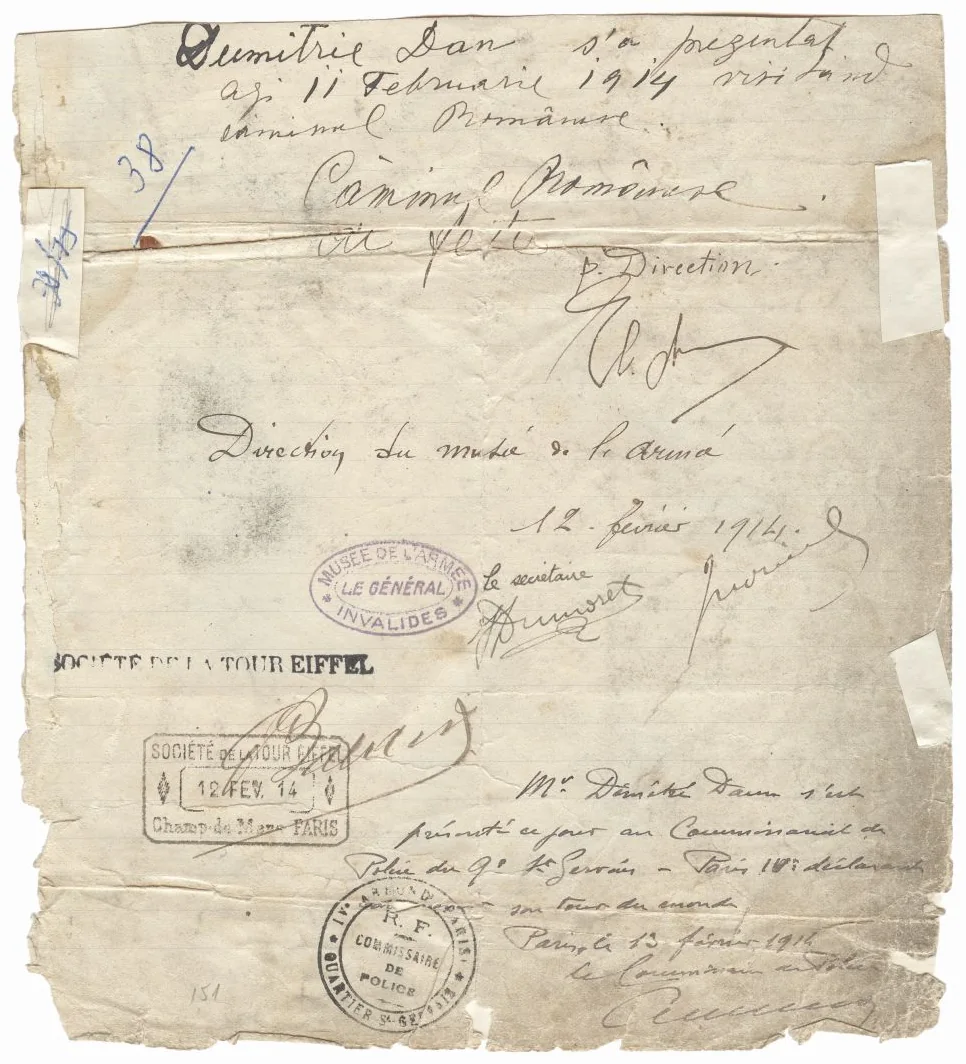
The first certain document comes from Paris, 11 February 1914. The last of this run records visits to Alexandria and Drăgănești-Vlașca on 3 August 1916, Old Style, eleven days before Romania entered the war. In between: 348 dated entries, from 12 countries and territories, with stamps on 225 days.
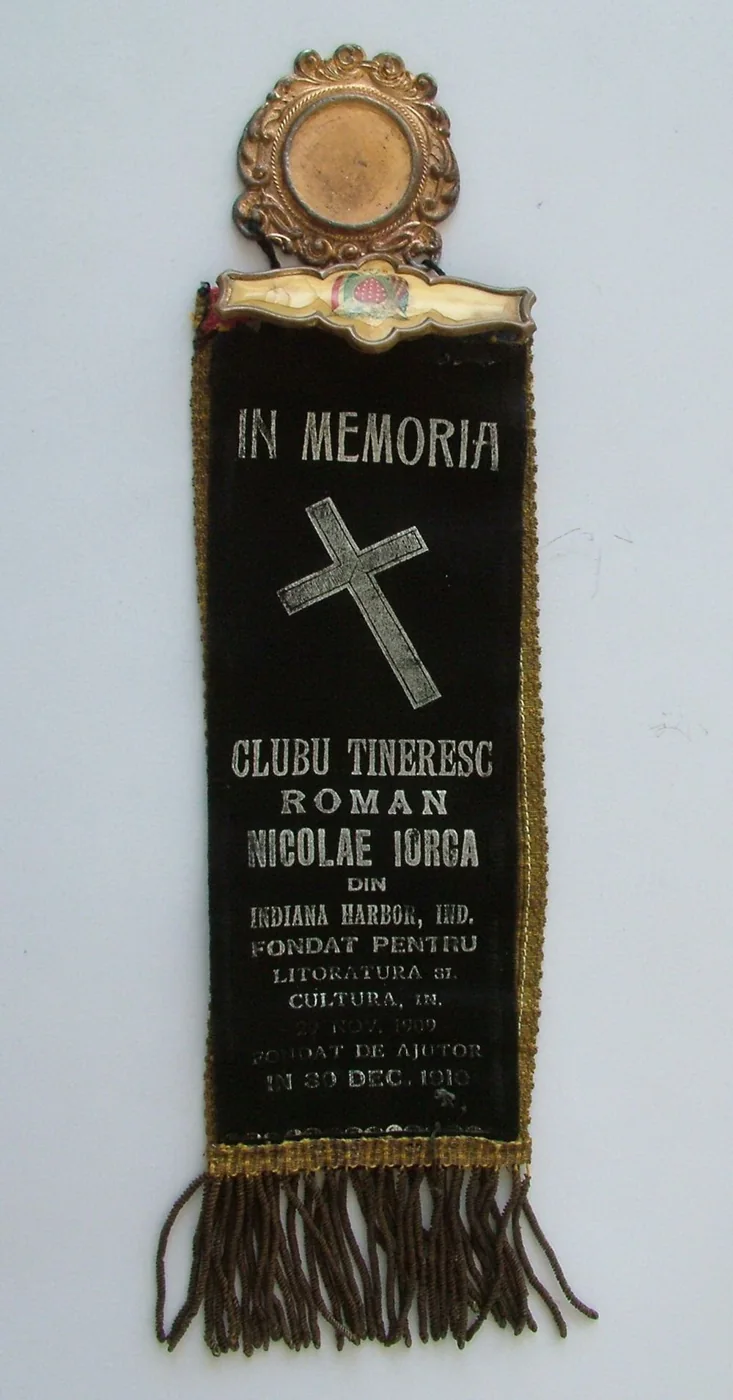
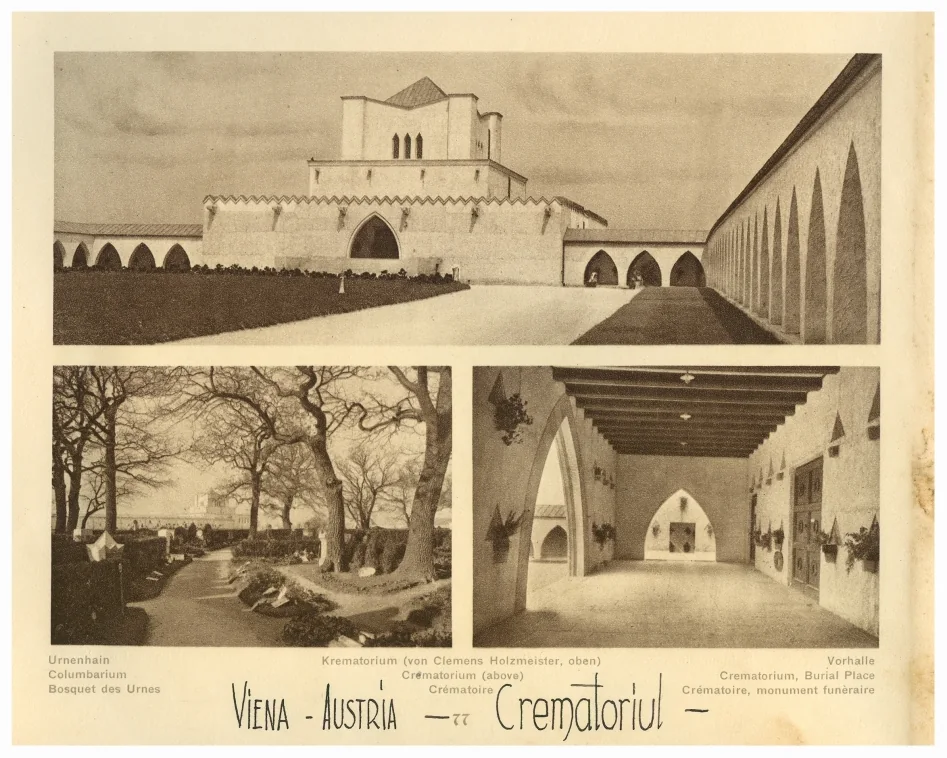
The papers
The story grows from town to town
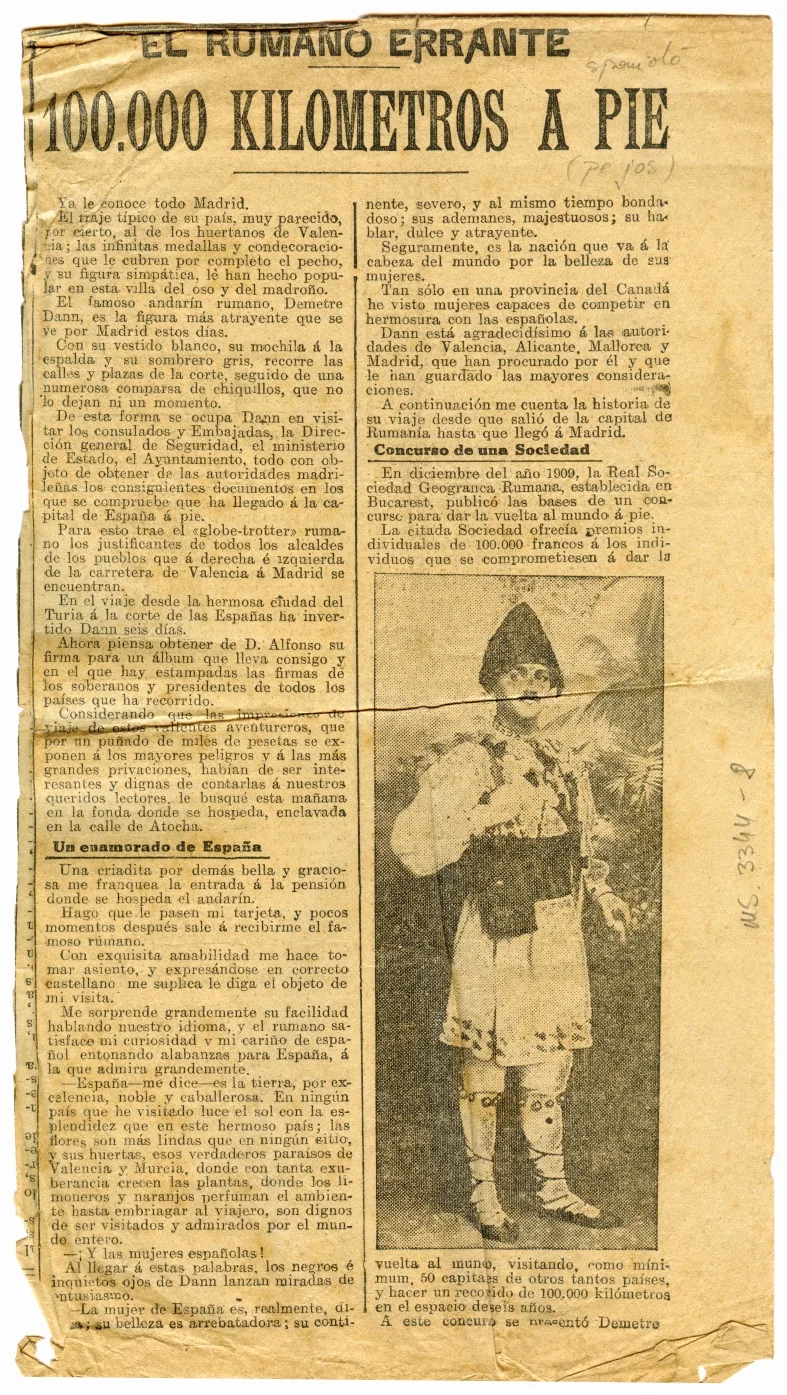
Dan’s collection also kept cuttings from the papers that interviewed him on the road. Read in order, they show the story changing as it was told. The year he set out, the prize, who put it up and how many kilometres lie behind him differ from paper to paper, sometimes within a month.
In the summer of 1914 the Glasgow and Jackson, Michigan, papers gave 1 April 1912 as his departure date; in Jackson, Dan said he had been wounded in the war with Bulgaria and ill for six months. In between, in Hamilton, the start was “some four years ago”. In March 1915 the Port-au-Prince paper gave 1 April 1910, with a route through Siberia, Japan, India and Africa. In Madrid, in España Nueva’s interview of 29 July 1915, come the three friends, Pascu’s death on Mont Blanc and 498 pairs of sandals. Two weeks later the magazine Nuevo Mundo printed 96,000 kilometres, 49 countries and the number that would stick: 497 pairs. The later story has 74 countries.
-
Glasgow, June 1914
Started on 1 April 1912; must walk 63,000 miles within six years, for £4,000 offered by the “Sports Club” of his country.
-
Hamilton, Ontario, 28 July 1914
Left “some four years ago”; has already covered 47,000 miles; the prize: $20,000 from the “Roumanian Sporting Society”. Uses up one pair of shoes a week.
-
Jackson, Michigan, 26 August 1914
Left Bucharest on 1 April 1912, was called back by the war with Bulgaria; has worn out 180 pairs of shoes. Paul Parvu “of Cleveland” has just joined him.
-
Port-au-Prince, March 1915
Now the start is 1 April 1910, and the route runs through Siberia, Japan, China, India, Persia, Arabia, Africa and Madagascar. The target: 100,000 kilometres.
-
España Nueva, Madrid, 29 July 1915
Started on 1 January 1910 with three friends; Pascu died on Mont Blanc. The contest was supposedly announced in December 1909 by a “Royal Romanian Geographical Society”. He has 96,420 kilometres and has worn out 498 pairs of sandals.
-
Nuevo Mundo, Madrid, 13 August 1915
“World champion”, the only Romanian to have covered 96,000 kilometres through 49 countries, penniless and on foot. Has worn out 497 pairs of sandals; six months and 4,000 km to go. The prize: 100,000 francs from the “Geographical Society of Romania”.
The Touring Club de France appears in none of these cuttings. The organiser is, in turn, a “sports club”, a “Roumanian Sporting Society” and a “Royal Romanian Geographical Society”. In the later story, Pascu dies in India, not on Mont Blanc. Carlos J. Gómez-Miota, who retraced his route through Spain, still thinks some contest or wager existed, judging by the care with which Dan gathered his certificates.
Scans: Buzău County Museum, Dumitru Dan collection (dumitrudan.muzeubuzau.ro), licensed CC BY-NC-ND.
The route
The stamped route: 11,000–12,400 km over land
Every document gives a place and a day. For the route, only stamps from an authority counted: town hall, police, government, consulate (121 stops). Joined in order, they make 9,186 km over land in straight lines, plus the sea crossings: the Channel, the Atlantic twice, the Caribbean islands, Majorca. With a road factor of 1.2–1.35, the land part would come to about 11,000–12,400 km.
How far he walked remains unknown: the stamps show where he was, not how he got there, and detours and walks around town leave no trace. But even doubled, the distance between the stamps would stay under a quarter of 100,000. Between two stops the median is 26.7 km a day. Seven stages exceed 60 km a day; one document from Jacksonville is dated 4 January 1915, and the mayor of Bartow signed on 5 January, 272 km away in a straight line.
The map holds a surprise too. In Ohio, Indiana and Pennsylvania his hosts were often the mutual-aid societies and parishes of Romanian immigrants: “Patria Română” in Lorain, “Horea, Cloșca și Crișan” in Zanesville, “Dr. Iuliu Maniu” in Canton. Dan travelled from community to community, from one steel town to the next, living on lectures, shows and the sale of postcards of himself.
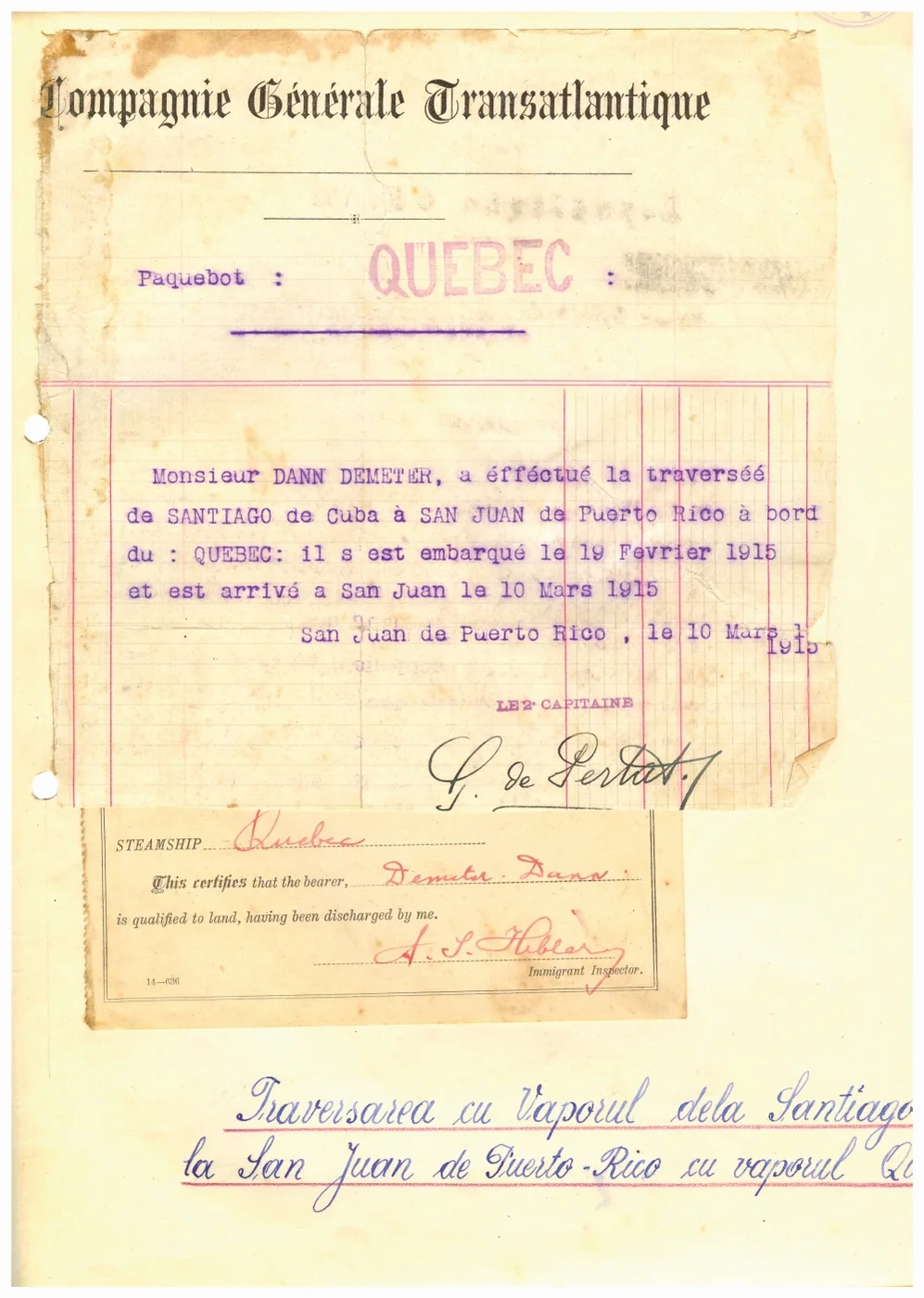
The sandals
497 pairs, from 1915
Footwear is the story’s second counter. In Jackson, on 26 August 1914, Dan had worn out 180 pairs. In Madrid, in España Nueva on 29 July 1915, he had worn out 498, and in Nuevo Mundo two weeks later, 497: the number that entered the legend. From 180 to 498 is 318 pairs in 11 months, almost one a day.
Between the two papers, his stamps add up to 5,520 km over land, in straight lines. That would be one pair every 17.4 km. With the 96,000 km he claimed in Madrid, it would be about 190 km a pair: the count of pairs keeps pace with the story’s kilometres, not the stamps’.
The diplomas
World champion, from 1967
The third pile in the archive is the one that made the legend. Between 1960 and 1975 Dan, a retired geography teacher in Buzău, gave talks in schools, cultural centres and Pioneer camps. The collection keeps 62 diplomas from the 1960s and 1970s. Some thank him for talks, others record honours or appearances at events; many call him “world champion at 100,000 km on foot” or “the first man in the world to walk 100,000 km”.
The title was not new: a Madrid magazine called him “world champion” as early as 1915. But the diplomas of the 1960s were issued on the strength of the story told in the hall, and in April 1968 Paul Diaconescu wrote about Dan’s account of the journey in the monthly supplement of Scînteia, the Communist Party daily.
What remains
A real journey, documented town by town
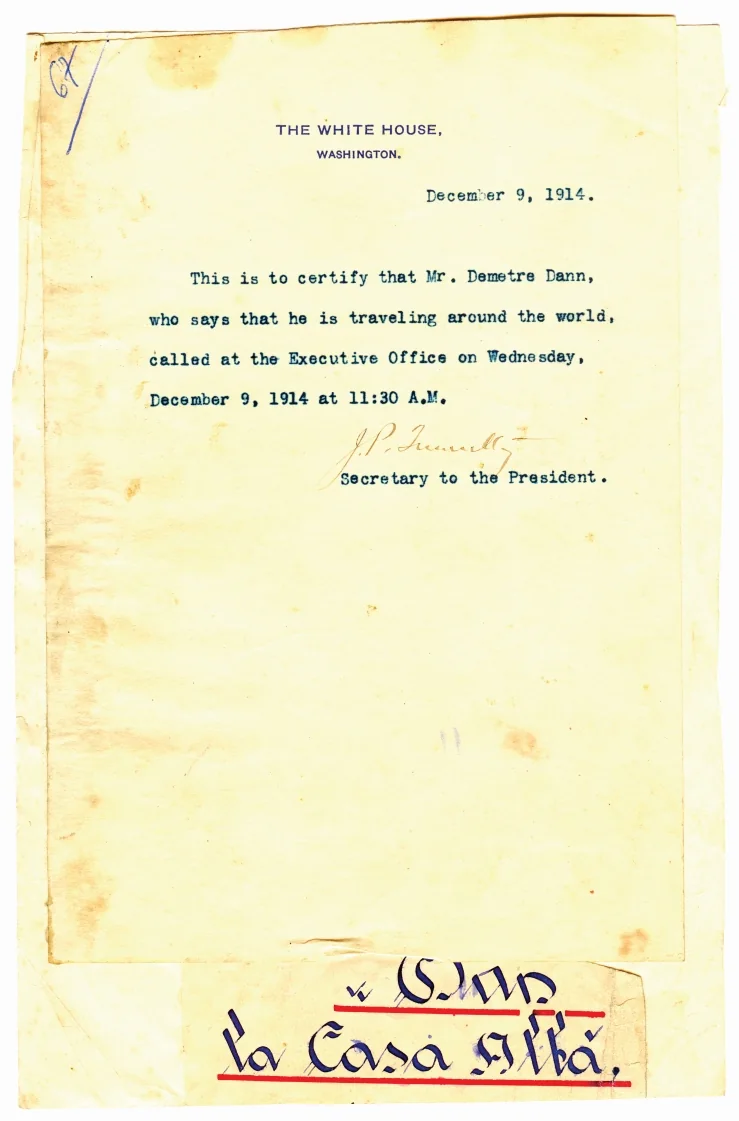
The stamps show a 23-year-old who, between February 1914 and August 1916, crossed 12 countries and territories in folk costume. He called at the White House Executive Office; Cuba’s president, Mario García Menocal, and Venezuela’s provisional president, Victorino Márquez Bustillos, each signed that they had received him. He lived on lectures and shows, in a world that was just going to war.
From 1915 his papers also record the claim: the walk around the world and the 100,000 kilometres, as he told them to the press. They record no stamp from Asia, Africa, Australia or Alaska, no Touring Club de France and no dog. The Buzău collection tells a smaller story than the legend, but one that can be followed on the map, town by town.
Sources and method
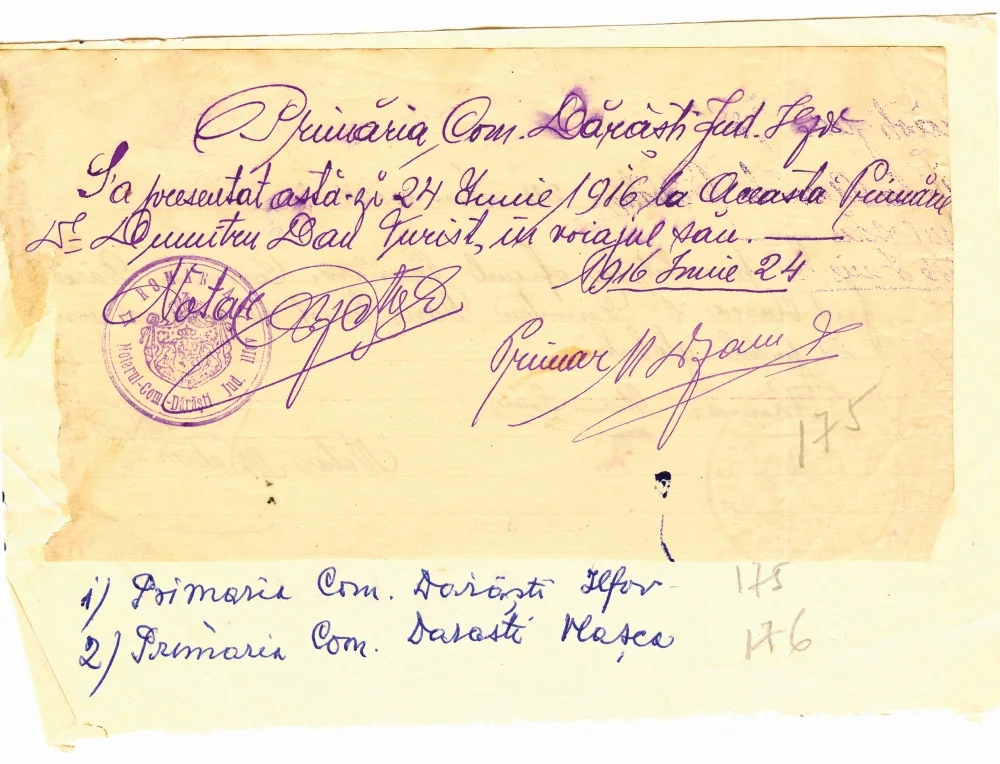
The source is the Buzău County Museum’s online catalogue, consulted on 25 November 2026 (677 entries). Places were read from the issuers’ names and mapped with GeoNames. Romanian documents of 1916 are dated Old Style. Only documents from an authority (town hall, police, government, consulate, legation, customs) counted for the route; letters from societies, libraries or newspapers can be issued or dated at a distance. The Dărăști document reads 24 June 1916, although the catalogue gives 1914; the Columbus certificate stamped “SEP 25 1913” is shown in the calendar at the date it carries, as doubtful, and on the route at 25 September 1914; 7 documents that contradict the run of dates or only record a parcel sent to him were set aside. On sheets with several towns and a single date, stops were ordered by proximity. Distances are great circles between consecutive stops; a road factor of 1.2–1.35 gives the land range. Stages between continents and islands were counted as sea. The gap between Madrid (13 August 1915) and Bucharest (19 June 1916) has no document and is left out of the total. Completing 100,000 km between 1 April 1910 and 29 March 1916 would have required an average of 45.7 km a day; in the later story the route was finished only in 1923.
- Muzeul Județean Buzău, „Ocolul lumii pe jos. Povestea celor 497 perechi de opinci”, arhiva online a colecției Dumitru Dan (677 numbered entries with date, issuer, country and scan; consulted on 25 November 2026).
- The newspaper cuttings in the collection, read from the scans: Glasgow (June 1914), Hamilton Times (28.07.1914), The Patriot, Jackson (26.08.1914), Port-au-Prince (1–3.03.1915), La Almudaina, Palma (30.06.1915), España Nueva, Madrid (29.07.1915, an interview kept in two cuttings), Nuevo Mundo, Madrid (13.08.1915).
- Carlos J. Gómez-Miota Sánchez, „El andarín Dumitru Dan. La historia del primer rumano en pisar el Altiplano de Utiel-Requena”, Oleana 42, 2025, pp. 215–240.
- Davy Crockett, „Around the World on Foot – Part 5 – Dumitru Dan”, Ultrarunning History, 16.12.2019 (the American press of 1914–15, passenger lists, Paul Parvu’s later life).
- Ionuț Sociu, “Dumitru Dan, the Legendary Romanian Globetrotter that Never Was”, Scena9, 31 May 2021.
- Gazeta Sporturilor, reconstruction of the four men’s route, 2011 (republished 2021).
- Buzău Media, 31.10.2017: the unveiling of the grave monument.
- Natural Earth, 1:50m land (naturalearthdata.com).
Images
- Scans: Buzău County Museum, Dumitru Dan collection (dumitrudan.muzeubuzau.ro), licensed CC BY-NC-ND.
- Land outlines: Natural Earth (public domain).