WHEN THE SUN DISAPPEARS

A MULTIDISCIPLINARY ATLAS · 12 AUGUST 2026

When the Sun
disappears

What a total solar eclipse reveals about clouds, birds, insects, human minds, crowds, political power, electricity grids, ancient knowledge and science itself.

An eclipse is an experiment the Solar System runs on the Earth.

Peer-reviewed research · primary historical material · official operational sources · claims labelled by evidence strength

1input suddenly changes
sunlight
9systems examined
from atmosphere to authority
>2.8mpeople in one natural
psychology experiment
720 BCEeclipse records reaching
into modern science
FIELD NOTE · 12 AUG 2026

Today's total eclipse crossed Greenland, Iceland, the Atlantic and northern Spain, with a small part of Portugal also in totality. In Spain it arrived close to sunset. S01

Beforehand, European grid operators modelled a clear-sky fall of up to 9.7 GW in photovoltaic output and coordinated reserves and forecasts around it. S02

Post-event grid outcomeAwaiting official operational data

THE TWO-MINUTE VERSION

Nine things an eclipse teaches unusually well

This is the argument. The sections below add evidence, qualifications and history.

01

Totality is a threshold, not a percentage.

In one continent-scale bird study, the broad decline in vocal activity appeared only above 99% maximum obscuration. Radar work found insect behaviour at totality qualitatively different even from 98%. The last fraction can change the state of a biological system. S05 S07

02

An eclipse can begin dismantling the clouds beneath it.

Satellite observations and simulations found shallow cumulus over land declining from roughly 15% obscuration: less sunlight cools the surface, weakens convection and starves those clouds of rising warm air. The result applies to shallow land-based cumulus under the studied conditions; other cloud regimes may behave differently. S03

03

Cause and consequence travel on different clocks.

Across UK weather stations in the 2015 eclipse, the mean temperature minimum arrived about ten minutes after maximum eclipse. The Sun's geometry changed first; the lower atmosphere responded later. S04

04

Light is information to living things.

Abrupt darkness can feed animals the wrong time-of-day signal. Birds can quiet, nocturnal species can begin calling, bees can stop flying, and the return of light can elicit something resembling a second dawn. S06 S08

05

Human language changes inside the shadow too.

Among 2,891,611 Twitter users around the 2017 eclipse, people in the path of totality expressed more awe, less self-focus and more collective, affiliative and prosocial language. The finding concerns language; it does not show that everyone in the path behaved more altruistically. S10

06

Knowledge does not abolish meaning.

Maya eclipse calculation, Mesopotamian prediction and divination, some Aboriginal Australian causal understanding, and Islamic ritual responses all show different combinations of explanation, prediction, cosmology and practice. The phrase "myth, then science" compresses a more complicated history. S15 S16 S17 S20

07

Prediction is a form of authority.

If an anomaly can be read as a judgement on a ruler, the person who predicts and interprets it matters politically. In historical China, a modern economic-history study finds total eclipses amplified the damaging effect of climate shocks, with civil conflict as a proposed mechanism through weakened legitimacy. S18 S19

08

Modern civilisation has made sunlight infrastructure.

The Moon's shadow now passes through power systems, traffic networks, tourism and communications. A predictable celestial event still demands system-wide preparation. In the 2017 eclipse, fatal-crash involvement rose 31% over a three-day travel window. S02 S21

09

We learned enough from natural eclipses to manufacture them.

Historical eclipse records help reconstruct Earth's rotation, eclipse spectroscopy helped reveal helium, and the 1919 expeditions tested gravitational light deflection. ESA now flies two spacecraft about 150 metres apart to create artificial eclipses and study the corona on demand. S22 S23 S24 S26

If you remember one sentence:The ordinary world can suddenly break while the deeper order remains intact.

THE SIGNATURE EXPERIMENT

Move the Moon across the Sun

One slider, many systems. The responses below are a schematic synthesis across different studies, places and eclipses. The 2026 event has no complete response series here.

0% obscured
ordinary day98%99%totality

BASELINE

The system is receiving its ordinary daytime signal.

At zero obscuration there is no eclipse forcing. Move the slider: some systems respond gradually, some after a lag, and some only when the last sliver of photosphere disappears.

Why this matters beyond eclipses. "98% is almost 100%" is mathematically true, yet it can mislead when a system has a threshold. Ecosystems, grids, crowds, phase transitions and institutions can change state at a boundary. The eclipse makes non-linearity visible.

THE 40-MINUTE VERSION

Nine systems under one moving shadow

The tour follows the disturbance through radiation, air, organisms, minds, crowds, cultures, states, infrastructure and the institutions that turn a rare anomaly into knowledge.

01

EXPERIMENTAL LOGIC · EARTH SYSTEM SCIENCE

The clean intervention

Most experiments gain clarity by changing one thing while holding other conditions steady. Nature rarely offers that kind of intervention at continental scale. A solar eclipse comes close.

For a narrow moving region, direct sunlight falls steeply and rapidly on a schedule that celestial mechanics lets us calculate with extraordinary precision. The Moon changes one input: radiation. Temperature, wind, animal metabolism, human expectation and electricity demand then reveal their own response functions.

That known input gives eclipse studies their leverage. Researchers can compare places with different obscuration, times before and after maximum, models that include the eclipse with models that omit it, or organisms that occupy different sensory niches. The Royal Society has called an eclipse a "natural meteorological experiment"; the same logic reaches beyond meteorology. S27

A total eclipse is a rare spectacle. As an experiment, its value lies in the known geometry of a huge environmental perturbation.

This is a natural experiment with no randomized assignment. Clouds vary. People choose whether to travel into totality. Species and cities differ. An eclipse moves through geography. Good eclipse science therefore uses controls, repeated sites, pre-registered hypotheses where possible, before-and-after baselines and explicit acknowledgement of confounding.

The animals stay in their habitats; crowds have real expectations; grid operators face real demand; institutions face real consequences. The shadow intervenes without asking any of them to behave like experimental subjects.

Evidence status · direct

The astronomical forcing is known independently of the terrestrial responses. Individual studies vary in causal strength. This atlas separates eclipse-specific measurements from the broader theories used to interpret them.

02

METEOROLOGY · ATMOSPHERIC PHYSICS

The atmosphere notices in layers and with delays

The sky darkens, and the lower atmosphere begins losing energy from the ground warmed by sunlight.

A 2024 Communications Earth & Environment study used geostationary satellite data from three eclipses and large-eddy simulations to measure a clear response. Over land, shallow cumulus cloud cover began to decrease at around 15% solar obscuration. The proposed chain is physical: less solar heating cools the land surface; sensible and latent heat fluxes weaken; turbulent updrafts lose strength; the small clouds that depend on those updrafts dissipate. S03

A careless headline would say "an eclipse clears its own sky." The measured result is narrower. It concerns shallow cumulus over land under the studied conditions. Thick frontal cloud, high cloud and other regimes can persist. A reduction in sunlight can erase cloud by shutting down the convection that sustains it.

Temperature gives the same system a different signature. During the 20 March 2015 eclipse, analysis of 76 UK Met Office stations found a mean temperature decrease of 0.83°C, with the minimum arriving roughly ten minutes after the eclipse maximum; average wind speed also fell by about 9% during the first half of the event. S04 The delay comes from heat storage, turbulent mixing and advection.

Sunlightforcing changes immediately
Surface fluxresponds as land cools
Shallow cloudconvection weakens
Air temperatureminimum can lag maximum eclipse

The upper atmosphere supplies another version of the same story. Solar ultraviolet and X-ray radiation continually ionize parts of the atmosphere. Reduce that radiation and electron densities change; radio propagation changes with them. Eclipse campaigns exploit the moving shadow to watch ionospheric chemistry relax toward a night-like state and recover, without waiting for the whole planet to rotate into darkness.

Together, these observations show that one shock can produce several response times. Each subsystem carries memory. The lag tells us how that system stores and moves energy.

Evidence status · direct + mechanistic

Cloud and surface-weather claims come from eclipse measurements and modelling. The visual latency bars above are conceptual, not a shared quantitative time axis.

03

ECOLOGY · CHRONOBIOLOGY · ANIMAL BEHAVIOUR

Life gets the wrong clock signal

To an organism, sunlight is not scenery. It is data: about time, temperature, predation risk, food, navigation and when to begin or end a behavioural programme.

An eclipse creates a temporary timing error for biology. It tells a diurnal system "evening" at the wrong hour, sometimes strongly enough to push behaviour across a threshold, then tells it "dawn" minutes later.

A 2025 Scientific Reports study used a continent-scale acoustic network during the 8 April 2024 eclipse. Across the network, bird vocalization showed a significant broad decline only at sites that experienced more than 99% maximum obscuration; below that, responses were much more heterogeneous. S05 A 2026 follow-up examined birds through their "photic niche" and found that responses were structured by species' relationship to light and habitat exposure. That helps explain why "birds go silent" is memorable but too crude. S09

A separate 2025 Science paper found that some bird behaviour resembled dawn behaviour as light returned after totality. S06 The eclipse compresses a false dusk, a short false night and a second dawn into minutes. Natural selection usually delivers these cues many hours apart.

Insects make the threshold visible from another sensor. Fine-scale radar during the 2024 eclipse found insect behaviour during totality qualitatively different from behaviour under even 98% obscuration. S07 And during the 2017 eclipse, an acoustic citizen-science experiment found bees continued flying through partial phases but flight activity essentially ceased at totality. S08

Different organisms infer the world's state from light. An eclipse exposes the rules of that inference.

Even zoo evidence needs controls. A 2020 study found behavioural changes in many of 17 zoo species during the 2017 total eclipse, while noting that visitor reactions could have influenced the animals. S28 A 2026 study observed a total eclipse while the zoo was closed. Most studied species showed little notable response; Japanese macaques and zebras were exceptions. S29 With the human crowd absent, some of the reported "eclipse behaviour" disappeared.

The eclipse is a clean radiative shock inside a crowded, changing world. Humans gather, roads fill, noise changes, temperature falls and wind shifts. To interpret an animal's response, researchers must separate light from the other changes that arrive with totality.

Evidence status · direct, heterogeneous

Multiple eclipse studies find biological responses. Species and sites differ substantially. "Animals think it is night" describes cue-driven behaviour; the evidence concerns responses to light rather than animal cognition.

04

PSYCHOLOGY · AWE · SCIENCE IDENTITY

The small self under a very large sky

The eclipse also changes the scale at which people describe themselves.

Sean Goldy, Nickolas Jones and Paul Piff turned the 2017 US eclipse into a large naturalistic psychology study. Their dataset contained 2,891,611 Twitter users. Comparing language inside and outside the path of totality, they found totality associated with more expressions of awe and language indicating affiliation, collective focus, humility and prosocial orientation, alongside less self-focused language. In a longitudinal analysis, people whose eclipse-related awe increased also showed corresponding shifts in these social-language measures. S10

A broader experimental literature on awe points in the same direction. In five studies published in 2015, Piff and colleagues found that awe was associated with a diminished sense of individual self-importance, the "small self", and with several prosocial outcomes. One field experiment induced awe by having participants look up at towering trees. S11 The eclipse supplies a vast stimulus without a researcher building it.

The Twitter paper measured linguistic markers. Those markers describe words, not private motives. "Prosocial language" and observed generosity are different measures; "humility" is operationalized through language. People also self-select into the path of totality. The study's strength comes from its scale, geography and temporal comparison, while alternative explanations remain.

Newer work asks whether the effect can be recruited for science engagement. A 2025 study at NASA-hosted 2024 eclipse events collected responses from more than 1,300 attendees and followed a smaller subset six months later. The memory of the eclipse remained highly awe-laden, and awe, science identity and engagement were correlated. S12 A 2026 People and Nature study of 528 participants aged 8–80 who recorded animal behaviour during the eclipse found that totality predicted more awe, while awe predicted reported increases in science identity and belonging; the authors modelled indirect effects through awe. S13

Strongest direct evidenceEclipse exposure ↔ eclipse language / reported awe
Supported mechanismAwe ↔ "small self" and prosocial outcomes in broader experiments
Promising applicationAwe + participation ↔ science identity / belonging
Claim outside the evidence"Eclipses make people permanently kinder or turn them into scientists."

Human attention is scale-sensitive. A perceptually vast event can temporarily reorder what feels salient: the individual self becomes less dominant; a collective frame becomes easier to access. A science institution can decide whether that opening remains a memory, becomes a conversation or leads to participation.

Evidence status · direct + adjacent mechanism

The 2017 language effect is eclipse-specific. The "small self" mechanism is supported by a broader experimental literature. Long-term science-identity findings are promising but rely substantially on self-report and selected participants.

05

SOCIOLOGY · COLLECTIVE ATTENTION · RITUAL

A crowd with no performer

Concerts have musicians. Football crowds have teams. Political rallies have speakers. A total eclipse can synchronize thousands of strangers around an object that is not human at all.

That makes it a good case for the sociology of gatherings. Émile Durkheim's idea of collective effervescence describes the emotional energy and social bonding that can emerge when people assemble, orient toward shared symbols and experience emotion together. Modern empirical work has tested parts of that framework across collective gatherings. S14

The evidence supports a comparison rather than a full test of the Durkheimian mechanism. Totality brings several conditions together: co-presence, common anticipation, a precise shared climax, simultaneous sensory change, visible reactions and a focal object that no participant controls.

That last condition is unusual. In many collective rituals, human institutions stage the object of attention. At an eclipse, orbital mechanics sets the schedule. The crowd cannot start totality early, extend it, encore it or negotiate with it. The event's indifference to the crowd may strengthen the sense that everyone present is subject to the same external reality.

An eclipse asks a beautiful sociological question: how little ritual machinery is needed to make strangers feel, briefly, like a "we"?

The Goldy study gives this interpretation an empirical foothold: people exposed to totality used more collective and affiliative language. S10 Sociology adds the group-level question. People notice that other people are noticing the same thing.

Shared attention creates common knowledge: I see the sky change; I see you see it; I know you know I saw it. The event becomes a collective timestamp: "where were you when the sky went dark?" For editors, museums and public institutions, interpretation can attach knowledge to a memory with strong temporal and collective anchors.

Totality is shared in principle, unequal in access. Travel, accommodation, work flexibility, geography, cloud risk and safe viewing equipment shape who gets the full experience. Even a universal spectacle arrives through unequal infrastructures.

Evidence status · editorial synthesis

Collective-effervescence theory is well developed, but the application here is interpretive. Eclipse-specific evidence supports increased collective language. The data do not establish every sociological mechanism described above.

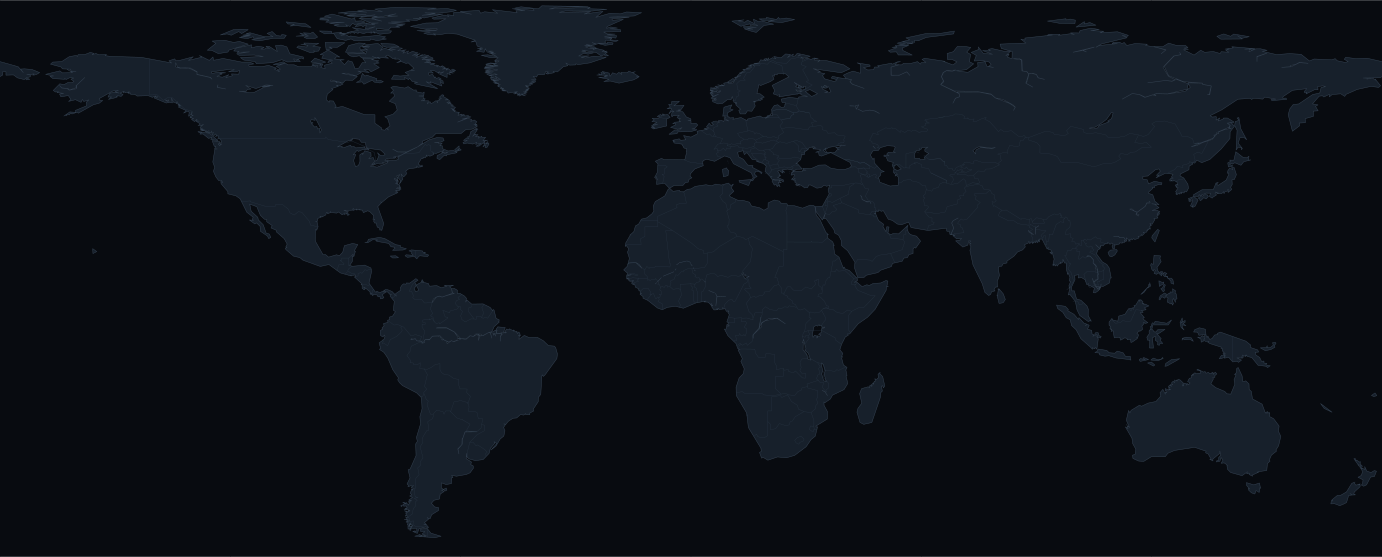
A WORLD OF RESPONSES · SELECTED CASES

One darkness, many institutions of meaning

These are analytical cases rather than an exhaustive inventory. For a dedicated cultural survey, the Spanish Astronomical Society's 2026 Un mundo de eclipses maps more than 100 cultural manifestations. S30

World map showing selected eclipse cases

SELECT A POINT

The map links evidence to place.

Each case asks the same questions: What was known? What did the eclipse mean? Who had authority to interpret it? What evidence survives?

contemporary / direct source scholarly reconstruction disputed attribution modern empirical study
06

ANTHROPOLOGY · HISTORY OF RELIGION · CULTURAL ASTRONOMY

Meaning survives explanation

A familiar history runs from terrified ancients to enlightened moderns. The record is richer: predictive skill, causal understanding, ritual and cosmology repeatedly coexist.

In Mesopotamia, celestial observation became extraordinarily systematic while remaining embedded in divination and kingship. Eclipses could be treated as ominous for a ruler, and elaborate substitute-king rituals were used to deflect the danger when ominous celestial configurations were predicted. S17 Prediction could strengthen ritual administration rather than replace it.

The Maya show how calculation and ritual can share an intellectual system. The Postclassic Dresden Codex contains lunar and eclipse tables structured around intervals of 148 and 177 days, allowing specialists to track windows in which solar or lunar eclipses were possible. S16 Mathematical regularity and ritual significance belonged to the same world.

The Australian record resists a single account. Hamacher and Norris surveyed roughly fifty accounts from different Aboriginal groups. Many traditions associated eclipses with danger, death or powerful magic. The authors also found evidence that some groups understood a solar eclipse as the Moon blocking the Sun and possessed sophisticated knowledge of lunar and solar motions. S15 The evidence points to multiple knowledge traditions, some combining mechanism and meaning in ways a modern taxonomy would separate.

An early Islamic case makes the distinction between mechanism and meaning clear. A hadith in Sahih al-Bukhari recounts that a solar eclipse coincided with the death of Muhammad's son Ibrahim. When people linked the celestial event to the death, Muhammad rejected that causal claim, saying the Sun and Moon do not eclipse because of a person's birth or death, while still directing believers to respond with eclipse prayer. S20 The event remains religiously significant after the personal omen is denied.

Even the famous Greek story that Thales predicted the eclipse of 585 BCE is a lesson in evidence discipline. Ancient tradition credits him with prediction; modern scholarship debates whether the techniques available could have supported the feat with the claimed specificity. S31 The responsible atlas therefore labels the claim disputed rather than choosing the more cinematic version.

Explanation and meaning answer different questions: What causes this? When will it happen? What should we do? What does it say about us?

Modern eclipse tourism carries the pattern forward. People who understand orbital geometry perfectly still travel thousands of kilometres, gather in chosen places, observe safety practices, become silent, cheer, cry, take photographs, tell stories and preserve souvenirs. Scientific knowledge changes how people explain the event while leaving room for ritual, emotion and memory.

Evidence status · mixed historical record

Traditions differ and evidence quality varies. Contemporary texts, later reports, ethnography and modern reconstruction are marked separately in the atlas. Mechanistic explanation and observation belong to different categories.
07

POLITICAL SCIENCE · LEGITIMACY · INSTITUTIONS

Prediction and power

An anomaly becomes politically consequential when people read it as a sign about authority. It also becomes institutionally consequential when specialists claim the ability to foresee it.

Early Chinese political cosmology developed a dense relationship between celestial order and political order. Scholarship on the Mandate of Heaven shows how astronomical events could be read within a moral-political cosmos in which the ruler's legitimacy and the condition of Heaven were linked. S18 Court astronomy held state functions: calendar-making, prediction and portent interpretation.

A 2024 study turns that historical setting into a quantitative test. Chengjiu Sun and Hongfei Li assembled data spanning more than two millennia of Chinese history and asked whether total eclipses changed the economic consequences of climate shocks. Their estimates indicate that adverse climate shocks were associated with worse economic performance when accompanied by total solar eclipses. They propose increased civil conflict, through damaged political legitimacy, as a mechanism. S19

The study supports a conditional claim tied to a specific institutional environment in which celestial events carried political meaning. A physical shock matters through the interpretive regime around it.

Mesopotamian substitute kings demonstrate a different institutional adaptation. If an omen threatened the king, a substitute could temporarily occupy the dangerous symbolic position. S17 Read literally, the ritual can seem exotic. Read institutionally, it is recognizable: a polity develops a protocol for a forecasted low-frequency, high-salience threat to the office at its centre.

The political variable is rarely the eclipse itself. It is the social technology that converts celestial prediction into legitimacy, responsibility or blame.

Modern states have changed the vocabulary while keeping the institutional demand for prediction. An eclipse forecast mobilises civil aviation notices, transport management, public-safety messaging, energy-system models and scientific campaigns. Authority now sits across ephemeris providers, meteorological services, grid operators and researchers. Precision creates trust; failed precision can damage it.

Institutions gain authority when they make anomalies legible in advance. Earthquakes remain politically treacherous partly because exact short-term prediction is unavailable. Eclipses sit at the other pole: spectacular disruptions with almost no timing surprise. The public can compare an institution's promise with reality to the second.

Evidence status · historical + quantitative

The China result is a historical econometric study with a context-specific mechanism. The broader claim that prediction can produce institutional authority is comparative synthesis, not an estimated universal effect size.

08

ECONOMICS · INFRASTRUCTURE · RISK

Sunlight becomes infrastructure

For most of human history the eclipse disrupted light. The energy transition has given the Moon another lever: it now temporarily disrupts generation.

Ahead of the 12 August 2026 eclipse, ENTSO-E said that under clear-sky conditions photovoltaic output could fall by as much as 9.7 GW across Europe between 19:15 and 21:30 CEST. Transmission-system operators coordinated forecasts, avoided planned outages where appropriate and prepared balancing resources. S02 The operational value comes from a large, foreknown production shock.

A solar-heavy grid therefore turns an astronomical ephemeris into an operational input. The better the forecast of cloud, regional PV capacity, demand and the moving shadow, the less reserve needs to be held defensively. This is a miniature of the central problem of renewable integration: variable generation becomes manageable when power systems convert forecasts into flexibility.

The eclipse also produces demand shocks outside the grid. People travel into a narrow corridor; hotels and campsites fill; roads that are normally adequate can become bottlenecks. This temporary geography is unusually sharp: two towns separated by a short drive can offer radically different experiences, so willingness to travel is concentrated around an invisible astronomical boundary.

The clearest warning comes from road safety. Redelmeier and Staples compared the three-day window around the 2017 US eclipse with matched control days. They counted 741 people involved in fatal crashes during the eclipse window, 10.3 per hour, versus 7.9 per hour during controls, a relative risk of 1.31. In absolute terms, they estimated roughly one additional crash-involved person every 25 minutes and one additional fatality every 95 minutes. S21

The likely channels were travel by tens of millions of people, unfamiliar roads, congestion, distraction and fatigue. The eclipse's economic footprint therefore came largely from the coordination problem created by human response to the eclipse.

The modern eclipse is a stress test for systems whose inputs are predictable but whose users are not.

Hazard and risk describe different links in this chain. Totality is not, in itself, a road-traffic hazard hundreds of kilometres away. Exposure grows through the social behaviour it induces. Solar generation follows a forecastable ramp, and preparedness determines how vulnerable the grid becomes. The eclipse lets us watch risk form around a scheduled physical event.

Evidence status · official forecast + observational epidemiology

The 9.7 GW figure was a pre-event clear-sky scenario, not an observed final 2026 loss. This atlas leaves the post-event value open until official operational data are published.

09

HISTORY OF SCIENCE · ASTRONOMY · KNOWLEDGE INFRASTRUCTURE

Turning darkness into knowledge

An eclipse helps science for the same reason it shocks a person: something normally overwhelming disappears, and previously hidden structure becomes visible.

In 1868, Pierre Janssen travelled to Guntur, India, for a total eclipse and used spectroscopy on solar prominences. Around the same period Norman Lockyer independently studied the same unfamiliar yellow spectral line. The work led to the identification of helium, an element inferred in the Sun before it was isolated on Earth. S23 The eclipse changed the contrast problem that made the solar atmosphere difficult to study.

In 1919, expeditions to Sobral in Brazil and Príncipe off West Africa photographed stars near the eclipsed Sun to measure gravitational deflection of starlight. The 1920 Royal Society paper by Dyson, Eddington and Davidson reported results consistent with Einstein's general relativity. S24 The episode later acquired its own mythology, including claims that Eddington discarded inconvenient data because of theoretical bias. Modern reanalysis has argued that the simplified misconduct story does not survive scrutiny. S25 The canonical "eclipse proved Einstein" story therefore needs an evidence badge.

Eclipses also let the present retrieve information from people who were not doing our science. Stephenson, Morrison and Hohenkerk compiled ancient and medieval eclipse observations from 720 BCE to AD 1600, combined with later occultation data, to reconstruct changes in Earth's rotation. S22 An observer recording an eclipse for calendrical, administrative or religious purposes created a geophysical measurement that became valuable centuries later.

A record can outlive the question that created it.

That is the value of knowledge infrastructure. Preserving a record creates options for future research. We cannot know every question a later researcher will ask, so accurate time, place, uncertainty and provenance can matter long after the original purpose has faded.

Scientific understanding then turned the natural event into engineered apparatus. ESA's Proba-3 mission flies an Occulter spacecraft and a Coronagraph spacecraft roughly 150 metres apart. The first casts a controlled shadow onto the second, creating artificial eclipses so the faint solar corona can be observed for far longer than natural totality allows. S26

The sequence is striking: people recorded eclipses, predicted them, used them as instruments, extracted physics from them, then reproduced the geometry with spacecraft. A rare event became a tool.

Evidence status · historical primary science

Helium and 1919 are often told as hero stories. The source ledger links both original/authoritative accounts and later historiography so the simplified versions can be checked.

WHAT ALL NINE LENSES HAVE IN COMMON

What the shadow reveals about systems

01

Systems have thresholds.

Small final changes in an input can produce a different state. Totality makes the difference between "almost" and "across the boundary" unusually visible.

02

Systems have memory.

Temperature, clouds, organisms and institutions respond on their own timescales. Their lags reveal stored energy, routines and constraints.

03

Signals are interpreted.

The same reduction in light can mean "cool the surface," "return to the roost," "start dawn song," "balance the grid," or "the ruler has lost Heaven's favour."

04

Prediction creates capability.

Foreknowledge can support ritual, political authority, public safety, scientific measurement or grid balancing. The value lies in what institutions do with the forecast.

05

Explanation and meaning coexist.

A causal account answers one question. People can still ask what an event means, how to mark it and whom to experience it with.

06

Good records compound.

An eclipse report can become a chronology anchor, a rotation measurement or a future dataset. Provenance extends the half-life of observation.

The Sun vanishes. Birds run fragments of dusk and dawn. Air cools after the geometry has already begun reversing. Clouds can weaken. People use less "I" and more "we". Roads fill. Power systems compensate. A court may read political danger; a scientist may read a spectral line.

Orbital mechanics supplies the switch. The world reveals itself in its response.

The ordinary world can violate every expectation while obeying a deeper order.

A total solar eclipse is one of the rare times you can feel that distinction with your own body.

HOW TO READ THIS ATLAS

How to read the evidence

DIRECT ECLIPSE EVIDENCE

Measurements made during a solar eclipse: birds, clouds, tweets, traffic, meteorology.

ADJACENT MECHANISM

Evidence from outside eclipses used to interpret them: for example, experiments on awe and the small self.

HISTORICAL RECONSTRUCTION

Claims inferred from texts, artefacts, ethnography or astronomical back-calculation. Reliability varies.

EDITORIAL SYNTHESIS

Connections made across literatures. These are arguments, labelled as arguments.

Editorial standards and known limits

Forecasts stay forecasts. The clear-sky scenario remains labelled a forecast until official post-event observations are available.

Totality has no random assignment. People and places inside the path differ from those outside it; self-selection and geography remain part of the evidence.

Animal responses vary. Species and sites differ, so the page makes no universal "animals do X" claim.

Culture has many traditions. The page keeps them distinct, and presents Indigenous knowledge as knowledge in its own right rather than as a step toward modern astronomy.

Historical hero stories get friction. Thales is marked disputed; 1919 is presented with later methodological reassessment.

Every numerical surprise points to a source. The ledger below is designed for readers, editors and academics to audit the object rather than trust its tone.

COPY DESK · CLAIMS THAT SURVIVE FACT-CHECKING

Six accurate ways to describe the eclipse

These are short formulations for the claims most likely to be flattened in retelling.

BIRDS

Safe: In one continent-scale 2024 study, the broad drop in bird vocalisation was significant only above 99% maximum obscuration.

Avoid: "All birds go silent at totality."

CLOUDS

Safe: Shallow cumulus over land can begin dissipating from relatively modest obscuration as surface cooling weakens convection.

Avoid: "Eclipses clear the sky."

PSYCHOLOGY

Safe: People in the 2017 path of totality used less self-focused and more collective, affiliative and prosocial language.

Avoid: "The eclipse made people kinder."

GRID

Safe: ENTSO-E modelled a clear-sky 2026 PV drop of up to 9.7 GW across Europe before the eclipse.

Avoid: presenting 9.7 GW as the measured post-event loss.

1919

Safe: Eclipse observations provided an early test of Einstein's predicted gravitational deflection of light.

Avoid: "Eddington proved relativity in one experiment."

CULTURE

Safe: Different societies combined prediction, causal explanation, ritual and political meaning in different ways.

Avoid: "Ancient peoples thought a monster ate the Sun until science explained it."

SOURCE LEDGER

Audit the object

Primary papers and institutional sources are preferred. Filter by field or search author, title, claim or DOI.