Marius Comper RO
Schematic drawingEuropean vineVitis vinifera on its own rootsResistant American vineV. riparia, V. rupestris, V. berlandieriswellings on the fine rootslesions on thick roots, where infections entercork-like tissue around the woundphylloxera on the rootabout 1 mm
Schematic drawingScion of a European varietyshoots, leaves, grapes: the variety stays the sameThe graft unionwhere scion and rootstock grow togetherRootstock of American originhybrids of V. riparia, V. rupestris, V. berlandieri

Phylloxera · 1863 – today · France · Spain · Italy · Portugal · Romania · Hungary · Germany · United States

The louse that devastated Europe’s vineyards

Phylloxera is an aphid-like insect about a millimetre long that feeds on the roots of grapevines. Brought from North America in the mid-nineteenth century, it destroyed vineyards across most of Europe over the following decades, from the Gard to the Danube. Growers rebuilt them with the same varieties, grafted onto American roots.

1858–1860

Europe’s vineyards before phylloxera

The golden hatching on the globe shows today’s vineyards in the European Union, region by region: the denser the rows, the larger the share of the region planted with vines. Around 1860, European wine grapes were generally grown on their own roots.

In 1860 France produced 39.6 million hectolitres of wine. It was only just recovering from another disease from America, powdery mildew, caused by a fungus: in 1854 output had fallen to 10.8 million hectolitres.

◆ Vines: Eurostat 2020 · output: NBER

1850s–1860s

How American vines reached Europe

Phylloxera is native to North America, where some wild grapevines tolerate it. Genetic evidence points to the upper Mississippi basin as the likely source of the main populations that reached Europe.

Around 1860, European collectors and nurseries were importing rooted American vines. Planchon later wrote that imports increased between 1858 and 1862. The historian George Gale argues that faster steamship crossings may have helped the insect survive the voyage. The first shipments are unknown.

◇ Illustrative routes; the exact shipments are unknown

1863

Pujaut, 1863: vines wither and nobody knows why

French chronologies date the first symptoms on the plateau at Pujaut, near Roquemaure in the Gard, to 1863, sometimes with a question mark. The leaves yellow, the shoots grow less each year, and badly affected vines can die within a few years.

On the globe, a widening red ring marks each dated report in its year. The number under the year in the corner counts the reports so far.

◆ Date: S2HNH, OIV 1956

Underground

What a one-millimetre insect does

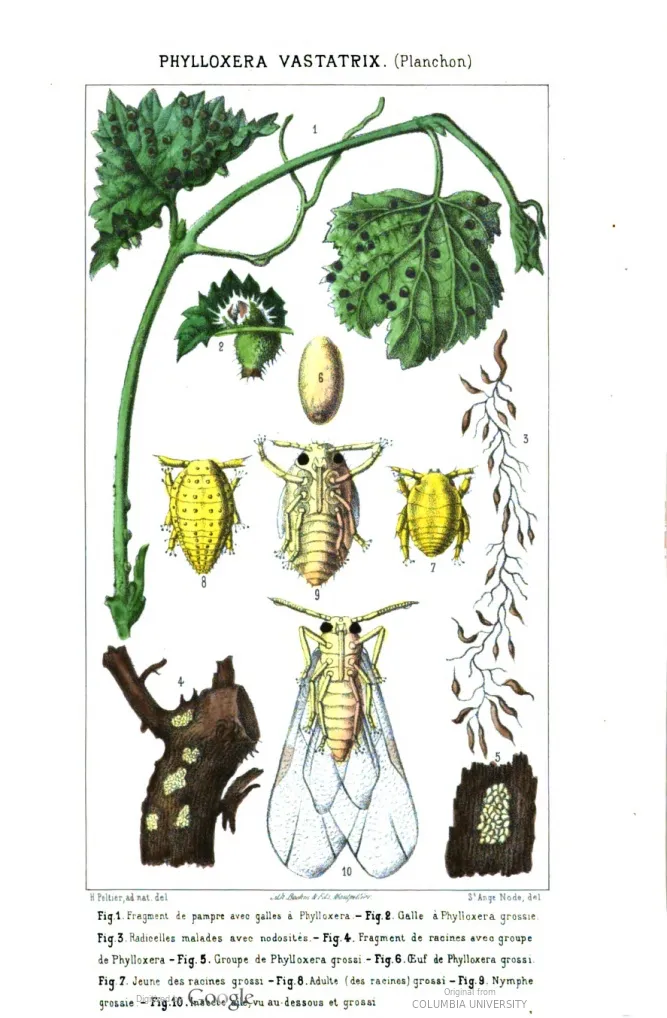
Phylloxera is a yellowish insect related to the aphids. The females pierce the roots and feed on their tissues; through the summer, several generations follow one another, breeding without mating.

On a European vine, feeding raises swellings on the young roots and lesions on the thick ones, where infections get in. The roots die, then the vine. Some American vines are attacked just the same, but form cork-like tissue around the wound and survive.

An 1872 plate showing phylloxera at several magnifications, winged and wingless females and swollen roots.
Phylloxera vastatrix, plate of 1872. Wikimedia Commons, public domain.

◇ Drawn after period plates

15 July 1868

How the insect got its name

The Hérault agricultural society sends a commission to Provence: the botanist Jules-Émile Planchon, Gaston Bazille and Félix Sahut. On 15 July 1868, on the Lagoy estate near Saint-Rémy-de-Provence, they dig up the roots of vines still green beside dead ones and find them covered with yellow insects.

In their first report the three name the insect Rhizaphis vastatrix; Planchon then uses Phylloxera vastatrix, “the devastator”. In 1870 the French entomologist Victor Signoret compares specimens sent from the United States by Charles Valentine Riley with those from French roots and concludes that they are the same species.

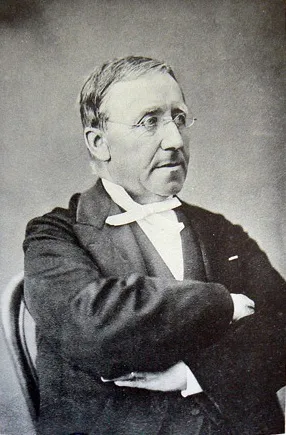
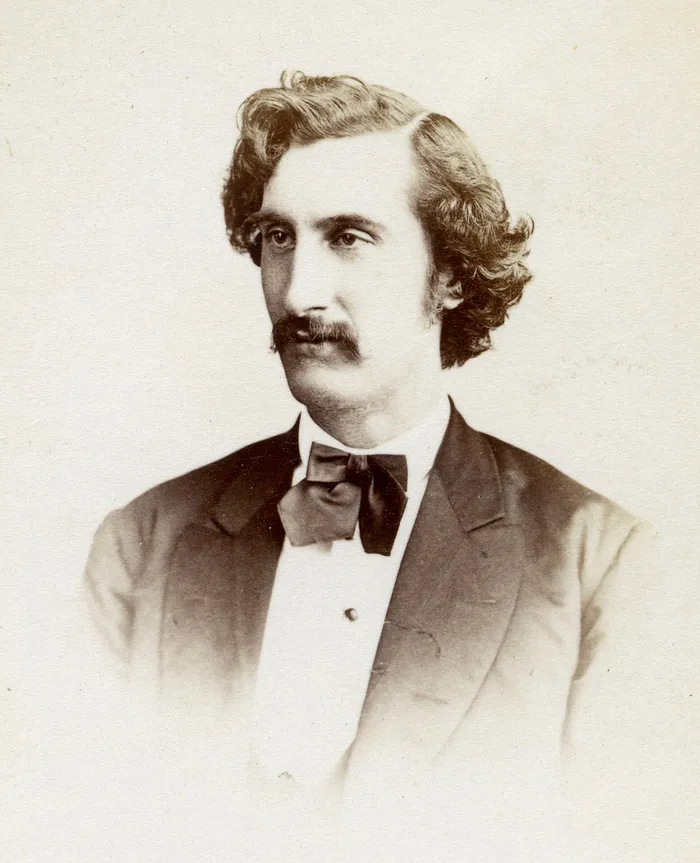
Photographic portrait of Jules-Émile Planchon.
Jules-Émile Planchon (1823–1888). Firmin Comte. Wikimedia Commons, CC BY-SA 3.0.

◆ Carton et al. 2007; Planchon 1876

1866–1878

Reports multiply across France

Over the next years, more and more wine districts report it: damage at Floirac, near Bordeaux, in 1866, Lunel-Viel in the Hérault in 1870, Cognac, where it was formally found in 1873, Beaujolais in 1874, Meursault in Burgundy in 1878.

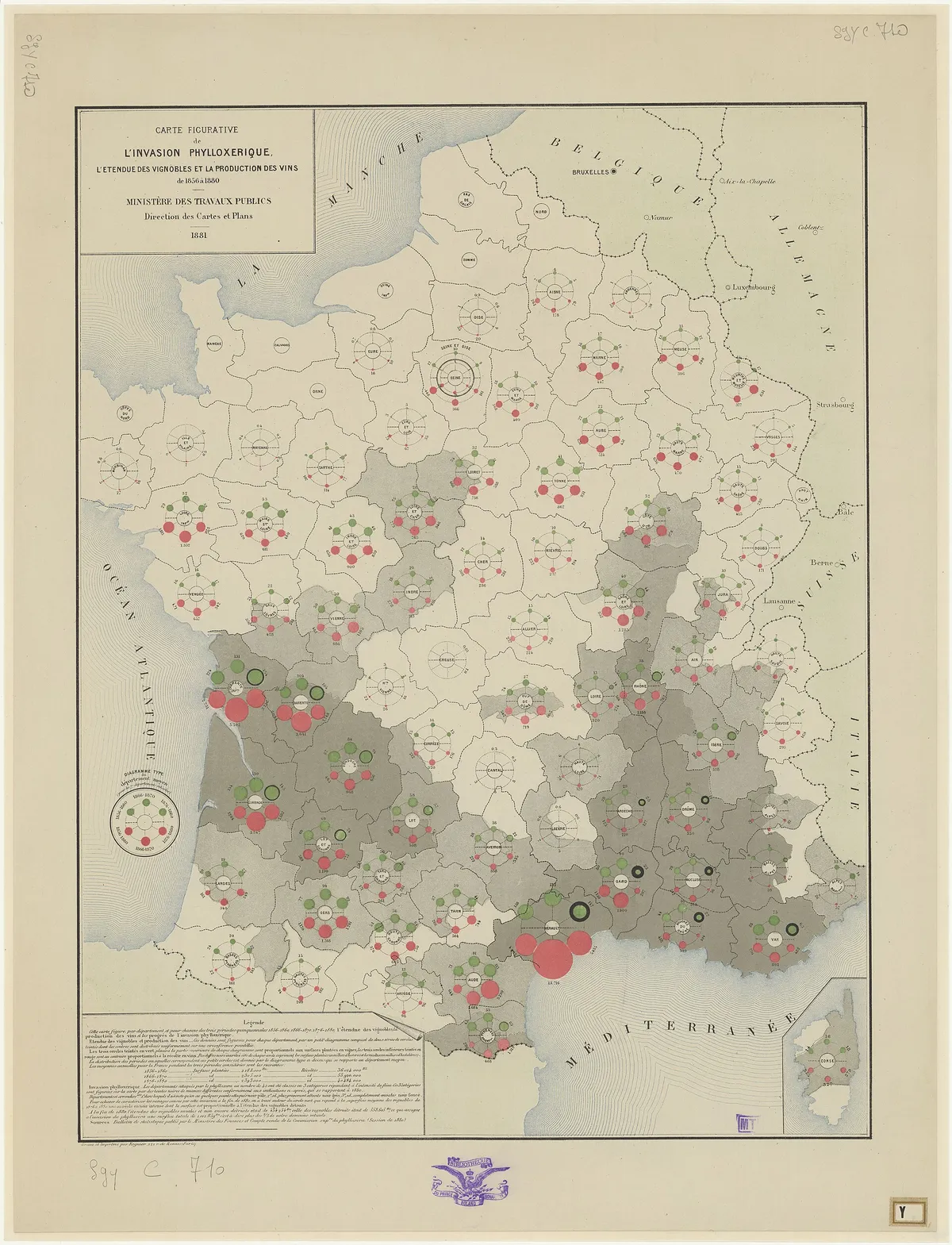
Phylloxera spreads locally, and infested vines sold by nurseries carry it far. In Alsace it turned up in 1876 at a nursery in Bollwiller; Planchon blamed vines brought from New York in 1863. The official map of 1881, below, shows the départements where the authorities had recorded it.

An 1881 map of France: départements coloured by the phylloxera invasion, with circles for vineyard area and wine output.
Ministry of Public Works map, 1881: the phylloxera invasion, vineyard extent and output, 1865–1880. BnF / Wikimedia Commons, public domain.

◆ Report dates: Académie des sciences, Planchon 1876, S2HNH

1875–1889

France’s wine output falls by 72%

In 1875 France produced 83.8 million hectolitres of wine, the highest in the NBER series. In 1889 output fell to 23.2 million hectolitres. The area under vines fell from about 2.5 million hectares in 1874 to 1.5 million in 1913.

◆ NBER; Carmona and Simpson

1870–1885

The 300,000-franc prize nobody won

In 1874 the French state raised to 300,000 francs its prize for an effective, cheap way to destroy the insect or stop its damage. The prize was never awarded.

A few methods worked, at a high cost and only in some places. Louis Faucon developed controlled autumn flooding of vineyards, repeated every year. Carbon disulphide injected into the soil near the roots reduced the infestation, but it was expensive and had to be repeated. And in the coastal sand at Aigues-Mortes the insect breeds poorly, so new vineyards were planted there, on the dunes.

◆ London Gazette 1874; Chaire UNESCO; Planchon 1876

1867–1886

Phylloxera spreads across Europe

The Douro in 1867, Klosterneuburg near Vienna in 1872, Geneva in 1873, Bonn in 1874, Pančevo, then in Hungary, in 1875, Málaga in 1878, Lombardy, where it was confirmed in 1879, Crimea and Arad in 1880. Several early outbreaks were found at places that collected vines, such as the wine school at Klosterneuburg or the nursery at Bollwiller.

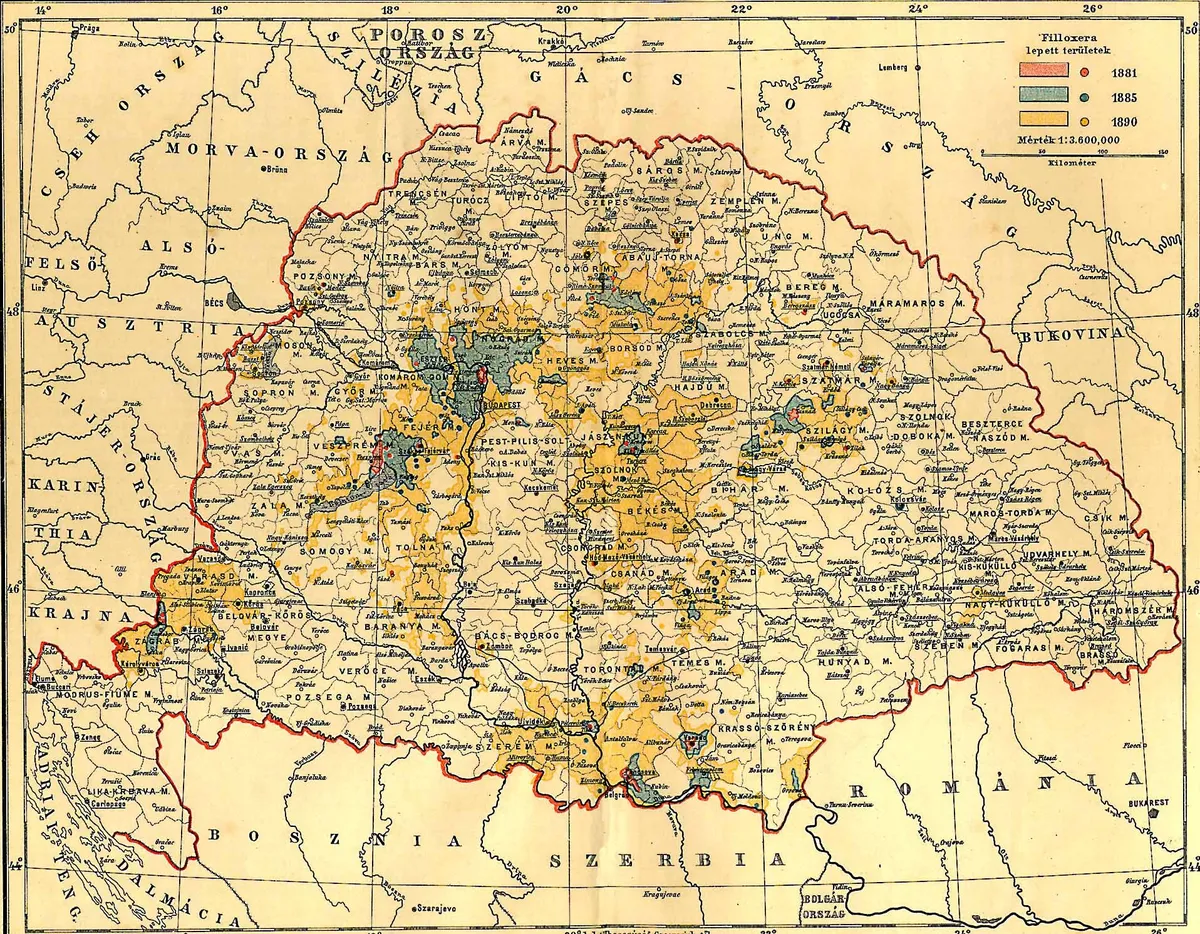
Governments restricted the movement of vines and sent commissions, but the insect kept spreading. Hungary printed phylloxera maps like this one, from 1890.

An 1890 map of Hungary with the areas hit by phylloxera coloured in.
Phylloxera map of the Kingdom of Hungary, 1890. Wikimedia Commons, public domain.

◆ Dates: the table at the end, with a source for every row

1880–1886

Arad, Dealu Mare, Teleșeu

In what is now Romania, phylloxera was first reported in Arad on 26 July 1880, in a vineyard in the town, according to a 1980 article in the Arad newspaper Flacăra Roșie; Arad was then in Austria-Hungary. In the Kingdom of Romania it was reported in 1884 in the Dealu Mare wine district, at Chițorani. In 1886 it was reported at Teleșeu, near Orhei, in Bessarabia.

Twenty-one years separate the report at Pujaut from the one at Chițorani, and the two places are about 1,700 km apart. Vidin, across the Danube in Bulgaria, and Tokaj in Hungary were hit in the same few years. Growers then rebuilt their vineyards with grafted vines.

◆ ONVPV; Flacăra Roșie 1980; IBN Moldova

1873–1890

Phylloxera beyond Europe

Infested vines carried phylloxera to other continents too. Sonoma, California, in 1873, where European vines planted by settlers died as they had in France. Geelong, Australia, where it was identified in 1877. Tlemcen in French Algeria in 1885, and Istanbul, where it was observed in 1885 and officially recognised in 1886. Mowbray, near Cape Town, in 1886. Whangārei, New Zealand, in 1890.

Some outbreaks came with vines shipped from Europe: in Argentina, for instance, a historical account cited by a genetic study describes plants arriving from Marseille in 1878.

◆ UC 1903; NSW DPIRD; Péringuey; Arancibia et al.

1871–1887

Grafting onto resistant American vines

Gaston Bazille, one of the three men who found the insect, was among the first to try grafting French varieties onto American vines, from 1871. The American entomologist Riley, who visited Montpellier in 1871, backed the use of resistant American vines. At Montpellier, Planchon, Bazille, Sahut, Foëx and local growers turned grafting into a method.

One problem remained: many American vines grow poorly in the chalky soils of Cognac or Champagne. In 1887 Pierre Viala went to the United States. In Texas, the viticulturist Thomas Volney Munson helped him find and obtain vines. Viala recommended Vitis berlandieri, V. cinerea and V. cordifolia for chalky soils; V. berlandieri became a parent of important rootstocks.

Photographic portrait of Charles Valentine Riley, around 1871.
Charles Valentine Riley, c. 1871. Maull & Co. Wikimedia Commons, public domain.

◆ Legros 2005; Sorensen et al.; Viala’s report, 1887; Grayson College

1880s–1890s

Two plants, one vine

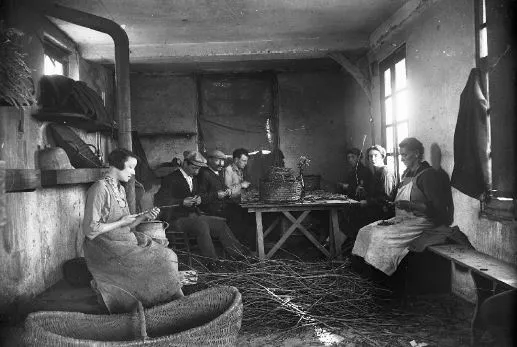
Grafting meant rebuilding vineyards vine by vine. The rootstock forms the roots; the scion grows the shoots, leaves and grapes. The variety keeps its identity, Pinot noir or Tempranillo, though the rootstock can affect growth and ripening.

The photograph from 1903 shows workers grafting vines at a bench, in a workshop. With the American vines came downy mildew, another American disease, reported in France in 1878. In 1885 Millardet and Gayon presented the final formula for Bordeaux mixture, copper sulphate and lime.

A 1903 photograph: workers grafting vines at long benches in a workshop.
A grafting workshop, 1903. Photograph by Ronco Frères. Wikimedia Commons, public domain.

◇ Drawn · ◆ INRAE

1878–1911

Spain, hit slowly, from several outbreaks

As French output fell, Spain sold more wine to France. Phylloxera was identified near Málaga in 1878 and in the Empordà in 1879, but reached the centre slowly: Gelida in the Penedès in 1886, Jerez in 1894, Rioja in 1899, and Valdepeñas, in the south of La Mancha, only in 1911.

On the map, Rioja has the densest vine rows in the whole European Union.

◆ Piqueras, Cuadernos de Geografía

1890–1913

Vineyards rebuilt on American rootstocks

In 1900 France produced 67.4 million hectolitres of wine, but output still swung from year to year: in 1902 it was 39.9 million. By 1913 France had about 1.5 million hectares of vines, and grafting had become the main way of rebuilding vineyards.

On the globe the rows turn green: an illustration of replanting on grafted vines, not a measured year for each region. Researchers estimate that more than 80% of the world’s vineyards now use grafted vines.

◆ NBER; Carmona and Simpson; Eurostat; ISHS

1935 – today

The “direct producers”

Some growers planted American vines or hybrids on their own roots and made wine straight from their grapes: the “direct producers”. Their resistance to phylloxera varied. Among them were Noah, Isabelle, Othello, Clinton, Jacquez and Herbemont.

A French decree of 18 January 1935 restricted these six varieties. EU rules still do not allow them to be classified for wine production, but do not require grubbing up areas used only for the grower’s household. In Romania, Law 164/2015 limits their wine to household consumption, wine-derived alcohol or wine vinegar. In Moldova the ministry estimated about 5,000 hectares of Isabella and Noah in July 2025. In Austria’s Burgenland, Uhudler is made from several American varieties; in north-east Italy, Fragolino was traditionally made from Isabella.

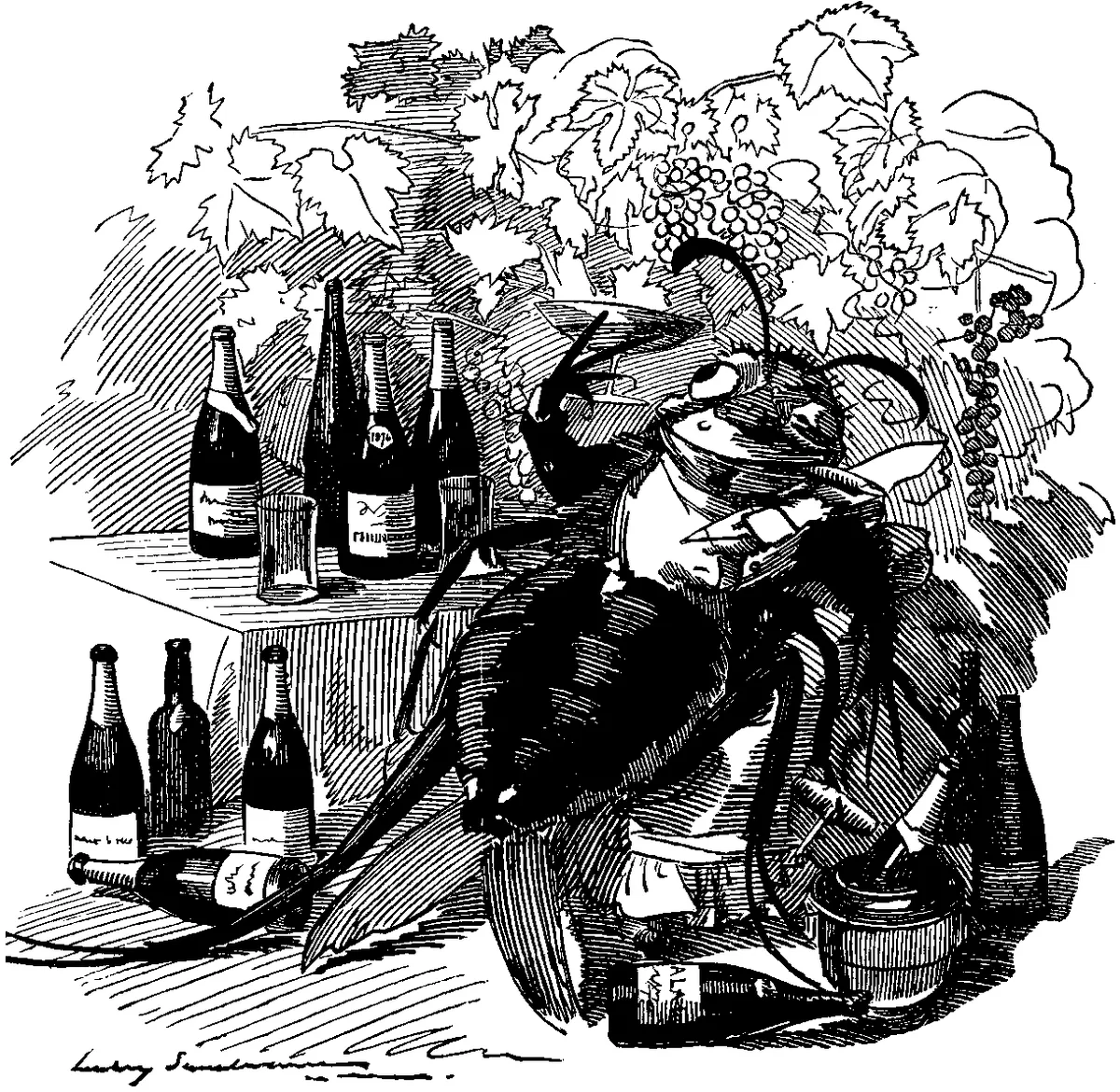
Punch cartoon, 1890: an insect in a top hat tasting wine from a glass, with bottles and casks around it.
„The Phylloxera, a true gourmet”, Edward Linley Sambourne, Punch, 6 September 1890. Wikimedia Commons, public domain.

◆ Annales des falsifications 1935; Reg. 1308/2013; Law 164/2015; MAIA

On their own roots

Vines that still grow on their own roots

Phylloxera has not been found in Chile, where ungrafted vines have a long tradition alongside grafted ones. Plant-health surveys in Cyprus have not detected it. On Santorini the vines grow on their own roots, and South Australia remains phylloxera-free.

Some vineyards survived on sand. At Colares, near Lisbon, the traditional sandy plots were largely spared: the cutting is planted in the soil beneath the layer of sand. In the Kunság, on the plain of central Hungary, the sandy vineyards were left almost untouched, and at Dăbuleni, in southern Romania, the old ungrafted Romanian vine survived on the sands.

◆ EPPO; Santorini PDO; DO Colares; Kunság PDO; Velcea 1975

July 2025

The Canary Islands, 2025

Until 2025 phylloxera had never been found in the Canary Islands, which have had strict rules on plant imports since 1987. On 30 July 2025 the authorities found it at Valle de Guerra, on Tenerife, and Spain’s national reference laboratory confirmed it on 12 August.

In 2026 the authorities made 5,429 checks across the islands and found the insect at 16 sites, all abandoned plots in the outbreak zone on Tenerife; no other island has it. They are working to eradicate the outbreak. Where phylloxera is established, growers protect new plantings with resistant rootstocks.

◆ Gobierno de Canarias, 13 August 2025 and 21 August 2026

Today

When phylloxera reached your region

Choose one of the European Union’s 132 statistical regions with vines: see the report used for it on the map, the distance from Pujaut and the vineyard area recorded by Eurostat. In 2020 the European Union had 3,194,614 hectares of vines.

Or tap a region on the globe.

◆ Eurostat 2020; the table of reports

How to read the map

The hatching is today’s vineyards. For each of the 132 European Union regions with more than 50 hectares of vines, the spacing of the rows shows how much of the region’s area is under vines, from Eurostat’s 2020 survey: dense rows in La Rioja, where vines cover 9.4% of the region, sparse ones in the north. The rows are a drawn symbol; the exact place of each vineyard inside a region is not on the map.

The colour changes in the year of the phylloxera report used for the region. For 43 regions that year comes from a report made inside the region; for the other 81, from the nearest dated report in the same country, and the region search says which one. The dots are the 75 reports in the table that have a place; the locations are approximate. The roots, the graft, the routes across the ocean and the greening at the end are illustrations, not measurements.

Where and when phylloxera was reported: all 76 records

Each row gives the place, year and source of a report. Where sources separate first symptoms, identification and official recognition, the note in brackets says what the year marks. Places where it was not detected in that era, according to the sources read: the traditional sandy plots at Colares, Santorini (Greece), Cyprus (Cyprus), South Australia (Australia), Chile (Chile).

YearPlaceCountry todaySource
1863Pujaut, Gard (first symptoms; date sometimes queried)FranceLe phylloxéra, dates repères
1865Saint-Rémy-de-Provence (symptoms, dated retrospectively)FranceLe phylloxéra, dates repères
1866Bordeaux (Floirac) (damage reported)FranceLe phylloxéra, dates repères
1866Châteauneuf-du-PapeFranceAcadémie des sciences, Phylloxera vastatrix, Enquête 1873–1878
1867DouroPortugalA filoxera na viticultura nacional
1870Lunel-Viel, HéraultFranceLe phylloxéra, dates repères
1871NarbonneFranceLa filoxera en España y su difusión espacial, 1878–1926
1872KlosterneuburgAustriaMitteilungen Klosterneuburg 65, Weiss
1872Madeira (official verification)PortugalElucidário Madeirense, Filoxera
1873Cognac (formal discovery)FranceLa Question du Phylloxéra en 1876
1873Geneva (Pregny)SwitzerlandDie Reblaus und die Versuchsstation für amerikanische Reben in Twann
1873SonomaUnited StatesThe Grape Phylloxera in California, UC Agricultural Experiment Station
1874BeaujolaisFranceAcadémie des sciences, Phylloxera vastatrix, Enquête 1873–1878
1874Bonn (Annaberg)GermanyArchivalien zur Geschichte des sächsischen Weinbaus
1874ForezFranceAcadémie des sciences, Phylloxera vastatrix, Enquête 1873–1878
1874Ica (retrospective account)PeruUniversidad Católica de Santa María thesis on Peruvian wine history
by 1874Vienne–AmpuisFranceAcadémie des sciences, Phylloxera vastatrix, Enquête 1873–1878
1875MâconnaisFranceAcadémie des sciences, Phylloxera vastatrix, Enquête 1873–1878
1875PančevoSerbiaMagyar Néprajzi Lexikon, Filoxéra
1875PrekmurjeSloveniaVinogradništvo, Andrej Dular, Slovene Ethnographic Museum
1876Alsace (Bollwiller)FranceHistoire de la lutte contre les maladies de la vigne en Alsace
by 1876CorsicaFranceLa Question du Phylloxéra en 1876
1876OrléansFranceLa Question du Phylloxéra en 1876
1877Geelong (identification)AustraliaGrape phylloxera pest information, NSW DPIRD
1878Buenos Aires (infested plants distributed in the province)ArgentinaGrape phylloxera in Argentina, Arancibia et al.

Share the story

If you chose a region, the shared link opens the map with that region selected.

More projects

Sources

The data, period documents and studies behind every number. The years of the first reports, each with its source, are in the table above.

  1. Eurostat, area under vines by NUTS 2 region (vit_t1), 2020; 2015 where 2020 is missing ec.europa.eu
  2. Eurostat GISCO, NUTS 2021 region boundaries gisco-services.ec.europa.eu
  3. Natural Earth, land and borders 1:50m (via world-atlas) www.naturalearthdata.com
  4. NBER Macrohistory, wine production in France, 1830–1938 (FRED A01027FRA413NNBR) fred.stlouisfed.org
  5. Société d’Horticulture et d’Histoire Naturelle de l’Hérault, Le phylloxéra, dates repères s2hnh.org
  6. J.-É. Planchon, La question du phylloxéra en 1876 (Revue des Deux Mondes) fr.wikisource.org
  7. Académie des sciences, Phylloxera vastatrix. Enquête 1873–1878 upload.wikimedia.org
  8. Y. Carton et al., La découverte du Phylloxéra en France (2007) zoologie.umons.ac.be
  9. Chaire UNESCO Culture et traditions du vin, Le phylloxéra en Bourgogne chaireunesco-vinetculture.ube.fr
  10. J. Piqueras, La filoxera en España y su difusión espacial, 1878–1926 www.uv.es
  11. Treccani, Fillossera (Enciclopedia Italiana) www.treccani.it
  12. ONVPV, Dealu Mare PDO specification (Chițorani, 1884) onvpv.ro
  13. Flacăra Roșie (Arad), 7 August 1980 (Arad, 1880) digital.bibliotecaarad.ro
  14. Secvențe din istoria cercetării filoxerei viței-de-vie (Teleșeu, 1886) ibn.idsi.md
  15. M. Weiss, Mitteilungen Klosterneuburg 65 (2015) www.weinobst.at
  16. Ulrich, Archivalien zur Geschichte des sächsischen Weinbaus (Annaberg, 1874) geschichte-des-weines.de
  17. Területfejlesztés és Innováció 2013 (Tokaj, Balaton) real-j.mtak.hu
  18. UC Agricultural Experiment Station, The Grape Phylloxera in California (1903) upload.wikimedia.org
  19. NSW DPIRD, phylloxera history in Australia www.dpird.nsw.gov.au
  20. L. Péringuey, A Note on the Phylloxera Vastatrix at the Cape upload.wikimedia.org
  21. P. Viala, report of the mission to the United States, 1887 pandor.u-bourgogne.fr
  22. Grayson College, T. V. Munson Viticulture and Enology Center www.grayson.edu
  23. G. Gale, Dying on the Vine (University of California Press, 2011)
  24. B. Tello et al., Scientific Reports (2019) www.nature.com
  25. J. Carmona, J. Simpson, French vineyard area, 1874 and 1913 isnie-archive.sioe.org
  26. ISHS, Acta Horticulturae 1136 (more than 80% of vineyards worldwide grafted) www.ishs.org
  27. INRAE, Millardet and Gayon (1885) sante-agroecologie-vignoble.bordeaux-aquitaine.hub.inrae.fr
  28. Annales des falsifications, January 1935 (decree of 18 January 1935) pandor.ube.fr
  29. Regulation (EU) 1308/2013, Article 81 eur-lex.europa.eu
  30. Romania, Law 164/2015 on vines and wine www.onvpv.ro
  31. MAIA (Republica Moldova), July 2025 maia.gov.md
  32. Santorini PDO, single document (OJ C 143, 2022) eur-lex.europa.eu
  33. DO Colares, specification www.ivv.gov.pt
  34. Kunság PDO (OJ C 171, 2020) eur-lex.europa.eu
  35. EPPO Global Database, Daktulosphaira vitifoliae gd.eppo.int
  36. Vinehealth Australia vinehealth.com.au
  37. Gobierno de Canarias, 13 August 2025 www3.gobiernodecanarias.org
  38. I. Velcea et al., Geografia economică a României (1975), Dăbuleni www.biblioteca-digitala.ro
  39. J.-P. Legros, Les américanistes du Languedoc, 1868–1893, Etude et Gestion des Sols (2005) maisons-champagne.com
  40. Gobierno de Canarias, order of 20 August 2025 www.gobiernodecanarias.org
  41. London Gazette, 7 August 1874 (the French prize) www.thegazette.co.uk
  42. W. C. Sorensen et al., Charles V. Riley, France, and Phylloxera www.researchgate.net
  43. Arancibia et al., Grape phylloxera in Argentina onlinelibrary.wiley.com
  44. Gobierno de Canarias, 21 August 2026 www3.gobiernodecanarias.org
  45. Wikimedia Commons: archival images, author and licence in each caption commons.wikimedia.org