Step 1 of 6 · 90°
Four spokes
A quarter turn. Every fourth seed lands on the same ray: 4 straight arms with wide gaps between them.
Sunflower · spirals · 137.5°
A sunflower head packs up to 2,000 tiny flowers by a single geometric rule: in the model, each new one appears at 137.5° from the previous. The rule lays the seeds out in spirals of 34 and 55 — and when a study counted the spirals on 657 flowers, nearly one count in five came out non-Fibonacci. Below, grow your own flower from its angle and count the spirals on a real photograph.
Grow the flower Skip to the photograph
Simulation from Vogel's 1979 recipe · Sources at the end

The head in the photograph is an inflorescence: a whole bouquet crammed onto a single plate.
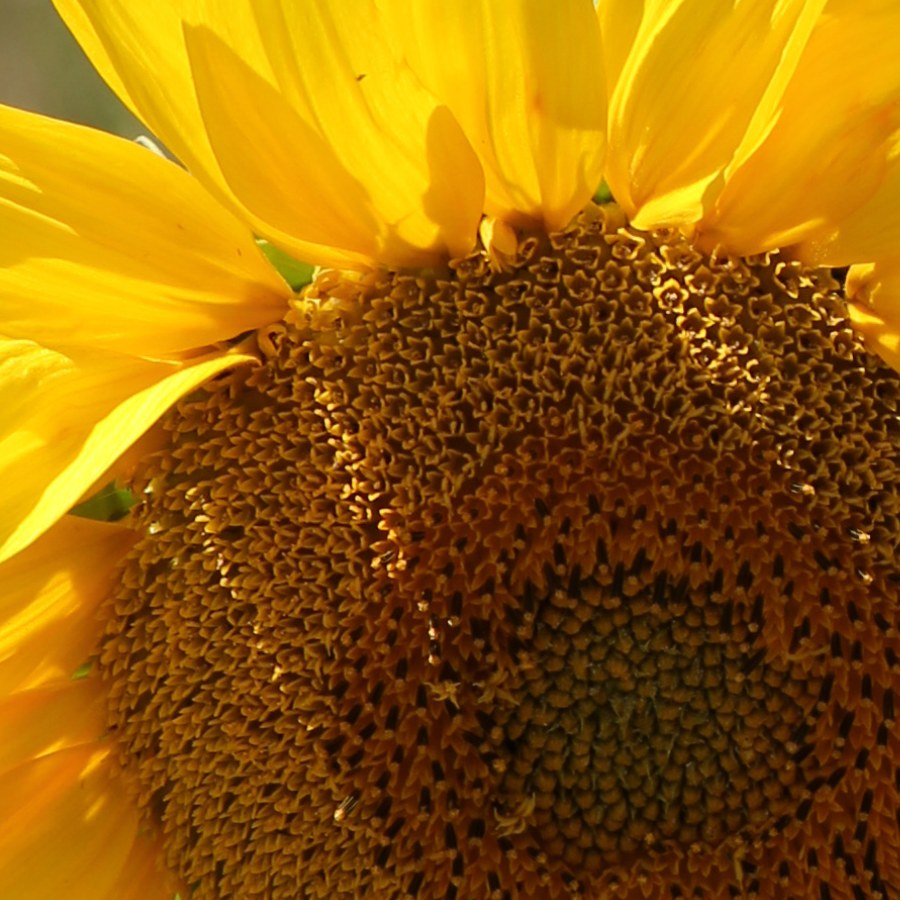
The centre is packed with tiny flowers, each with a single ovary that can make one seed. When the plant carries several heads, each holds far fewer.
The yellow rim is made of flowers too, but ones that make no seeds.
The tubular flowers bloom in turn, from the outside in: the oldest sit at the rim, the buds at the centre.
And the yellow “petals” are usually about 21: a 1976 study counted them on 1,002 heads, and the distribution clusters around 21.
The recipe is two lines (Vogel, 1979): seed number n sits at angle n × 137.5° and at distance √n from the centre. The phenomenon is called phyllotaxis — “leaf arrangement”. Scroll to see what other angles produce — the picture is the model, not a photograph.
angle = n × 137.5°distance = √nn counts the seeds from the centre outward — the reverse of their age.
Step 1 of 6 · 90°
A quarter turn. Every fourth seed lands on the same ray: 4 straight arms with wide gaps between them.
Step 2 of 6 · 137.143°
Exactly 8/21 of a turn. Every 21st seed lands on the same ray: 21 straight arms. Any simple fraction of a turn makes spokes.
Step 3 of 6 · 137.3°
Two tenths below Vogel's value, the arms all bend one way, with empty lanes opening between them.
Step 4 of 6 · 137.5°
Here the seeds settle evenly, with no lanes. The middle panel of Prusinkiewicz and Lindenmayer's classic triptych: 137.3°, 137.5°, 137.6°.
Step 5 of 6 · 137.508°
360° divided by the square of the golden ratio. It is irrational, so it never lands on exact spokes, and it is hard to approximate with simple fractions. This is where the spirals of 34 and 55 live.
Step 6 of 6 · 137.6°
A tenth above, the arms bend the opposite way. Tenths of a degree decide everything.


Every picture above comes from the same recipe with a different angle: a geometric model of how the seeds sit.
Now you drive. Nudge the angle by tenths and watch what happens; then paint the spiral families and count the arms one by one.
Paint the family of
The slider moves in thousandths of a degree; the buttons jump to the story's values.
For the 55 and 89 spirals to show, the angle must sit between 137.45° and 137.53° — a tolerance of one part in 1,869. (Ridley, quoted by Prusinkiewicz and Lindenmayer.) Computed on the model, like the rest.
The model is lovely, but it is a model. The photograph is a real head, from the 657-flower study (Swinton et al., 2016). Count the spirals toward the rim, both ways — as the researchers did — and write down the two numbers.
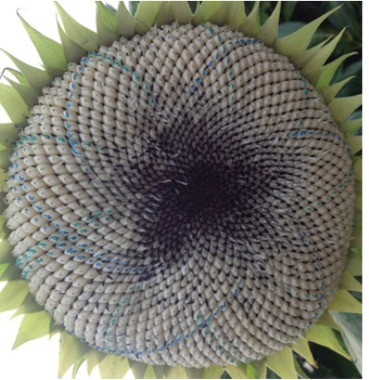
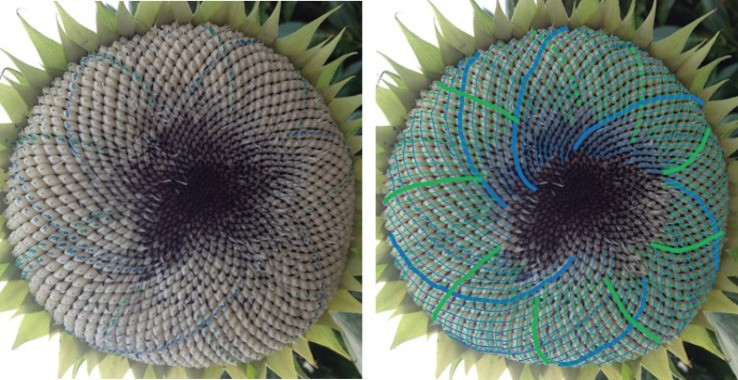
Old textbooks say the spirals are always Fibonacci numbers. The 2016 study checked on 657 flowers — and nearly one count in five came out different.
Of 768 photograph-verified counts, 632 had Fibonacci structure (82%) — and 136 (18%) did not. It was the first systematic publication of heads without Fibonacci structure.
One below beats one above: 49 counts sat one below a Fibonacci number, only 17 one above (p = 3.3×10⁻⁵). The count of 54 appeared more often than 47, the commonest Lucas count.
By pairs — one count each way on the same head — 245 of 368 (66.6%) were Fibonacci both ways. The rest split between Lucas with Lucas (16), double with double (11) and all kinds of mixtures.
Two brand-new pairs: (73, 45) on flower 113 and (69, 112) on flower 669, from the F5 and F8 sequences — the first reported in sunflowers. Plus “quasi-regular” heads, where no number could be assigned at all.
Before that, as far as the study's authors knew, nobody had systematically published a non-Fibonacci head: Weisse (1897) and Schoute (1938) had counted 459 together without reporting one — and without describing their method.
Geography, growing conditions and variety showed no significant effect. The authors conclude that models with noisy development “may be both necessary and testable” — and their paper is a testbed for them.
How does the plant know the angle? In 1992, two physicists showed that at least in a dish of oil, nobody needs to know it: it appears on its own.
Douady and Couder dripped ferrofluid drops into a dish of oil inside a vertical magnetic field. Each new drop became a small magnet, slid from the centre toward the edge and repelled the others. The outward drift stood in for growth; the rhythmic dripping, for the birth of flowers.
Nobody programmed any angle. Yet as the dripping quickened, the angle between drops closed in on 137.5°: at 139°, Fibonacci pairs (5, 8) appeared in the dish — “strikingly similar to a very usual organization observed in botany”. In the simulation, the angle settled at 137.47°, with the pair (13, 21).
The dish's moral: each new drop squeezes into the largest gap left. It is the same assumption as in Vogel's recipe — each new flower seeks the largest gap — and in the dish it yields, on its own, something very close to the golden angle. The dish does not prove the plant does the same. And when conditions shifted abruptly, the dish also produced the Lucas mode (11, 18), at 99.49°.
In 2024, Romania harvested sunflowers from 1,243,250 hectares — more than any other EU country (EU total: 4,791,220 ha). That is nearly 26%, about a quarter of the EU's area. Next came Bulgaria with 929,150 ha.
But the harvest was much smaller: 1,508,000 tonnes, against 2,015,620 in 2023 — about 1.21 tonnes per hectare. By volume, Hungary led the EU in 2024 (1,798,950 t). The largest area does not automatically mean the largest harvest.
It is October: dry heads still stand on stalks or in sheds. Take one, count the spirals toward the rim both ways as you learned above, and compare with the study's numbers: 34 with 55, the usual pair — or 54, 47, uncountable, like the exceptions.
Six questions from the page. The answers are above, sources included.
1 What angle separates two consecutive seeds in Vogel's recipe?
2 What does the model show between 137.3° and 137.6°?
3 How many straight arms does the model make at exactly 8/21 of a turn?
4 How many of the 768 verified counts had no Fibonacci structure?
5 Which deviation was more common?
6 What share of the EU's sunflower area does Romania grow?
No. It is an inflorescence: up to 2,000 tiny tubular flowers in the middle — each can make one seed — plus a rim of sterile flowers that look like petals.
The model that explains it best: each new flower seeks the largest gap, and the angle that rule yields — the golden angle, 360° divided by the square of the golden ratio — is irrational and hard to approximate with simple fractions. Simple fractions make spokes; it lands on none.
No. In the 2016 study, 136 of 768 verified counts (18%) had no Fibonacci structure — and some heads could not be counted at all.
Toward the head's rim, both ways, following each spiral family to its end. That is how the study's 657 flowers were counted, with guides drawn on the photographs.
For the 55 and 89 spirals to show, the angle must sit between 137.45° and 137.53° — a tolerance of one part in 1,869. In the model; the plant keeps no accounts — the geometry does.
In 2024: 1,243,250 hectares, nearly 26% of the EU area — more than any other member state, according to Eurostat.
The simulator is Vogel's 1979 recipe: seed n at angle n × α, distance √n. The default head has 500 seeds; the colours show age (dark at the centre, gold at the rim), and the painted families group every kth seed (every 34th, say). A geometric model of the arrangement.
The counting photograph is figure 6 of Swinton et al. 2016 (flower 095), shared CC BY 4.0; the clean half is the left of the composite, cut at the divider. The field photograph is George Chernilevsky, public domain.
The charted counts are the authors' photograph-verified ones (768), not the public's submissions; the classes and percentages come from the study's tables 1 and 3.
Areas and harvests come from Eurostat apro_cpsh1 (sunflower seed, I1120), pulled in October 2026; harvests are in EU standard humidity, and 2025 values are still provisional. The area is harvested area (excluding sown but unharvested parcels).
Vogel's assumptions — a fixed angle, the largest gap — have been criticised as insufficient (Ridley): where the plant's angle comes from stays debated.
The study's raw data — pictures, tables, analysis code — are public in Dryad (doi:10.5061/dryad.f9k77). The page reports the study; it does not re-analyse it.
What the page does not say: why any given head breaks the rule. The study found no effect of geography, conditions or variety; the cause of the exceptions stays an open question.
All links were checked at publication.