Marius Comper Română

Avdella · Ioannina · Bitola · 1898–1964

The Manaki brothersOne camera, seven armies and a grandmother at her spinning wheel

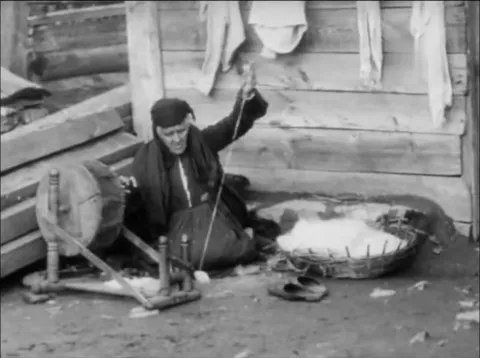
Probably in 1907, in an Aromanian village in the Pindus mountains, two photographer brothers turned a newly bought film camera on their grandmother. Despina was spinning wool. Turn the crank to play the film.

frame 1/91·0 frames a second
Turn the crank

The viewer uses 91 frames from a digital clip on Wikimedia Commons. Stardelov catalogues the original shot at 4.8 metres of film.

I · Avdella

A woman at her spinning wheel

Avdella was an Aromanian village of shepherds high in the Pindus mountains, in today's Greece, then part of the Ottoman province of Monastir. The Aromanians, also called Vlachs, speak Aromanian, an Eastern Romance language closely related to Romanian. Yanaki Manaki was born there in 1878 and his brother Milton in 1882 (Milton's gravestone says 1880). Their father, Dimitri, backed the Romanian-language schools that Bucharest paid for among the Aromanians of the Ottoman Balkans, and Yanaki attended them in Avdella and then the Romanian lycée in Bitola.

A portrait catalogued as 1898 shows their grandmother Despina. She appears spinning in the short film above and again in footage of the family's women preparing yarn. The same face, the same way of sitting. Published accounts give her age as 107, 113 or 114; her age at filming remains uncertain.

In 1898 Yanaki opened a photographic studio in Ioannina (Yanya), where he taught calligraphy and drawing at the Romanian school, and Milton joined him. According to Țuțui, in 1905, accused by the Greek press of Romanian propaganda and with Avdella burned, Yanaki had to leave Ioannina; the brothers settled in Bitola, where their studio on Širok Sokak opened in 1905 or 1906, depending on the source.

Left: Despina, glass-plate portrait, 1898. Right: a frame from the film.

Avdella after it was burned in 1905; Milton Manaki is among the people in the picture

II · 1905 or 1907

A theatre poster dates the trip to London

Encyclopaedias say 1905. The date comes from Milton's memories, told in old age. But among the glass plates in Bitola is one broken into five pieces and glued back together: a man in a bowler hat on a London pavement. It is Yanaki, outside the Criterion Theatre in Piccadilly.

Cătălin D. Constantin, a visual anthropologist at the University of Bucharest, enlarged the details of the posters visible between the cracks. Above the entrance is The Liars, Henry Arthur Jones's comedy, which ran at the Criterion from 13 April to 15 October 1907. Four minutes' walk away, at 48 Rupert Street, was Charles Urban's firm, which sold the Bioscope cameras.

If Yanaki bought the camera on that trip, the Despina film dates from 1907, as Țuțui and Emil Țîrcomnicu also propose. A 1907 letter from Yanaki confirms that he bought equipment abroad, but no receipt for the sale has been found. 1905 remains the traditional date; 1907 is the strongest candidate.

Another plate in the archive, described as Yanaki on the ship to London to buy the camera. The archive dates it 1905.

III · Camera 300

A camera with 300 engraved on its front

The camera survives at the Bitola branch of the State Archives of North Macedonia, in Fonds 580. It is a 35 mm Urban Bioscope in mahogany with a leather handle, sold by the Charles Urban Trading Company of London and built in Alfred Darling's workshop in Brighton. The front plate is engraved with the London and Paris shop addresses and the number 300. The top prize of the Bitola festival, the Golden Camera 300, is named after it.

It was cranked by hand. The manual recommended two turns of the crank a second, giving 16 frames a second; the speed at which each shot was actually filmed is unknown. Here, turn faster and the film plays faster; slower, and movement breaks into jerks.

Sixteen consecutive frames from the digital copy: at the recommended speed, roughly one second of film.

IV · Bucharest, 1906

The first time they saw moving pictures

In autumn 1906 the brothers travelled to Bucharest with an Aromanian delegation led by the poet Constantin Belimace, for the Romanian General Exhibition marking forty years of King Carol I's reign. Țuțui reports that their photographs received two gold distinctions and a silver, and that it was there, in Petre Ganciu's bioscope in the cinema pavilion, that they first saw moving pictures.

Milton's surviving papers include an exhibition diploma and a separate Carol I Jubilee Medal patent. Historians also report that the brothers were named photographers to the Romanian royal court and that Yanaki received a travel grant from the king, with which he would buy the camera. According to Țuțui, Yanaki gave the Romanian Academy five albums of photographs of Aromanian life, and the ethnographer Alexandru Tzigara-Samurcaș acquired Manakia photographs for the collection now held by the National Museum of the Romanian Peasant.

In April 1911 they filmed a Romanian delegation led by the academician Constantin I. Istrati visiting Bitola, Gopeš and Resen, where Ahmed Niyazi Bey, one of the leaders of the Young Turks, received them. Stardelov catalogues three surviving sections. Romania's National Film Archive holds the Romanian-intertitle version, A Trip to Turkish Macedonia, tentatively credited to Ion Voinescu until Țuțui showed in 1994 that it was the work of the Manaki brothers.

Yanaki Manaki before an audience with King Carol I, according to the archive, Bucharest, 1906
Exterior of the royal palace, Sinaia, 1906
Student orchestra of the Romanian high school in Bitola, 1905
Romanian visitors in Bitola (Monastir), identified in the archive as Constantin I. Istrati's delegation; the archive dates the plate 1908, Istrati's documented visit was in April 1911

V · Bitola, 1898–1944

Seven armies in one studio's archive

The brothers' studio stood on Širok Sokak, the main street of Monastir, today Bitola. In four decades the town changed hands again and again. The Manaki archive holds the Sultan, the rebels, the kings, and Ottoman, Serbian, Bulgarian, German, French, Russian and Italian soldiers, most of them photographed in Bitola. Pick a year to see who held the town and what survives on the plates.

Who held the town

19001910192019301940
  • Ottoman Empire
  • Serbia
  • Bulgaria
  • Entente
  • Kingdom of Serbs, Croats and Slovenes, then Yugoslavia
  • German and Bulgarian occupation
1898–1908

1898–1908

Abdul Hamid II's Monastir

The capital of an Ottoman province, with consulates, a garrison and the schools of rival nations. In 1904 the brothers photograph fighters from the Ilinden uprising in chains at the railway station, before they are taken to prison.

Panorama of the city of Bitola, about 1900
Ilinden fighters in chains at Bitola railway station, before transfer to prisons in Asia Minor, 1904
The Russian consul Nikolay in uniform, with his family, Bitola, 1905

VI · The studio

Rivals in front of the same camera

The brothers photographed people from rival movements, some in their Bitola studio and others on location. Many came after the 1908 revolution, when the bands that had fought in the mountains came down into town: a Greek guerrilla captain, voivodes of the Internal Macedonian Revolutionary Organisation, an Albanian band leader, Aromanian band leaders, the Ottoman governor, Ahmed Niyazi Bey, an Ottoman officer of Albanian origin, and later a Serbian chetnik. Tap a face to see who it is.

The captions reproduce the archive catalogue's identifications. Historians differ on the national affiliations of some of the people pictured.

VII · The films

42 films, nearly two and a half kilometres of film

The main surviving collection is held by the Cinematheque of North Macedonia in Skopje; Romania's National Film Archive holds two Romanian-intertitle versions. Igor Stardelov's catalogue lists 42 films and fragments, with listed lengths totalling 2,447 metres; the DVD edition runs to about 70 minutes. Each stripe below is one film, its width set by the length of the reel. The Aromanian village comes first, the Sultan in the middle, the kings at the end.

The 42 films in Stardelov's catalogue, by length

2,447 metres in all, by the lengths in the catalogue

  • Life in the Pindus
  • The 1908 revolution
  • The town
  • Ottoman army
  • Romanian delegation
  • The Sultan
  • Kings and armies
Fair at the church of St Nedela in Bitola, before 1912. A silent extract from the film.

VIII · The archive

A light table with 266 photographs

Stardelov's 2003 inventory lists 18,513 photographic units (glass plates, sheet film and roll film) and 17,854 prints, including 6,902 made later by the archive. A few hundred have been published on Wikimedia Commons in the public domain. Here are 266; the map shows 252 of them at 38 places identified in the catalogue. In 1905 most of these places were under direct Ottoman administration; today they lie in 6 countries.

Tap a place on the map or pick a theme. Plates marked with a crack are broken or damaged.

BitolaIoanninaAvdellaGopešBačDebarThessaloniki

IX · Kino Manaki

A cinema, then a fire

After rebuilding their studio in 1919, the brothers opened an open-air cinema on Širok Sokak on 26 August 1921. On 1 December 1923 they opened the purpose-built Manaki cinema, Kino Manaki. An orchestra sometimes accompanied silent screenings. It was not the town's first screen.

Business went badly, the hall was leased to others, and in 1939 it burned down, apparently from the projection booth. The rebuilt Kino Manaki opened on the same site on 26 August 2021, exactly a century after the brothers opened their outdoor cinema.

Construction of the Manaki cinema, Bitola, 1923
The Manaki brothers' cinema after the fire, Bitola, 1939

X · After

Two brothers, two cities

Yanaki settled in Thessaloniki in the 1930s (most probably in 1935, in other accounts 1939) and taught at the Romanian commercial school. Milton kept the studio in Bitola. The brothers wrote to each other on postcards; according to Țuțui, they never met again. Yanaki died in Thessaloniki on 19 May 1954. Țuțui writes that he died in grief: the Romanian schools in Greece had been closed, and his son had died young.

Milton kept photographing until 1963. In 1955 he sold the surviving films to the Archive of Macedonia, with a list of 67 entries; they later went to the Cinematheque. In 1958 Branko Ranitović made a documentary about him, Kamera 300. He died in Bitola on 5 March 1964 (some accounts say 6 March) and is buried in the town's Aromanian cemetery.

Yanaki Manaki with his wife Anastasia, Bitola, 1918–1941
Milton Manaki with his Indiana motorcycle and his dogs, Bitola, 1920

XI · Whose are they?

Six film traditions, two Aromanians

Reviewing Marian Țuțui's monograph, Mihai Fulger listed six film traditions that claim the Manaki brothers as their pioneers: Yugoslav, Greek, Macedonian, Turkish, Albanian and Romanian. Each rests on a real part of their lives.

  1. North Macedonia

    Bitola was the brothers' main professional base and remained Milton's home until his death. The plates and the camera are there, the films in Skopje. Since 1979 the town has held the festival that bears their name.

  2. Greece

    Avdella, their birthplace, is in Greece today. Yanaki died in Thessaloniki, where the Museum of the Macedonian Struggle has shown photographs from the family archive.

  3. Romania

    They attended Romanian-language schools and Yanaki taught drawing and calligraphy; historians report that they were named photographers to the royal court. The Romanian Academy and the Museum of the Romanian Peasant keep their photographs. The National Film Archive holds two of their films, with Romanian intertitles.

  4. Albania

    The Marubi Museum in Shkodër credits them with photographs of the 1908 Congress of Monastir and its alphabet commission. The congress endorsed two alphabets, a step towards a common Albanian script.

  5. Turkey

    They were Ottoman subjects and filmed the public life of the empire, including the Sultan's visit of 1911.

  6. Yugoslavia

    The Yugoslav state saved and duplicated their films and honoured Milton in his lifetime; in 1980 Yugoslavia issued a postage stamp in his honour.

They were themselves Aromanians. On Milton's grave, an inscription in Aromanian was later added to the one in Macedonian.

Share

Sources

Photographs and film clips are reproduced from Wikimedia Commons; each file page lists its source and public-domain status. The captions were rewritten from the archive's descriptions. Where the sources disagree on a date, the text names both.

  1. Igor Stardelov, Manaki, Cinematheque of North Macedonia, Skopje, 2003 (catalogue of the 42 films with lengths; inventory of the photographs). manu.edu.mk
  2. Marian Țuțui, “The Manakia Brothers and Bitola Are Back in the News”, Studii și cercetări de istoria artei. Teatru, muzică, cinematografie, 2021–2022. www.scia.istoria-artei.ro
  3. Cătălin D. Constantin, “The man in front of the theatre. London, 1907”, Beyond Yesterday. beyondyesterday.org
  4. Dimitar Gjorgievski, “Camera 300”, Makedonski Arhivist 31–32, State Archives of North Macedonia, 2022, pp. 81–90. arhiv.mk
  5. Nikolaos Siokis, study of the Manaki brothers' identities, Society for Vlach Studies (EEMPV). eempvlachon.com
  6. Maša Guštin, “The Manaki Brothers. The Chroniclers of the ‘Third’ Europe”, Panoptikum, 2023. czasopisma.bg.ug.edu.pl
  7. Emil Țîrcomnicu, archival study of Ioan D. Manakia, Anuarul Institutului de Etnografie și Folclor “C. Brăiloiu” 30, 2019. biblioteca-digitala.ro
  8. Mihai Fulger, review of Marian Țuțui's monograph (claimed by six national cinemas), LiterNet. agenda.liternet.ro
  9. Ottoman Archives, itinerary of Sultan Mehmed V in Macedonia, 1911. www.devletarsivleri.gov.tr
  10. Marubi National Museum of Photography, exhibition “Janaki and Milton Manaki”, 2023. marubi.gov.al
  11. ICFF Manaki Brothers, festival history. manaki.com.mk
  12. Photographs: uploaded to Wikimedia Commons by the State Archives of North Macedonia (public domain). commons.wikimedia.org
  13. Film clips: Wikimedia Commons copies of material from the Cinematheque of North Macedonia's collection. commons.wikimedia.org
  14. Maps: Natural Earth (today's borders); place coordinates: Wikidata. www.naturalearthdata.com
Page on Wikimedia Commons