This browser cannot draw the relief, so the globe is shown flat. The data, the text and the lookup below are unchanged.
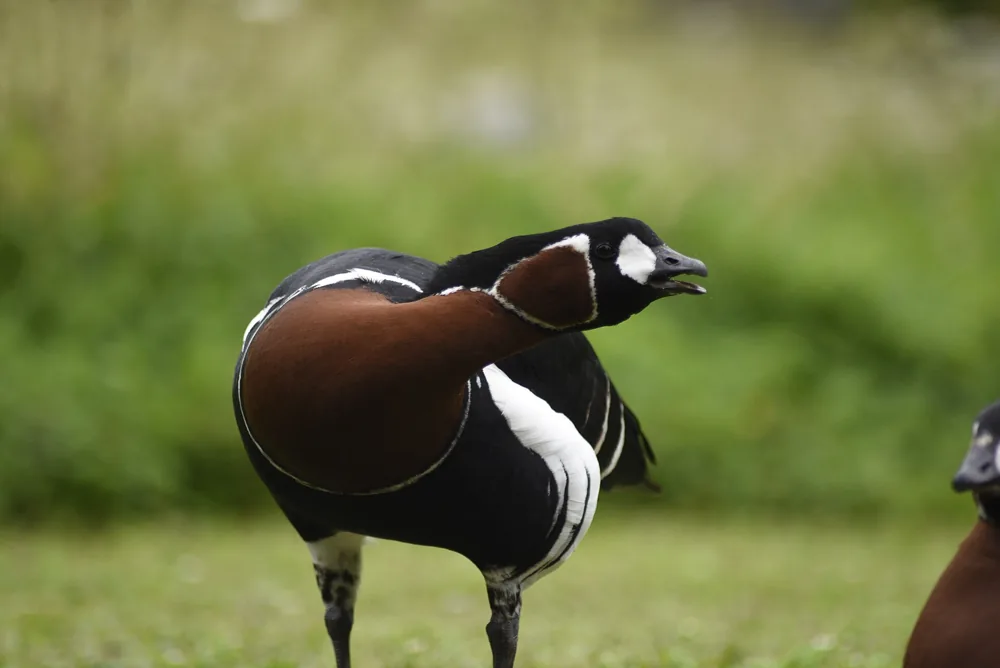
Red-breasted goose · Branta ruficollis
The goose that winters here
Each autumn this small goose, with a rust-red breast, leaves the Arctic tundra for the fields of south-east Romania. Two tagged birds flew 5,420 and 5,847 km to get here. Over 2012–2022 Romania held, on average, almost 30% of the world's red-breasted geese in winter.
SCROLL
Where people have seen it, month by month
Each square is 1° of latitude by 1° of longitude, about 110 km from south to north, where someone logged a red-breasted goose in that month. Brighter means more different years. In July the squares sit on the tundra of Taymyr. In March they gather on the steppe between the Black Sea and the Caspian. By January they cover the coast of the Black Sea.
The grey-blue squares in western Europe lie off the flyway and are crowded with watchers. The map shows where people looked, not how many geese there are.
77,001 dated records with coordinates from GBIF, mostly from this century: eBird, Observation.org, iNaturalist and a few others.
A male leaves the Pyasina delta on 1 September
His satellite tag logged 61 days and 5,847 km to the lower Danube. He rested 30 days at one lake system in Kazakhstan, then crossed to the Caspian Sea and flew the last 2,050 km to Romania.
Dates and distances come from the paper's table. The line between the named places is our drawing, with our own approximate placement by region; the distances and dates are the paper's. The place where he landed in Romania is shown only as a region.
A female takes 80 days
She left Taymyr on 2 September and spent 23 days around the Gydan peninsula, 18 at the Zharkol lakes in Kazakhstan, 12 at a second lake system and 13 at a reservoir in southern Russia. She reached the Danube Delta region on 20 November, after 5,420 km.
Which winter were you born in?
The geese spend November to March on the fields of south-east Romania. Type your birth month and year to see how many were counted that winter.
Twenty-two winters, and why we draw no trend
Romania's national action plan (2022) prints one number per winter, the highest count, from 2000/01 to 2021/22: from 752 to 23,641. It is the longest list we found. But the plan says the monitoring scheme was improved along the way, and its last five winters equal Romania's highest figure in the coordinated weekend counts of Iliev et al. A second compilation with one fixed protocol of synchronised counts (Todorov et al.) covers ten winters and gives other totals: 22,149 against 15,330 in 2016/17, 16,624 against 12,726 in 2017/18. Our reading, not the plan's: very low early winters, such as 752 in 2002/03, may reflect where observers could look.
At least 15 winters counted by one method. Not met. There are 22 winters, but at least two counting schemes sit inside them. So this page draws no trend line and claims no decline or recovery from these counts. The plan itself reports a long-term decline since 1990 of 13 to 38% from its own analysis; we could not check it.
- highest count per winter (dots), national plan
- highest synchronised monthly count, Todorov et al.
- same as Romania's highest figure in the coordinated weekend counts, Iliev et al.
- older single figures, left of the break
Older counts survive as single figures: at most 11,500 in 1988–89, about 34,000 in December 1990 – January 1991, 26,913 in January 1992. The plan's text also says 34,905 for 2001, while its chart shows 5,655 for 2000/01, and it calls 2010/11 the lowest winter (under 5,000) while the chart shows 752 in 2002/03. We could not reconcile these.
Hold your phone up to the sky
A recording of red-breasted geese calling in flight. Press play and the flock on the globe lifts.
Grégoire Chauvot · xeno-canto XC790353 · CC0 (public domain), via Wikimedia Commons
Back north: 97 days
The male left the Bulgarian Black Sea coast on 12 March and reached Taymyr on 16 June: 6,359 km, with 15 days at one lake in Kazakhstan and 14 at the next. The female, in 2020, left on 12 March and reached Taymyr on 30 May: 5,505 km in 80 days, including 37 days on one steppe near Kishi-Karoy.
The line shows the male's journey. The geese are not in a hurry: they travel in bursts and sit for weeks where there is food.
Where they sleep stays off the map
The national plan lists disturbance among the pressures on the species. So no roost, lake or field in Romania or Bulgaria is named here. Romanian records are snapped to squares of 1° (about 110 km tall), the flocks above are drawn at random places, and the routes end in a region, not at a site.
The two tagged birds' own GPS data, deposited on Movebank, did not open to us, so none of their fixes are used: the routes come from the paper's table of stopovers.