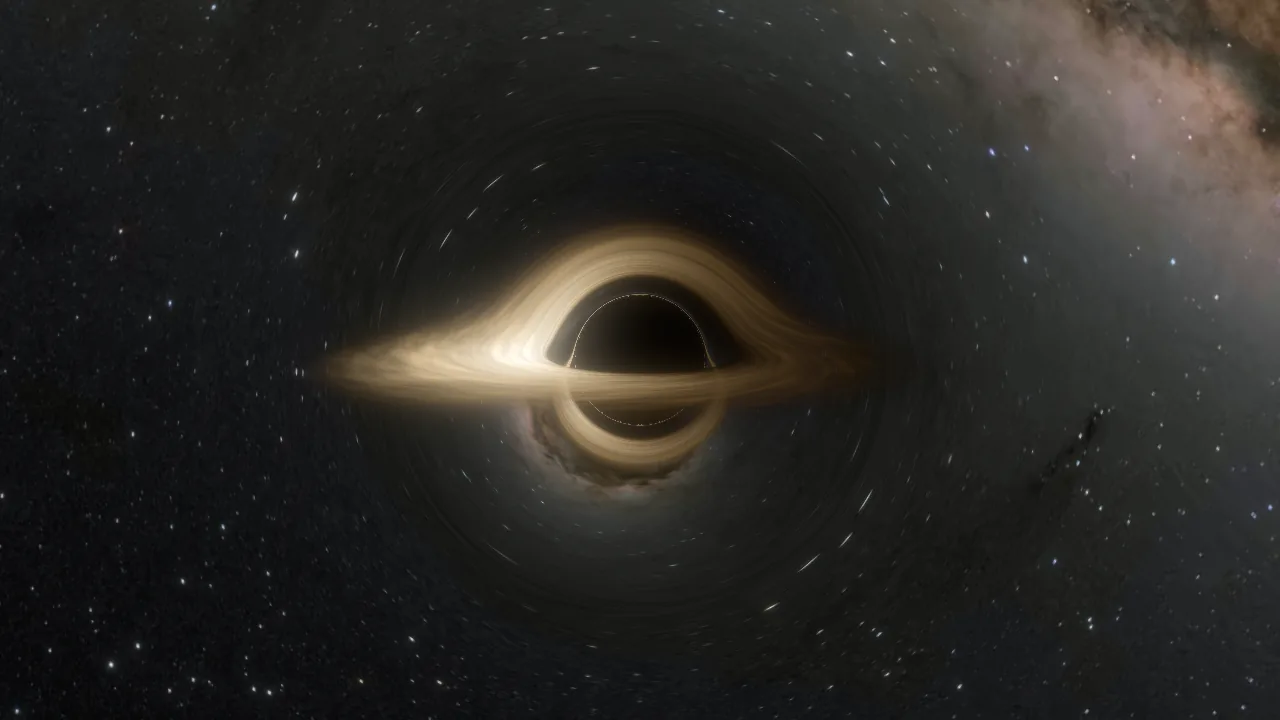
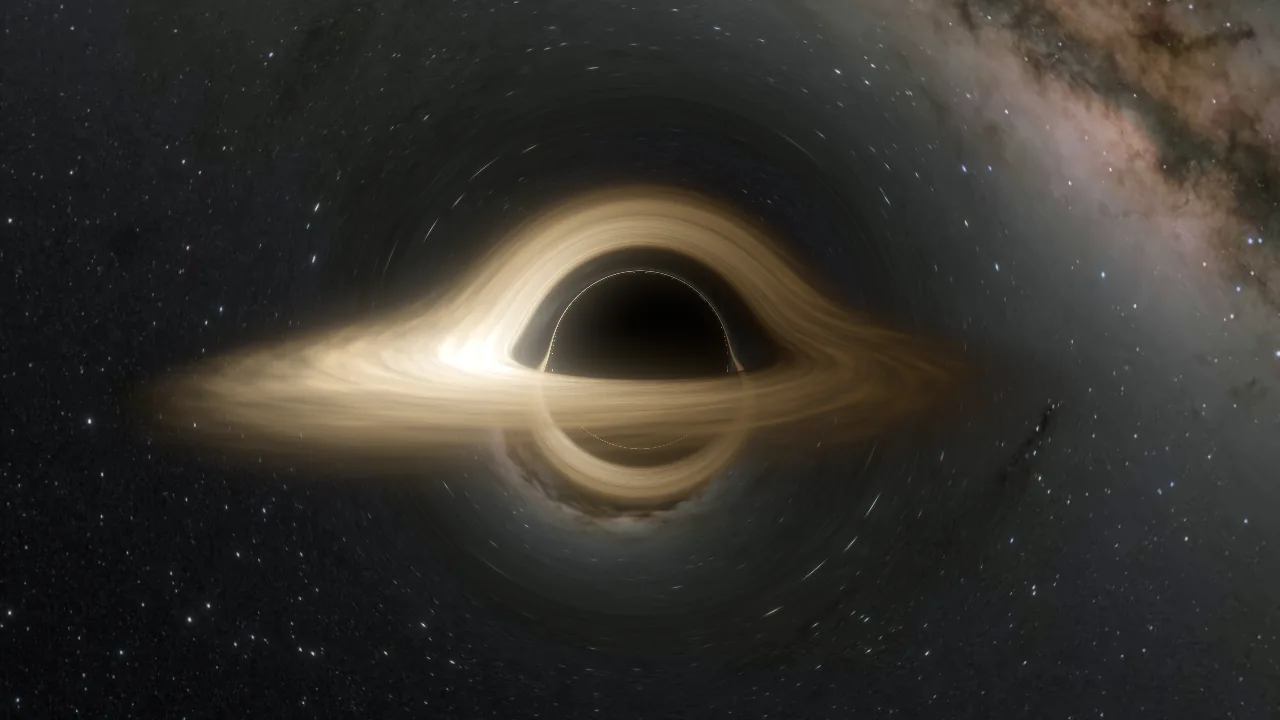
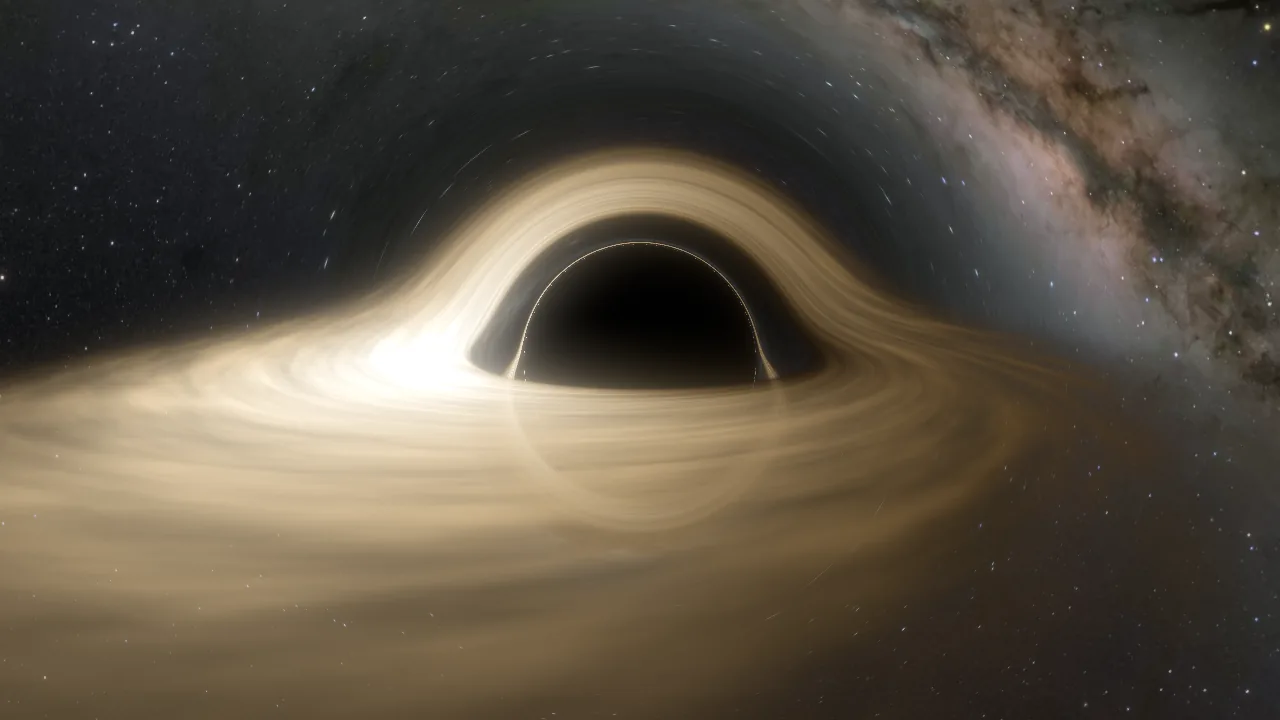
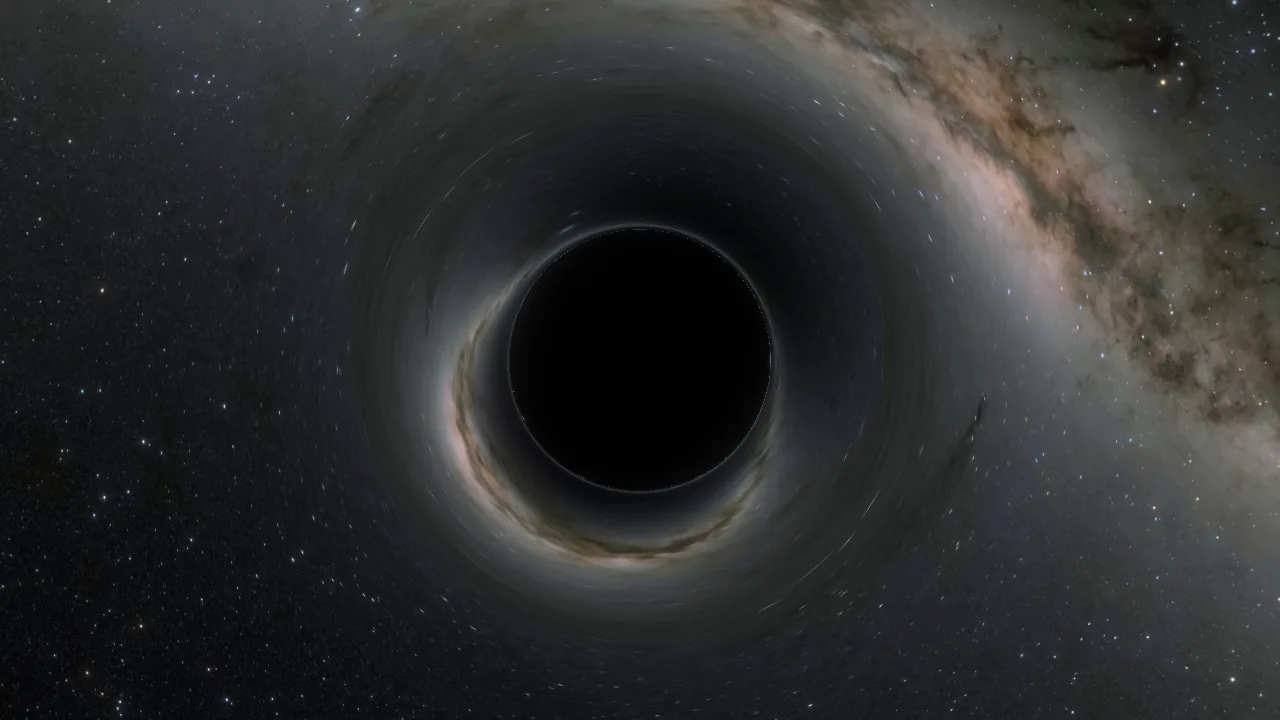
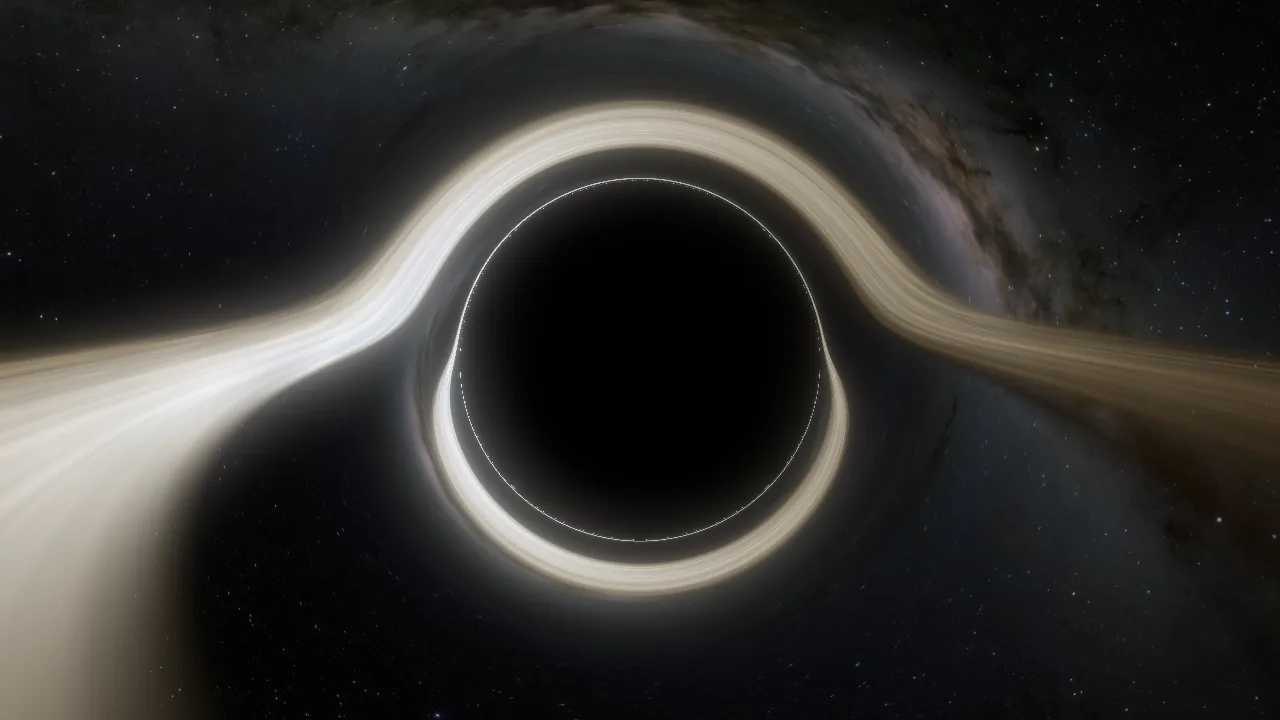
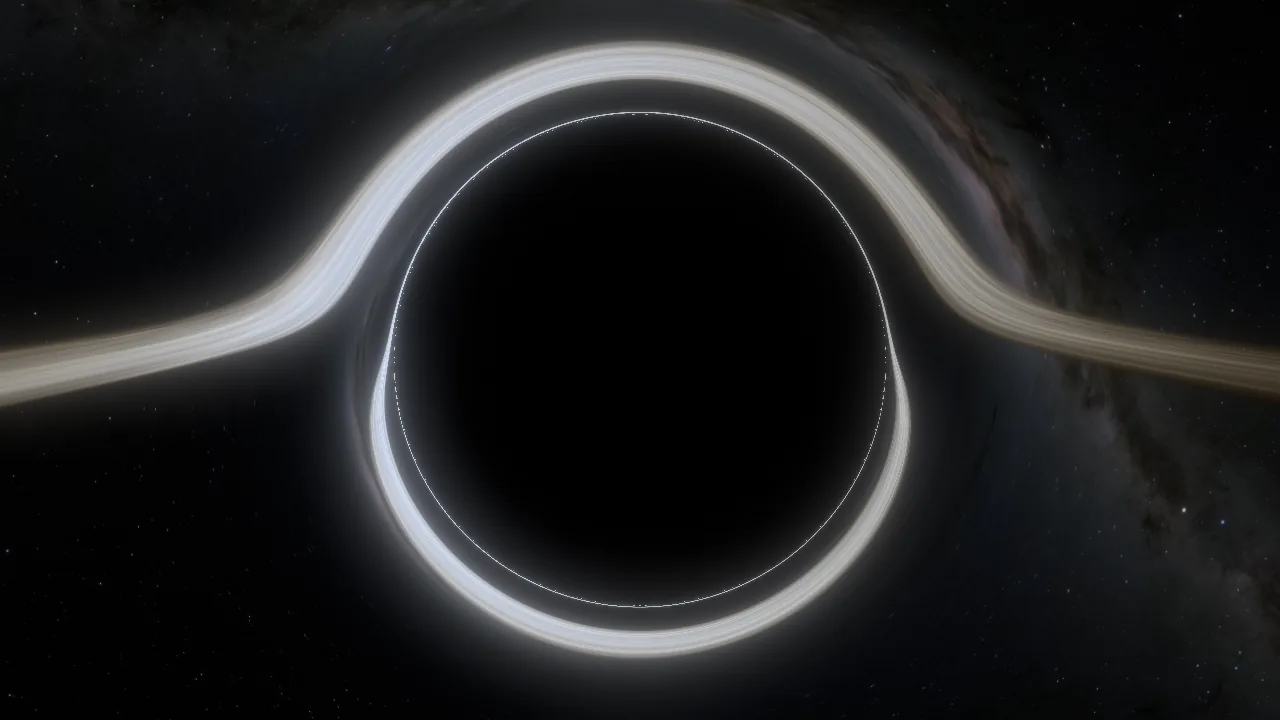
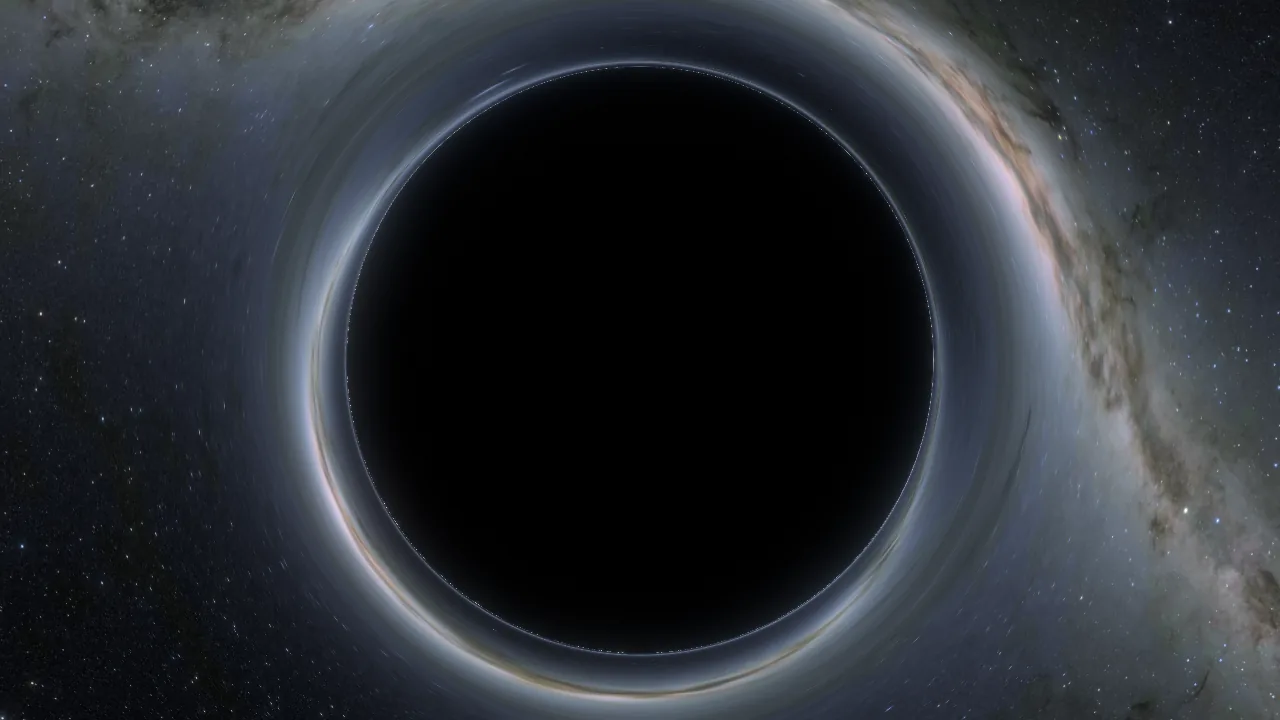
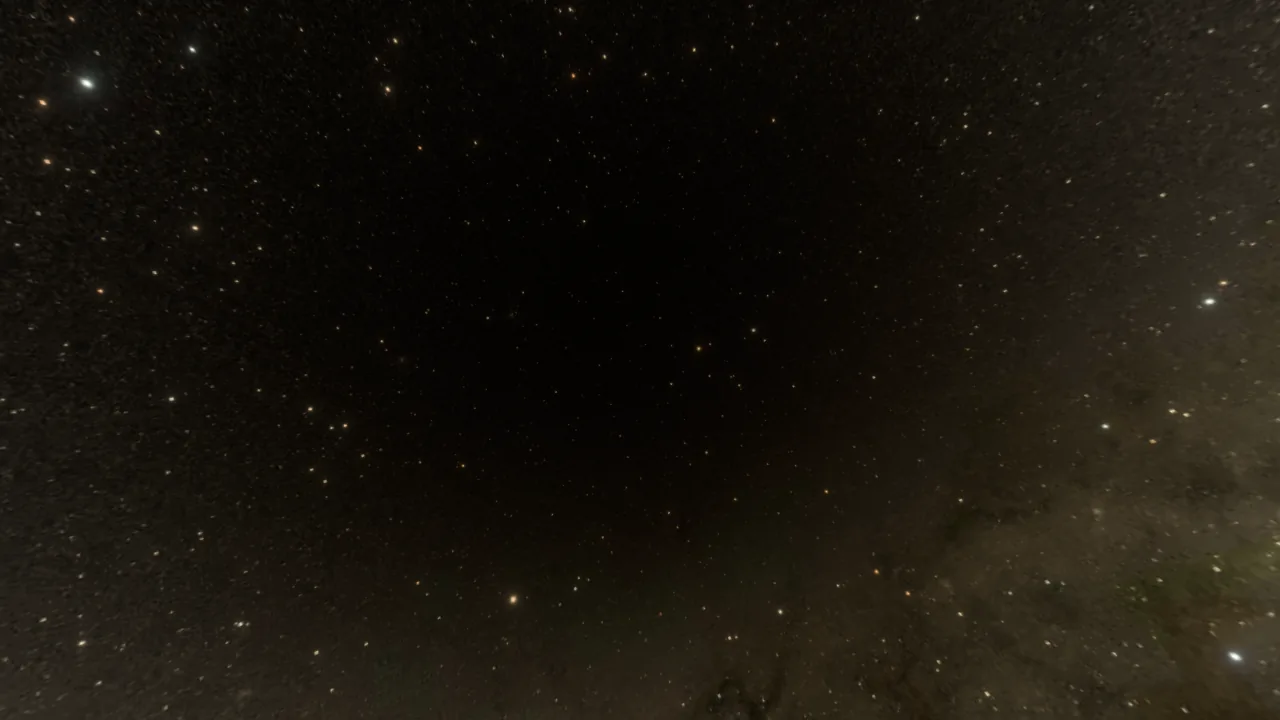
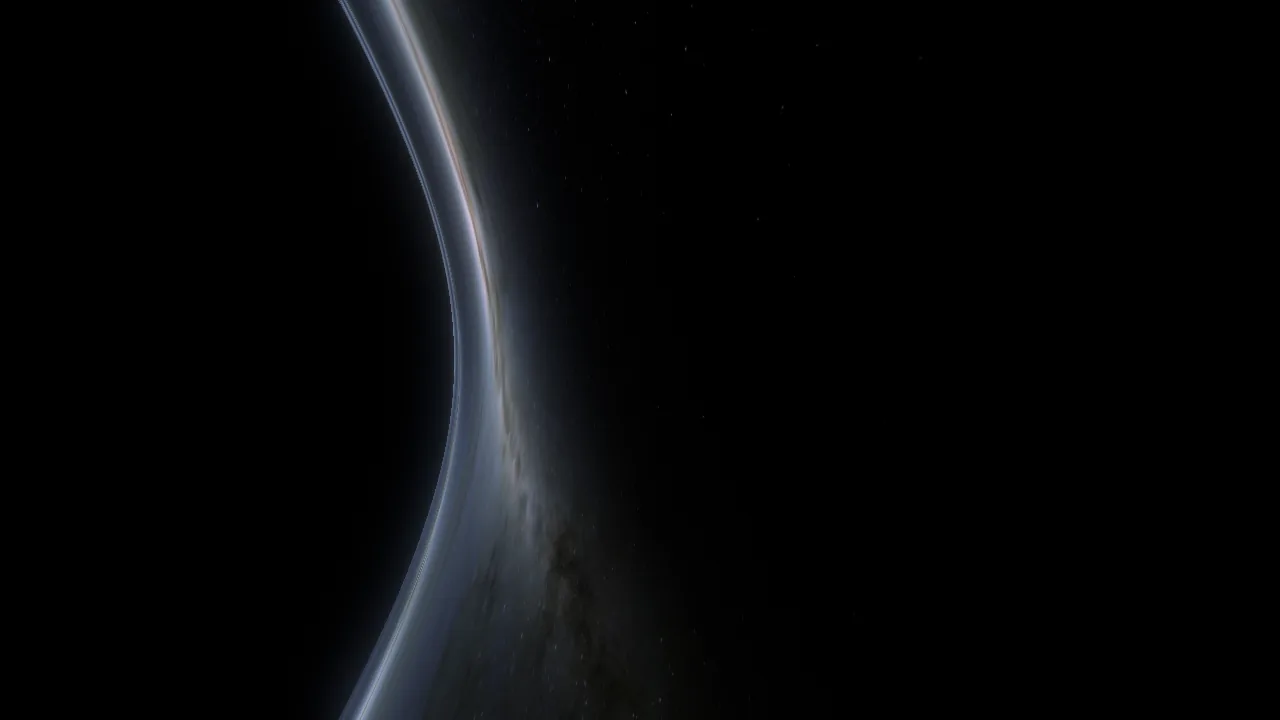
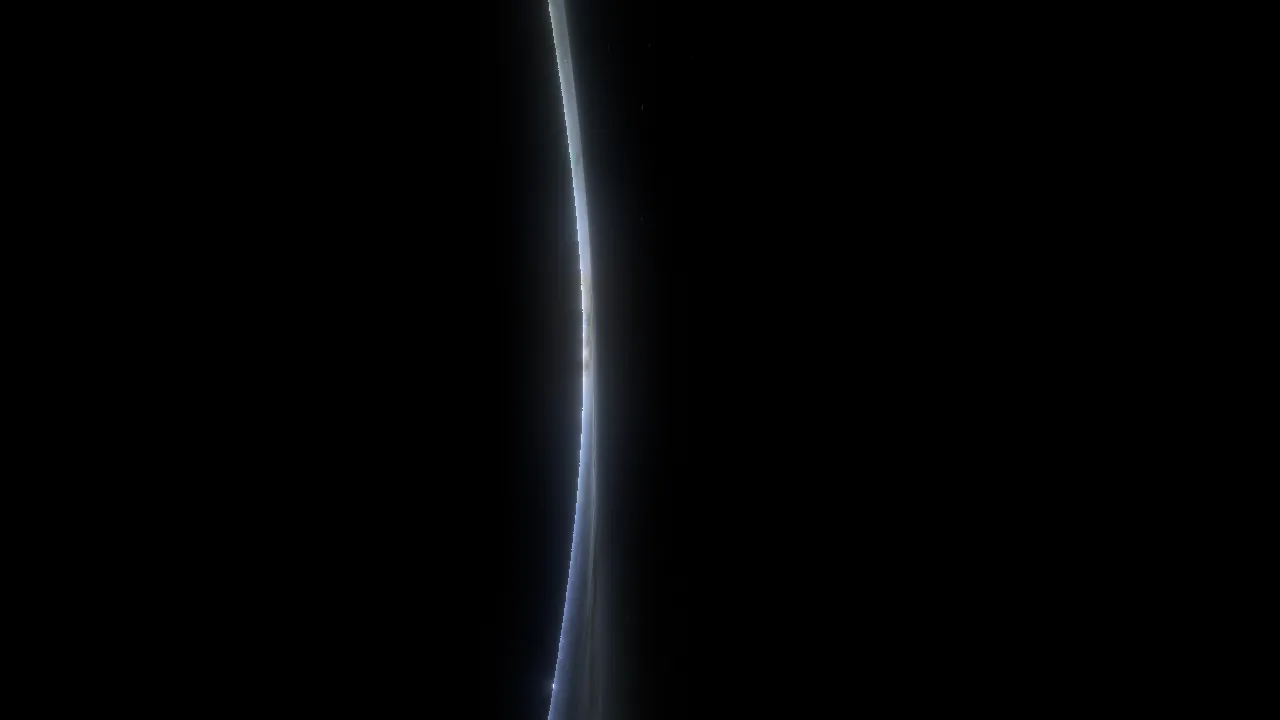
The bending of light is computed with the equations of general relativity, over NASA’s map of 1.7 billion stars as seen from Earth. The ring of gas is the simplest textbook model. Drag the picture to look around.
40 radii from the centre
From here the hole is a black disc inside a ring of glowing gas
Distances on this page are counted in radii of the black hole. One radius is the distance from the centre to the horizon, the surface nothing returns from. For Sagittarius A*, the black hole at the centre of the Milky Way, one radius is 12.7 million km, about 18 times the radius of the Sun.
You are 40 radii out and falling freely, with no engine. You are already moving at 16% of the speed of light past anyone hovering at this distance.
22 radii
The glow is gas on its way in. The hole gives off no light
Gas pulled towards a black hole circles it, rubs against itself and heats until it shines. When a telescope shows a black hole directly, what it shows is this gas.
On the left of the picture the gas is coming towards you at a large fraction of the speed of light, which makes it look brighter and whiter. On the right it is moving away, and looks dimmer and redder.
12 radii
The arch over the top is the far side of the ring
The ring of gas is flat and you see it almost edge-on. The arch above the black disc is the part of the ring that lies behind the hole. Its light sets off upwards and is bent over the top of the hole into your eyes. The thinner arc underneath is the underside of that same far part.
No one drew the arch. It appears when each ray is followed backwards from your eye to wherever it came from.
8 radii, with the gas removed
Without gas, the hole shows only as missing stars
Take the gas away and the black hole gives off nothing at all. It is a disc 25° across with no stars in it, and round it the sky is pulled out of shape.
A star that lies almost directly behind the hole appears twice, once on each side of it. The band of the Milky Way is smeared round the edge of the disc.
3 radii
The inner edge of the gas
Closer than three radii, no circular orbit is stable. Anyone hovering at this edge would see the gas go past at 50% of the speed of light. In the standard model the gas then drops into the hole too quickly to go on shining.
You pass 9° above the ring and keep falling, at 58% of the speed of light.
1.5 radii
Here light itself can go round in a circle
At this distance a ray of light aimed exactly sideways circles the black hole. The thin bright line along the edge of the black disc is light that went at least half way round the hole before it reached you.
An observer hovering here on rocket engines would see the black disc cover exactly half the sky. You are falling past at 82% of the speed of light, and for you it is 71° across: your speed makes everything ahead look squeezed towards the centre.
1 radius: the horizon
Nothing marks the horizon
This is the horizon. There is no wall, no flash and no jolt. The black disc ahead is 84° across and covers 13% of the sky. The rest of the sky is still full of stars. From here on the picture leaves the gas out: seen ahead and to the sides, its light is shifted blue-white by your speed and would hide the stars.
One thing changes: what can leave. From here inwards, even a ray of light aimed straight outwards moves towards the centre. Light from outside goes on reaching you. Nothing from you will reach the outside again.
0.75 of a radius, looking back
Behind you the universe is still there
Turn round. The sky behind you is all still there. Nothing in it runs faster, and you do not get to watch the future of the universe go by.
A star like the Sun straight behind you now looks about 170 times dimmer than it did from far away, and redder, because you are moving away from its light at great speed. The exposure of the picture has been raised to show the stars.
0.4 of a radius, looking sideways
The sky gathers into a band
Ahead of you the black disc keeps growing. The sky that is still visible is pressed towards a line round your middle, at right angles to the direction of the fall. Along that line the light turns blue-white and grows brighter.
The cause is the same tidal force that pulls on a falling body: it stretches along the line of the fall and squeezes across it.
0.04 of a radius
The last thing to see is a ring of light
This close to the centre the black disc covers 40% of the sky, on its way to half. Behind you the stars have gone red and then too faint to see. Nearly all the light you can still see is in one thin, blazing ring.
At Sagittarius A* the fall from the horizon to this point takes 28 seconds on your own watch. The equations give no description of the centre itself, so the picture stops here.
How long would the fall last, and where would it start to pull you apart?
The view is the same at every black hole. Only the scale changes: at a larger hole the fall is slower and gentler. Choose one of four real black holes and enter a height.
The damage is done by tidal force: gravity pulls harder on the end of the body that is nearer the hole. The threshold used here is a difference of 10 g between head and feet, taken as the most a body can stand. Fighter pilots withstand turns of 9 g, though a turn presses the whole body one way and tidal force pulls its two ends apart.
Falling feet first
At Sagittarius A*, a person 170 cm tall crosses the horizon unharmed, with 28.2 seconds left before the centre
The horizon is 25.4 million km across, 18.2 times the width of the Sun. Light would take 84.7 seconds to travel that far in empty space.
At the horizon the difference in pull between head and feet is 96.7 millionths of a g. It reaches 10 g only 270,000 km from the centre, 87.8 thousandths of a second before the end.
The fall from the horizon to the centre takes 28.2 seconds on your own watch.
Share this page
Does time stop at the horizon?
For someone watching from far away, in effect it does. Your clock seems to run more and more slowly, your image turns redder and fainter, and they never see you cross.
On your own watch nothing of the kind happens. You cross the horizon and reach the centre in the time given above.
The slowing is real for anyone who stays near the hole without falling, held in place by engines. The table shows how much time passes far away during one hour spent hovering at each distance. At the horizon itself no engine can hold you.
Hovering at
One hour there lasts, far away
10 radii
63.2 minutes
3 radii
73.5 minutes
2 radii
84.9 minutes
1.5 radii
104 minutes
1.1 radii
3.32 hours
1.01 radii
10 hours
1.0001 radii
4.17 days
What the two photographs of black holes show
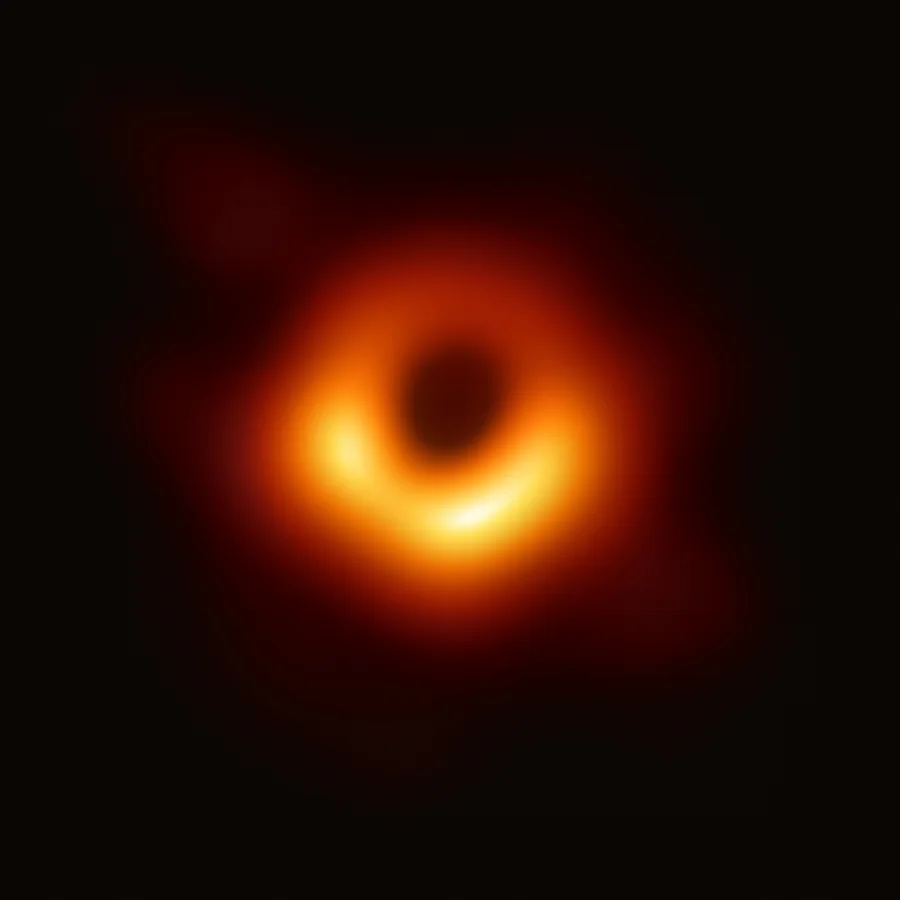
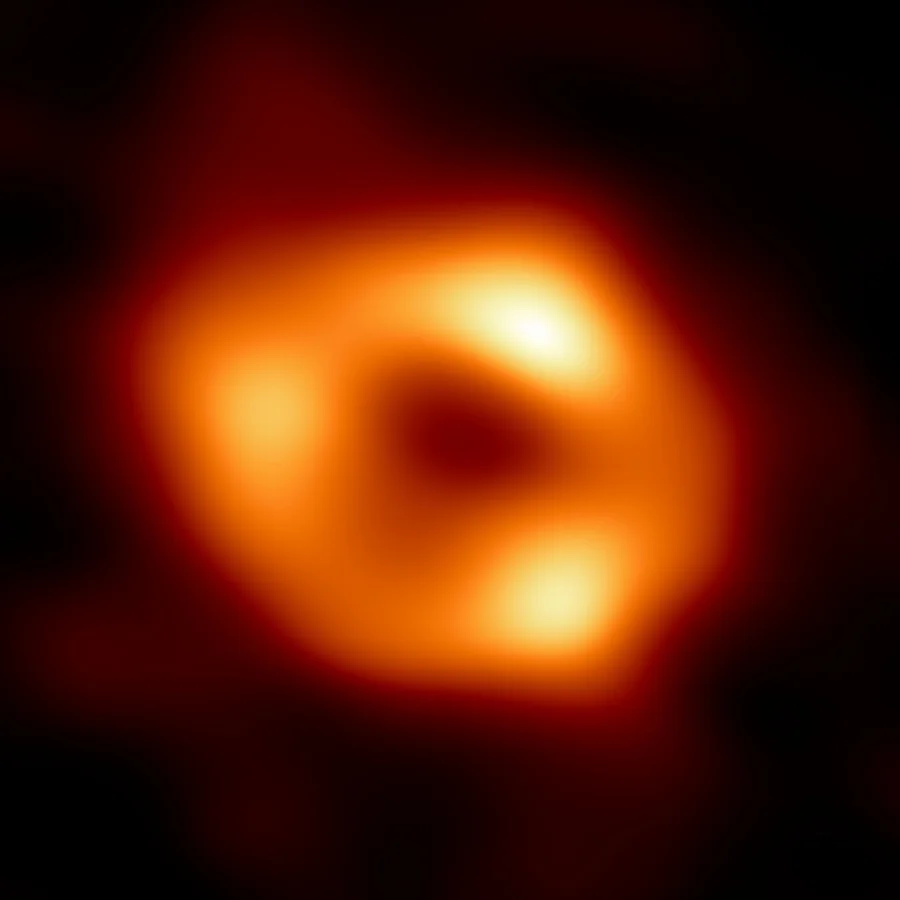
Two black holes have been photographed, both by the Event Horizon Telescope, a set of radio telescopes on several continents that work as one. Each picture shows a ring of glowing gas round a dark centre, blurred because the ring is at the limit of what the telescopes can separate.
M87*, the black hole at the centre of the galaxy M87, observed in April 2017 at a radio wavelength of 1.3 mm and published on 10 April 2019. The colours stand for radio brightness. Image: EHT Collaboration, via ESO, CC BY 4.0.Sagittarius A*, the black hole at the centre of the Milky Way, from the same April 2017 observations, published on 12 May 2022. Image: EHT Collaboration, via ESO, CC BY 4.0.
The dark centre is where the black disc on this page lies, seen from very far away, and the bright ring is expected to sit close to its edge. For a hole that does not rotate, the disc is 5.2 radii across. How large that looks from Earth depends on two numbers only: the mass of the hole and its distance.
For Sagittarius A* both numbers come from stars that have been tracked for decades as they orbit the hole, so the size could be worked out before anyone had a picture. It comes to 53.3 millionths of an arcsecond. The ring measured in the photograph is 51.8 ± 2.3, and the collaboration’s own estimate of the dark disc is 48.7 ± 7.
For M87* the same calculation gives 39.7, and the measured ring is 42 ± 3. Here the agreement proves less, because the mass of 6.5 billion solar masses was itself worked out from the ring.
Black hole
Mass, in Suns
Distance
Black disc, computed
Ring, measured
Sagittarius A*
4.3 × 10⁶
27,000 light-years
53.3
51.8 ± 2.3
M87*
6.5 × 109
54.8 million light-years
39.7
42 ± 3
millionths of an arcsecond (μas)
Questions about falling into a black hole
What would you see if you fell into a black hole?
A black disc that grows as you approach, with the sky bent round its edge. At the horizon the disc is 84° across and the rest of the sky is still stars. Inside, the visible sky is pressed into a band round your middle, and the last thing to see is a thin bright ring.
Does everything go black when you cross the horizon?
No. For someone falling freely from far away, the black disc covers 13% of the sky at the horizon. Light from outside still falls in after you and reaches your eyes. Light from you can no longer get out. The idea of being swallowed by darkness fits a different traveller: one lowered slowly on engines, for whom the outside sky shrinks to a small bright circle overhead.
Would you see the whole future of the universe?
No. In a black hole that does not rotate, the fall from the horizon to the centre takes 28 seconds at Sagittarius A*, and only the light that catches you up in that time reaches you. The sky behind you gets redder, and nothing in it runs faster.
Would falling into a black hole hurt?
It depends on the size of the hole. At a black hole of about ten times the Sun’s mass, tidal force passes 10 g thousands of kilometres before the horizon. At Sagittarius A* or M87* a person crosses the horizon without feeling anything, and tidal force reaches 10 g less than a tenth of a second before the centre.
How long does it take to fall into a black hole?
From the horizon to the centre, falling freely from far away: 28 seconds at Sagittarius A*, about 12 hours at M87*, and 63 millionths of a second at Gaia BH1. The time is proportional to the mass of the hole.
Which is the nearest black hole to Earth?
The nearest one known is Gaia BH1, 1,560 light-years away. It has 9.62 times the mass of the Sun, and a star like the Sun orbits it.
How the picture is made, and what it leaves out
What is computed. For every point of the picture, a ray of light is followed backwards from the eye through the space round a black hole that does not rotate, using the exact equation for light in that space. Where the ray ends decides the colour: a star, the gas, or nothing. The eye belongs to someone falling freely who started at rest far away; their speed changes the directions, colours and brightness of everything they see, and that is computed too.
What was checked. The edge of the black disc was worked out a second time with a different form of the equations and agrees to a fraction of a degree. At the horizon it gives a disc 84° across, the figure published by Alain Riazuelo in 2019.
The stars. The sky is NASA’s Deep Star Maps 2020, drawn from the positions, brightness and colours of 1.7 billion stars in the Hipparcos, Tycho and Gaia catalogues. It is the sky as seen from Earth. The sky from beside a real black hole would hold other stars; the bending would be the same.
The gas. The gas is shown as a thin flat ring between 3 and 13 radii, the simplest textbook model, glowing as a body at about 3,400 K would look to a camera set for daylight. Around real black holes the gas is far hotter and shines mostly in X-rays, ultraviolet light or radio waves, depending on the hole. The change of brightness and colour from one side to the other is computed. The mottling is drawn in, so that the turning can be seen, and it turns far faster than the real gas would appear to.
Brightness. The picture is exposed like a photograph, and the exposure changes along the way as a camera’s would: it drops where the light ahead grows many times brighter and rises when you turn to look back. The current exposure is shown beside the picture. From the horizon inwards the gas is left out, because its light would hide the stars; the button on the picture brings it back.
What is left out. Real black holes rotate, which flattens one side of the black disc slightly and changes the inside. The hole here does not. The centre itself is beyond what the equations describe.
The 10 g threshold follows J. Richard Gott and Deborah Freedman, who took 10 g between head and feet as the most a body can stand, with pain and dismemberment beyond it, and showed that the fall from there to the centre takes under a tenth of a second whatever the mass of the hole.