London, 1916 · an engineer from Craiova, Romania · the war in the air
The gun that fired through the propeller
In 1916 Gogu Constantinescu, an engineer from Romania working in London, connected an aeroplane’s machine gun to its engine with a thin copper pipe full of oil. The gear’s secret handbook told mechanics to time the trigger on the propeller blade itself. By the handbook’s own rules, the bullet got through because it arrived about a hundredth of a second later.
Slow motion: a thousandth of a second lasts a tenth. Sound is off.
Hold the button or the space bar
From cam to propeller
Meanwhile the propeller turns .
Move the throttle and fire. With four blades, below 500 rpm, the bullets hit the blade: the handbook says so too.
1915–1917
A machine gun behind a propeller
A fighter pilot aims with the whole aeroplane. The gun has to fire straight ahead, and in front of it a wooden propeller turns more than 20 times a second. By 1 April 1915 the French airman Roland Garros was flying with steel wedges on his blades that knocked away the bullets striking them. That summer Germany’s Fokker monoplanes had a mechanism that timed each shot to miss the blade.
British gears of 1916 did the same with rods, cams and levers running from the engine to the gun. A rod that expanded in the heat or flexed slightly could shift the moment of firing far enough to put bullets into the propeller. According to Harry Woodman’s history of early aircraft armament, at the end of 1917 Sopwith Camel squadrons were still reporting propellers shot through by their own guns.
Craiova – London
Power carried by waves
Gogu Constantinescu was born in Craiova, in southern Romania, in 1881, and graduated first in his year from the National School of Bridges and Roads in Bucharest in 1904. He built reinforced-concrete bridges, then moved to London, where he went into partnership with the manufacturer Walter Haddon and set up an experimental works at Alperton, in the west of the city.
His idea was this: push the end of a long column of liquid fast enough and the liquid cannot all move at once. It compresses next to the piston, and a pressure wave sets off down the pipe at the speed of sound in the liquid. Constantinescu called the field sonics. In 1915 he applied for a patent on a rock drill based on it.
In 1916 Major Colley of the Munitions Inventions Department arranged the loan of a Vickers machine gun for him. The provisional patent application for the firing gear was filed on 14 July 1916. The services called it the C.C. gear, for Constantinesco and Colley.
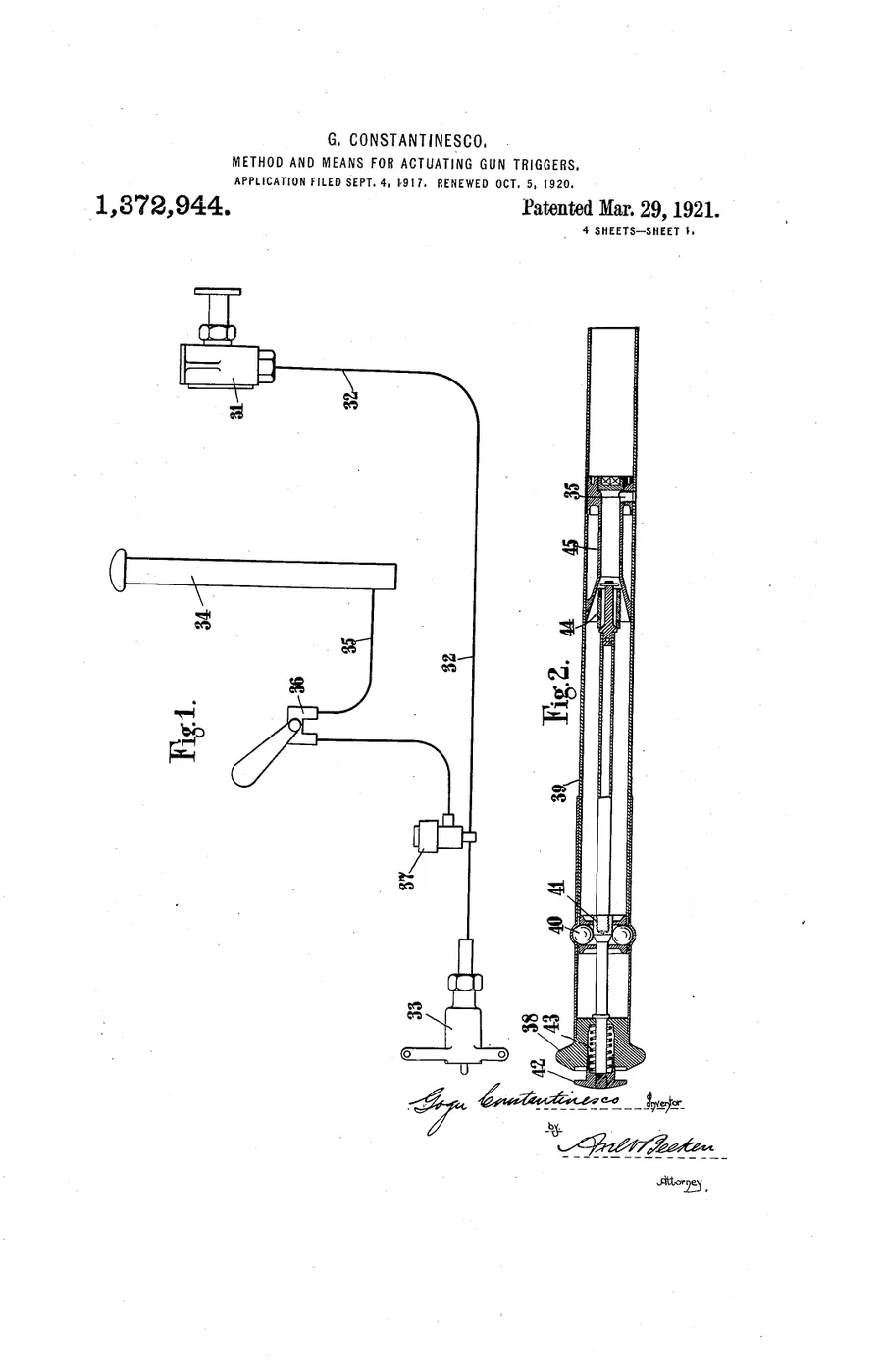
The secret handbook, March 1918
Timed on the centre of the blade
In March 1918 the Ministry of Munitions printed the second edition of the “Handbook of ‘C.C.’ Interrupter Gear”, stamped SECRET. Page 26 has a table: for each aeroplane, where the propeller must stand at the moment the generator’s cam pushes the piston. For gears with rods the answer is one inch after the trailing edge: the blade has just gone by. For the C.C. gear on two-bladed propellers the answer is “Centre of Blade”.
So on two-bladed propellers the mechanic took as his mark the moment the centre of the blade passed the barrel. The bullet got through because it arrived later. Between the push of the cam and the bullet crossing the propeller’s plane there is a delay that does not depend on engine speed. The handbook does not state it, but implies it in a rule for four-bladed propellers: above 1,200 rpm the timing must be advanced about 6 degrees for each extra 100 rpm. If those 6 degrees are propeller degrees, as in the handbook’s own example (at 1,200 rpm, a thousandth of a second means 7.2 degrees), and if the delay does not change with speed, it is 10 thousandths of a second: one hundredth.
How far the propeller has turned when the bullet crosses
Read with that hundredth, the handbook’s other rules make sense. Below 500 rpm the propeller turns less than 30 degrees in that time, too little for the blade to clear: “unsafe”, says the handbook. At 1,200 rpm, the limit up to which the handbook accepts the basic setting, it turns 72 degrees, which leaves room for late shots. With two blades timed on the blade centre, the bullet passes exactly halfway between the blades at 1,500 rpm.
Of that hundredth, the pressure wave in the pipe takes little. The handbook gives its speed, “about 4,000 feet per second” (about 1,219 metres per second), and the pipe’s length, at least six feet in the 1918 edition and nine in another. The wave crosses a six-foot pipe in 1.5 thousandths of a second and a nine-foot one in 2.25. The rest, nearly 8.5 thousandths, is the gun: the trigger, the firing pin, the cap, the bullet’s travel down the barrel and its flight to the propeller.
Constantinescu had written in his US patent that the difference in the wave’s travel time at different speeds is so small that there is no danger of hitting the propeller. He was right: the wave’s time does not change with speed at all. Only the angle it covers changes, from 9 degrees at 1,000 rpm to 16.2 at 1,800. Because the whole chain appears to run late by a fixed time, the angle grows with speed. That is why the handbook asks for the lowest and highest speeds at which the pilot wants to fire.
The 1918 notes of the Turnberry school of aerial gunnery, in Scotland, say the same: late shots are “more likely” caused by neglect of the gun than by faults of the gear, chiefly caps struck lightly, which burn slowly. A hundredth of a second late at 1,200 rpm means the propeller has turned 72 degrees more than it should have, the notes add. On a four-bladed propeller, with blades 90 degrees apart, that can put the shot into the next blade.
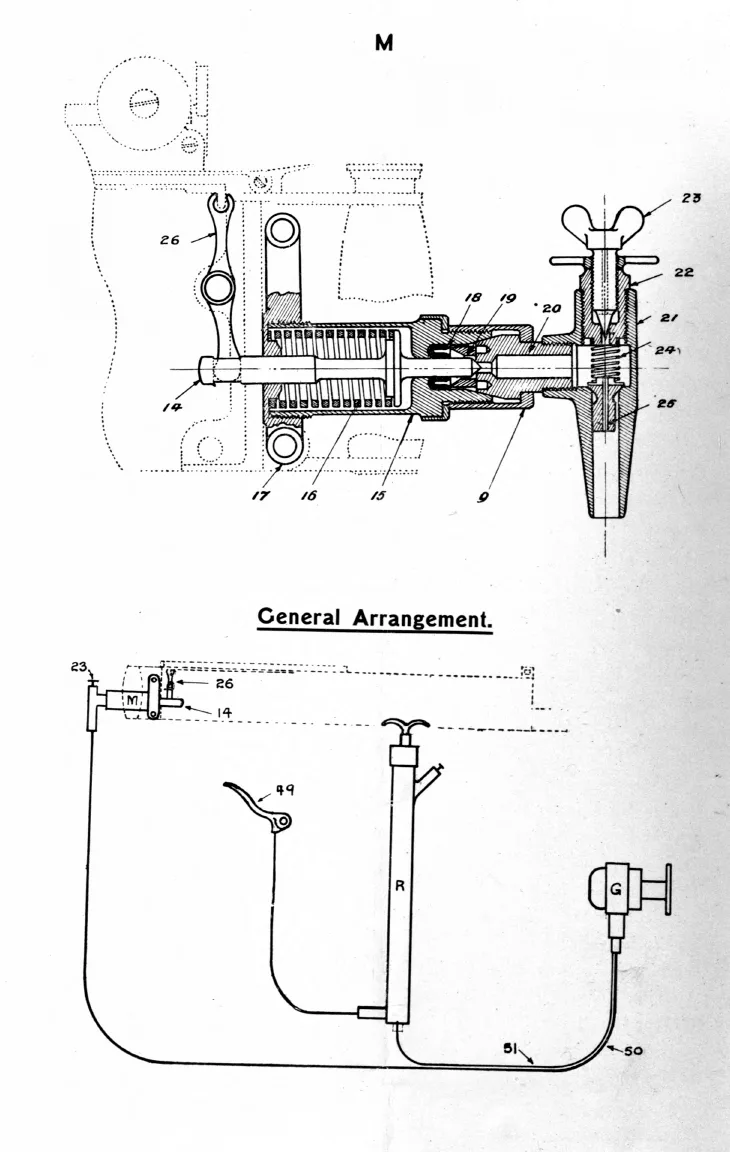
The bubble in the pipe
The worst enemy: a bubble of air
One edition of the handbook is categorical: the gear never fires stray shots if no air is left in the pipe. Several pages explain how to fill it: nine parts paraffin to one of oil, strained through gauze, the unions tightened while the liquid is still running so that no bubble is caught. The morning check is done by hand: when the lever is pulled, the reservoir handle should drop a little and stop dead, “as if it had hit on something solid”.
The physics shows why. Air compresses thousands of times more easily than oil, so a little air slows the wave a lot. A simple model with 1% air at the line pressure (about 150 pounds per square inch) brings the wave down from about 1,219 to about 421 metres per second. The wave would then take 4.3 thousandths of a second to cross the 1.8-metre pipe instead of 1.5: at 1,500 rpm the bullet leaves 26 degrees later. The pressure pulse can also weaken.
The first trials had the opposite problem. The wave bounced from the gun back to the generator and back again, and worked the trigger plunger two or three times for a single movement of the cam. Constantinescu fitted a damping valve at the end of the pipe, with a small hole through its middle, which lets the wave through on the way in and smothers it on the way back. The handbook records no trouble since.
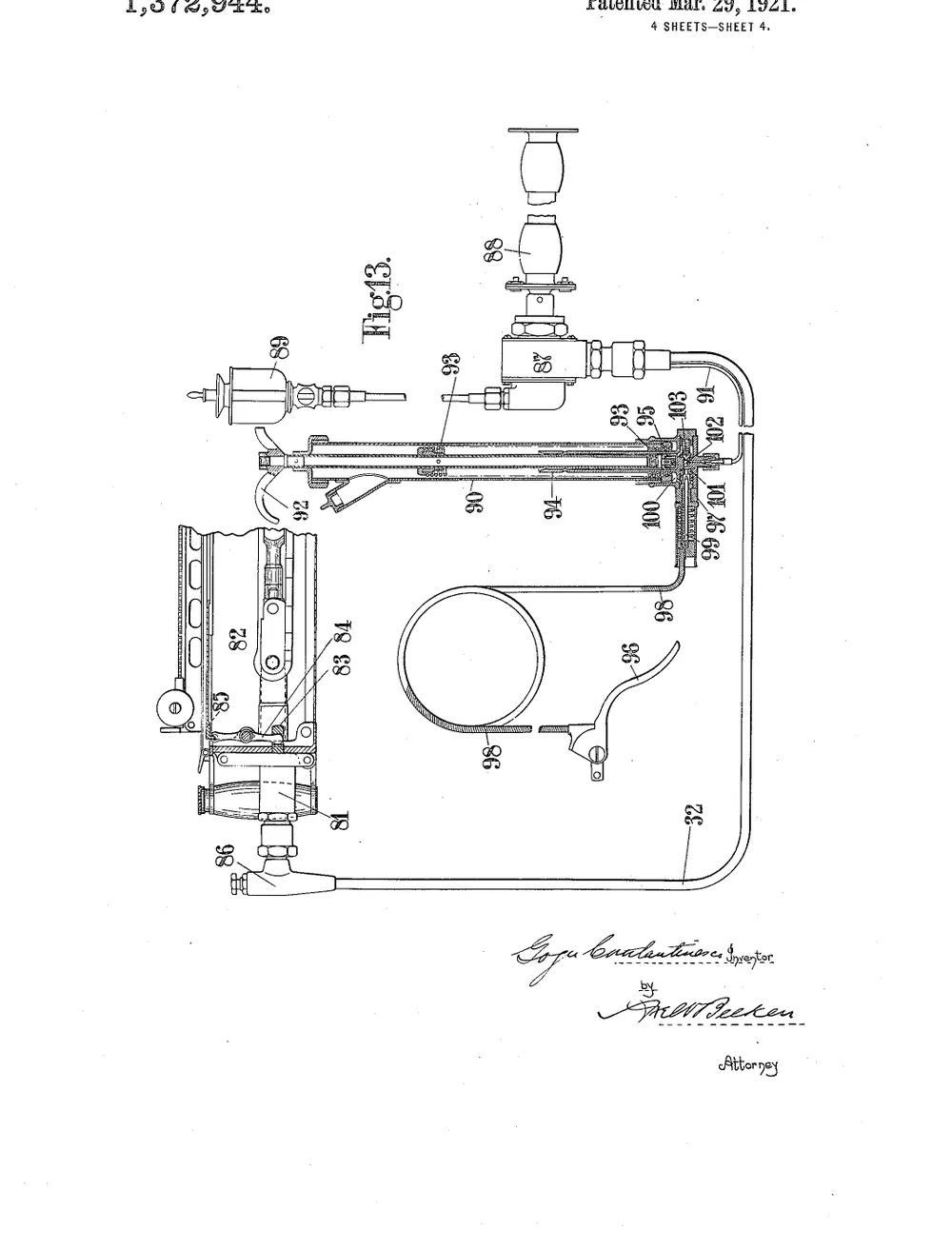
600 a minute
The gun waits for the wave
The generator usually turns at twice propeller speed, so it sends a wave every half turn. The gun cannot fire at every wave: it needs time to reload. The handbook says that with a properly tuned gun “600 rounds per minute can be obtained” with no stray shots: one round every tenth of a second.
If the gun is ready a tenth of a second after a shot, it fires on the first wave that arrives after that. At 1,200 rpm the fourth wave comes exactly on time: 600 a minute. At 1,201 the fourth comes a fraction too early and the gun waits for the fifth: 480 a minute. The rate of fire “varies as gun and trigger bar movements synchronise or otherwise”, says the handbook. The chart shows the model; in the simulator you can hear it.
Rate of fire against propeller speed (model)
1917–1965
Into service
No. 55 Squadron’s DH.4s reached France on 6 March 1917 with the gear fitted, followed by Bristol Fighters and S.E.5s. Histories of British aviation give it as standard on new British aircraft with synchronised guns from November 1917; the last RAF fighter to carry it was the Gloster Gladiator, which entered service in 1937. In the March 1918 handbook’s table, though, the Sopwith Camel appears with the mechanical Sopwith-Kauper gear and the Sopwith Pup with the Scarff gear.
In August 1919 an MP asked in the Commons whether Constantinescu was leaving England because he could not get his share of royalties, and claimed that over £300,000 was due under the arrangement. The government replied that the engineer was only on leave. In 1919 the Royal Commission on Awards to Inventors gave him and Haddon £50,000 for the gear, and further sums followed later.
Constantinescu stayed in England. He worked for the Admiralty on uses of sonics, published his “Theory of Wave Transmission” and built a car with a torque converter of his own design. He died in December 1965 beside Coniston Water, in the Lake District. The Romanian Academy had elected him a corresponding member in 1920, and made him an honorary member in the year he died.
Sources
Period documents are quoted from their public scans. Figures marked “model” are calculated on the page from the handbook’s data.
- Ministry of Munitions, Department of Aircraft Production, Handbook of “C.C.” Interrupter Gear, Types A, A1 and B, second edition, March 1918 (SECRET). Scan: Vickers MG Collection & Research Association, Internet Archive. Wave speed, pressure, pipe length, damping valve: pp. 14–17; timing table and four-blade rules: pp. 25–27.
- Hand book of “C.C.” gear: the Constantinesco Fire Control Timing Gear, undated edition (Martin & Huberty), Internet Archive: main line at least 9 feet, 600 rounds per minute, stray shots and air.
- Notes on Guns, Gears and Sights, Turnberry, 1918, Internet Archive, pp. 88–89: late shots; generator at twice propeller speed.
- G. Constantinesco, Method and means for actuating gun-triggers, US patent 1,372,944, filed 4 September 1917, granted 29 March 1921, Google Patents. Corresponding British application: GB 129,299, of 14 July 1916.
- G. Constantinesco, Theory of Wave Transmission: a treatise on transmission of power by vibrations, second edition, Walter Haddon, London, 1922, Internet Archive.
- House of Commons, 18 August 1919, “War inventions (Mr. Constantinesco)”, Hansard.
- Grace’s Guide to British Industrial History, George Constantinescu: the Alperton works, the 1919 award, citing The Times.
- Wikipedia, Synchronization gear, after H. Woodman, Early Aircraft Armament (1989) and E. F. Cheesman (ed.), Fighter Aircraft of the 1914–1918 War (1960): Garros, Fokker, the British gears, entry into service in 1917.
- Wikipedia, George Constantinescu and Gogu Constantinescu (Romanian): biographical details.
- Model (on this page): the hundredth-of-a-second delay is inferred from the 6° per 100 rpm rule, read as propeller degrees. Wave speed with air: Wood’s equation, oil of density 800 kg/m³, air compressed adiabatically at 150 psi. Blade width at the gun line: about 24°, what the four-blade 500 rpm rule leaves room for. Rate of fire: gun ready 0.1 s after each shot. In the simulator, “air in the pipe” loses 30% of the waves and “faulty cartridge caps” delay 30% of shots by 2–14 thousandths of a second: values chosen to illustrate, with no period source.
Images
- US patent 1,372,944, G. Constantinesco, 1921 (Google Patents). Public domain.
- “Hand book of ‘C.C.’ gear”, undated edition, University of California Libraries copy (Internet Archive). Public domain.