Scroll scene: the noon line crossing the Earth, then the Greenwich courtyard to scale
GREENWICH · LONGITUDE ZERO · YOUR NOON
Zero moved 102.5 metres. Nobody told the line.
In 1884 the world voted to count longitude, and with it the world’s time, from a line in a London courtyard. The zero in use today runs 102.5 m east, across the park. Your own zero is wherever you stand, and today the sun will mark it at a minute no clock shows.
Right now, noon is at one meridian.
Somewhere under that gold line the sun is at its highest and shadows are at their shortest. The line never stops. It slides west at 15° an hour, about 1,670 km an hour at the equator, and in the next 24 hours it will cross every person alive.
It reaches you at your own noon.
That is true noon today for your place, . Your clock probably disagrees with the sun by a few minutes or more: time zones are wide, summer time adds an hour, and the Earth’s tilted, oval orbit makes the sun run up to 16 minutes early or 14 minutes late through the year.
Yet the time on every clock you own began at one line in a London park.
Your phone, your bank, air-traffic control and the world’s time signals all keep a time that began as the time of one meridian, through one telescope, on a hill above the Thames. Nature did not choose it. People did, after two centuries of shipwrecks, prize money, almanacs and railway timetables.
Washington, 13 October 1884: zero is put to a vote.
Twenty-five delegations. The motion: the zero of longitude should be “the meridian passing through the transit instrument at the Observatory of Greenwich”. 21 ayes. San Domingo voted against; France and Brazil abstained; El Salvador was absent. The conference could only propose; governments followed one by one. France took until March 1911, and even then its law avoided the name: legal time became “Paris mean time, delayed by nine minutes and twenty-one seconds”. That is Greenwich time.
Then zero moved, and nobody told the courtyard.
Visitors straddle a metal line in the Observatory courtyard for a photo. It is Airy’s meridian of 1851, the one the world voted on. The zero your phone reads today runs 102.5 m east of it, across the park, unmarked. At Greenwich a plumb line tilts slightly east–west of the direction satellites use, and world time had to stay continuous: that put the modern line where it is.
At real speed, the gap is a blink.
At Greenwich’s latitude the ground turns under the sun at about 289 metres a second. Noon reaches true zero first, then the strip where everyone takes the photo, 0.35 seconds later. Malys and colleagues, who measured the telescope against the satellites, give the same gap in time: “more than 1/3 s”.
Go outside at your noon, .
Look at your shadow at your solar noon. It is the shortest it will be all day, and it points along your own meridian.
How the noon is worked out
True solar noon from NOAA’s published solar-position formulas (equation of time and declination), for the longitude shown, today. Accurate to within a minute or so; a city is taken at its centre. Your rough place comes from your internet connection and is not stored; an exact location is used only if you ask, and is kept only in this browser. The courtyard is drawn to scale: 102.5 m is the Observatory’s figure, and 289 m/s is the Earth’s equatorial circumference × cos 51.48° ÷ 86,400 s.
| Longitude | Noon against Greenwich |
|---|---|
| ±180° | twelve hours before or after |
| 150° E | ten hours before |
| 120° E | eight hours before |
| 90° E | six hours before |
| 60° E | four hours before |
| 30° E | two hours before |
| zero (Greenwich) | with Greenwich noon |
| 30° W | two hours after |
| 60° W | four hours after |
| 90° W | six hours after |
| 120° W | eight hours after |
| 150° W | ten hours after |
The longer story
The problem
Lost at sea, found by the clock
Sailors could find their latitude from the sun and stars. Longitude — how far east or west — needed the time at some agreed zero, carried aboard. Without it, ships wrecked on rocks they thought were miles away.
The wreck
In October 1707, Admiral Shovell's squadron went onto the Scilly rocks: four ships, over 1,300 men. Whether bad longitude caused it is debated — but the disaster hangs over everything Parliament did next.
The prize
In July 1714 Parliament offered public money for longitude at sea: £10,000 for one degree, £15,000 for 40 minutes of arc, £20,000 for 30. A Board of Longitude would judge the claims.
The clockmaker
John Harrison spent decades building sea clocks. He never won the prize itself: an interim £10,000 in 1765, then a parliamentary award of £8,750 in 1773. The money acknowledged the work; the prize stayed unclaimed.
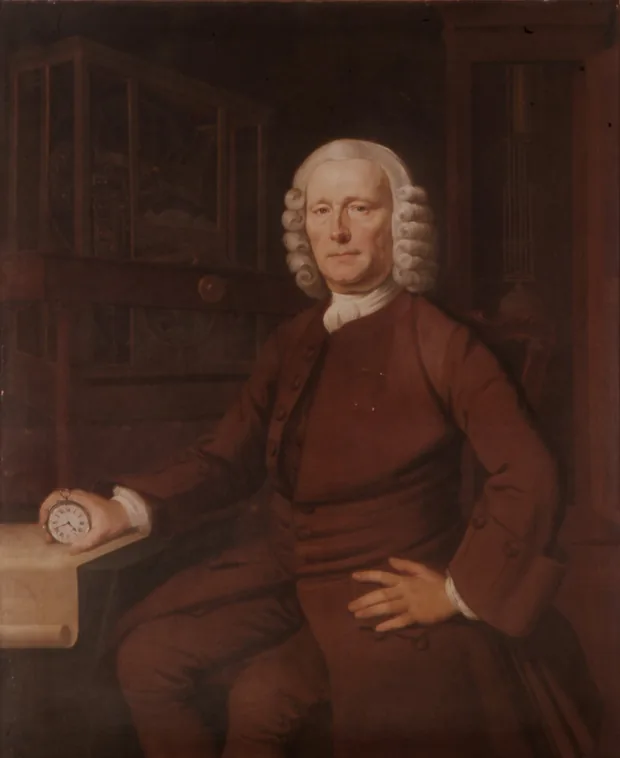
Figure receipt
1767 · Thomas King · Public domain
The name is older than the line: Greenwich was Gronewic, a green trading-place, in 918 — the full parse lives next door: Read London like Old English
The story
Two centuries to a vote
From a warrant paid in gunpowder money to a roll call in Washington: each stage below is dated, and each date carries its paper.
1675
The warrant
In March 1675 Charles II appoints John Flamsteed his “astronomical observator”; in June a second warrant orders a small observatory on the highest ground in Greenwich Park, to Wren's design, for no more than £500, paid out of old gunpowder. The motive, in the warrant's own words: finding longitude “for perfecting navigation and astronomy.”
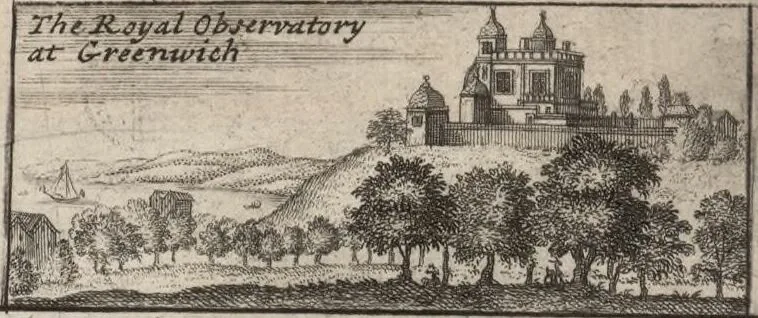
The Royal Observatory on its hill, in a margin vignette from Moll's map of Kent, 1724 — the earliest view of the building. Figure receipt
1724 · Herman Moll · Public domain
1714
The prize
Parliament's Longitude Act offers £10,000, £15,000 and £20,000 for one degree, 40 minutes and 30 minutes of arc. The Board it creates judges claims for over a century.
1767
The almanac
Maskelyne's Nautical Almanac for 1767 — lunar-distance tables, published the year before by order of the Commissioners of Longitude — gives every navigator the same sky. By the 1880s it sells 14,000 to 18,000 copies a year, and Admiralty charts carry Greenwich time around the world.
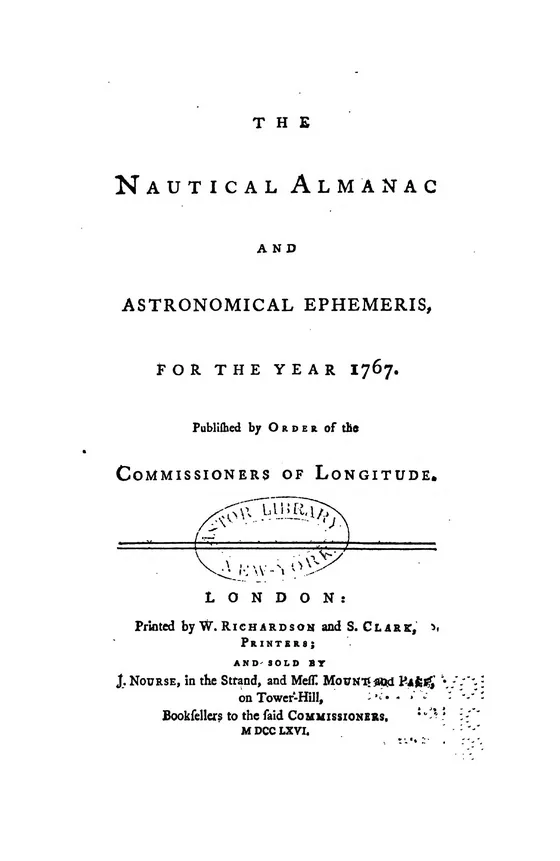
The title page of the first Nautical Almanac: for the year 1767, by order of the Commissioners of Longitude. Figure receipt
1766 imprint · Public domain
1833
The ball
John Pond's time ball rises above Flamsteed House: ships on the Thames set their chronometers by its one o'clock drop. From 1852 the Shepherd master clock fires it by electric impulse and sends Greenwich time down the telegraph wires.
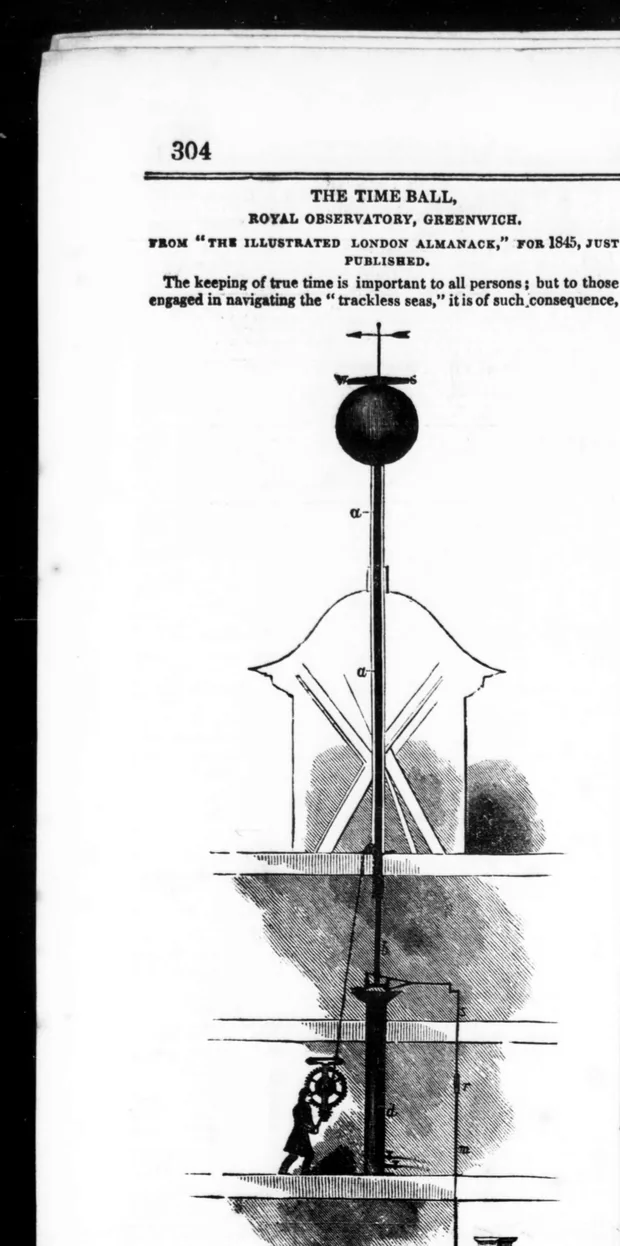
The time ball on its mast, with the men who worked it. Illustrated London News, November 1844. Figure receipt
1844 · Illustrated London News · Public domain
1840–47
The railways
The Great Western adopts London time in November 1840; the Railway Clearing House recommends it for every station in September 1847, and Bradshaw's timetables follow in January 1848. The country starts keeping one time because the trains do.
1851
The instrument
Airy's new transit circle sees its first star on 4 January 1851 and defines the Greenwich meridian from that month. Three lines now cross the courtyard — Halley, Bradley, Airy — and Airy's is the one the world will vote on.
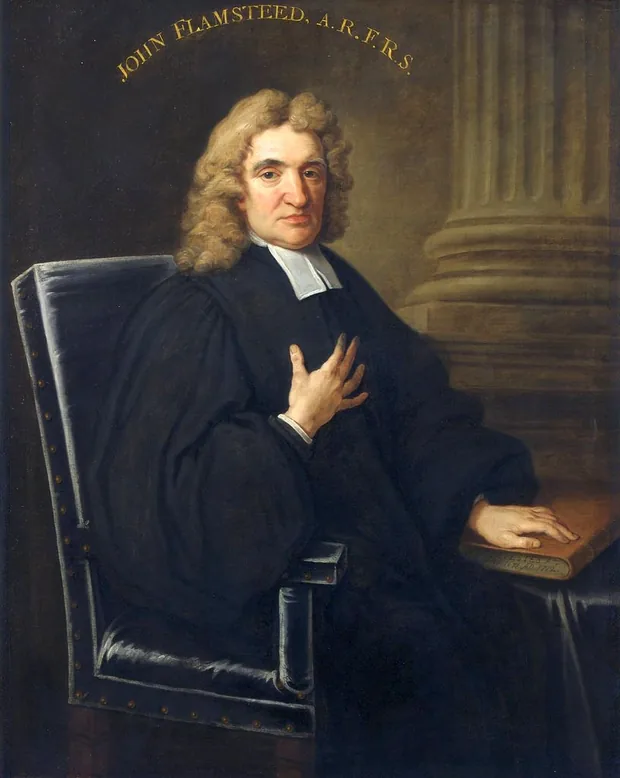
John Flamsteed, the first Astronomer Royal, hand on his book of observations. Oil by Thomas Gibson, 1712. Figure receipt
1712 · Thomas Gibson · Public domain
1880
The statute
Parliament makes Greenwich time the legal time of Great Britain. The clocks were already keeping it; the law catches up.
1884
The vote
Twenty-five delegations meet in Washington. On 13 October the zero resolution passes: 21 ayes, one no from San Domingo, Brazil and France abstaining, El Salvador absent. The Final Act records the same decision as 22 to one, with El Salvador joining the ayes. The verb in both texts is “proposes”: the conference recommended, and governments adopted.
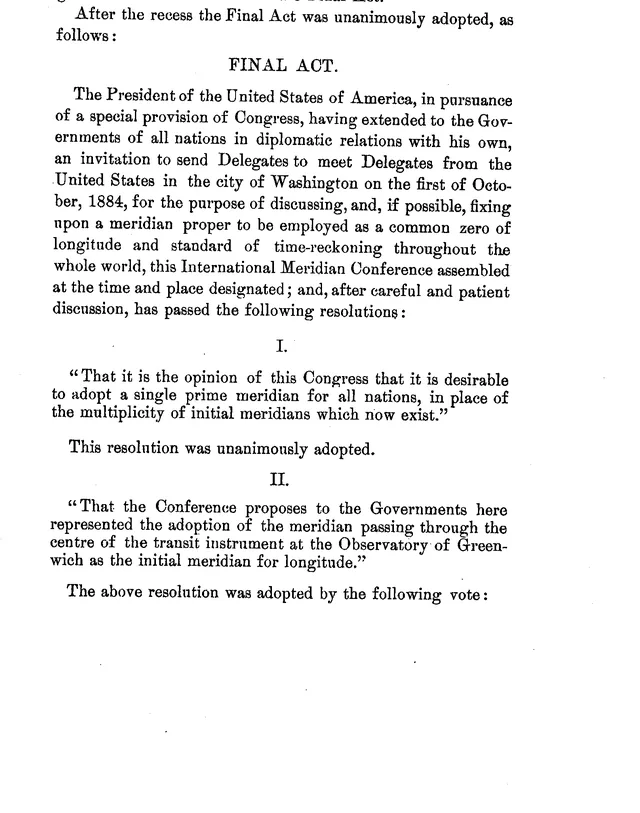
The Final Act, Resolution II: the meridian through the centre of the transit instrument at Greenwich. From the 1884 protocols. Figure receipt
1884 protocols, book p.199 · Public domain
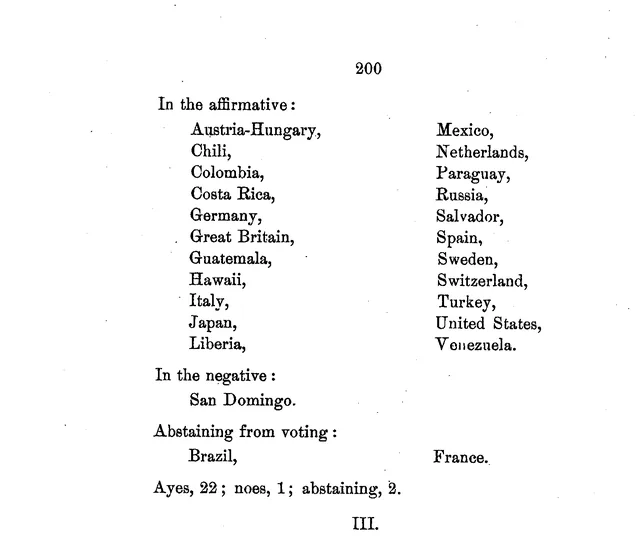
Figure receipt
1884 protocols, book p.200 · Public domain
Why it moved
Two zeroes, one time
Today's zero runs east of Airy's line. It is the IERS Reference Meridian: a plane through the Earth's centre of mass, realised by satellites and stations, adopted across 1984–88. It passes 102.5 m east of the courtyard strip, and your phone reads 0° there, not on the strip.
The figure
The Observatory gives 102.5 m. Malys and colleagues, measuring the Airy instrument in the modern frame, put it at 5.3 seconds of arc west: about 102 m of ground, and more than a third of a second of time.
The cause
Local gravity. The vertical at Greenwich tilts east–west, so the astronomical line through Airy's eyepiece and the geodetic plane through the Earth's centre run parallel but offset. Add the demand that Universal Time never jump, and the modern zero lands where it lands. Polar motion and plate tectonics were checked and ruled out.
The meaning
Both planes sweep past the same stars together, so both keep the same Universal Time. The strip tells you where zero was voted; your phone tells you where zero works. Stand on one, read the other.
Measurement receipt
Malys, Seago, Pavlis, Seidelmann and Kaplan, “Why the Greenwich meridian moved”, Journal of Geodesy 89 (2015), open access. DOI 10.1007/s00190-015-0844-y. Observatory public figure: 102.5 m east.
Nothing marks the place where the modern zero crosses the park. The gap is measured, not signposted.
The visit
One hill, six stops
Everything below sits inside one ticketed site on the hill. Go on a clear day, book ahead, and be at the ball for one o'clock.
The strip
The metal line in the Meridian Courtyard: stand astride it, one foot in each hemisphere. At night a laser carries the line across the London sky, visible more than 20 km away.
The courtyard between Flamsteed House and the Meridian Building.
The instrument
Airy's transit circle, still in its original mounting in the Transit Circle Room. The cross-hairs the 1884 conference voted on.
Meridian Building, through the museum.
The ball
Pond's time ball, dropping at one o'clock daily since 1833 — unless the wind says no.
Atop Flamsteed House; watch from the courtyard.
The gate clock
The Shepherd Gate Clock: the first dial ever to show Greenwich time to the public, round the clock.
On the gates; visible without a ticket.
The Octagon Room
Wren's high room above Flamsteed's lodgings, built for observing the sky.
Flamsteed House, first floor.
The earlier lines
Halley and Bradley drew meridians across the same courtyard before Airy. Three zeroes, one courtyard.
Beside the Airy strip.
The modern zero crosses the park 102.5 m east, unmarked. Walk east with a phone map open and watch the longitude reach 0°.
The words
The paper trail
Four documents that made zero. Originals first, glosses after.
The building warrant
Greenwich Park, 22 June 1675
“…a small observatory within our park at Greenwich, upon the highest ground… for finding out of the longitude of places for perfecting navigation and astronomy.”The motive, in the King's own warrant: longitude first, astronomy beside it. Cost capped at five hundred pounds, paid from old gunpowder.
The Longitude Act
Parliament, July 1714
“An Act for Providing a Publick Reward for such Person or Persons as shall Discover the Longitude at Sea.”Ten, fifteen and twenty thousand pounds for one degree, forty minutes and thirty minutes. The Board it created judged claims for over a century.
The resolution
Washington, 13 October 1884
“That the Conference proposes to the Governments here represented the adoption of the meridian passing through the transit instrument at the Observatory of Greenwich as the initial meridian for longitude.”Twenty-one ayes, one no, two abstentions. “Proposes” — the room recommended; the world adopted.
The paper
Malys and colleagues, 2015
“The 102-m offset between the Airy Transit Circle and zero longitude indicated by a GNSS receiver is attributable to the fact that continuity in the UT1 time series was maintained…” (conclusion, abridged)Gravity plus continuity: the whole gap explained, no error anywhere. The strip keeps the vote; the satellites keep the time.
Sources
Receipts
The protocols carry the vote, the Observatory carries the instruments, and the last shelf lists the claims that were cut and why.
The vote


The observatory
Time
The money and the sky
The figures


.jpg)
.jpg)
Cuts and corrections
- Scilly wreck “caused” the 1714 Act: a modern retrofit — hedged.
- Harrison “won” the prize: interim money, never the prize — corrected.
- France “refused” 1884: abstained on zero, voted elsewhere — corrected.
- “Twenty-two to one” is the Final Act tally; the October resolution ran twenty-one to one, with two abstentions — reconciled.
- “102.478 m”, laser date, brass-to-steel: unsourced — cut.
- RMG collections as an image source: no free path — cut.
- Greenwich etymology: lives next door, in the decoder.
Type: Fraunces and Source Serif 4, under the SIL Open Font Licence.
Keep walking
The name is older than the line — Greenwich was a green trading-place in 918, two centuries before any observatory. The full parse:
Short answers
Can I stand on zero?
You can stand on the voted zero — the courtyard strip. The working zero passes 102.5 m east, through the park, with no marker. Both keep the same time.
Why Greenwich and not Paris?
Much of the world's shipping already ran on Greenwich time: the Nautical Almanac's thousands of copies a year, Admiralty charts, railway time. The conference weighed charts, telegraphs and the Rome recommendation — and Greenwich was where they braided. France abstained on the zero vote; it did not walk out.
Is the strip wrong, then?
No. The strip marks exactly what 1884 voted: the line through Airy's instrument. The modern zero is a different, parallel plane — gravity plus timekeeping continuity put it 102.5 m east. Same stars, same time, different paint.
What time is it at zero?
Mean solar noon when the sun culminates — plus whatever your civil clock adds. GMT is now the winter legal name in Britain and a zone name elsewhere; the working standard is UTC.