mariuscomper.uk RO
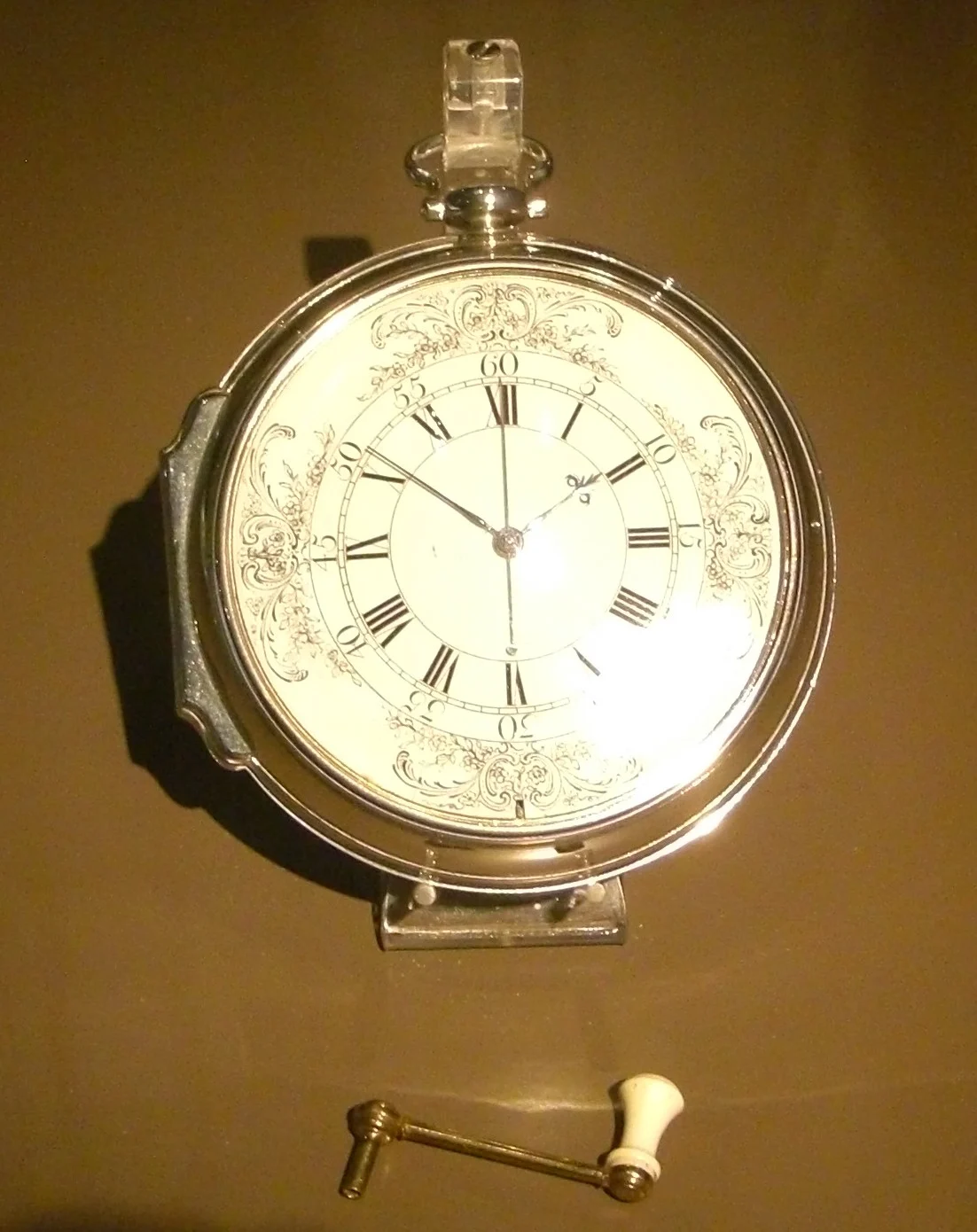
Photograph of John Harrison’s H4 marine chronometer showing its white enamel dial and silver pair-case.

Britain, 1759 · Solving the longitude problem

John Harrison’s H4 Chronometer

In 1707, four warships struck the rocks because nobody on board knew their east–west position. The solution arrived inside a 13-centimetre, 1.45-kilogram silver sea watch beating five times a second on diamond pallets.

22 October 1707

Four warships lost for lack of a clock

On the night of 22 October 1707, a British fleet returning from the Mediterranean struck the rocks of the Isles of Scilly. Four warships sank and between 1,400 and 2,000 sailors drowned.

Navigators could read latitude from the Sun or Polaris, but without knowing the exact time at their home port they could not determine longitude. Because Earth turns 360° in 24 hours, every four seconds of clock error shifts your position by one arcminute.
The Longitude Act of 1714

£20,000 for two minutes of time

In 1714 Parliament established the Board of Longitude and offered three prize tiers: £10,000 for accuracy within 1° (four minutes), £15,000 for two-thirds of a degree, and £20,000 for half a degree.

Half a degree allows at most 120 seconds of error after an ocean crossing—30 nautical miles at the Equator. Leading astronomers looked to the sky; a self-taught Yorkshire carpenter, John Harrison, bet on brass and steel.

From 34 kg to 1.45 kg

Why the giant sea clock became a pocket watch

Harrison’s first marine timekeeper, H1 (1735), weighed 34 kilograms and coupled two large swinging bar balances to cancel a ship’s roll.

After twenty-four years of work, Harrison reversed course: in 1759 he completed H4, an oversized silver watch 132 millimetres (about 13 cm) across weighing just 1.45 kilograms—23.4 times lighter than H1.

Photograph of John Harrison’s H4 marine chronometer showing its white enamel dial and silver pair-case.
John Harrison’s H4 marine timekeeper (1759) at the Royal Observatory, Greenwich. Photo: Colonel Warden, Wikimedia Commons, CC BY-SA 3.0.

White enamel & blued steel

Five beats a second beneath glass

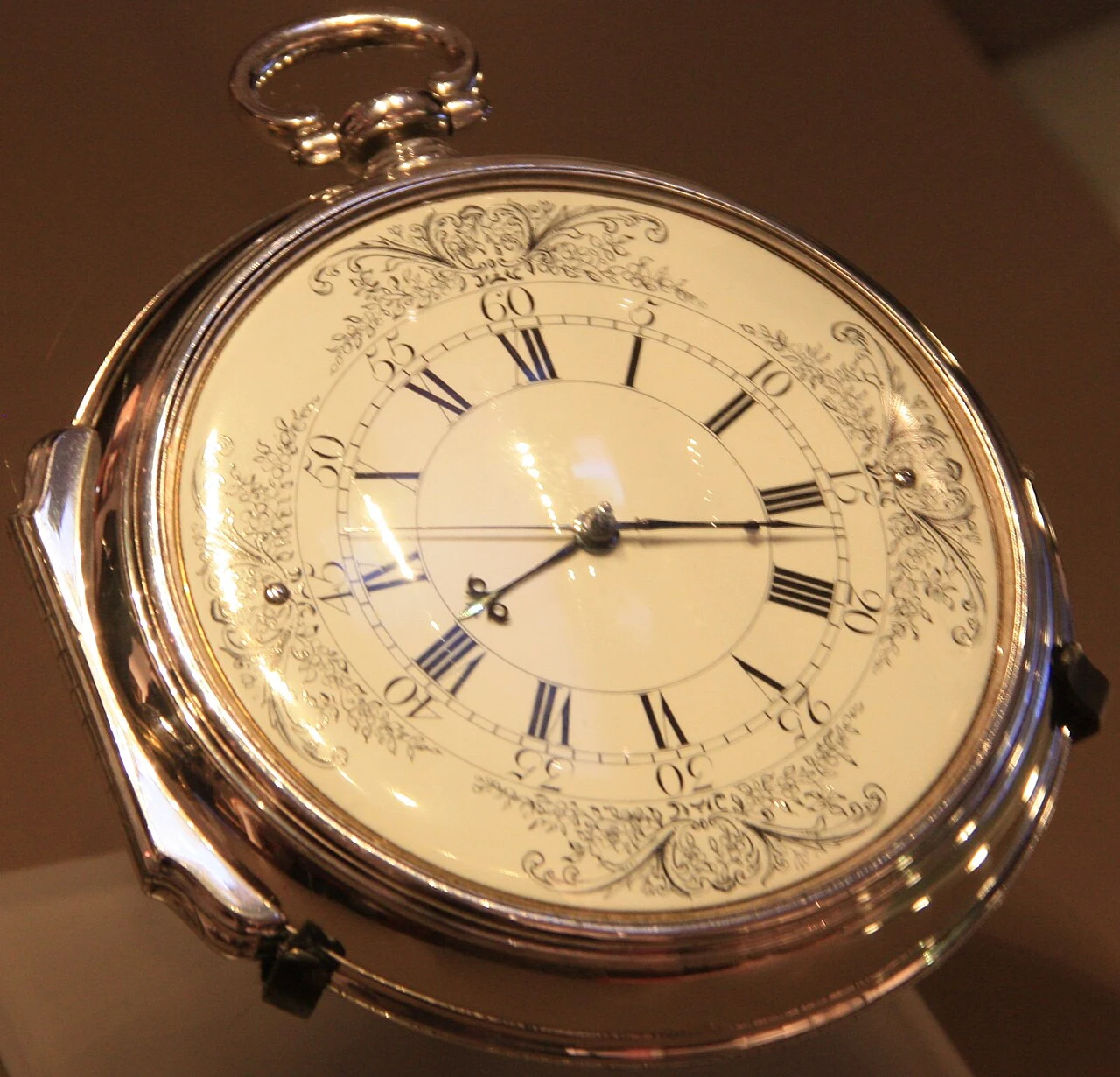
Swing open the silver bezel: beneath the domed crystal sits a 102-millimetre white vitreous enamel dial signed John Harrison & Son, A.D. 1759, with Roman hours and a crisp fifth-of-a-second track.

The slender blued-steel sweep seconds hand advances in five steps per second (18,000 beats per hour)—far faster than ordinary pocket watches of the day, so a rolling deck could not stall the balance.

Drag across the dial to wind the hour · right-drag to orbit

Twin-plate architecture

Inside the gilt brass movement

Lifting the enamel dial and pierced golden balance cock exposes two gilt-brass plates joined by turned pillars and fitted with natural ruby jewel bearings to cut friction.

Every component is designed to hold steady torque and amplitude whether the ship pitches in Atlantic gales or bakes in Caribbean heat.

Constant torque for 30 hours

The tapered cone and steel chain

A mainspring pulls harder when fully wound than when nearly run down. To keep the driving force uniform across H4’s 30-hour run, Harrison linked the barrel to a tapering conical fusee via a fine steel chain.

At full wind the chain pulls on the narrow tip of the cone (short lever arm); as the spring weakens, it unwinds onto the wider base (long lever arm), delivering steady torque.

Total isolation

A secondary spring rewound every 7.5 seconds

Even a fusee cannot erase small friction ripples inside the gear train. Harrison added a remontoire: a tiny secondary spring mounted right beside the escape wheel.

Every 7.5 seconds (eight times a minute), the main train rewinds this secondary spring in a flash, ensuring the balance receives the exact same impulse every beat.

15 teeth & two diamond pallets

H4’s 5 Hz beating heart

Inside H4, a 15-tooth brass crown wheel engages two microscopic D-shaped diamond pallets—hard enough to run cleanly without oil thickening in cold seas.

The large steel balance oscillates at 2.5 Hz (five beats per second) while its spiral hairspring breathes in and out. Hit slow motion below to inspect each tooth-to-diamond contact.

Thermal compensation

The brass-and-steel bimetallic curb

Heat softens a steel hairspring and makes a watch lose; cold stiffens it and makes it gain. Harrison riveted together a strip of brass (19 ppm/°C) and steel (11 ppm/°C).

Because brass expands faster than steel, warming bends the strip toward the steel side and slides its forked curb pins along the hairspring, shortening its active length. Drag the slider below from 0°C to 35°C.

The HMS Deptford trial

5.1 seconds off over the 81-day trial

Checked at Portsmouth on 6 November 1761, H4 sailed aboard HMS Deptford on 18 November with William Harrison. At Port Royal observations on 26 January 1762 (81 days between checks), the watch had lost 3 minutes 36.5 seconds raw.

After subtracting the daily rate Harrison had declared before sailing, the net unexplained error was just 5.1 seconds: 1.21 nautical miles (2.25 km) at Jamaica’s latitude—23.5 times better than Parliament’s 0.5° limit. An ordinary 1760 pocket watch would have been over 4,280 km off.

The second crossing

HMS Tartar to Bridgetown: 39.2 seconds

The Board of Longitude demanded a second official trial. On 28 March 1764, William Harrison sailed for Bridgetown, Barbados aboard HMS Tartar, arriving on 13 May after 47 days at sea.

Even in tropical heat, H4’s net error was 39.2 seconds—9.55 nautical miles (17.68 km), again more than three times inside the £20,000 prize threshold.

1769–1775

Kendall’s copy and Cook’s “trusty friend”

Before releasing the full prize, the Board commissioned master watchmaker Larcum Kendall to build an exact copy of H4, completed in 1769 and designated K1.

Captain James Cook carried K1 around the world in 1772–1775 and called it “our trusty friend the Watch.” After King George III intervened in 1772, Parliament awarded Harrison a further £8,750 in 1773.

Photograph of Larcum Kendall’s K1 marine chronometer at the Royal Observatory, Greenwich.
Larcum Kendall’s exact 1769 copy K1, carried by Captain James Cook across the Pacific. Photo: Richard Ash, Wikimedia Commons, CC BY-SA 2.0.

Why latitude matters

Same seconds, shrinking miles

Meridians are widest at the Equator and converge toward the poles by the cosine of latitude (cos φ). So a two-minute clock error (120 seconds = 0.5°) spans very different distances depending on where you sail.

At the Equator, 120 seconds equals 30.0 nautical miles (55.56 km). At the latitude of Constanța on the Black Sea (44.2°N), that shrinks to 21.52 nautical miles (39.85 km), and at the Isles of Scilly (49.9°N) to 19.32 nautical miles.

Longitude workbench

Test any clock error on the globe

Adjust the clock error, port latitude, and cabin temperature below to watch the longitude-error arc expand on the 3D globe and see H4’s mechanism respond.

Adjust the clock error, latitude, or presets below to see how every lost second maps onto nautical miles across the Atlantic.

Share this chronometer

Send the live 3D H4 reconstruction—or your custom longitude test—directly to someone else.

Sources, calculations, and reference values

Mechanical dimensions come from Royal Museums Greenwich and the monographs of Rupert Gould and Jonathan Betts; longitude distances compute directly from Earth’s rotation (4 seconds = 1 arcminute).

Component / trialValueEquivalent / context
H1 (1735) vs H4 (1759)34 kg vs 1.45 kg23.4× lighter; 102 mm dial inside a 132 mm silver case
Balance frequency18,000 beats/hour5 beats per second (2.5 Hz); 30-hour power reserve
H4 escapement15 teeth · 2 palletsBrass crown wheel and D-shaped diamond pallets
Remontoire7.5 secondsRewinds 8 times per minute for constant impulse
Longitude Act (1714)0.5° (120 s)Top £20,000 prize (30 nautical miles at the Equator)
Jamaica trial (1761–1762)5.1 s net error1.21 nmi (2.25 km) at 17.9°N after 81 days
Barbados trial (1764)39.2 s net error9.55 nmi (17.68 km) at 13.1°N
Ordinary 1760 watch2 min/day × 81 days40.5° longitude = 2,311.89 nmi (4,281.63 km)
  1. Royal Museums Greenwich (RMG) — John Harrison collection (H1: 34 kg; H4: 1.45 kg, 102 mm dial, 132 mm case, 30 h power reserve, 18,000 vph): rmg.co.uk.
  2. Rupert T. Gould, The Marine Chronometer: Its History and Development, London, 1923; Jonathan Betts, Time Restored, Oxford University Press, 2006 (15-tooth crown wheel, D-shaped diamond pallets, 7.5 s remontoire, and bimetallic curb).
  3. Board of Longitude archives, Cambridge University Library (1714 Longitude Act, HMS Deptford trial 6 Nov 1761 – 26 Jan 1762, 81 days, 3 m 36.5 s raw, 5.1 s net; HMS Tartar Barbados trial 1764, 39.2 s net).
  4. Isles of Scilly naval disaster (22 October 1707, four warships lost, 1,400–2,000 sailors), Larcum Kendall K1 (1769), Captain James Cook’s voyages (1772–1775), and Parliament’s £8,750 award (1773): RMG archives.
  5. H4 photograph: Colonel Warden, Wikimedia Commons, CC BY-SA 3.0. K1 photograph: Richard Ash, Wikimedia Commons, CC BY-SA 2.0.