Three waves, three reckonings
Waves §
Cholera reached Europe with the second pandemic, in the 1830s, and returned with the third (1846–1862) and the fourth (1865–1875). In the Romanian lands, each wave met a different state: in 1831, two principalities under Russian occupation; in 1848, a revolution; in 1873, a Transylvania under another flag.
Before cholera came plague. In 1829–1830 the official count recorded 26,302 dead civilians and 9,557 dead Russian soldiers — 35,859 dead in the two principalities. That is why the peace of Adrianople, in September 1829, let the principalities raise their own sanitary cordons and quarantines. Two years later, they would be tested.
1831–1832: cholera crosses the Prut
20,218registered dead in Moldavia and Wallachia
The first cases appear on the banks of the Prut in February 1831. Kiseleff orders quarantines guarded by lines of soldiers, but the disease passes through: Moldavia and Wallachia count 20,218 dead in 1831–1832. The physicians treat it with chamomile, St John's wort and lime teas, and with a thorn brew actually called “cholera” — to no effect. The Iași Board of Physicians demands the dispersal of townspeople through the market towns, by police if needed: the rich to clean air, the poor to barracks of two or three families each.
1848–1849: cholera in the revolutionary year
no complete tollno verifiable figure in open sources
The third pandemic strikes in the middle of revolution. The Prut and Danube quarantines, reopened in 1847, serve double duty: they are set to stop the disease and, at the same time, the liberal ideas crossing the border. The British traveller Patrick O'Brien would call quarantine “a polite incarceration of four or five days”. No complete toll survives for this wave in open sources — the parish registers remain to be studied, and this page does not fill the gap with guesses. The wave is dated here from the third pandemic's chronology and the 1847 reopening of the quarantines; a direct source for the year 1848 in the principalities remains to be found.
1872–1873: the heaviest wave, in Transylvania
22,053dead in Transylvania, the heaviest wave
The last great wave hits Transylvania: 22,053 dead — nearly twelve times more than in 1841 (1,866) and over twenty-one times more than in 1855 (1,049). With the Banat, Crișana and Maramureș, the count passes 50,000 dead.
Cholera, by county
In Bihor, 30,447 people fell ill and 10,980 died (2.28% of the county, of whom 1,096 in Oradea alone); in Sătmar, 17,330 ill and 5,268 dead (2.13%). Measured against the ill, more than one in three died in Bihor and nearly one in three in Sătmar. In Cluj, the summer of 1873 took 537 lives. These are parish-register reckonings, not censuses — orders of magnitude, not exact counts.
The frame: seven pandemics, two men The second pandemic brings cholera to Europe for the first time, in the 1830s; the third lasts from 1846 to 1862, the fourth from 1865 to 1875. Only in 1854 does John Snow show that the water of one pump sickens a whole London district, and only in 1883 does Robert Koch find the vibrio, Vibrio cholerae. Until then, at the border, miasma and contagion were one and the same.
The Prut, the Danube and stamped paper
Cordon §
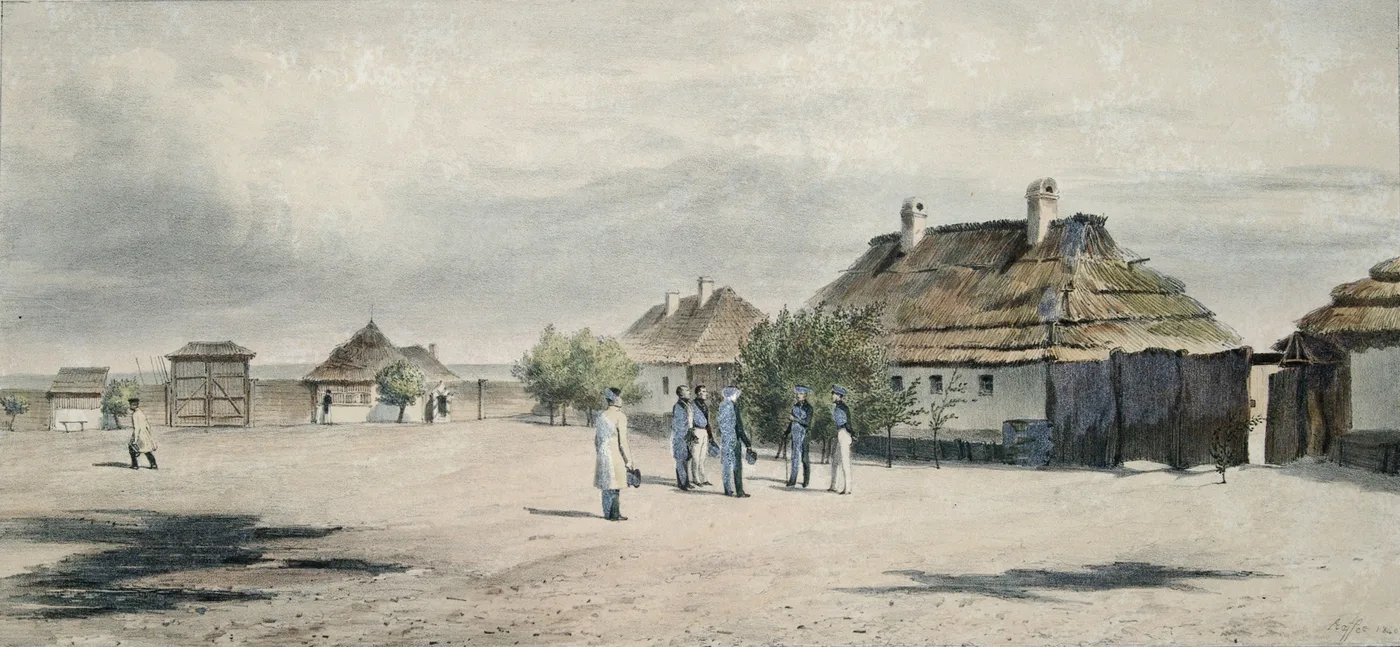
The quarantine at Sculeni, on the Prut, looked like a customs house of fear: papers checked, an oath on health and route, the physician's visit. Whoever stayed healthy to the fourth day of confinement walked free on the fifth, with all belongings fumigated. Clothes were set aside for 14 days, and at the gate you received proof that you had served quarantine and were healthy.

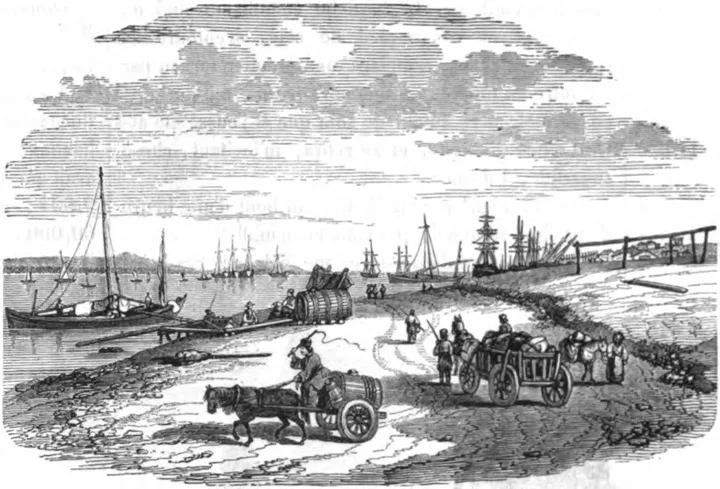
At Galați and Brăila, goods and travellers went through fumigation with vitriol, magnesium and salt, sometimes with brimstone, and people endured the spoglio — stripping naked. The chief inspector was usually a Russian. The Brăila port of the 1840s, pictured, shows the port the grain sailed from before quarantine stopped it at the border.

Fear was paid for. Moldavia gave its quarantines 100,000 lei in 1833 and 120,000 a year later — a fifth more. The Sculeni physician earned 500 lei a month and began each day with fumigating the rooms and seeing the patients twice.
Not everyone believed in the paper wall. The British vice-consul at Galați, Charles Cunningham, said cholera passed through quarantine like through a sieve: what had held the disease in check was the cleanliness of towns, while quarantine struck chiefly at grain exports.
On 7 November 1844 the Committee of Ministers abolishes the quarantine terms on the Prut — from 1 January 1845, travellers and goods pass without stopping. The measure lasts two years: in 1847 the quarantines reopen against cholera, Sculeni with a director, a physician and two servants. By then quarantine had gained a police duty too: it stopped liberal ideas along with the disease. The first international sanitary conference meets in Paris in July 1851 — twelve states, six months of quarrelling — and the 1856 Treaty of Paris places the Danube quarantines under international control. The paper wall had become European business.
Sculeni, July 1831 — a game with round figures
Checkpoint §
You are a salt merchant at the Sculeni fair. You hold goods worth 600 lei and four weeks to reach the Iași fair. Each week you choose a road, and the fair bulletin decides what your goods fetch. The game's customs — papers, fumigation, the pass — come from documents; its sums are a model, not archival figures.
Rules
- Through quarantine, with papers: four days and an 18-lei fumigation on the first crossing, two days and the same 18 lei once you hold the pass. Goods untouched. Two road points.
- Detour through Galați: seven days, 30 lei, and goods lose a tenth of their value with each detour. One road point.
- Shortcut without papers: the first time you slip through in a day, free — then you are turned back: six days and a 40-lei fine. Three points the first time, none after.
- Five road points bring you to Iași. The fair bulletin: week one open (full price), week two restricted (85%), week three closed, week four reopened (115%).
- Arrive in the closed week and you wait for reopening: seven days and 10 lei lodging. Finish four weeks short of five points and you sell at Sculeni for 60% of value.
Every sum, day and point in the game is an illustrative model, reckoned from the rules above. No game figure is an archival number — the verified reckonings sit in the method section.
| Week | Iași | % |
|---|---|---|
| 1 | open | 100% |
| 2 | restricted | 85% |
| 3 | closed | — |
| 4 | reopened | 115% |
- 0Road points
- 0Days lost
- 0 leiExpenses
- 600 leiGoods left
Choose your road
Waiting on the first choice: papers, detour or shortcut.
· · days
The checkpoint did not start. The rules and reckonings below still stand.
Three roads reckoned in advance
The same rules, no clicks: three merchants have walked the road already, and their reckoning is verified in the method section.
| Merchant | Road | Days | Expenses | Sale | Gain |
|---|---|---|---|---|---|
| The papered man | quarantine, quarantine, shortcut | 14 | 46 lei | 690 lei | 44 lei |
| The patient man | quarantine, quarantine, quarantine | 15 | 64 lei | 690 lei | 26 lei |
| The hasty man | shortcut, shortcut, shortcut, shortcut | 19 | 120 lei | 360 lei | -360 lei |
The road, in brief
Without the interactive game the reckoning stands: the patient road arrives in week three, waits for reopening and sells at 115% — a gain of 44 lei in 14 days. Paperless haste sells at Sculeni for 60% — a loss of 360 lei. The table above shows every step.
Four words from quarantine times
Words of the time §
The words below are glossed in the page's own terms; dictionary definitions sit at DEXonline.
- carantină
- The four or five days of stoppage and control at the border, with papers, fumigation and a pass at the gate. dictionary entry at DEXonline
- lazaret
- The quarantine house: at Sculeni, nine small houses with yards and plank fences, guarded by old soldiers. dictionary entry at DEXonline
- holeră
- The disease that strikes suddenly, with vomiting and diarrhoea that empty the body within hours; its name stuck to a thorn brew too. dictionary entry at DEXonline
- cordon sanitar
- The chain of pickets and sentries that closed a border or a stricken town. dictionary entry at DEXonline
What stands behind
What we know — and what we do not §
- The tolls come from period official counts preserved through historians: 35,859 plague dead and 20,218 cholera dead in 1831–1832, after Constantin Ardeleanu (Utrecht University). They are registered numbers, not censuses.
- The quarantine routine — papers, oath, physician, release on the fifth day, fumigation, fourteen days for clothes, the exit pass, the budget risen from 100,000 to 120,000 lei — comes from a 2018 study of the Iași medical university, worked from National Archives holdings, Academy Library manuscripts and the 1831 Parliamentary Annals.
- The closure of shops in stricken market towns and the abolition of quarantine terms from 1 January 1845 come from a 2019 study of Moldova State University. No complete toll was found for the 1848 wave in open sources, and the page invents none.
- The 1872–1873 figures — 22,053 dead in Transylvania, over 50,000 with the Banat, Crișana and Maramureș — come from a Sibiu university study, after Istoria Românilor, volume VII. The Bihor and Sătmar reckonings come from parish registers (the Brie study, 2010), and Cluj from a 2020 Hungarian Historical Review study — all verified directly — and they read as orders of magnitude.
- The checkpoint game is a model: its rules follow documented customs, but its sums, days and points are round and verified only against each other, in the project's own reckoning. The images are period drawings in the public domain, served locally, with full attribution in each caption.
Readings and evidence
Sources §
The sources were opened and read on 20–21 September 2026, and the 1873 county reckonings were verified directly on 24 September 2026. Reckonings and borrowings sit in the list below.
- Constantin Ardeleanu, “Security in times of plague and cholera”, Utrecht University
- Melinte et al., “Measures to prevent contagious diseases…”, Iași, 2018 (PDF)
- Andrei Emilciuc, trade restrictions in Bessarabia, 2019 (PDF)
- Frank Snowden, “Asiatic Cholera”, Yale HIST 234, lecture 10
- Valeria Soroștineanu, medical discourse in Transylvania (PDF)
- DEXonline — definitions: carantină, lazaret, holeră