Iași · Palace of Culture
The tunein the tower
In the clock tower of Iași’s Palace of Culture, a metal cylinder makes eight bells play Hora Unirii. Follow one note from pin to bell, then set a tune of your own on the drum.
I. The clock
Three faces, one clock
One face looks out over the square. The other two are visible from the sides. Each face is 3.24 metres across. Shafts and gears carry the same motion to all three from a central clock installed in 1925.
The stained glass with the signs of the zodiac was destroyed during the war. When the faces were made again in 1958, the signs were painted from the earlier design.
II. The weights
The clock runs as the weight falls
Behind the clock faces is the machinery. The bells are one floor up. The weights descend through the tower, each driving a different part of the clock.
Writing in 1971, Eugenia Ursescu describes a weight of about 120 kg for the clock and another, of about 100 kg, to turn the melody drum.
III. The pins
Move a pin, change the melody
The drum is 35 centimetres across and carries 69 pins. As it turns, each pin catches a lever. The pin’s place along the drum selects the lever. Its place around the drum sets the moment the lever moves.
The lever pulls a metal wire. At the other end, a hammer moves to strike a bell.
IV. The strike
Eight bells, 13 hammers
The bells stay still. Hammers strike them from outside. Some bells have two hammers, according to the 1971 account.
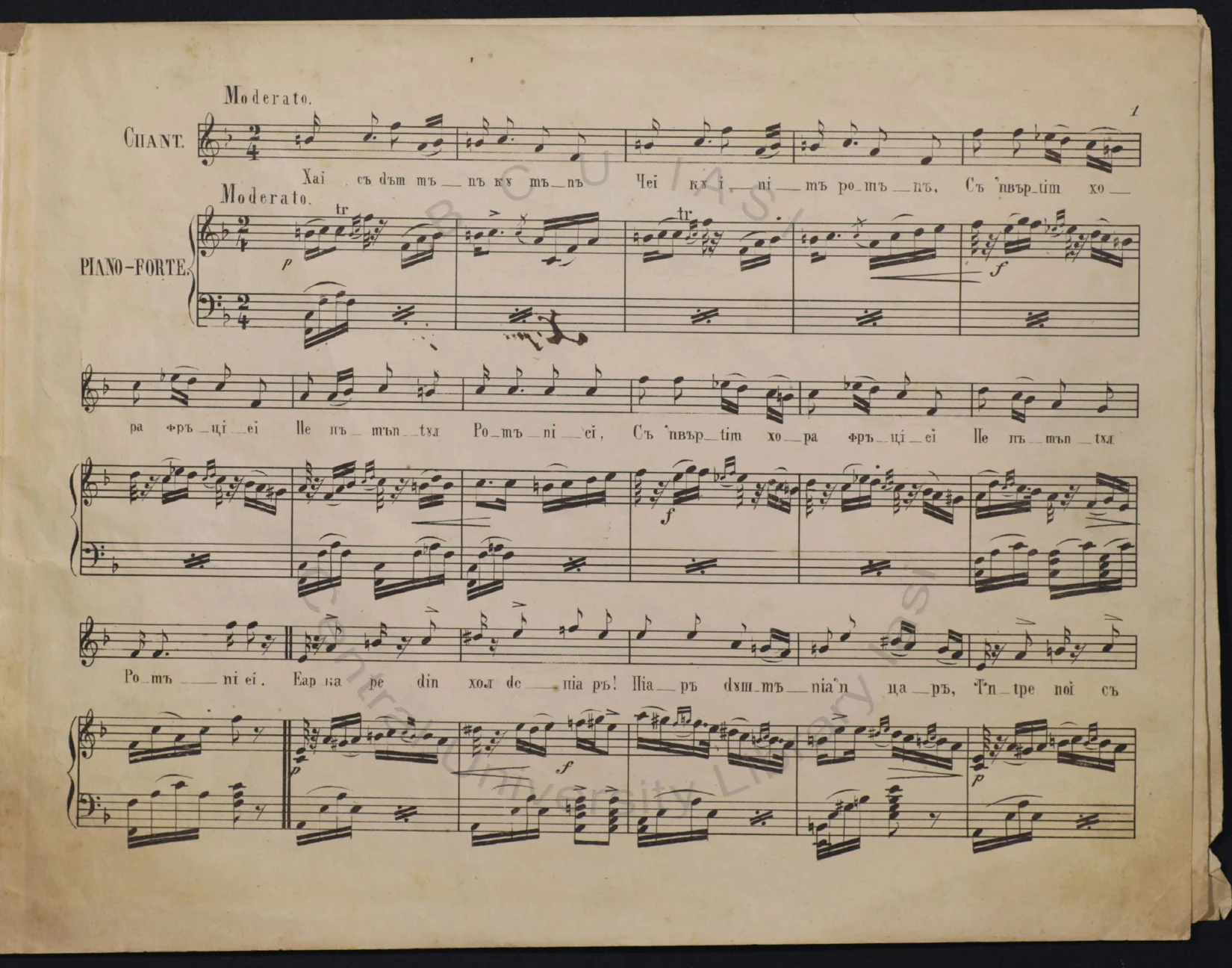
Watch which bell lights up with each note. The sound here is synthesised, using four bars from the score printed in Iași in 1856.
V. Your drum
What would you have the tower play?
Each row of the grid leads to a bell. Each column is a moment in the tune. Add or remove pins and hear what changes.
VI. Back at the window
After the tune, the clock strikes the hour
The 1971 account describes two mechanisms taking turns. The drum plays the tune once. A separate drum then controls the strikes announcing the hour.
The next time you pass the Palace of Culture, listen to the end. The tune and the strikes come from different mechanisms.